How does NetWitness reconstruct an attack using network traffic?
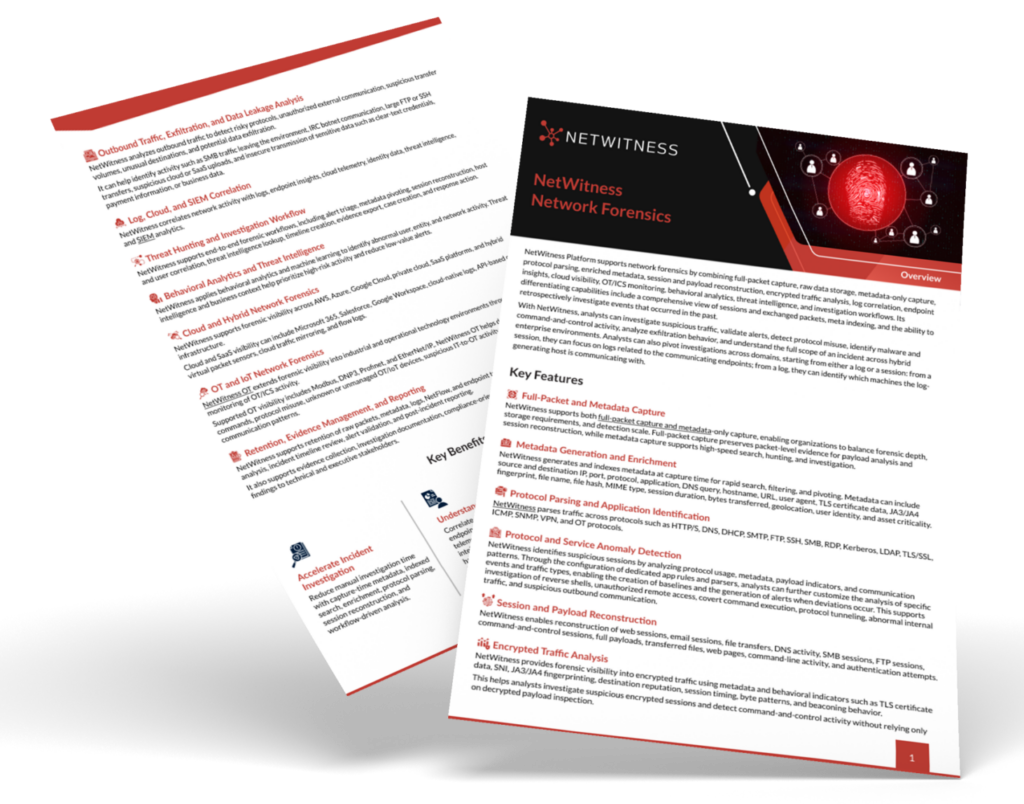
Network protocols are analyzed by NetWitness and the raw data and metadata of the raw data are stored into a database. Search can be conducted through IP addresses, domain names, users or protocols, etc., to form a full view of the sessions on the application layer (web, mail, file transfer, commands execution).
Introduction
Organizations seeking enterprise network forensics analysis through their SOCs have no need for additional detection capabilities. When an organization reaches the point where they have to choose the right product, the issue is clear – they understand that their detection systems are raising alerts but providing no insight into how the attack happened, how far the attacker moved, and what data was affected.
The worldwide average cost of data breaches amounts to $4.88 million and operational disruptions impact 70% of businesses, thus, investigating security incidents requires more than just alerts and summary information about connection attempts. According to industry research, 63% of all daily security alerts remain uninvestigated due to the lack of context in telemetry, as attackers are using credential abuse (22% of breaches) and software vulnerabilities (20%) for evading initial controls.
Closing the existing gap requires detailed packet-level information and automated session reconstruction. While traditional Network Detection and Response (NDR) solutions are using sampled traffic statistics or even just NetFlow information, NetWitness sees the network traffic as a forensic evidence material. Using the combination of PCAP, metadata search, protocol parsing, and cross-domain correlation allows security analysts to move from suspicious signals to attack reconstruction.
What Makes NetWitness Valuable for Enterprise Network Forensics Analysis
The enterprise network handles terabytes of data per day. Collecting packets of data without organizing it leads to a huge data storage center that is almost impossible to utilize in an ongoing attack. However, collecting only high-level telemetry does not help much in post-event analysis.
NetWitness makes up for this by possessing five key platform features aimed at deep analysis and threat reconstruction.
1. Flexible Packet and Metadata Capture
Every enterprise environment balances storage costs, regulatory compliance, and forensic depth differently. NetWitness provides architecture-level flexibility, allowing organizations to combine full packet capture (PCAP) with enriched metadata generation.
Effective network forensic analysis requires both deep visibility and efficient storage strategies. NetWitness allows organizations to balance long-term evidence retention with operational performance through flexible capture architectures.
- Full PCAP Retention: Preserves complete payload data on critical network segments, high-value assets, and internet egress points where complete payload visibility is mandatory.
- Metadata-Centric Surveillance: Generates real-time, lightweight metadata on high-volume internal segments to maximize retention windows without overloading storage infrastructure.
This hybrid approach ensures security teams retain the exact depth of evidence required without paying for unnecessary storage overhead.
2. Searchable, Enriched Network Metadata
Searching through raw packet files during an incident is slow and operationally inefficient. NetWitness continuously processes raw traffic on the wire, generating over 100 structured metadata keys.
Searchable metadata is a foundational component of network forensics analysis, enabling rapid network traffic analysis across large environments without manually reviewing raw packet data.
Instead of starting an investigation with a massive PCAP download, analysts begin with structured, searchable metadata attributes:
- Source and destination IP, host, and user context
- Decoded protocol attributes and non-standard port behaviors
- File hashes, transfer directional indicators, and custom threat indicators
Analysts can query, filter, and pivot across weeks of network activity in seconds, surfacing relevant sessions before extracting deep packet details.
3. Native Session Reconstruction
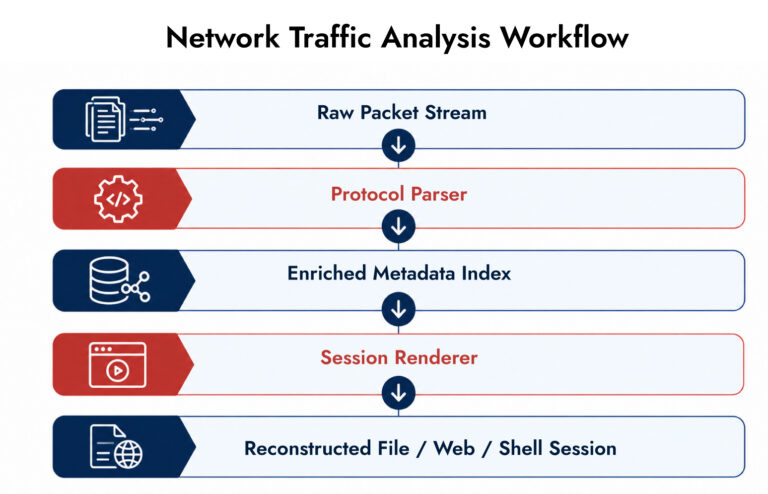
Attackers do not function as isolated alarms; rather, they create connections that stay alive, send remote commands, plant tools, and steal files. NetWitness automatically decodes network protocols to create the entire session at the application layer exactly as it happened over the network.
Instead of viewing hexadecimal representations of packets in an external tool, analysts examine web sessions, command-line communications, email transactions, and file transfers right from inside the NetWitness interface.
4. Real-Time Processing & Behavioral Analysis
NetWitness uses its patent protected stream analytics technology on the raw input data received from the network. As the data passes through the NetWitness Sensor, its behavior engines perform analysis based on connection behavior, protocol anomaly, and threat intelligence feeds all at the same time.
These capabilities support both network threat detection and proactive threat hunting by identifying suspicious behaviors as traffic flows through the network.
5. Cross-Domain Investigation
Network artifacts are never seen alone. Advanced Persistent Threats (APTs) use stolen credentials, run scripts on the endpoint, and traverse from cloud to hybrid environments.
NetWitness natively correlates network forensics data with system logs and EDR data. This broader network security monitoring capability helps analysts understand attacker behavior across network, endpoint, and cloud environments.
NetWitness vs. Traditional Alert-Centric Workflows
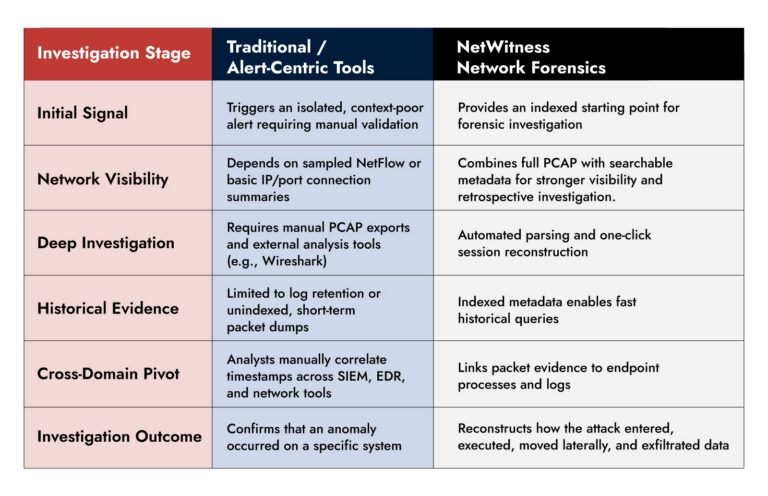
Most enterprise security operations struggle not from a lack of detection, but from manual labor required to reconstruct incidents across siloed tools. The table below illustrates how NetWitness shifts SOC operations from reactive alert triage to comprehensive attack reconstruction.
From Detection to Full Reconstruction: The 7-Step NetWitness Workflow
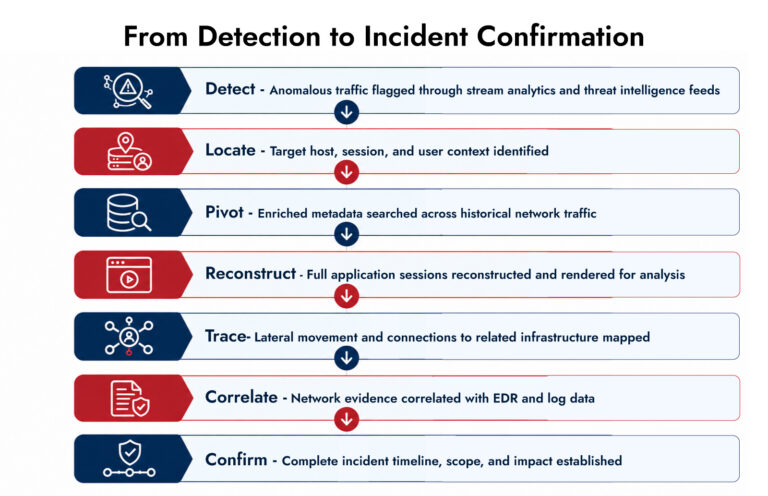
When a serious incident occurs, the primary goal of the investigation is establishing absolute proof. NetWitness guides analysts through a structured, 7-step operational workflow to fully map the attack lifecycle.
This structured process transforms routine alerts into actionable cybersecurity investigation workflows, helping analysts quickly determine attack scope and business impact.
Step 1: Detect Suspicious Activity
NetWitness identifies anomalous network behavior using continuous behavioral analytics, statistical rule engines, and integrated threat intelligence.
Step 2: Investigate Network Context
The analyst isolates the initial signal, gaining immediate visibility into the affected host, destination IP, user identity, and associated network sessions.
Step 3: Pivot into Enriched Evidence
Using indexed metadata keys, the analyst pivots backward in time to identify related infrastructure, subdomains, or communication patterns preceding the initial trigger.
Step 4: Reconstruct Relevant Sessions
Where deeper payload inspection is necessary, the analyst executes single-click session reconstruction to inspect application payloads, transferred binaries, or command-and-control (C2) instructions.
Step 5: Trace the Attack Trail
The analyst queries historical metadata to identify lateral movement. This includes searching for internal SMB/RDP connections, credential reuse across adjacent hosts, or staging servers.
Step 6: Connect Cross-Domain Telemetry
NetWitness ties together the telemetry from the packet and from the endpoint. The analyst establishes which exact process initiated the outbound connection.
Step 7: Determine Full Scope and Impact
The analysis ends with the creation of a confirmed timeline of events. The analyst confirms entry point, lateral movement, affected systems, and amount of exfiltrated data.
Evaluating Enterprise Network Forensics Platforms: Key Buyer Criteria
Organizations looking to deploy network forensics analysis and network security monitoring solutions should assess vendors’ capabilities against six technical requirements:
- Dual-Pace Functionality: Is the platform able to analyze streams in real time for rapid response while offering retrospective capability to investigate historical incidents?
- Flexible Capture Architecture: Can the capture architecture offer the flexibility to create hybrid implementations where full PCAP is captured on critical links whereas metadata is gathered on corporate networks?
- Usable Session Analysis: Are security analysts able to dissect, visualize, and analyze application layer sessions without having to download raw PCAPs?
- Cross-Domain Correlation: Is the platform capable of ingesting and correlating packet data with system and SIEM telemetry and EDR process logs natively?
- High-Throughput Ingestion: Is the combination of hardware and software architecture able to ingest multiple gigabit traffic streams without dropping packets and delaying metadata indexing?
- Defensible Chain of Evidence: Is the platform able to store packet evidence in a forensically sound manner ready for legal, regulatory, and compliance reporting?
Conclusion
In dealing with critical incidents on a business level, confirmation is not sufficient. Security officers need to provide a rationale for how the intruder came in, what measures he used, how much he went past the boundary point, and whether any information got out.
Traditional detection engines leave these questions unanswered. By combining flexible capture models, real-time metadata indexing, deep session reconstruction, and cross-domain correlation, NetWitness delivers advanced network forensics analysis capabilities that support network threat detection, improve network visibility, and accelerate cybersecurity investigations. The result is a complete understanding of how attacks enter, move through, and impact enterprise environments.
Frequently Asked Questions
1. What are the best software tools for network forensics analysis?
The best network forensics analysis tools should provide more than network alerts. Enterprise platforms should support meaningful network visibility, metadata analysis, packet-level evidence where required, protocol analysis, historical investigation, and efficient workflows for reconstructing incidents.
NetWitness supports these capabilities by combining network detection with packet capture, metadata enrichment, protocol parsing, session reconstruction, and broader threat investigation.
2. What are the essential steps in a network forensic investigation?
The process of network forensics involves spotting suspicious activities, collection and analysis of network data, review of communications and sessions, host identification, attack timelines, attack scope determination, among others.
The objective is not simply to confirm that something malicious occurred. It is to understand how the attack unfolded.
3. How do you choose a network forensics analysis platform for enterprise use?
In selecting a network forensics analysis tool, consider the depth of evidence available on the network, capability for full packet capture, ability to analyze metadata, visibility of protocols, historical searching, investigation process, scalability, and integration with other threat detection/response activities.
Another important consideration is whether the tool will assist in attack reconstruction rather than producing more alerts.
4. What should organizations look for in a network forensics solution?
Organizations should look for strong network security forensics capabilities, deep network traffic analysis, flexible evidence collection, support for session reconstruction, and the ability to connect network evidence with other security telemetry.
The platform should help analysts investigate the root cause and full scope of an incident.
5. How does NetWitness support network forensics analysis?
NetWitness provides network forensics capabilities that encompass the following: packet capture, metadata enrichment, protocol parsing, session reconstruction, behavioral analysis, threat intelligence, and cross-domain investigation.
The analyst can thus go from responding to alerts to investigating and conducting a thorough reconstruction of attack activities.
6. Why does full packet capture important for network forensics?
Full packet capture can provide deeper evidence for investigations when connection records and logs do not provide enough context. It can support detailed examination of network communications and help investigators validate what occurred during an incident.
For organizations with demanding forensic requirements, packet-level evidence can play an important role in digital forensics, attack reconstruction, and incident response.
See Every Packet. Understand Every Threat.
- Capture Network Traffic
- Reconstruct Attacker Sessions
- Uncover Hidden Threats
- Accelerate Investigations