Why Full Packet Capture and Metadata Deliver Better Threat Investigations?
Organizations that rely only on alerts or summarized network data often struggle to reconstruct attack timelines, validate suspicious activity, and understand the full scope of a breach. Full packet capture preserves every network conversation, while metadata provides rapid visibility across massive environments. Together, they create the foundation for effective network detection and response (NDR), stronger investigations, and more accurate threat detection.
Key insights:
- Full packet capture provides complete forensic evidence of network activity.
- Metadata enables rapid search, correlation, and large-scale threat hunting.
- Using one without the other creates visibility gaps during investigations.
- Modern NDR solutions combine both capabilities to improve detection accuracy and incident response speed.
- Enterprise SOCs need packet-level evidence and metadata-driven analytics to handle today’s sophisticated threats.
Introduction
It’s tough for the security team. Threats act fast, but a lot of investigation is still being done with insufficient knowledge.
The threat might be detected by an alarm but what really happened, which machines communicated, what type of data was involved, and whether the action was malicious or not – that’s the question when there isn’t enough network visibility in place.
And here comes full packet capture into play.
Although the majority of the security solutions rely on logs, events, and network meta-analysis to analyze threats, hackers tend to take advantage of the gaps between the mentioned sources. Security Operations Center needs to look both high-level and in-depth at once.
In this case, the best solution is implemented when both full packet capture and meta-analysis are incorporated in one product. Network metadata gives a speed and scale advantage, while full packets give insights and proof.
Why Full Packet Capture Remains Essential for Modern Threat Detection
Full packet capture records every packet traversing a monitored network segment. Instead of storing summaries, it preserves the complete communication stream. This capability allows investigators to revisit network activity long after an event occurs and reconstruct exactly what happened.
When a security incident unfolds, analysts often need answers such as:
- What commands did the attacker execute?
- What files were transferred?
- Which credentials were exposed?
- What data left the environment?
- Which systems communicated with malicious infrastructure?
Logs rarely provide all these answers.
Full packet capture provides a complete historical record that supports:
- Incident investigations
- Compliance audits
- Insider threat investigations
- Advanced threat detection
- Network forensic analysis
- Malware analysis
According to guidance from the National Institute of Standards and Technology, retaining detailed network activity significantly improves incident investigation and evidence collection capabilities.
Without packet-level evidence, organizations often spend valuable time attempting to recreate events after the fact.
Why Metadata Alone Cannot Answer Every Security Question
Network metadata provides structured information extracted from traffic without storing entire packets.
Examples include:
- Source and destination IP addresses
- Ports and protocols
- Session durations
- DNS requests
- SSL certificate information
- User and device attributes
Metadata enables analysts to quickly identify anomalies across billions of connections. This makes metadata for threat hunting highly valuable.
Analysts can rapidly:
- Search months of network activity
- Identify unusual communication patterns
- Track lateral movement
- Correlate events across environments
- Prioritize investigations
However, metadata has limits. It can reveal that a connection occurred but not necessarily what was exchanged during that connection.
For example: Metadata may show an employee workstation communicating with an external IP address.
Only full packet capture can reveal:
- Commands transmitted
- Files downloaded
- Data exfiltrated
- Payload contents
- Protocol abuse techniques
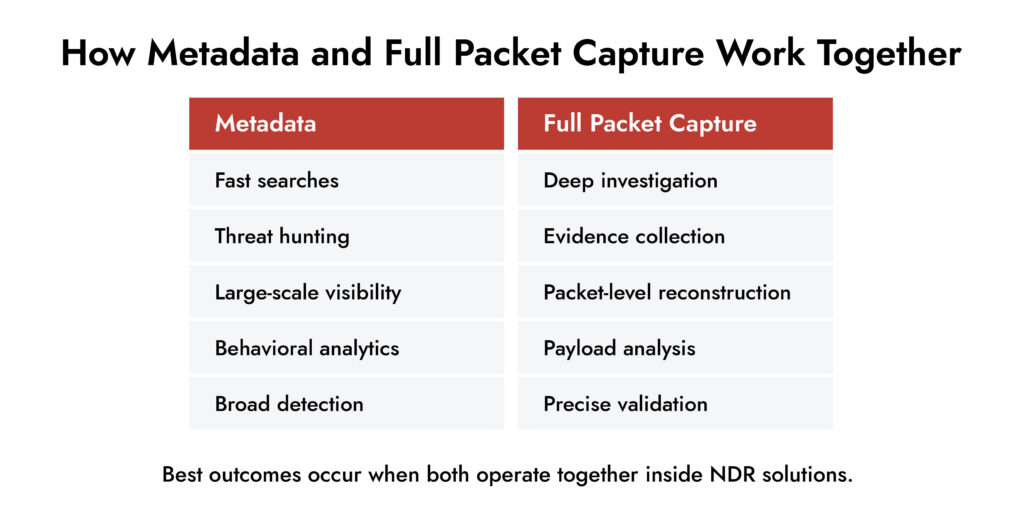
Metadata points investigators in the right direction. Full packets provide the proof.
Full Packet Capture and Metadata: Why Enterprise SOCs Need Both
The strongest SOC visibility strategy combines both approaches. Metadata serves as the index. Full packet capture serves as the evidence repository.
Think of metadata as a map and packet capture as the complete recording of every journey.
A typical investigation often follows this workflow:
Step 1: Detection – Analytics identify suspicious behavior through metadata.
Examples include:
- Beaconing activity
- Command-and-control communications
- Lateral movement patterns
- Abnormal DNS behavior
Step 2: Investigation – Analysts use metadata to identify affected systems and narrow the scope.
Step 3: Validation – Investigators access full packet capture records to examine exact communications.
Step 4: Response – Teams confidently determine:
- What occurred
- When it occurred
- Who was affected
- Whether data was exposed
This approach significantly reduces uncertainty during investigations.
How Full Packet Capture Strengthens Network Forensic Analysis
Forensic investigations depend on evidence. The more complete the evidence, the more accurate the findings.
Full packet capture enables analysts to:
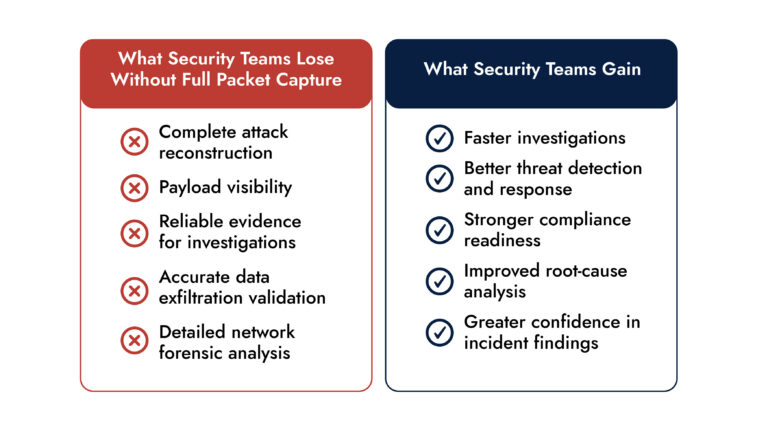
- Reconstruct Attack Timelines: Every network interaction remains available for review.
- Verify Data Exfiltration: Teams can determine exactly what data left the environment.
- Analyze Malware Communications: Investigators can inspect malicious payloads and attacker commands.
- Support Legal and Compliance Requirements: Packet-level evidence provides defensible records when investigations require detailed documentation.
The significance of forensic visibility is also gaining traction. The threat landscape in 2025 will see more of ransomware actors who lateral, encrypt quickly, and cover up their tracks.
In cases where logs become unavailable, packets can provide the most trustworthy information.
SOC Visibility Challenges That Full Packet Capture Solves
Many organizations invest heavily in endpoint, SIEM, and cloud security technologies. Yet visibility gaps remain.
Common challenges include:
Encrypted Traffic Growth –
Encrypted traffic now dominates enterprise networks.
Metadata identifies encrypted sessions, while full packet capture preserves the communication details required for deeper investigation when decryption capabilities exist.
Alert Fatigue –
Security teams receive thousands of alerts daily.
Packet-level validation helps determine which alerts represent genuine threats.
Hybrid Infrastructure Complexity –
Organizations now manage:
- On-premises environments
- Cloud workloads
- Remote users
- Operational technology systems
Maintaining comprehensive SOC visibility across these environments requires multiple layers of network intelligence.
Advanced Persistent Threats –
Sophisticated adversaries deliberately blend into legitimate traffic.
Packet-level inspection often reveals indicators that metadata alone cannot detect.
How Modern NDR Solutions Combine Metadata and Full Packet Capture
Modern NDR solutions no longer treat packet capture and metadata as separate functions.
The most effective platforms integrate:
- Continuous packet collection
- Real-time metadata extraction
- Behavioral analytics
- Threat intelligence
- Automated investigations
- Threat hunting workflows
This architecture enables security teams to move from detection to evidence without switching tools. The result is faster investigations and improved operational efficiency.
As organizations face increasingly sophisticated attacks, combining network traffic analysis, metadata analytics, and full packet capture has become a practical requirement rather than an optional capability.
How NetWitness Delivers Deep Network Visibility
Effective threat detection requires more than alerts. Security teams need visibility that extends from high-level network activity down to individual packets.
NetWitness Network Detection and Response combines:
- Comprehensive network visibility
- Rich metadata generation
- Full packet capture capabilities
- Threat hunting workflows
- Advanced investigation tools
- Network forensic analysis
This approach enables analysts to quickly identify suspicious activity through metadata and immediately pivot into packet-level evidence for deeper investigation.
By connecting detection, investigation, and response workflows, NetWitness helps organizations reduce investigative blind spots while improving overall threat detection and response outcomes.
Conclusion
The comparison between metadata vs. packet capture fails to address the core issue. Enterprise security operations require both.
Metadata provides the speed necessary for visibility and threat hunting at scale. Packet capture offers the information needed for validation and investigation.
With the complexity of modern-day cyberattacks and IT infrastructure, having faith in just one of the technologies leaves an organization vulnerable.
Those companies leveraging full packet capture along with network metadata analysis and network detection and response have their SOCs primed for fast investigations and accurate detection.
Should SOC visibility and investigation capability be a continuing concern, a look at how your NDR solution handles both packet data and metadata would make sense.
Frequently Asked Questions
1. Why do enterprise SOCs need both full packet capture and metadata?
Whereas metadata enables efficient searching and analyzing of network activity, full packet capture ensures that there is adequate evidence that validates any threat as well as allows incident reconstruction and network forensic investigations.
2. What are the best tools for full packet capture in enterprise networks?
The ideal enterprise SOC solution would offer a combination of all these functionalities in one package – full packet capture, metadata, analytics, threat hunting, and investigation tools.
3. Which companies provide full packet capture appliances for small businesses?
Several cybersecurity vendors offer packet capture appliances and network monitoring platforms designed for smaller environments. Organizations should evaluate scalability, retention capabilities, metadata support, and integration with existing security tools.
4. What are the top full packet capture services for cybersecurity monitoring?
Leading services focus on continuous packet collection, network traffic analysis, metadata generation, and integrated threat detection. The most effective offerings support both real-time monitoring and retrospective investigations.
5. How to configure full packet capture for high-speed network environments?
High-speed deployments typically require network taps, packet brokers, storage optimization, selective retention strategies, and scalable analytics platforms. Organizations should align capture policies with operational and compliance requirements.
6. What providers offer full packet capture with integrated threat detection?
Several enterprise-focused NDR solutions combine full packet capture with behavioral analytics, threat intelligence, metadata analysis, and automated investigations. These platforms help security teams move from detection to evidence without losing context.
7. Can full packet capture improve advanced threat detection?
Yes. Full packet capture enables analysts to inspect attacker communications, identify malicious payloads, validate suspicious activity, and uncover indicators that may not appear in logs or metadata alone. This makes it a valuable component of advanced threat detection strategies.
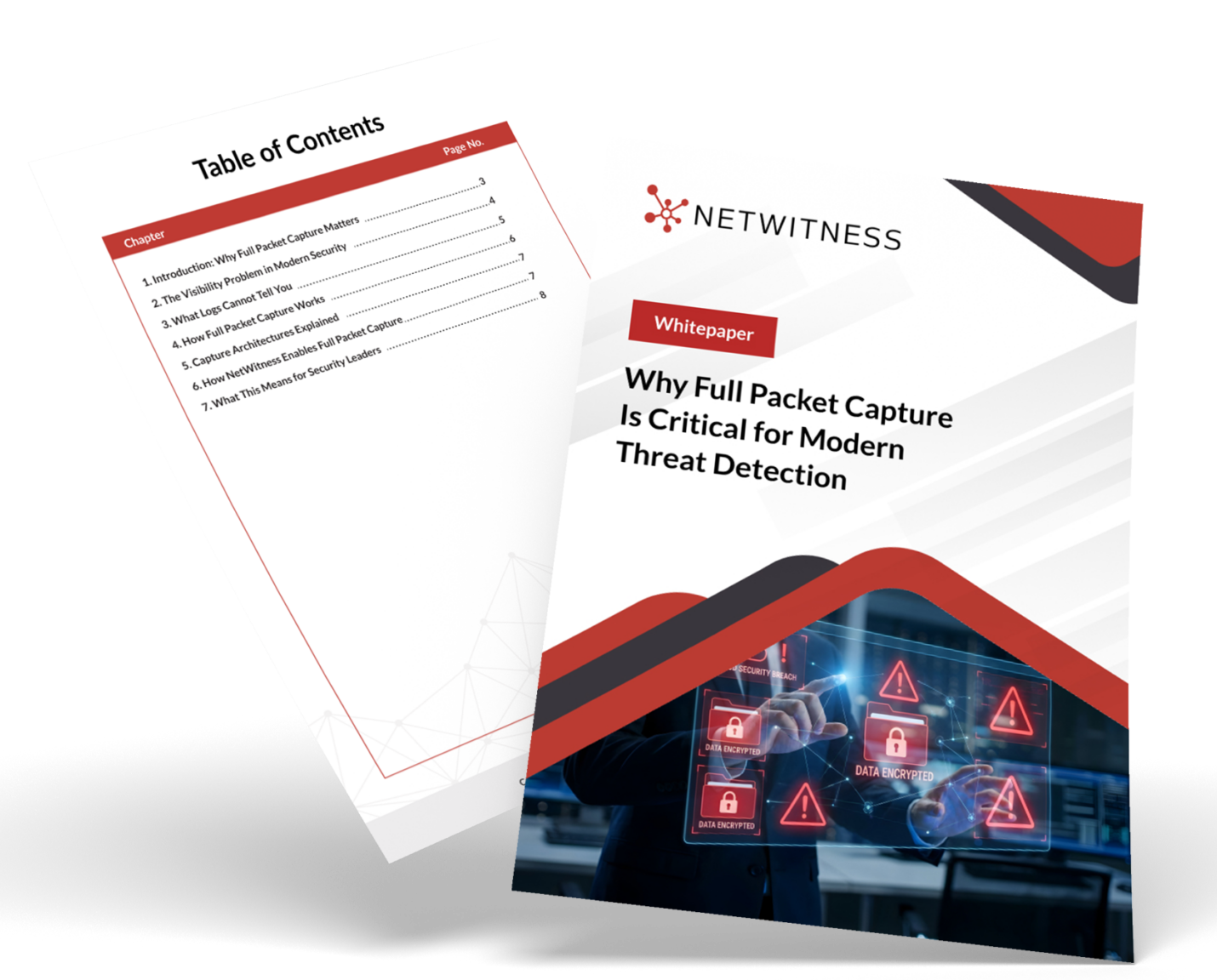
Learn why full packet capture is critical for modern threat detection and faster incident response.
Inside you’ll find:
- Clear guidance on where log-driven security falls short
- Ways to uncover threats hidden in network traffic
- How to reconstruct attacks from end to end
- Practical insight to investigate incidents with packet-level proof