What are the top features to look for in a SIEM?
A SIEM buyer guide should evaluate:
- telemetry coverage,
- parsing and normalization,
- correlation and detection engineering,
- UEBA and analytics,
- threat intelligence,
- investigation capabilities,
- automation,
- historical search,
- retention,
- scalability,
- compliance,
- integrations,
- data portability,
- deployment options,
- total cost of ownership.
It should also provide a method for proving those capabilities through production-like testing rather than relying entirely on vendor specifications. For enterprise SOCs, investigation depth deserves particular attention because analysts need access to the evidence behind a detection.
Selecting a SIEM platform is rarely difficult because of a shortage of options. The harder part is determining which SIEM solution will continue to perform once it is operating at enterprise scale, processing real telemetry, supporting active investigations, and serving analysts when security operations are under pressure.
That is where a practical SIEM buyer guide needs to go beyond feature comparisons.
For teams evaluating enterprise SIEM, the decision should extend beyond connector counts, ingestion pricing, dashboards, and lists of prebuilt detections. The platform needs to prove that it can collect the right evidence, interpret it accurately, support meaningful detection and investigation, integrate with the existing security stack, and remain operationally and commercially sustainable as the environment grows.
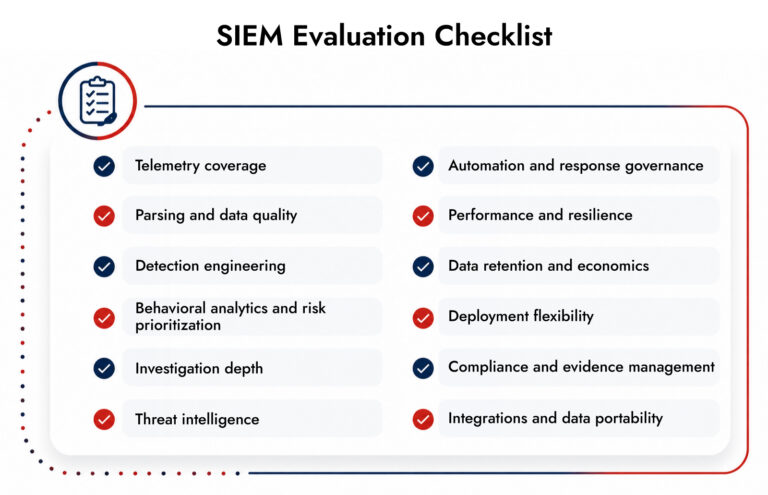
The weighting will differ by organization. For instance, a regulated utility operating segmented environments will evaluate enterprise SIEM differently from a cloud-native software company.
Why SIEM Buying Criteria Have Changed
The basic role of security information and event management remains familiar: collect security data, normalize it, correlate activity, generate alerts, support investigations, and provide reporting.
CISA continues to recommend detailed logging across servers, firewalls, endpoints, cloud services, user activity, administrative activity, and network traffic, along with centralized log management to make suspicious activity easier to detect.ong with centralized log management to make suspicious activity easier to detect.
The environment around that foundation has become considerably more complicated. An investigation may begin with a cloud identity, continue through a vulnerable public-facing application, move onto an endpoint, traverse internal network segments, use legitimate administrative tools, and eventually touch a third-party service.
For a SIEM buying committee, the implication is practical: alert generation represents one part of the workflow. The SOC platform also needs to support validation, scoping, root-cause analysis, investigation, response, and evidence preservation.
Basic Rules Before Buying a SIEM: Start With Your Own Operating Requirements
Vendor demonstrations are useful after the buying team has established its requirements. Otherwise, the evaluation naturally follows the areas where each vendor presents best.
Before comparing SIEM solutions, establish five baselines.
1. Telemetry Baseline
Inventory the sources that can provide security-relevant evidence across:
- Identity and authentication
- Active Directory and directory services
- Public cloud
- SaaS
- Endpoints and servers
- Network infrastructure
- Firewalls and security controls
- Business applications
- Databases
- APIs
- Vulnerability and exposure management
- OT and IoT
- Remote access
- Third-party services
Classify telemetry according to its security value, expected volume, required retention, and use cases.
2. Detection Baseline
List the attack scenarios that the platform needs to detect. For a large enterprise, that might include:
- Compromised privileged accounts
- Password spraying
- Session-token theft
- Cloud privilege escalation
- Lateral movement
- Command-and-control activity
- Malicious administrative-tool usage
- Data staging and exfiltration
- Insider activity
- Third-party access abuse
- Persistence after endpoint compromise
- Cross-domain attacks spanning IT and OT
For every priority scenario, identify the data required, detection logic, investigation path, likely response actions, and expected outcome.
This gives every vendor the same test.
3. Investigation Baseline
Define the level of evidence analysts need after a detection fires. Some SOCs need rapid triage and escalation. Others routinely perform forensic investigation, historical reconstruction, malware analysis, regulatory reporting, or deep network analysis.
Those environments place different demands on SIEM software. A platform that presents an incident neatly while leaving those pivots scattered across separate tools can still create substantial investigation friction.
4. Deployment Baseline
Map where telemetry can be collected, processed, stored, and searched.
Include:
- Data sovereignty requirements
- Regional restrictions
- On-premises systems
- Public cloud
- Private cloud
- Air-gapped or isolated environments
- Subsidiaries and business units
- Remote offices
- Disaster recovery
- High availability
- “Cloud versus on-premises” is too broad for many enterprise architectures. Collection, analytics, storage, investigation, and management may each have different placement requirements.
5. Commercial Baseline
Model costs before starting the proof of concept.
Include:
- Daily ingestion volume
- Peak event rates
- Expected annual data growth
- Retention requirements
- Hot, warm, cold, and archive storage
- Historical search
- Rehydration
- High availability
- Disaster recovery
- Additional analytics
- Automation
- Threat intelligence
- Migration
- Training
- Professional services
- Detection engineering
- Integration maintenance
- Platform administration
The cheapest per-GB ingestion number can become irrelevant once storage retrieval, infrastructure, engineering time, separate forensic products, and analyst workload enter the calculation.
SIEM Buyer Guide: 12 Capabilities to Evaluate
1. Broad Telemetry Coverage Without Creating Blind Spots
A SIEM needs access to the telemetry that supports your threat model.
During a SIEM integration assessment, classify required sources as:
- Natively supported
- Partner supported
- Community supported
- Generic ingestion
- Custom parser required
- Unsupported
- These categories can produce very different operational outcomes.
A generic syslog connector might technically bring data into the platform while failing to extract the fields needed for correlation. API integration may create latency or rate-limit issues. A community connector can introduce an ownership question when the source changes.
2. Parsing, Normalization, and Metadata Quality
Raw telemetry has limited value when analysts cannot reliably search or correlate it. Strong SIEM tools need to extract meaningful fields, normalize events, identify entities, resolve timestamps, and enrich activity with security and business context.
Parser maintenance deserves particular scrutiny.
Applications change. SaaS APIs change. Acquisitions introduce unfamiliar systems. Internal applications often produce inconsistent event formats.
A parser failure that silently removes one field can disable detection without stopping data ingestion.

“The most revealing test in a SIEM proof of concept isn’t how fast a dashboard loads. It’s what happens when a log source quietly changes its format. Ask the vendor to break a parser on purpose, then ask how you would find out.”
—Dominik Czyz, NetWitness
At NetWitness, we approach this with dynamic parsing and metadata enrichment at capture time, along with automated source discovery. Our SIEM supports 350+ log sources across on-premises, cloud, SaaS, and hybrid environments, with custom parsing available where needed.
3. Detection Engineering Your Team Can Operate
Prebuilt detection content can help organizations get value from a SIEM faster, especially during the early stages of deployment. But as the environment grows more complex, enterprise SOCs usually need detection logic that reflects their own users, applications, infrastructure, threat model, and risk priorities.
That means the evaluation should look beyond the size of the vendor’s content library. Security teams need to understand how easily they can create, test, tune, version, approve, and maintain detections over time.
The platform should support:
- Correlation rules
- Sequence analytics
- Threshold detections
- Threat intelligence matches
- UEBA
- Risk-based alerting
- Statistical anomalies
- Machine-learning analytics
- MITRE ATT&CK mapping
- Rule testing
- Detection tuning
- Versioning
- Promotion between environments
- Detection performance
- False-positive measurement
A mature detection program also needs visibility into dependencies.
The team should know which sources and fields a detection requires and what happens when one of those inputs becomes unavailable.
4. Explainable Analytics and Risk Prioritization
AI, machine learning, UEBA, anomaly detection, copilots, and risk scoring are now common across modern SIEM platforms. These capabilities can help reduce noise and surface activity that deserves attention, but their value depends on how clearly the platform explains the reasoning behind a finding.
Analysts should be able to see factors such as:
- Behavioral deviations
- Identity activity
- Asset criticality
- Threat intelligence
- Related detections
- Network activity
- Historical context
- Confidence levels
This level of transparency is especially important when the platform uses automated prioritization to influence triage and investigation workflows.
At NetWitness, we combine machine learning and UEBA with threat intelligence, business context, and underlying security evidence so analysts can investigate the activity contributing to prioritization rather than relying on the score alone.
5. Investigation Depth Beyond the Incident Screen
A SIEM can present an alert clearly and still leave analysts with substantial work to do. For enterprise SOCs, the real test begins after the detection is generated: how quickly can the platform help the team
- validate the activity
- establish scope
- reconstruct the sequence of events
- determine what needs to be contained
This is where investigation depth becomes a critical buying criterion.
The platform should help analysts move from an initial detection to the supporting evidence needed to answer questions such as:
- What happened before the alert?
- Which identities and assets were involved?
- Did the activity spread to other systems?
- Was there evidence of lateral movement or external communication?
- What data or resources were accessed?
- Is the activity still ongoing?
- What evidence supports the final incident assessment?
The fewer manual pivots and disconnected consoles required to answer those questions, the more effectively the SIEM can support real investigation workflows.
At NetWitness, we extend that investigation beyond log events by bringing together logs, full packets, network metadata, NetFlow, endpoint telemetry, user behavior, and threat intelligence across our broader threat detection and response platform. Our NDR capabilities can preserve full packet data and reconstruct network sessions, giving investigators another layer of evidence when an alert needs to be validated or reconstructed.
6. Threat Intelligence That Changes the Investigation
Threat intelligence adds value when it changes how the SOC interprets and prioritizes activity. Simply feeding more indicators into a SIEM can create additional matches without necessarily giving analysts enough context to decide whether the activity represents a genuine threat.
A stronger SIEM platform should be able to connect threat intelligence with the telemetry already being collected. An unfamiliar domain observed in network traffic, for example, becomes more useful when the analyst can immediately see its reputation, intelligence source, confidence level, related infrastructure, previous sightings, and whether the same indicator appears elsewhere in historical data.
Threat intelligence should therefore support more than enrichment at the point of alerting. Security teams should evaluate whether the platform can use intelligence across detection, investigation, retrospective analysis, and threat hunting.
Useful capabilities include:
- Commercial and open-source threat intelligence
- Internal intelligence generated by the organization
- STIX and TAXII support
- Indicator matching across current telemetry
- Retrospective searches against historical data
- Intelligence source and confidence tracking
- Indicator aging and expiration
- Behavioral and adversary intelligence
- Threat hunting support
- Detection and case enrichment
- Context around previous sightings
- The ability to operationalize newly discovered indicators quickly
At NetWitness, we use threat intelligence as part of the context surrounding security activity rather than treating it as a separate feed analysts have to investigate independently. NetWitness SIEM enriches log data at capture time with threat intelligence and additional context, helping analysts prioritize activity and move from a detection into an investigation with more information already available.
NetWitness also supports STIX 2.x threat intelligence, including STIX 2.0 and 2.1, with File, REST, and TAXII Server sources available through Context Hub. The resulting intelligence can be surfaced through contextual lookups within investigation and response workflows, allowing analysts to connect indicators with the activity they are already examining.
This becomes particularly useful when intelligence is combined with the broader evidence available across NetWitness. Threat intelligence can be examined alongside logs, network data, endpoint activity, user behavior, and other telemetry instead of being evaluated as an isolated indicator. NetWitness’ broader platform is designed to collect and correlate data from network, endpoint, cloud, log, and threat intelligence sources through a common investigation environment.
7. Automation With Appropriate Governance
Automation can reduce the amount of repetitive work analysts perform during triage, investigation, and response. Tasks such as enriching an alert, creating a case, gathering supporting evidence, opening a ticket, or notifying the right team can often be handled automatically without adding operational risk.
The evaluation becomes more important when automation begins changing the environment.
A SIEM or broader SOC platform should allow security teams to apply different levels of automation depending on the workflow. Low-risk enrichment tasks may run automatically, while disruptive containment actions may require analyst review or approval.
Evaluate support for:
- Automatic alert and incident enrichment
- Case creation and assignment
- Evidence collection
- Notifications and escalation
- ITSM and ticketing integration
- Identity actions such as disabling or resetting accounts
- Endpoint isolation
- Firewall and network actions
- Cloud remediation workflows
- Analyst approval gates
- Role-based access and permissions
- Playbook versioning
- Audit trails
- Error and failure handling
- Manual overrides
- Rollback or recovery options where supported
The level of control should reflect the potential business impact. Automatically enriching an alert with asset and identity context does not carry the same risk as disabling a privileged account or isolating a production server.
Buying teams should also examine how the platform handles incomplete or failed workflows. If an automated playbook successfully disables an account but fails to block a malicious IP address, analysts need to see exactly which steps completed, which failed, and what action is still required. Silent or partially completed automation can create a false sense that an incident has been contained.
At NetWitness, we connect detection and investigation with NetWitness Orchestrator to support case management, guided workflows, threat intelligence enrichment, collaboration, and playbook-driven response. We use orchestration to help analysts move from an alert into investigation and response without manually transferring context between every security tool.
8. Performance and Resilience Under Real SOC Load
SIEM performance is easy to assess under controlled conditions and much harder to predict during a real security incident. Published ingestion rates provide a useful reference point, but they do not show how the platform behaves when collection, analytics, search, and investigation are all competing for resources at the same time.
That distinction is important for enterprise environments. During normal operations, the SIEM may already be processing large volumes of telemetry from endpoints, identity systems, cloud platforms, applications, and network infrastructure. When an incident occurs, analyst activity increases just as the platform is being asked to process more security data and execute more analytics.
At that point, the SIEM may simultaneously be:
- Ingesting high volumes of telemetry
- Parsing and normalizing incoming events
- Running correlation and detection rules
- Updating behavioral baselines and risk models
- Processing threat intelligence
- Serving dashboards and alerts
- Supporting multiple concurrent investigations
- Running historical and retrospective searches
- Executing automated workflows
- Generating compliance or incident reports
A platform that handles expected ingestion volumes but slows significantly when analysts begin searching months of historical data can create problems precisely when the SOC needs it most. The same applies if heavy correlation workloads increase indexing latency or a sudden telemetry spike causes dropped or delayed events.
Enterprise buyers should therefore evaluate more than maximum events per second or daily ingestion capacity. The architecture team should understand:
- Sustained throughput: The volume the platform can process continuously under normal operating conditions
- Burst capacity: How it handles sudden increases in telemetry during incidents or infrastructure changes
- Indexing latency: How quickly newly collected data becomes searchable and available to detection logic
- Query performance: How search speed changes across large datasets and longer retention periods
- Concurrent workload performance: Whether investigations, dashboards, detections, and reporting affect one another
- Buffering and backpressure: What happens when collectors or downstream components cannot keep pace
- Data-loss behavior: Whether events are queued, dropped, duplicated, or delayed when components fail
- Recovery: How the platform catches up after a collector, node, or service becomes unavailable
- High availability: How monitoring and investigation continue during component failures
- Scalability: Whether additional capacity can be introduced without major architectural changes
- Platform health monitoring: How quickly administrators can identify bottlenecks, failed collectors, or degraded processing
Resilience deserves the same attention as raw performance. Collector failures, network interruptions, delayed cloud APIs, storage problems, and sudden traffic spikes are normal operating conditions for large environments. The SIEM should make these failures visible and provide enough information for the security team to understand whether detection coverage has been affected.
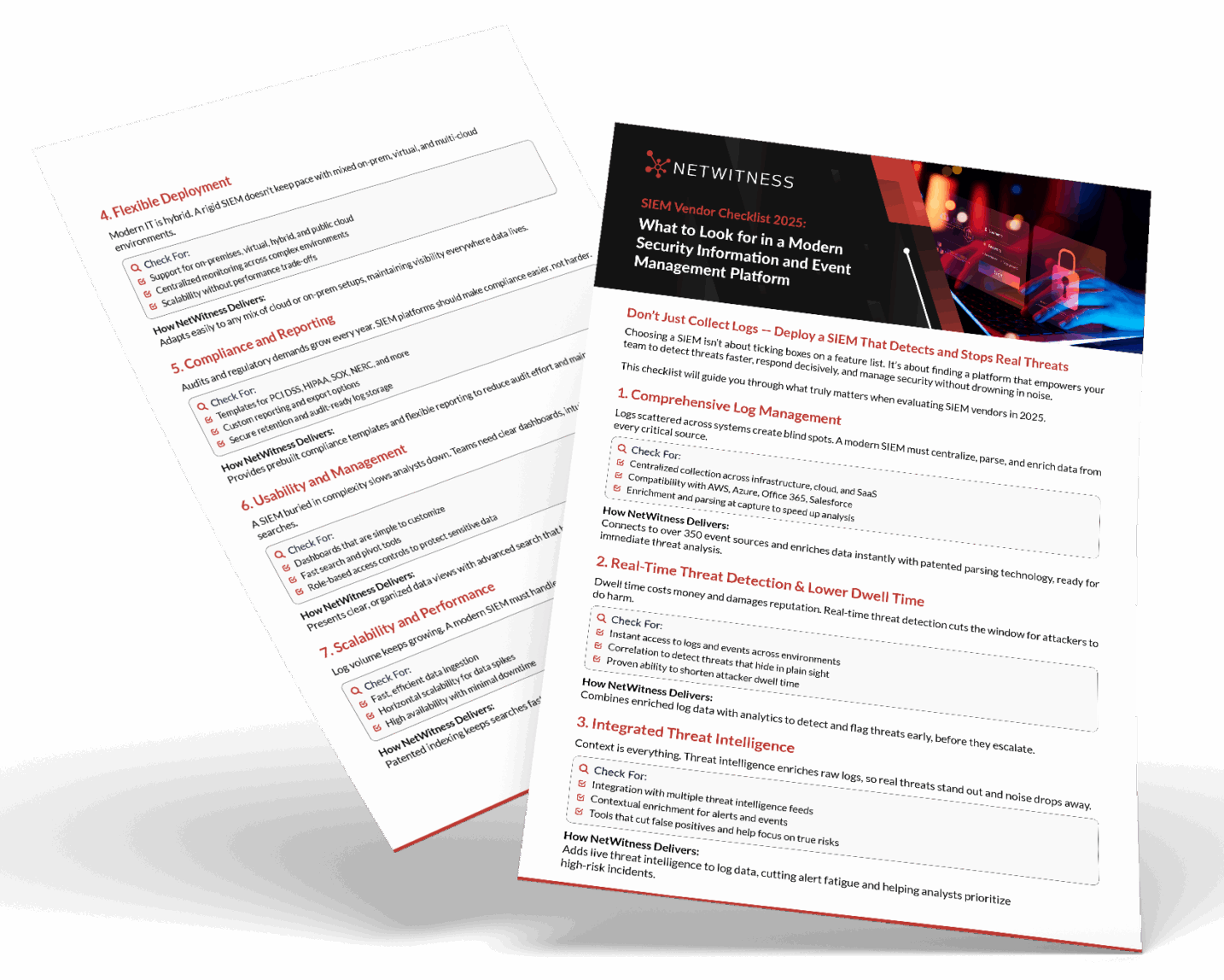
Evaluate Your SIEM Strategy with Confidence
Use a structured, expert-driven checklist to assess next-gen SIEM platforms. Understand which capabilities matter most for visibility, detection speed, and operational efficiency. Compare vendors effectively and choose a SIEM that scales with your business and security needs.

9. Retention Strategy and Predictable Data Economics
Security data does not have uniform value, and treating every source the same can make a SIEM unnecessarily expensive.
Privileged-account activity, cloud administrative events, authentication records, packet evidence from a confirmed incident, and endpoint telemetry may all carry significant investigative value. Routine infrastructure logs, on the other hand, may not require the same search performance or retention period.
A mature retention strategy therefore needs to be considered more than how long data is stored. It should also account for how quickly the data may need to be searched, how likely it is to support an investigation, what regulatory obligations apply, and how much it costs to retain and retrieve.
For example, recent high-value security telemetry may need to remain immediately searchable in hot storage, while older data can move to lower-cost tiers. Some evidence may need to be preserved for regulatory, legal, or forensic reasons even if it is rarely accessed. Other telemetry may be filtered, compressed, or retained for a shorter period if its investigative value is limited.
During a SIEM evaluation, assess support for:
- Hot storage for frequently searched data
- Warm storage for less frequently accessed telemetry
- Cold storage for longer-term retention
- Archive options for compliance or historical investigations
- Different retention policies by data source
- Compression and storage optimization
- Search across archived data
- Rehydration time and process
- Rehydration or retrieval charges
- Cloud egress costs
- Filtering before ingestion
- Raw-data preservation
- Regional storage requirements
- Legal hold capabilities
- Data deletion and lifecycle controls
The cost model deserves particular attention. A platform may appear economical based on ingestion pricing but become considerably more expensive once long-term retention, archive searches, cloud storage, rehydration, or egress fees are included.
This can also influence security decisions. If retrieving older evidence is expensive or slow, teams may retain less data than investigators actually need. That creates a difficult trade-off during incidents where the initial compromise occurred weeks or months before the alert was generated.
Enterprise buyers should therefore compare SIEM solutions using a multi-year data model rather than first-year licensing alone.
10. SIEM Deployment Options That Match the Architecture
The best SIEM deployment architecture depends on where the enterprise operates and where its data is permitted to go. A cloud-native platform may fit a cloud-first organization extremely well.
Other environments need combinations of:
- On-premises deployment
- Virtual infrastructure
- Public cloud
- Private cloud
- Hybrid architecture
- Regional data processing
- Centralized management
- Isolated collection
- At NetWitness, we support deployment patterns spanning on-premises, cloud, virtual, and hybrid environments. That flexibility is particularly relevant when enterprises operate substantial data-center infrastructure, sensitive environments, or regional data requirements alongside cloud services.
Validate where collection, parsing, enrichment, analytics, storage, and administration occur. Those functions may carry different privacy and operational requirements.
11. Compliance Reporting Backed by Usable Evidence
Organizations in regulated industries operate under stringent compliance requirements that can add significant complexity to security operations. Failure to meet these obligations can result in regulatory penalties, legal exposure, and reputational damage, making compliance capabilities an important criterion when evaluating a SIEM platform.
Prebuilt compliance templates can reduce the time and effort required for reporting, but reporting alone is not enough. Security teams should also be able to trace compliance findings back to the underlying logs, events, and investigative evidence needed to demonstrate control effectiveness and support audits or regulatory investigations.
Evaluate support for:
- Control-specific reporting
- Administrative audit trails
- Access records
- Custom reporting
- Scheduled reports
- Protected records
- Retention policies
- Incident documentation
- Evidence export
- Regulatory investigation
At NetWitness, our SIEM includes reporting and use cases for frameworks and requirements including SOX, PCI, HIPAA, NERC, FISMA, and ISO 27002.
During evaluation, follow a compliance finding back into the underlying telemetry. A report becomes far more valuable when the same data can support investigation and evidence gathering after a control failure.
12. Open Integrations and Data Portability
No enterprise SIEM operates in isolation. It sits at the center of a much broader security and IT ecosystem that may include IAM, EDR, NDR, firewalls, cloud security platforms, vulnerability management tools, threat intelligence feeds, ITSM systems, case management platforms, data lakes, messaging tools, and custom applications.
The quality of those integrations has a direct impact on how efficiently the SOC can detect, investigate, and respond to threats.
A SIEM may ingest alerts from an endpoint tool, for example, but that integration is far more useful if analysts can also retrieve endpoint context, enrich the incident automatically, trigger a containment action, and preserve the response activity within the same case. The same principle applies across identity, network, cloud, and vulnerability data.
This is why integration should be evaluated as more than a connector count.
Buying teams should examine whether integrations are:
- Bidirectional, allowing the SIEM to both receive data and initiate actions
- Vendor-maintained, so updates do not depend entirely on internal engineering
- Versioned and documented, making changes easier to manage
- Monitored for failures, so broken integrations do not silently create visibility gaps
- Included in the license, rather than becoming an unexpected additional cost
- Accessible through APIs, allowing custom workflows and automation
- Capable of preserving context, rather than passing only basic alert information
- Flexible enough for custom systems, especially in large or highly specialized environments
Integration resilience is equally important. APIs change, authentication methods are updated, schemas evolve, and third-party platforms introduce new versions. The SIEM should make it easy to identify when an integration has stopped working or is returning incomplete data.
Data portability deserves the same level of scrutiny.
Security teams build significant operational value inside a SIEM over time: telemetry, detection rules, dashboards, cases, investigation history, reports, threat intelligence, and analyst workflows. If those assets cannot be exported in usable formats, changing platforms later can become expensive and operationally disruptive.
Organizations should therefore evaluate whether they can export:
- Raw and normalized telemetry
- Detection rules and correlation logic
- Dashboards and reports
- Cases and investigation records
- Threat intelligence
- Analyst notes
- Automation workflows
- Search results and evidence
A platform that is easy to adopt but difficult to leave can introduce long-term commercial and operational risk.
For enterprise buyers, the stronger SIEM integration model is one that allows the platform to participate in the broader security architecture without forcing every workflow, data source, or response action into a closed ecosystem.
How to Run a SIEM Proof of Concept and Score Vendors
A proof of concept only helps if every vendor faces the same test. Define the scope before the first demo, then score what each platform actually does rather than what it presents.
Fix the scope. Use the same telemetry, the same five to eight attack scenarios from the Detection Baseline, and the same data volumes for every vendor.
Measure outcomes per scenario. Record time to detect, the data each detection required, the number of analyst pivots, and the time to a supported conclusion.
Test failure, not just success. Break a parser, take a collector offline, spike ingestion, and run a historical search while detections are running. Note whether the platform makes each failure visible.
Score against the twelve capabilities. Weight them for your environment and require evidence for every score.
Model cost over the full period. Apply the Commercial Baseline across three to five years rather than comparing first-year licensing.
| Capability | Weight | POC test | Score (0-5) |
| Telemetry coverage | Onboard your priority sources; classify each as native, partner, community, or custom | ||
| Parsing and data quality | Break a parser on purpose; check whether the failure becomes visible | ||
| Detection engineering | Build, test, and tune one custom detection for a Detection Baseline scenario | ||
| Explainable analytics | Ask for the evidence behind each risk score | ||
| Investigation depth | Run one scenario end to end; count pivots, consoles, and time to a supported conclusion | ||
| Threat intelligence | Load an internal indicator set and run a retrospective search | ||
| Automation governance | Run a playbook that fails halfway; check what the analyst sees | ||
| Performance and resilience | Spike ingestion and search months of data while detections run | ||
| Retention and economics | Price the multi-year model, including archive search and rehydration | ||
| Deployment options | Validate where collection, storage, and analytics can run | ||
| Compliance and evidence | Trace one report finding back to the raw events | ||
| Integrations and portability | Export rules, cases, and data in usable formats |
Weights will differ by organization. Score each capability from evidence gathered during the POC, not from vendor presentations.
Why Should You Choose NetWitness SIEM
At NetWitness, we have built our SIEM around an operating reality we see repeatedly in mature SOCs: investigators usually need more than the event that generated the alert.
Our SIEM centralizes logs from 350+ sources across on-premises, cloud, SaaS, and hybrid environments. We use dynamic parsing, automated log-source discovery, and metadata enrichment at capture time to make incoming telemetry more useful for detection, search, and investigation.
We can then extend investigations beyond conventional log analysis with our broader threat detection and response platform.
Depending on the modules deployed, analysts can work with:
- Logs
- Full packets
- Network metadata
- NetFlow
- Endpoint telemetry
- User and entity behavior
- Threat intelligence
- Case management
- Response orchestration
Our network capabilities provide full packet capture and session reconstruction, while our Orchestrator adds case management, playbook-driven investigation, collaboration, and automation.
For enterprises operating complex hybrid estates, we also support flexible deployment models rather than requiring every workload and every piece of security telemetry to fit a single cloud architecture.
That combination is particularly worth evaluating when the SOC has requirements around forensic depth, network visibility, regulated infrastructure, hybrid operations, or investigations that routinely cross security domains.
Explore the NetWitness threat detection and response platform
Frequently Asked Questions
1. How do you compare SIEM vendors effectively?
Compare SIEM vendors against the same telemetry, attack scenarios, data volumes, retention requirements, deployment constraints, and analyst workflows.
Use a weighted scorecard and require vendors to demonstrate critical capabilities during a proof of concept. Measure detection latency, data quality, investigation time, analyst pivots, performance, failure behavior, administrative effort, and projected three-to-five-year cost.
2. How do you evaluate SIEM solutions?
Start by documenting the organization’s telemetry, threat scenarios, investigation requirements, architecture, compliance obligations, and expected data growth.
Then run a production-like POC using real or representative telemetry. Test detection accuracy, parsing quality, historical search, investigation workflows, automation controls, platform resilience, source failures, integration quality, analyst experience, and total cost of ownership.
3. How should organizations evaluate SIEM deployment options?
Organizations should evaluate where security data can be collected, processed, stored, searched, and administered.
Compare cloud, on-premises, virtual, and hybrid options against data-residency requirements, latency, scale, high availability, isolated environments, regional restrictions, disaster recovery, operational skills, infrastructure costs, and access to high-volume telemetry.
The deployment architecture should reflect the organization’s security and regulatory requirements rather than forcing those requirements to fit the platform.
Choose the Right SIEM with Confidence
Evaluate vendors using a comprehensive, expert-built checklist.
Identify must-have SIEM features for complete visibility and faster detection.
Make informed decisions with NetWitness’ proven SIEM guidance.