Introduction
The top SIEM solutions for enterprises include NetWitness, Microsoft Sentinel, Splunk Enterprise Security, IBM QRadar SIEM, Google Security Operations, Palo Alto Cortex XSIAM, Cisco Security, Exabeam, Securonix, and LogRhythm. Each platform offers different capabilities for security monitoring, threat detection, investigation, analytics, and response.
For enterprises, choosing among leading SIEM solutions requires more than comparing features. The right SIEM platform should provide broad visibility across network, endpoint, cloud, identity, and application environments while helping security teams detect sophisticated threats and investigate incidents quickly. Factors such as scalability, integrations, compliance requirements, deployment model, and SOC maturity also influence the decision.
This guide compares the top SIEM vendors across detection depth, investigation speed, and enterprise fit. It also examines the best SIEM tools for financial services, healthcare, public-sector organizations, and global enterprises to help security leaders identify the right enterprise SIEM solution for their environment.
What Defines an Enterprise SIEM Platform in 2026
Before evaluating vendors, it’s important to understand what makes a SIEM enterprise-ready in 2026.
Enterprise-grade SIEM security solutions must provide visibility across multiple telemetry layers:
| Telemetry Type | Why It Matters |
| Network traffic | Detect lateral movement and command-and-control activity |
| Endpoint telemetry | Identify malware execution and persistence |
| Identity activity | Detect credential abuse and privilege escalation |
| Cloud workloads | Monitor SaaS, IaaS, and container environments |
| Logs and events | Provide context across systems and applications |
| Threat intelligence | Correlate known attacker behaviors |
The strongest SOC SIEM platforms unify these sources into a single investigative workflow.
This enables security teams to answer the most important questions quickly:
- How did the attacker enter?
- What did they access?
- How far did they move?
- What is the business impact?
What to Prioritize When Evaluating SIEM Vendors
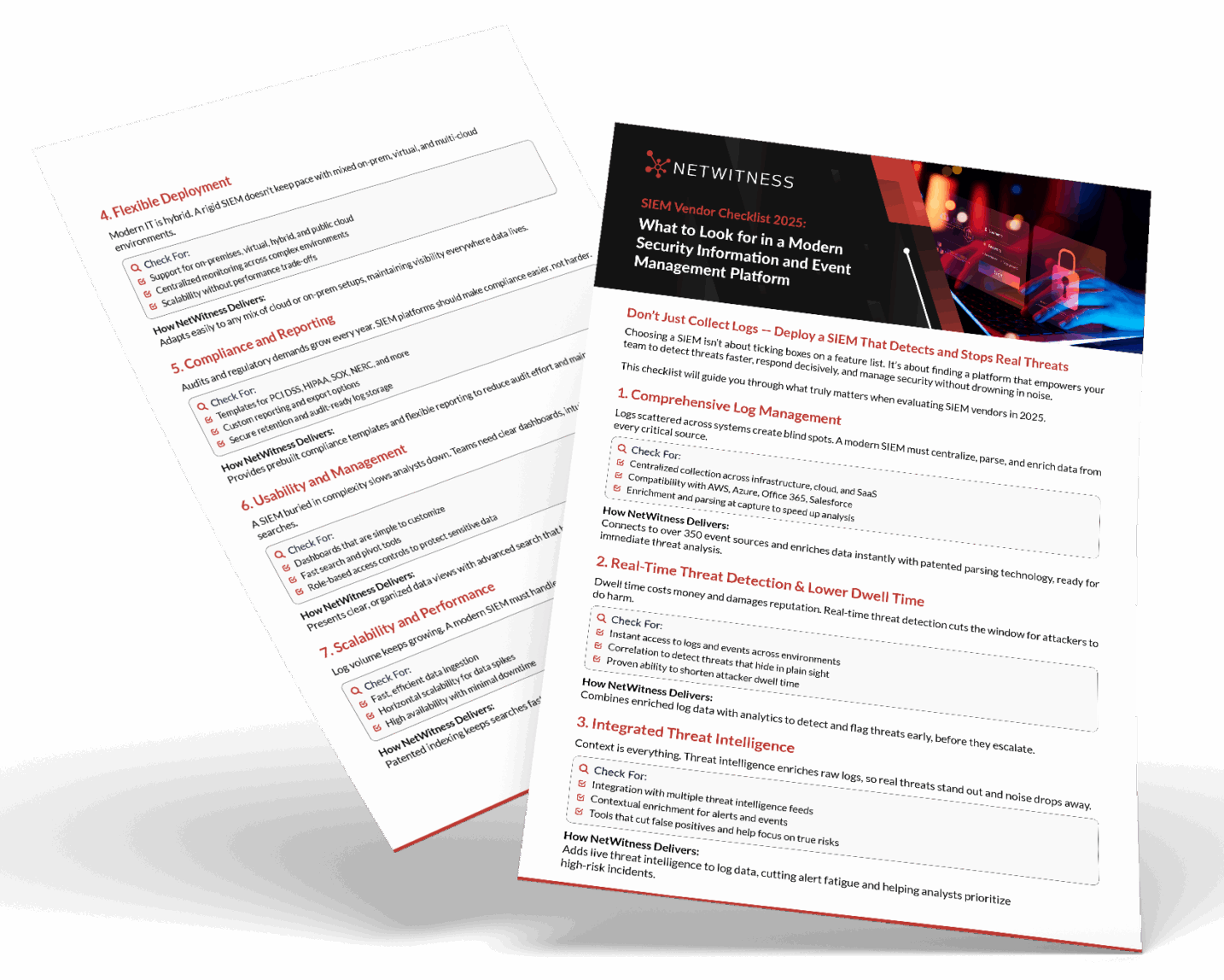
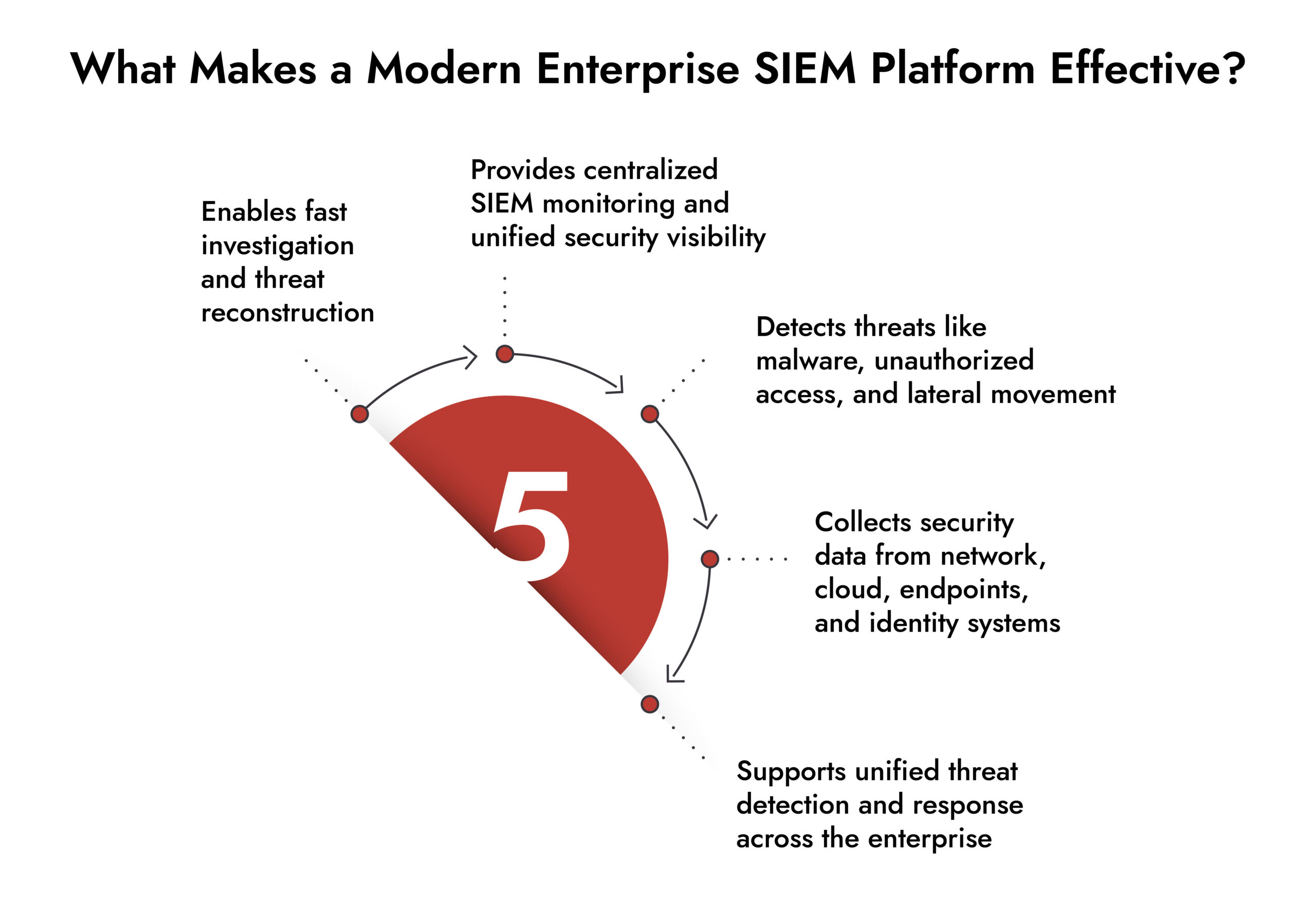
The telemetry coverage matters, but so does how the platform handles what it ingests. When making a confident, future-proof SIEM choice, prioritize unified log management across endpoints, networks, cloud platforms, and existing security stacks plus machine learning, behavioral analytics, and AI-driven investigation capabilities to detect sophisticated threats, reduce false positives, and accelerate root cause analysis.
Beyond features, ask the right operational question. When evaluating SIEM platforms, security leaders should ask: does this platform unify detection, investigation, and response in a single operational layer, or am I still assembling workflows across products? The answer will determine whether your team spends its time fighting threats or fighting its own tools.
A few other practical factors worth weighing:
Deployment model: Cloud-native SIEMs offer faster onboarding and lower infrastructure overhead. Self-hosted options give more control but require dedicated management resources.
Team size and expertise: Small security teams should focus on automation, alert prioritization, and UEBA for maximum impact with limited staff. Large enterprises should prioritize scalability, compliance automation, and custom rule creation to handle complex operations.
Types of SIEM tools: Modern SIEM solutions broadly fall into three categories traditional on-premises platforms (like LogRhythm), cloud-native platforms (like Microsoft Sentinel and Google Chronicle), and unified SecOps platforms that blend SIEM with XDR, SOAR, and behavioral analytics (like Cortex XSIAM and NetWitness). Knowing which type fits your environment narrows the evaluation significantly.
Top 10 SIEM Solutions for Enterprises in 2026
1. NetWitness Platform
Purpose-built for deep enterprise visibility and forensic-level investigations.
Unlike SIEM tools that rely primarily on logs, NetWitness captures and analyzes:
- Full network packets
- Logs across infrastructure
- Endpoint telemetry
- User and entity behavior
This gives SOC teams the ability to reconstruct attacks with precision.
Key capabilities:
a. Full packet capture for network visibility
Most SIEM tools analyze summaries of network traffic. NetWitness analyzes full packets, allowing security teams to see exactly what occurred during an attack.
This enables detection of:
- Command and control communication
- Data exfiltration attempts
- Lateral movement
- Encrypted threat patterns
b. Unified visibility across network, logs, and endpoints
NetWitness integrates multiple telemetry layers into one platform. This eliminates investigative blind spots and accelerates root cause analysis.
c. Advanced threat detection and investigation
Security teams can trace attacks from initial compromise to impact using unified investigation workflows.
d. Enterprise scale and performance
Designed to handle high-volume telemetry environments across hybrid infrastructure.
Best for: Enterprises that require deep visibility, threat reconstruction, and advanced investigation capabilities.
2. Microsoft Sentinel
Microsoft Sentinel is a cloud-native cloud SIEM solution built on Azure.
It provides strong visibility into:
- Azure workloads
- Microsoft 365 environments
- Identity activity through Entra ID
- Microsoft Defender security telemetry
Strengths
- Native integration with Microsoft ecosystem
- Strong cloud visibility
- Built-in automation capabilities
- Scalable cloud architecture
Best for: Cloud-first enterprises using Microsoft infrastructure.
3. Splunk Enterprise Security
Splunk is one of the most widely adopted SIEM security tools in enterprise environments.
It provides flexible log ingestion, search, and analytics.
Strengths
- Powerful search capabilities
- Large integration ecosystem
- Flexible analytics engine
- Mature threat detection workflows
Best for: Large enterprises with dedicated SOC teams.
4. IBM QRadar SIEM
IBM QRadar provides strong event correlation and compliance-focused capabilities.
It is widely used in regulated industries.
Strengths
- Strong correlation engine
- Compliance reporting capabilities
- Threat intelligence integration
- Mature enterprise deployment support
Best for: Enterprises with strict regulatory requirements.
5. Google Chronicle Security Operations
Chronicle is built on Google’s cloud infrastructure and designed for speed and scalability.
Strengths
- Extremely fast search performance
- Long-term telemetry retention
- Strong cloud analytics capabilities
- High scalability
Best for: Large-scale cloud environments.
6. Palo Alto Cortex XSIAM
Cortex XSIAM combines SIEM, XDR, and automation into one platform.
Strengths
- Automated investigation workflows
- Integrated endpoint and network telemetry
- AI-driven threat detection
- Unified security operations
Best for: Enterprises seeking automation-driven SOC operations.
7. Cisco Secure Cloud Analytics
Cisco provides strong network telemetry and behavioral analysis.
Strengths
- Strong network visibility
- Behavioral detection capabilities
- Integration with Cisco infrastructure
Best for: Enterprises with Cisco network infrastructure.
8. Exabeam Security Analytics
Exabeam focuses heavily on user behavior analytics.
Strengths
- Insider threat detection
- Behavior-based threat analysis
- Investigation timelines
Best for: Identity-driven detection strategies.
9. Securonix SIEM
Securonix provides AI-driven threat detection and analytics.
Strengths
- Behavior analytics capabilities
- Cloud-native architecture
- AI-based detection models
Best for: AI-driven security operations.
10. LogRhythm SIEM Platform
LogRhythm offers balanced SIEM functionality and automation.
Strengths
- Integrated automation
- Strong compliance reporting
- Flexible deployment options
Best for: Enterprises seeking balanced SIEM capabilities.
SIEM solution | Core capabilities | Deployment | Key consideration |
NetWitness Platform | Network detection, packet analysis, log management, endpoint visibility, threat investigation | Hybrid | Best suited to enterprises that need deep network visibility and investigation |
Microsoft Sentinel | SIEM, security analytics, threat intelligence, automation | Cloud | Strong fit for organizations invested in the Microsoft ecosystem |
Splunk Enterprise Security | Security analytics, threat detection, investigation, orchestration | Cloud/Hybrid | Suited to large SOCs with complex data and analytics requirements |
IBM QRadar SIEM | Event correlation, threat detection, analytics, compliance | Cloud/Hybrid | Useful for large and regulated environments |
Google Security Operations | SIEM, threat intelligence, detection, investigation | Cloud | Designed for cloud-scale security operations |
Palo Alto Cortex XSIAM | SIEM, XDR, analytics, detection and automated response | Cloud | Focused on consolidating and automating security operations |
Cisco Security | Network monitoring, threat detection, analytics and response | Cloud/Hybrid | Relevant for organizations with extensive Cisco infrastructure |
Exabeam | SIEM, UEBA, detection and investigation | Cloud/Hybrid | Focuses strongly on behavioral analytics and user activity |
Securonix | SIEM, UEBA, threat detection and analytics | Cloud | Designed for cloud-first security operations |
LogRhythm | SIEM, log management, detection, investigation and response | Cloud/Hybrid | Suited to organizations looking for integrated security monitoring |

Enterprise SIEM Visibility and Investigation Capability Overview
| Capability | Why It Matters | NetWitness Advantage |
| Log analysis | Provides baseline visibility | Supported |
| Endpoint telemetry | Detect malware and persistence | Supported |
| Network telemetry | Detect lateral movement | Deep packet inspection |
| Threat reconstruction | Understand attack sequence | Full attack reconstruction |
| Unified investigation | Faster incident response | Integrated workflows |
| Hybrid environment support | Enterprise scalability | Fully supported |
This depth of visibility is critical for modern threat detection because most enterprise attacks unfold across multiple systems, not a single point of entry. Attackers may enter through a compromised credential, move laterally across the network, escalate privileges on endpoints, and access sensitive data in cloud workloads. Without unified visibility across these layers, security teams see only isolated alerts instead of the full attack sequence.
Deep, correlated telemetry allows SOC teams to reconstruct attacker activity, understand how the compromise occurred, identify what was impacted, and respond with precision. This reduces investigation time, improves detection accuracy, and prevents attackers from remaining undetected inside enterprise environments.
Why Enterprises Are Moving Toward Unified SIEM Platforms
A unified SIEM platform centralizes and correlates telemetry from multiple security layers including network traffic, endpoints, cloud workloads, identities, and logs into a single investigative and detection environment. Instead of operating as a standalone log management tool, a unified SIEM connects diverse telemetry sources to provide complete visibility and a single source of truth for security operations.
This unified approach allows security teams to detect threats faster, investigate incidents more accurately, and understand the full scope of attacker activity without switching between multiple tools.
Fragmented visibility creates risk.
Security teams often use separate tools for:
- Logs
- Network monitoring
- Endpoint security
- Cloud monitoring
This slows investigations and creates blind spots. Unified siem security solutions eliminate this fragmentation. They allow teams to detect threats faster and respond more effectively.
A unified SIEM platform does not necessarily replace the existing security stack; rather, it serves as an integration and a visibility layer that brings together telemetry across network, endpoint, cloud, identity, and application environments.
For enterprises, the goal is not tool consolidation on its own, but operational cohesion. A unified approach reduces investigative friction, improves cross-domain correlation, and enables analysts to pivot seamlessly across data sources without stitching context manually.
As environments grow more distributed, organizations are prioritizing platforms that enhance alerts fidelity, streamline detection workflows, and strengthen the response procedure which will ultimately improving overall SOC effectiveness and security posture.
SIEM Solutions by Industry
The types of industries vary in terms of security concerns, which makes it difficult to determine which SIEM platform is the best fit for an organization. Finance
Financial institutions require SIEM solutions that offer extensive visibility into networks, endpoints, applications and user activity. Strong threat detection, quick investigation, fraud monitoring and compliance support are among the top priorities.
Healthcare
Healthcare organizations operate in complex distributed environments with sensitive patient and financial information. A SIEM platform should offer comprehensive visibility, ransomware detection, behavioral monitoring, and support compliance with regulations.
Public Sector
Public-sector organizations may have large, distributed IT environments that have strict security and data governance requirements. To ensure that SIEM platforms can monitor a growing number of applications, devices, and processes, offer advanced threat detection, provide compliance capabilities, and include robust investigation capabilities.
Global Enterprises
Enterprises require SIEM solutions that span across cloud, data centres, regions and not just a limited number of security telemetry trends. Some of the most important priorities are centralized visibility, cross-environment correlation, quick investigations, and deployment flexibility.
How to Choose the Best SIEM Solution for Your Enterprise
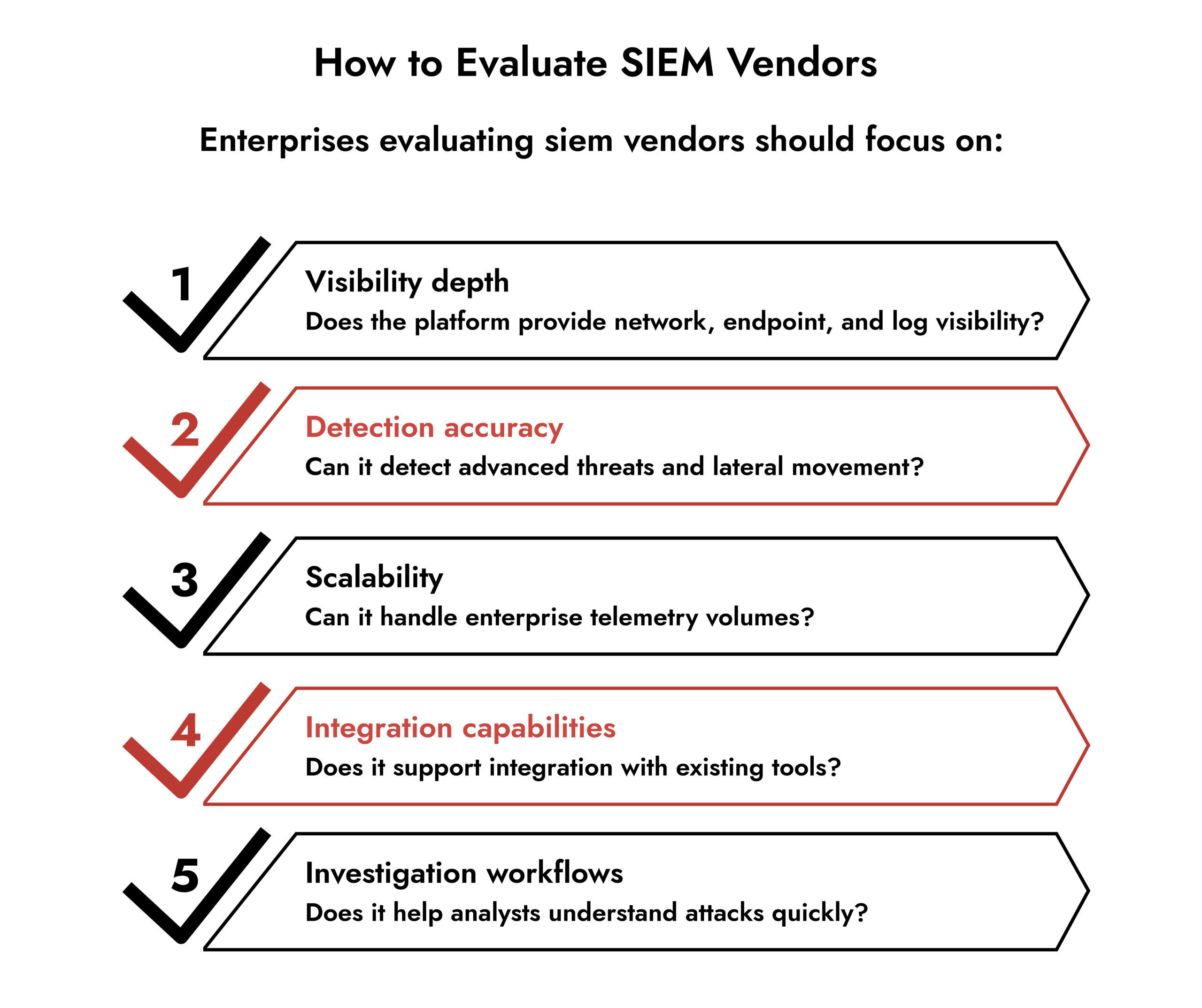
Choosing the right enterprise SIEM starts with understanding what your security team actually needs. When comparing SIEM vendors and SIEM providers, consider:
- Security visibility: Does it cover the network, endpoint, cloud, identity and log data you need?
- Threat detection: Can it detect suspicious activity and prioritize meaningful threats?
- Investigation: Can analysts quickly understand what happened and trace attacker activity?
- Cloud support: Can it monitor your cloud and hybrid environments?
- Integrations: Does it work with your existing security and IT tools?
- Scalability: Can it handle increasing data volumes as your environment grows?
- Automation: Can it reduce repetitive investigation and response work?
- SOC fit: Does it match your team’s skills, workflows and operational requirements?
- Compliance: Does it support your reporting, retention and audit requirements?
The best SIEM platform is not necessarily the one with the longest feature list. It is the one that gives your security team the visibility, detection, investigation and response capabilities that fit its environment.
Conclusion
The effectiveness of a SIEM platform comes down to one thing: how quickly and accurately it helps your security team understand what happened and act on it.
There is no single best SIEM tool for every organization. The right platform depends on whether you need broad compliance logging, modern cloud detection, a unified SecOps workflow, or deep customization for a mature SOC. Microsoft-heavy environments will often land on Sentinel. Mature detection engineering teams lean toward Splunk. Organizations that need forensic-grade network visibility alongside log correlation benefit most from platforms like NetWitness.
What matters most is matching the platform’s architectural philosophy to your team’s actual workflows not just checking feature boxes on a vendor sheet.