How does NetWitness connect network security with broader cybersecurity operations?
NetWitness connects network security with broader cybersecurity operations by correlating network, endpoint and cloud data within a unified threat detection and response platform. Its NDR capabilities provide full-packet capture, metadata enrichment, behavioural analytics and network forensics, while its broader platform supports threat hunting, investigation and automated response. This allows security teams to move from network threat detection to cross-domain investigation and coordinated response within a connected security workflow.
Security teams now have more visibility than ever, but that doesn’t mean that the analysts can make sense of an attack. Each one of the following can be an indicator of an incident: network activity, endpoint events, logs, user behaviour and threat intelligence. The problem is getting those pieces connected in a timely fashion so you can find out what’s going on, how far did the threat get, and what do you need to do next? This is where network security operations are expected to play a role in larger cybersecurity operations.
NetWitness integrates network, endpoint, cloud and other security data into a single threat detection and response platform. The platform’s Network Detection and Response (NDR) features deep network visibility, and the platform’s expanded capabilities enable detection, investigation, threat hunting and response throughout security operations.
Why Does Network Security Need to Connect with the Rest of the SOC?
Network security and cybersecurity are closely related, but they do not cover exactly the same ground.
The difference between cybersecurity vs network security is largely a matter of scope. Network security focuses on protecting and monitoring network communications and activity. Cybersecurity operations take a wider view across networks, endpoints, identities, applications, cloud environments and other sources.
An attack, however, does not stay within one of those boundaries.
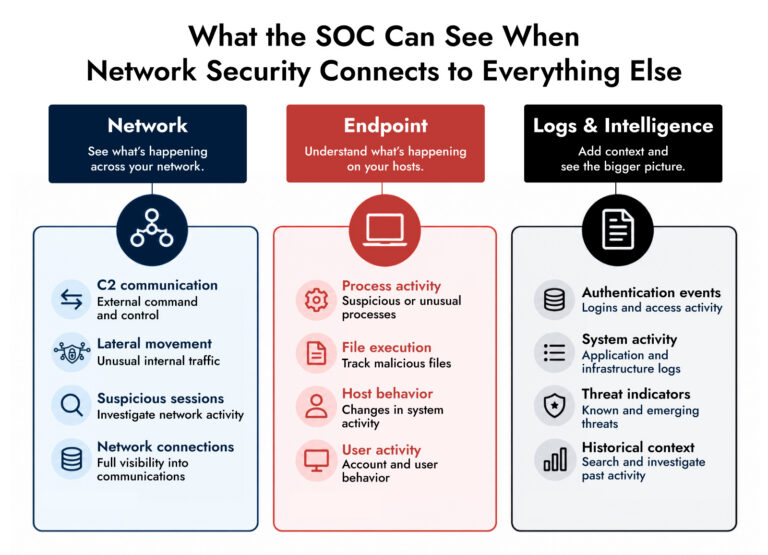
For example, a compromised endpoint may begin communicating with an external server. The attacker could then use that foothold to move laterally, access another system and eventually target sensitive data. Each stage may generate evidence in a different security system.
| Security data | What it can reveal during an investigation |
| Network data | Connections, communications, lateral movement and suspicious traffic |
| Endpoint data | Processes, files, user activity and host-level behavior |
| Logs | Authentication, application and system events |
| Threat intelligence | Context around known indicators and threats |
| User behavior | Anomalous activity associated with users or entities |
Connecting these sources gives analysts a better chance of seeing the complete attack rather than investigating isolated alerts.
How does NetWitness Connect Network Data with Other Security Telemetry?
The practical value of network security increases when analysts can move from a network event to the endpoint, user or system associated with it.
NetWitness is designed to correlate network, endpoint and cloud data in real time and provide a unified view for threat detection and investigation. Its platform also includes SIEM, UEBA, NDR, EDR and security orchestration capabilities.
That allows an investigation to develop across multiple data sources.
For example, an analyst investigating suspicious outbound communication can use network evidence as the starting point and then examine related endpoint activity. If the endpoint shows a suspicious process around the same time, the two events provide stronger context than either alert provides on its own.
The same process can work in reverse. An endpoint alert can lead analysts into network data to determine what the system communicated with and whether other systems showed similar activity.
This creates a more connected approach to network security monitoring, where network telemetry becomes part of the broader investigation rather than a separate alert stream.
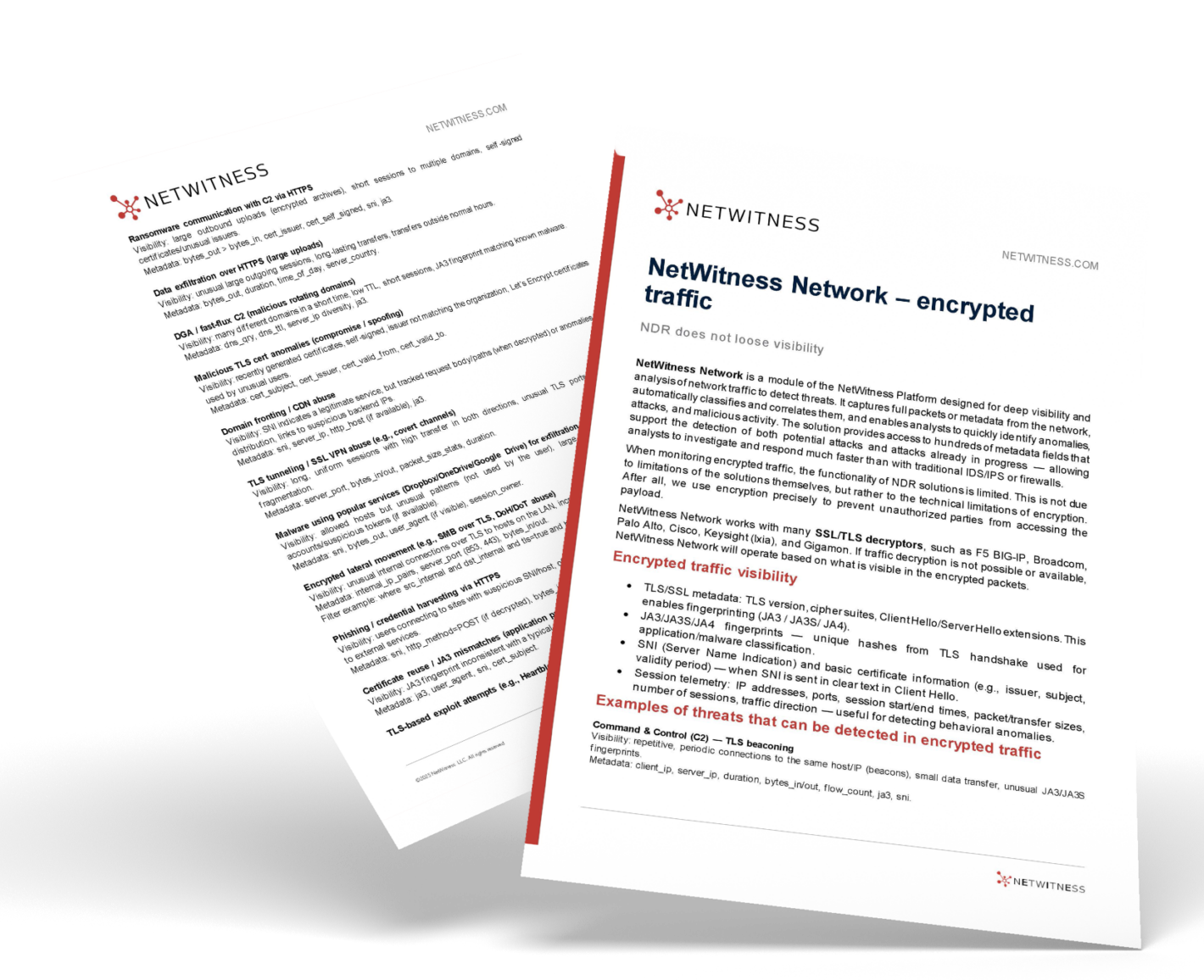
NetWitness Network Encrypted Traffic
- Inspect Encrypted Traffic
- Reveal Hidden Threats
- Maintain Complete Visibility
- Detect Attacks with Confidence
What Network Visibility does NetWitness Provide for Threat Detection?
Effective network threat detection depends on having enough network evidence to identify suspicious behavior and investigate it.
NetWitness NDR uses real-time full-packet capture and metadata enrichment across network infrastructure. It combines that visibility with behavioral analytics and threat intelligence to identify known and unknown threats.
The combination matters because analysts need both speed and depth.
Metadata helps teams search and analyze large amounts of network activity efficiently. Full-packet capture provides deeper evidence when an investigation requires analysts to examine what actually happened during a communication session. NetWitness describes these capabilities as complementary components of NDR and threat investigation.
This gives security teams a foundation for:
- Detecting unusual network behavior
- Identifying suspicious communications
- Investigating east-west traffic and lateral movement
- Examining encrypted or otherwise difficult-to-analyze activity
- Searching historical network activity for related indicators
- Reconstructing sessions during an investigation
The result is more than network visibility. It is network evidence that analysts can use throughout the incident lifecycle.
How does NDR fit into Broader Cybersecurity Operations?
NDR becomes more useful when it contributes to the same detection and response process as other security controls.
NetWitness describes its NDR methodology in three stages: capture and analyze network activity, detect and alert on suspicious behavior, and investigate and respond using network forensics and response capabilities.
In a broader SOC workflow, this can look like:
| Stage | Role of network security |
| Detect | Identify suspicious communications or network behavior |
| Correlate | Connect network activity with endpoint, cloud and other telemetry |
| Investigate | Examine sessions, metadata and packet-level evidence |
| Hunt | Search historical activity for related behaviors or indicators |
| Respond | Feed findings into coordinated response workflows |
| Document | Preserve investigation and response context |
This is the important distinction between using NDR as another security product and making it part of cybersecurity operations.
The goal is not simply to detect more network threats. It is to make network intelligence useful to the people responsible for managing the wider security operation.
How does Network Security help Analysts Investigate Incidents?
An alert rarely provides enough information to close an incident.
An analyst may know that a system communicated with a suspicious destination, but still need to determine when the communication started, what happened during the session, whether other hosts were involved and whether the activity is connected to a larger attack.
Network forensics can provide that additional evidence.
NetWitness combines network visibility with metadata enrichment, full-packet capture and session reconstruction to help analysts investigate suspicious activity and determine the scope of an incident.
During an investigation, analysts can use network data to:
- Establish a timeline by examining related network sessions and activity.
- Identify affected systems by tracing communications between hosts.
- Investigate lateral movement by looking for unusual internal connections.
- Validate alerts by examining the underlying network evidence.
- Determine scope by searching for similar activity elsewhere in the environment.
This turns network security analytics into an investigation resource rather than simply another detection layer.
How can Network Security Data Support Threat Hunting?
Threat hunting requires analysts to search for activity that may not have generated a clear alert.
Network telemetry gives hunters another source of evidence. Instead of relying only on endpoint or log data, analysts can investigate communication patterns, unusual connections, lateral movement and other behaviors across the network.
NetWitness combines network metadata, full-packet capture, behavioral analytics and network forensics to support this type of investigation.
A threat hunter can use network data to:
- Search for communication with suspicious infrastructure
- Identify unusual connections between internal systems
- Investigate potential command-and-control activity
- Look for patterns associated with lateral movement
- Pivot from a known indicator to related network sessions
- Examine historical activity to determine whether a threat has appeared elsewhere
This makes network security monitoring useful even when the initial compromise has not produced a conventional endpoint or SIEM alert.
How do you Automate Network Security Operations Workflows?
Automation becomes valuable when analysts repeatedly perform the same enrichment, investigation and response steps.
NetWitness SOAR provides case management, automated workflows, threat intelligence integration and orchestration across security tools. The platform supports more than 500 integrations and can connect SIEM, EDR, cloud, identity and IT service management tools.
A connected workflow can therefore automate activities such as:
- Alert aggregation and prioritization
- Threat intelligence enrichment
- Evidence collection
- Case creation and management
- Repetitive investigation tasks
- Response actions
- Incident documentation
The key is not to remove analysts from the process. NetWitness supports automated and semi-automated workflows while maintaining human oversight for higher-impact decisions.
That helps security teams spend less time moving information between tools and more time deciding what the evidence means.
What Should Organizations Look for in a Security Operations Platform?
Organizations evaluating a security operations platform should look beyond individual detection capabilities.
The more useful question is whether the platform can connect the different stages of security operations and allow analysts to move from detection to investigation and response without creating additional silos.
A practical evaluation can include:
| Capability | Why it matters |
| Network visibility | Provides evidence of communications and network behaviour |
| Cross-domain correlation | Connects network events with endpoint, cloud and other telemetry |
| Network forensics | Helps analysts investigate the activity behind an alert |
| Threat hunting | Enables proactive searches across historical security data |
| Threat intelligence | Adds context to suspicious indicators and activity |
| Automation | Reduces repetitive investigation and response work |
| Case management | Keeps investigation evidence and actions organized |
| Integrations | Connects the platform with the existing security ecosystem |
NetWitness brings these capabilities together around a unified threat detection and response model. Its platform correlates network, endpoint and cloud data, while NDR provides deeper network visibility and SOAR supports orchestration and response.
Why does Connecting Network Security and Cybersecurity Operations Matter?
The value comes from connecting evidence, not simply collecting more of it.
When network, endpoint and other security data remain separated, analysts spend time moving between tools and manually establishing relationships. When those sources work together, network activity can become the starting point for a wider investigation, while endpoint or log alerts can lead analysts back into network evidence.
That makes network security operations part of a broader security workflow.
NetWitness brings this model together through network detection, endpoint visibility, analytics, investigation and security orchestration. For organizations looking to strengthen detection and response, the result is a more connected way to understand threats, investigate their scope and coordinate action.
Frequently Asked Questions
1. How to set up automated network security operations workflows?
Start by identifying repetitive tasks across alert triage, enrichment, investigation and response. Connect network detection with endpoint, SIEM, threat intelligence and response tools, then define which actions can run automatically and which require analyst approval. NetWitness SOAR supports automated workflows, case management, threat intelligence and integrations across the security ecosystem.
2. Why should network security be connected to broader cybersecurity operations?
Network activity represents only one part of many attacks. Connecting network data with endpoint, cloud, log and other telemetry helps analysts correlate events, establish attack timelines, identify affected systems and determine the wider scope of an incident.
3. How does NDR fit into broader cybersecurity operations?
NDR provides network-level detection and investigation capabilities that can feed into the wider SOC workflow. NetWitness combines NDR with endpoint, cloud, SIEM, UEBA and orchestration capabilities, allowing network findings to contribute to broader detection, investigation and response processes.
4. How does network security help with threat hunting?
Network security data gives threat hunters visibility into communications, connections and behaviours that may not be obvious in endpoint or log data. With metadata, packet-level evidence and forensic capabilities, analysts can search historical activity, investigate suspicious behaviour and pivot from known indicators to related network sessions.
5. How can network security data improve incident investigations?
Network data can help analysts reconstruct sessions, establish timelines, identify communicating systems and investigate lateral movement. NetWitness combines full-packet capture, metadata enrichment and network forensics to give analysts deeper evidence for validating alerts and determining the scope of an incident.
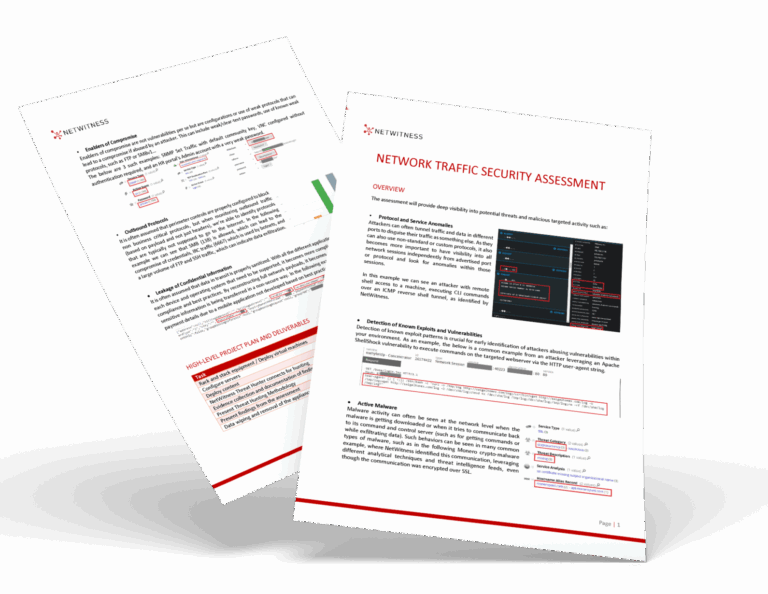
Strengthen Network Visibility with NetWitness® Network Traffic Security Assessment
- Uncover hidden threats through deep packet inspection and analytics.
- Identify vulnerabilities and blind spots before they’re exploited.
- Enhance detection and response with NDR-driven intelligence.