How does full packet capture improve enterprise threat hunting?
With full packet capture, threat hunters get access to the network evidence underlying the suspicious behavior. Together with logs and endpoint telemetry, it allows investigators to build a picture of what occurred rather than dealing with pieces of a puzzle. It can also fill visibility gaps when logs or endpoint telemetry are unavailable. For example, when activity involves unmanaged devices or systems without an endpoint agent.
Introduction
In most cases, an investigation doesn’t start with a full story. Analysts may have repeated authentication failures in the SIEM console, suspicious processes on endpoints, and odd outbound connections in network metadata. Each one is valuable information; however, none can answer the question.
And here comes full packet capture that enables storing network traffic in its packets and provides deeper evidence for investigators to analyze if there are any gaps in the metadata and alerts. Instead of relying only on what an alert or log recorded, analysts can examine the underlying communication itself, including, where available, the actual files transferred or the content of a phishing email.
The Verizon 2025 DBIR covered more than 22,000 security incidents and 12,000 data breaches showing the ever-growing complexity of attack paths via vulnerabilities, identities, systems, and even third parties.
For organizations, the issue is not just gathering more telemetry data but connecting evidence fast enough during investigation. The value is in reducing the time between an initial alert and enough evidence to validate, scope, and respond to the incident.
What is Full Packet Capture?
Full packet capture (FPC) records network packets so investigators can examine the underlying communication rather than relying only on alerts or network metadata. It can provide deeper evidence about network sessions, protocols, connections, and, where available and appropriate, transferred content.
Unlike logs, which typically record that an event occurred, packet capture can preserve additional details about how systems communicate. This makes it useful when investigators need to validate an alert, reconstruct a session, investigate suspicious communications, or fill visibility gaps involving unmanaged devices and systems without endpoint agents.
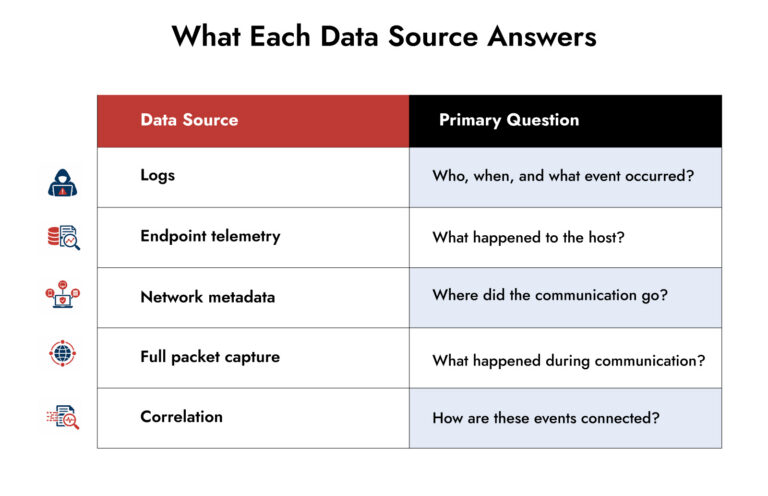
Full packet capture is most valuable when it is combined with other security telemetry. Logs provide identity and event context, endpoint telemetry provides host-level activity, and packet evidence provides deeper network context. Correlating these sources allows analysts to move from an initial detection to evidence that can help validate and scope an investigation.
How NetWitness Connects Packet Evidence with the Investigation
NetWitness approaches network forensics as part of the wider threat investigation rather than as a standalone packet repository.
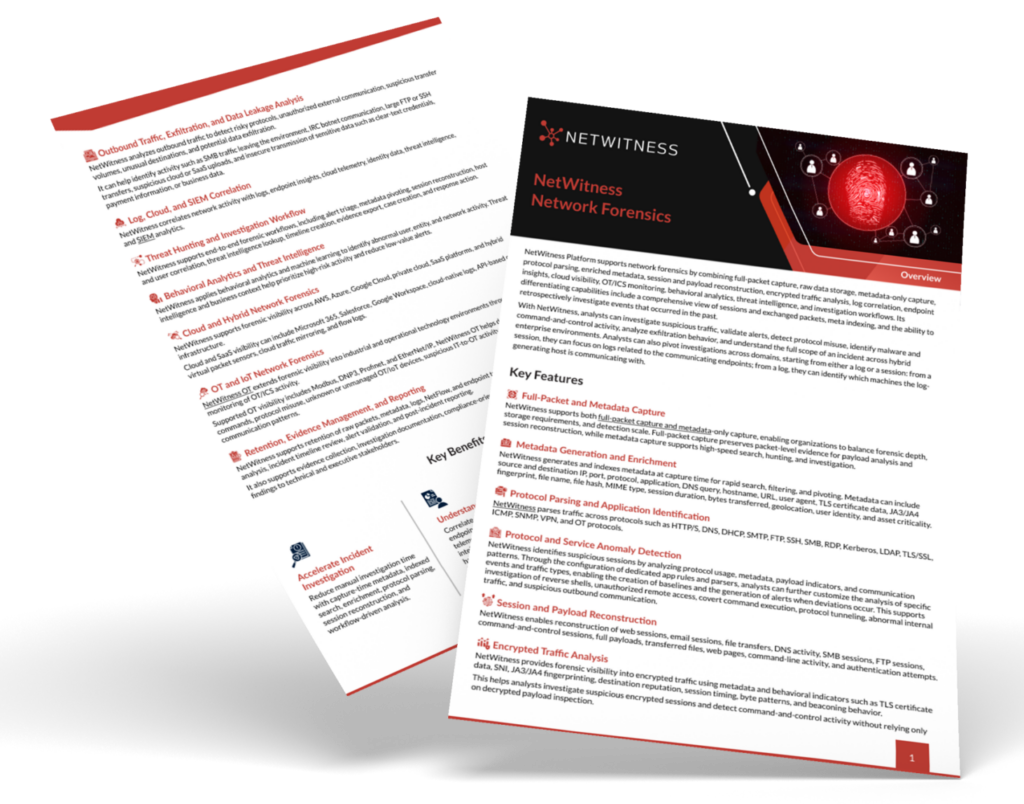
The Network Forensics feature set includes packet capture, metadata enhancement, protocol dissection, session reassembly, traffic analysis, and investigation workflow management.
This is significant because packet capture becomes meaningful only once one knows which traffic needs to be captured and correlated with other investigative activities.
A typical investigation might start with an authentication anomaly. The analyst identifies the affected user and endpoint through logs, reviews endpoint activity, examines associated network metadata, and then pivots into full packet capture for the relevant session.
Instead of manually rebuilding the timeline across several disconnected tools, the analyst can follow the evidence.
NetWitness supports this broader workflow by connecting network evidence with security telemetry, giving investigators a way to move from detection into deeper analysis.
Detection points to suspicious activity. Correlation connects the surrounding events. Packet evidence helps establish what happened.
Why Full Packet Capture and Log Correlation Work Together
Logs and packet data answer different questions.
A firewall log might confirm that a connection occurred. DNS records can show the domain involved. Endpoint telemetry can identify the process that initiated communication.
But investigators may still need to understand the communication itself.
Analysts can analyze the pertinent network sessions through full packet capture to conduct network forensics, protocol analysis, and session reconstruction. Depending on the traffic and available evidence, this can provide access to artifacts such as transferred files, email content, URLs, protocols, and other details that metadata alone may not preserve.
The recommendation of NIST on incorporating forensic practices in incident response has always stressed the requirement of using multiple sources of evidence that include operating systems, applications, files, and network traffic.
Consider a suspected credential compromise:
- The SIEM identifies unusual authentication activity.
- Log correlation links the account to an endpoint.
- Endpoint telemetry identifies a suspicious process.
- Network metadata shows outbound communication.
- Full packet capture provides deeper evidence from the relevant session.
- The analyst searches for related activities across the environment.
The important part is the pivot between those sources. Each pivot adds context while reducing the need to investigate an event in isolation.
Correlating Packets, Logs, and Endpoint Data
Full packet capture becomes more valuable when correlated with logs and endpoint telemetry. Logs provide user and event context, EDR shows host activity, network metadata identifies connections, and packet capture provides deeper communication evidence.
For example, an analyst can start with a suspicious SIEM alert, identify the affected user and endpoint, review EDR activity, locate related network sessions, and pivot into packet capture to examine the communication.
Analyst Investigation Workflow
- Start with the alert: Identify the suspicious authentication, process, network connection, or other event in the SIEM.
- Identify the affected entity: Determine the relevant user, host, IP address, application, and time window.
- Pivot to endpoint telemetry: Review EDR data to identify processes, command activity, files, or other host-level events associated with the alert.
- Pivot to network data: Search network metadata using the host, IP address, domain, protocol, and relevant timestamps.
- Retrieve packet evidence: Locate the corresponding packet capture and examine the relevant network session.
- Validate the activity: Compare packet evidence with SIEM and EDR findings to determine whether the activity is consistent with the suspected behavior.
- Pivot back across sources: Search for related users, hosts, destinations, processes, and events across the environment.
- Expand the hunt: Use the identified indicators and behavioral patterns to determine whether similar activity occurred elsewhere or during an earlier period.
The investigation becomes more effective when each data source provides a pivot into the next source rather than requiring analysts to investigate each console independently.
Where Full Packet Capture Adds the Most Value
Full packet capture is most useful when existing telemetry identifies suspicious activity but does not provide enough evidence to validate it or determine its scope.
Investigating lateral movement – Authentication logs can reveal connections between systems, but they may not explain the associated network activity.
Packet evidence can help investigators examine relevant sessions and identify additional hosts involved in the communication.
Validating suspicious outbound traffic – An unfamiliar destination is not automatically malicious.
The surrounding session can provide important context about what the system actually communicated and whether the behavior warrants further investigation.
Reconstructing attack activity – Attack evidence is often scattered across multiple systems.
Log correlation, endpoint telemetry, and full packet capture can help analysts piece together the sequence instead of investigating each event independently.
Hunting for related activity – Once an analyst identifies an indicator, destination, protocol, or behavior, historical network data can help determine whether the same pattern appears elsewhere.
That turns an isolated alert into a broader network threat hunting exercise.
14 Real Attacks. One Critical Lesson: Visibility Matters.
- See What Really Happened
- Reconstruct Attack Activity
- Uncover Hidden Threats
- Investigate with Packet-Level Evidence
Architecting Full Packet Capture in the Enterprise
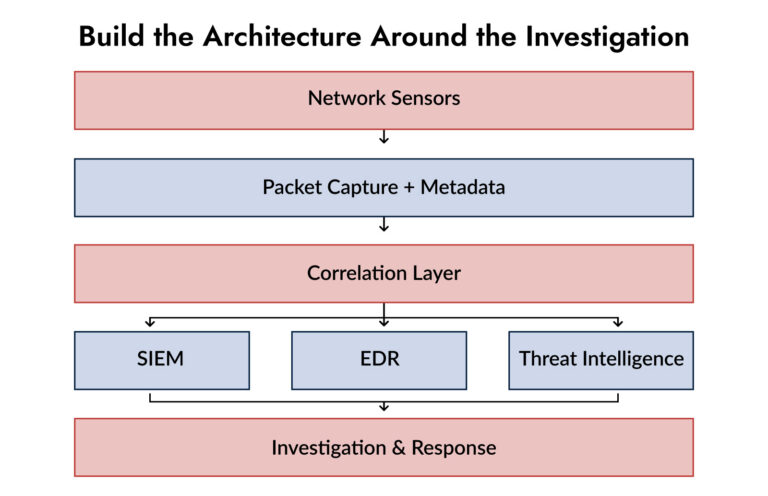
A practical full packet capture architecture is about more than storage. A practical architecture should also define how evidence moves between network sensors, packet capture, the SIEM or log store, and endpoint telemetry. The goal is not simply to collect packets, but to make those packets accessible as part of an investigation workflow.
It needs sensible sensor placement, useful metadata, appropriate retention, and clear paths between network evidence and the tools analysts already use.
1. Capture the traffic that matters
Sensors may need visibility into:
- North-south traffic
- Critical internal segments
- Data centers
- Cloud-connected infrastructure
- High-value applications
- Relevant IT and OT environments
- Third-Party and Supply Chain Links
- Remote Access & SASE Gateways
Capturing everything sounds straightforward until storage, retention, access, and investigation requirements enter the conversation.
2. Make packet data searchable
Metadata helps analysts narrow large traffic volumes to the sessions worth examining.
Useful search attributes include source and destination, protocol, port, domain, session characteristics, and application or file activity.
3. Set retention around investigation needs
Packet retention does not need to mirror log retention.
Define it around regulatory requirements, investigation timelines, critical assets, storage economics, threat models, and how far back analysts may realistically need to investigate.
Full Packet Capture vs. Logs
| Investigation Need | Logs | Full Packet Capture |
| Authentication history | Strong | Limited |
| System and application events | Strong | Limited |
| Network session discovery | Useful | Strong |
| Protocol-level investigation | Limited | Strong |
| Session reconstruction | Limited | Strong |
| Historical correlation | Strong | Strong when retained |
| Evidence validation | Context-dependent | Strong forensic context |
This is not a choice between two competing data sources.
Logs provide valuable identity, system, and event context. Packet data provides another layer of network evidence when an investigation needs to go deeper.
The real advantage comes from being able to move between them.
Implementing Full Packet Capture and Log Correlation
Before expanding a full packet capture strategy, security teams should validate the operational details that determine whether the data will actually help investigators.
- Synchronize time across NDR, SIEM, and EDR.
- Define packets and log retention separately.
- Identify high-value network segments.
- Establish common host, user, IP, and timestamp identifiers.
- Document workflows for pivoting from alerts to packet evidence.
- Test packet retrieval during realistic investigations.
- Validate storage against expected traffic volumes.
- Define requirements for investigating encrypted traffic.
- Restrict access to sensitive, captured data.
- Measure investigation time before and after implementation.
- Train analysts on cross-domain investigation workflows.
The last point is easy to overlook.
A security team can have excellent visibility and still run slow investigations if analysts have to manually reconstruct the same story across separate consoles.
Why NetWitness Matters for Evidence-Driven Threat Hunting
For enterprises that need deeper network visibility, NetWitness brings packet capture, network metadata, analytics, and forensic investigation into a broader threat detection and response workflow. This gives analysts multiple ways to approach an investigation, whether they are starting with a suspicious event, searching related network metadata, retrieving packet-level evidence, reconstructing relevant sessions, or correlating findings with logs and endpoint activity. This broader visibility can help close gaps left by endpoint and log-based monitoring, including investigations involving unmanaged devices.
This approach is particularly useful when an investigation begins after the original activity has already occurred. Analysts do not have to rely solely on what an alert happened to record at the time. Instead, they can use available network evidence to investigate activity retrospectively and identify related behavior. Where the relevant packets were captured and retained, analysts can investigate the underlying evidence, including, depending on the traffic, actual files or message content, rather than reconstructing the event from metadata alone.
NetWitness describes its Network Forensics capabilities as supporting:
- Packet capture
- Metadata enrichment
- Protocol parsing
- Session reconstruction
- Encrypted traffic analysis
- Investigation workflows
Together, these capabilities support a more evidence-driven approach to enterprise threat hunting:
- Find the signal
- Follow the trail
- Examine the evidence
- Expand the hunt
Use Full Packet Capture to Investigate Threats
Collecting more telemetry does not automatically make a security operation better.
What matters is whether analysts can use that telemetry to answer the questions that arise during an investigation.
Full packet capture provides deeper network evidence. Log correlation connects that evidence to users, systems, and events. Endpoint telemetry adds visibility into activity on the affected host.
When those sources can be investigated together, analysts have a clearer path from an initial alert to evidence, scope, and response.
That is the difference between having network data and being able to investigate it.
Explore how NetWitness Network Forensics can help connect packet-level evidence with the broader investigation workflow and support evidence-backed threat hunting.
Frequently Asked Questions
1. Why combine full packet capture with log correlation?
Full packet capture provides deeper network evidence, while log correlation adds identity, system, and event context. Using both can help investigators validate suspicious activity and understand how separate events relate to one another.
2. How does full packet capture improve threat hunting?
It allows analysts to examine historical network activity after suspicious behavior has been identified. Combined with metadata, logs, and endpoint telemetry, packet data can help validate findings, reconstruct activity, and expand a hunt.
3. What threats can packet capture and log correlation help investigate?
They can support investigations involving lateral movement, suspicious outbound communications, credential misuse, malware activity, command-and-control behavior, and other attacks that leave evidence across multiple systems.
4. What are the benefits of combining packet capture and logs?
Logs provide context around users, systems, and events. Packet capture provides deeper visibility into network communications. Correlating the two gives investigators more evidence to work with when validating and scoping suspicious activity.
5. How does full packet capture uncover hidden threats?
Captured network activity can be examined after an event, including activity that did not trigger an alert at the time. Combined with cybersecurity analytics and historical data, it can support broader network threat hunting.
6. How does log correlation improve threat detection accuracy?
Log correlation connects related events across security systems, helping analysts distinguish isolated anomalies from broader patterns. When combined with packet and endpoint evidence, it gives investigators more context for validating suspicious behavior.
See Every Packet. Understand Every Threat.
- Capture Network Traffic
- Reconstruct Attacker Sessions
- Uncover Hidden Threats
- Accelerate Investigations