How do SOC teams detect lateral movement?
Detect lateral movement by correlating authentication, endpoint, network, and cloud activity around the same user, host, and time window. The hard cases involve valid credentials and legitimate administration tools, so an isolated alert rarely tells the full story. A workable playbook starts with the first unusual connection, traces subsequent pivots, validates the identity behind each session, and preserves evidence for investigation. Full-packet visibility becomes especially useful when metadata tells you that a connection happened but not what actually moved across it.
Lateral Movement Starts Where the First Alert Ends
A lateral movement alert rarely arrives with a neat beginning and ending.
An endpoint may report suspicious credential access. An identity system may show an unusual authentication. A firewall may record an internal connection. A SIEM may flag an account accessing a server it rarely touches. Each event can look defensible on its own.
The investigation changes when those events are connected.
That is the central problem a lateral movement detection playbook needs to solve. The objective is not simply to detect one suspicious connection. It is to establish whether an attacker is using one compromised system, identity, or application as a launch point to reach another asset.
Modern attacks make this harder because attackers frequently use credentials and administrative tooling already present in the environment. Microsoft documents lateral movement involving legitimate credentials and native network or operating-system tools specifically because those techniques can blend into normal activity.
The SOC therefore needs to ask a more useful question: What changed in the relationship between this identity, this host, and the systems it is now accessing?
That question should drive the investigation.
What a Lateral Movement Detection Playbook Should Track
A useful playbook follows the movement of the attacker, not just the individual alerts generated along the way.
Start with four dimensions:
| Dimension | What to investigate |
| Identity | Account, privilege level, authentication method, source location, unusual access |
| Endpoint | Process execution, remote services, credential access, administrative activity |
| Network | Source-to-destination relationships, protocols, session timing, internal scanning |
| Asset context | Server role, business criticality, IT/OT classification, normal communication patterns |
Then establish the sequence.
For example:
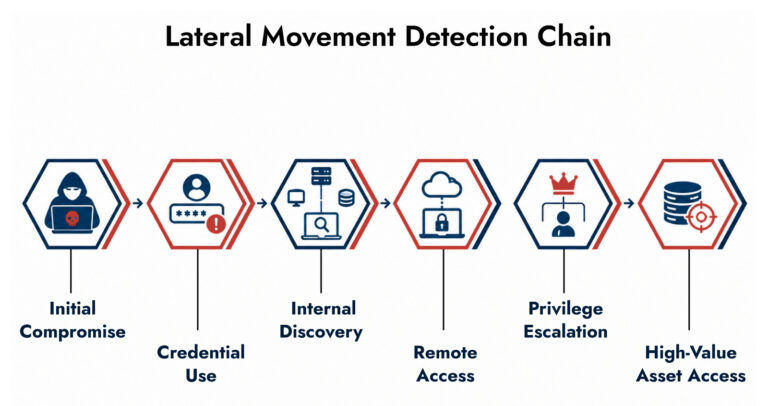
- A workstation authenticates to a file server outside its normal pattern.
- The same account subsequently authenticates to an administrative server.
- The workstation initiates additional SMB or remote-management sessions.
- A privileged account appears from the same source.
- Network activity then connects that host to a higher-value system.
No single event proves lateral movement. The sequence changes the investigation.
Detect Attacker Pivots Beyond Authentication Events
Authentication telemetry matters, but authentication by itself is weak evidence.
Enterprise environments generate legitimate administrative activity continuously. Help-desk staff connect to endpoints. Infrastructure teams manage servers. Service accounts authenticate across multiple systems. Backup systems create predictable bursts of traffic.
Telltale signal | What it can indicate |
Unusual source host | An identity is being used from a system it does not normally access |
New host-to-host connection | A new relationship may indicate an attacker pivot |
Remote access after credential activity | Credentials may be enabling lateral movement |
Privileged account on a new endpoint | Possible credential abuse or privilege escalation |
Internal scanning followed by authentication | Discovery followed by an attempted pivot |
IT-to-OT connection | Movement across a higher-risk trust boundary |
Use this detection logic:
- A user authenticating from an unusual host
- A workstation initiating administrative connections to multiple servers
- A privileged account appearing on a previously unrelated endpoint
- Remote service activity following credential-access behavior
- Internal scanning followed by successful authentication
- A new source-to-destination relationship involving a sensitive asset
- Multiple systems being accessed within an unusually compressed time window
This turns lateral movement detection from an isolated alerting exercise into a repeatable investigation workflow.
The detection problem starts when a legitimate-looking authentication breaks the environment’s normal pattern. The SOC therefore needs context around the session including the source host, destination, timing, privilege level, and subsequent network activity, to determine whether valid credentials are enabling an attacker pivot.
This is where lateral movement monitoring becomes more than watching authentication logs. The SOC needs enough context to understand whether the connection belongs to the environment’s normal operating pattern.
Microsoft’s 2024 Digital Defense Report found that 40% of identified attack paths included lateral movement based on non-interactive remote code execution. It also reported that 90% of organizations had exposure to at least one attack path in its analysis.
That matters operationally because attackers do not need to compromise every system independently. One foothold can become a route into several others.
Detect Behavioral Anomalies
A common mistake in lateral movement detection is building detections around known attacker tools.
Tool-based detections still have value. They should not become the entire playbook.
An attacker using PsExec is interesting. An attacker accomplishing the same objective through an existing administrative mechanism can be harder to distinguish from legitimate activity.
The stronger detection question is: What is this identity or host doing that it normally does not do?
That means combining:
- Authentication anomalies
- Remote execution activity
- Internal network connections
- Privilege changes
- Host-to-host communication patterns
- Process and endpoint telemetry
- Asset criticality
- Historical behavior
This approach also makes lateral movement prevention more practical. Once the SOC can identify the relationship that should not exist, security teams can apply segmentation, privilege controls, access restrictions, or credential remediation against the actual path.
14 Real Attacks. One Critical Lesson: Visibility Matters.
- See What Really Happened
- Reconstruct Attack Activity
- Uncover Hidden Threats
- Investigate with Packet-Level Evidence
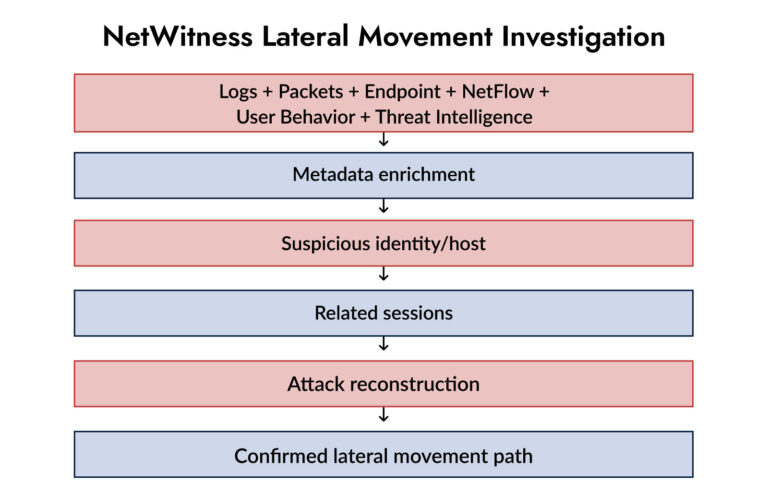
How NetWitness Supports Lateral Movement Investigation
This is where architecture matters.
NetWitness SIEM ingests logs from more than 350 sources, including AWS, Azure, Office 365, and Salesforce, and dynamically parses and enriches data at capture time. That gives analysts a common context for investigating activity across hybrid environments.
But lateral movement investigations often reach a point where logs are not enough.
You may know that Host A is connected to Host B. You may know which account is authenticated. You may know when the session occurred. The next question is often the one that determines whether the investigation moves forward: What actually happened during that session?
NetWitness extends the investigation beyond log records by bringing network data, packets, endpoint telemetry, NetFlow, user behavior, and threat intelligence into the same investigation architecture. Its platform is designed around network visibility and attack reconstruction, while SIEM provides enriched log data and analytics in the same environment.
For a lateral movement detection playbook, three capabilities are particularly important:
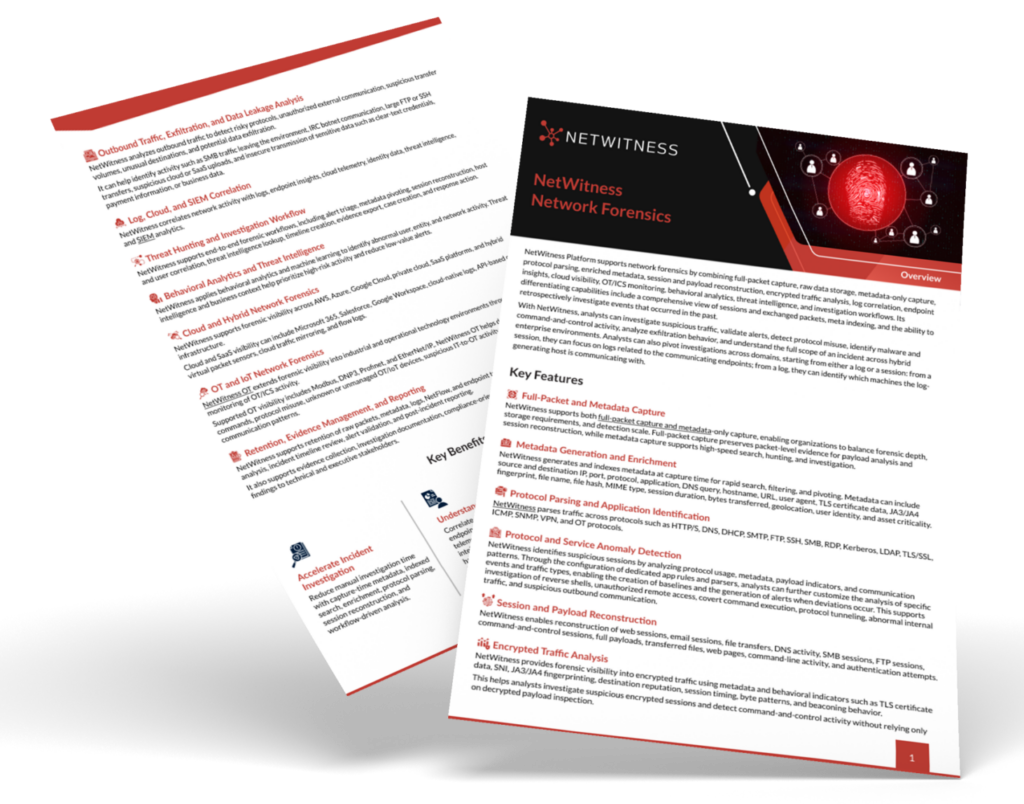
- Full-packet capture – Metadata can establish that communication occurred. Full packets can provide the evidence needed to understand the session itself. That distinction becomes important when an analyst needs to validate suspicious internal communications, investigate an unfamiliar protocol exchange, or reconstruct what happened after an alert.
- Attack reconstruction – Lateral movement rarely makes sense as a collection of disconnected events. Reconstruction allows analysts to work backward and forward through related activity instead of opening separate investigations for every alert. The goal is to establish the attack path and identify where the attacker changed direction.
- Metadata enrichment – NetWitness enriches data during capture, creating sessionized metadata that analysts can use for detection and investigation. That matters when the SOC is working through large volumes of traffic and log data. Analysts can begin with searchable metadata, then move toward deeper evidence when the investigation requires it.
The result is a practical workflow: Detect with context → pivot across related telemetry → reconstruct the session → establish the attack path → contain the compromised identity or host.
That is a very different workflow from treating SIEM as a log archive.
How Do You Detect Lateral Movement Across IT and OT?
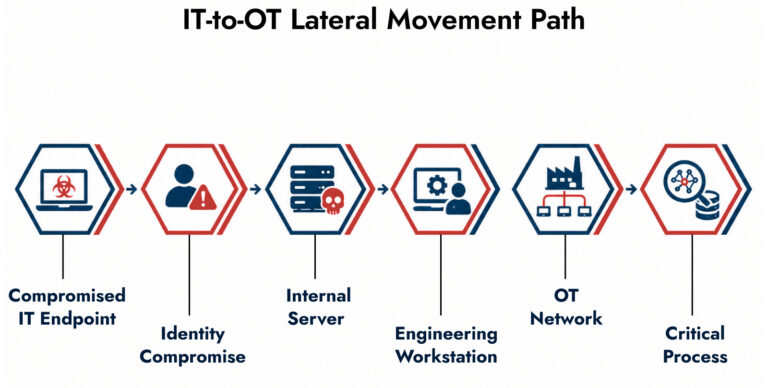
A lateral movement path does not necessarily stop at the corporate network.
In converged environments, an attacker may move from IT infrastructure toward operational systems. That makes asset context particularly important. A connection to another workstation and a connection toward an OT system cannot carry the same investigative weight.
NetWitness supports visibility across IT and OT environments, including integration with DeepInspect for OT traffic analysis. NetWitness describes native correlation across IT and OT telemetry so analysts can investigate activity across those domains rather than reconciling separate security views.
For SOC teams, the key is knowing when a lateral movement path crosses from corporate IT into an OT environment or another critical trust boundary.
How Should SOC Teams Investigate Suspected Lateral Movement?
A mature lateral movement detection playbook should give analysts clear actions after the first suspicious signal.
- Identify the initiating entity: Determine the source host, account, process, and first suspicious connection.
- Establish the baseline: Check whether the identity normally accesses the destination and whether the source host normally communicates with it.
- Trace the next pivots: Search for additional destinations, authentication events, remote services, and related network sessions.
- Validate the evidence: Move from metadata into packets, endpoint activity, or reconstructed sessions when the alert requires confirmation.
- Determine the objective: Ask what the attacker appears to be reaching. A domain controller, backup server, database, security infrastructure, or OT system changes the urgency of the investigation.
- Contain the path: Contain the compromised account, endpoint, or communication route based on the evidence. Avoid destroying evidence before the SOC has captured what it needs for reconstruction.
- Hunt backward: Find the first compromised identity or host. The visible lateral movement event may be several steps removed from initial access.
Two Metrics That Tell You Whether the Playbook Works
A SOC should measure more than the number of lateral movement alerts generated.
1. Time from first suspicious pivot to confirmed attack path
This shows whether analysts can connect fragmented telemetry quickly.
2. Percentage of lateral movement investigations with sufficient evidence for reconstruction
A detection that identifies a suspicious connection but leaves the analyst without supporting evidence creates investigative friction.
The objective is not maximum alert volume. It is enough context to make the next analyst action obvious.
Why Evidence Matters in Lateral Movement Detection
Lateral movement detection fails when the SOC can identify suspicious behavior but cannot explain what happened next.
The practical requirement is therefore bigger than another detection rule. Analysts need enough network visibility, identity context, endpoint evidence, and historical data to establish whether a suspicious connection represents ordinary administration or an attacker moving toward something valuable.
That is the role of architecture in threat hunting.
NetWitness combines SIEM telemetry with network and packet-level evidence, metadata enrichment, endpoint and behavioral context, and attack reconstruction. For enterprise SOC teams investigating lateral movement, that combination turns an isolated alert into an investigation path they can actually follow.
Frequently Asked Questions
1. How do I detect lateral movement in my environment?
Correlate identity, endpoint, network, and asset-context signals. Look for unusual host-to-host relationships, remote administration, privileged authentication, internal scanning, and changes in normal communication patterns. Then validate the sequence using deeper network or endpoint evidence.
2. How do I get full visibility across IT and OT to detect lateral movement fast?
You need telemetry that crosses the IT/OT boundary rather than separate monitoring silos. NetWitness supports IT and OT visibility and correlation, including integration with DeepInspect for OT traffic.
3. How do I investigate lateral movement across network, endpoint, and cloud in one place?
Use a platform that correlates telemetry across those domains. NetWitness SIEM brings logs together with network, endpoint, NetFlow, behavior, and threat intelligence data, allowing analysts to pivot through related evidence during investigation.
4. Can lateral movement be detected when attackers use legitimate credentials?
Yes, but credential validity alone cannot establish malicious intent. Detection needs behavioral context, including the source host, destination, timing, privilege, historical access patterns, and associated network activity. Microsoft specifically notes that attackers can use legitimate credentials and native tools for stealthier lateral movement.
5. How should SOC teams investigate suspected lateral movement?
Start with the first unusual identity or host relationship, establish what changed from baseline, trace subsequent pivots, and validate the attack path with supporting evidence. Preserve packet and endpoint evidence before containment actions remove the ability to reconstruct the sequence.
See Every Packet. Understand Every Threat.
- Capture Network Traffic
- Reconstruct Attacker Sessions
- Uncover Hidden Threats
- Accelerate Investigations