What is forensic evidence in cybersecurity?
Forensic evidence is the data security teams use to investigate and reconstruct a cyber incident. It can include network packets, metadata, logs, endpoint activity, sessions, files, user activity and other digital records. In network forensics, this evidence helps analysts validate threats, trace attacker activity, determine incident scope and support incident response.
Introduction
A detection can tell an analyst that something deserves attention. The harder part is working out what happened around it.
Was the traffic part of a malware infection? Did the same host communicate with suspicious infrastructure before the alert? Were other users or systems involved? Did data leave the environment? And how far back does the activity go?
Answering those questions requires access to the evidence behind the detection. Network sessions, packets, metadata, logs, endpoint activity and user context can each reveal a different part of an incident.
NetWitness centralizes them all enabling analysts to investigate from the point of detection. Its network forensic threat detection module encompasses the full-packet capture, metadata, protocol parsing, session and payload reconstruction, and encrypted traffic analysis and retrospective investigation. Log and endpoint activity can also be correlated with activity from the network, cloud telemetry, identity data, threat intelligence. This leads to a faster route from discovery of suspicious activity to the understanding of what occurred and the immediate action that needs to be taken.
How NetWitness Combines Threat Detection and Forensic Evidence for Faster Investigations
NetWitness starts with the traffic and data generated across the environment and turns it into evidence that analysts can search, connect and investigate.
Full-packet capture gives investigators the original traffic
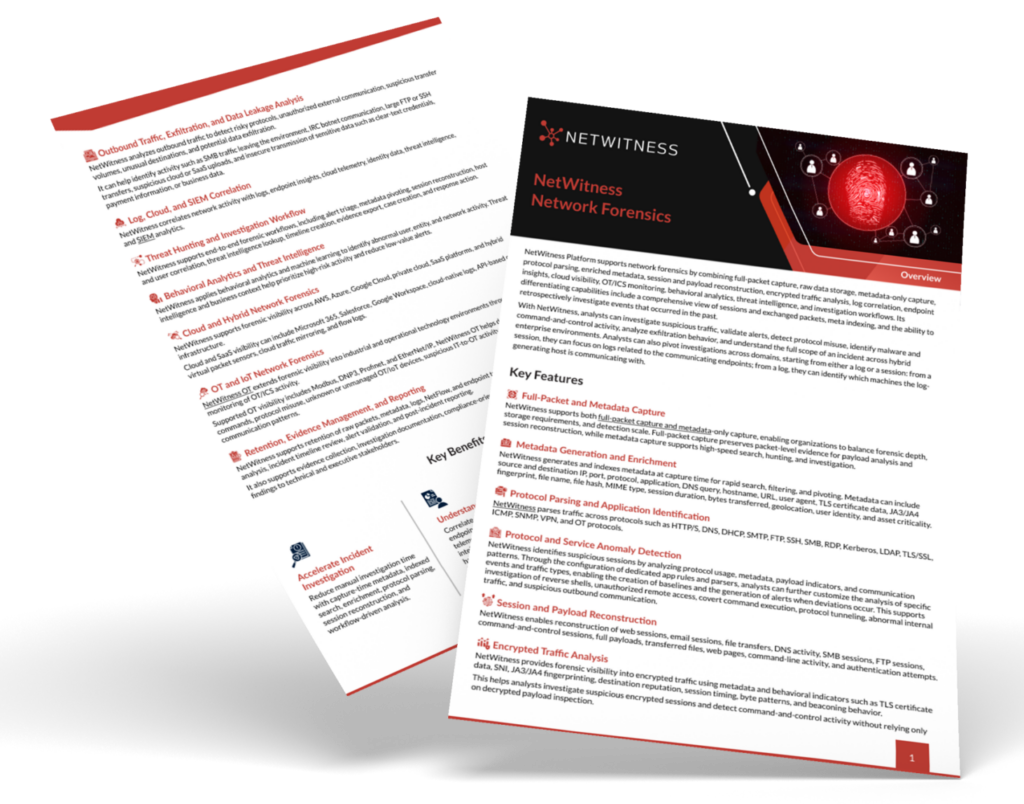
NetWitness supports both full-packet capture and metadata-only capture. Full-packet capture preserves packet-level evidence for payload analysis and session reconstruction. Metadata capture provides a faster way to search and investigate large volumes of activity.
This gives analysts a choice depending on the investigation. They can search metadata to find relevant sessions and then examine packet-level evidence when they need a deeper look.
For incident response teams, retaining this evidence also matters after the initial detection. Raw packets, metadata, logs, NetFlow and endpoint telemetry can be retained for historical analysis and post-incident investigation.
Metadata makes network activity searchable
NetWitness generates and indexes metadata at capture time. The information can include source and destination IP addresses, ports, protocols, applications, DNS queries, hostnames, URLs, user agents, TLS certificate data, JA3/JA4 fingerprints, file names and hashes, MIME types, session duration, bytes transferred, geolocation, user identity and asset criticality.
An analyst investigating a suspicious connection can use this information to find related sessions, identify communicating hosts or trace activity associated with a user, file or destination.
This is an important part of network forensics analysis. Analysts can start with a specific detection and quickly narrow the investigation to the traffic that matters.
Protocol parsing adds context to suspicious traffic
A connection by itself does not always explain whether something malicious is taking place. Protocol information can provide that context.
NetWitness parses protocols including HTTP/S, DNS, DHCP, SMTP, FTP, SSH, SMB, RDP, Kerberos, LDAP, TLS/SSL, ICMP, SNMP and VPN, along with OT protocols.
Its protocol and service anomaly detection examines protocol usage, metadata, payload indicators and communication patterns. Analysts can also configure application rules and parsers for specific events and traffic types, create baselines and identify deviations.
This supports investigations into reverse shells, unauthorised remote access, covert command execution, protocol tunnelling, abnormal internal traffic and suspicious outbound communication.
Session reconstruction shows what happened
Once analysts identify a suspicious session, they may need to examine the activity inside it.
NetWitness can reconstruct web sessions, email sessions, file transfers, DNS activity, SMB and FTP sessions, command-and-control sessions, transferred files, web pages, command-line activity and authentication attempts.
That gives an investigation a more detailed view of the event. Analysts can examine the session, inspect available payload information and connect the activity to other evidence.
For forensic threat detection investigations, this can be the point where an unusual connection becomes a clearer sequence of events.
Encrypted traffic still provides useful evidence
Encrypted communications can limit what analysts see in a payload. NetWitness uses other characteristics of the traffic to investigate suspicious encrypted sessions.
These include TLS certificate data, SNI, JA3/JA4 fingerprints, destination reputation, session timing, byte patterns and beaconing behaviour.
This information can help identify suspicious encrypted communications and command-and-control activity without relying only on decrypted payload inspection. It gives analysts another way to investigate encrypted malware traffic while maintaining network visibility.
Outbound traffic can reveal exfiltration
The investigation also needs to account for what is leaving the environment.
NetWitness analyses outbound traffic for risky protocols, unauthorised external communication, unusual destinations, suspicious transfer volumes and potential data exfiltration. This can help analysts investigate large FTP or SSH transfers, SMB traffic leaving the environment, IRC botnet communication and suspicious uploads to cloud or SaaS services.
It can also help identify insecure transmission of sensitive information, including clear-text credentials, payment information and business data.
By looking at the destination, protocol, volume and communication pattern, analysts can investigate whether outbound activity points to data leakage or a wider compromise.
Network evidence can be connected to other data
A network session is often one part of a larger investigation. NetWitness correlates network activity with logs, endpoint insights, cloud telemetry, identity data, threat intelligence and SIEM analytics.
The investigation can move in either direction. From a session, analysts can examine logs related to the communicating endpoints. From a log, they can identify the machines communicating with the host that generated it.
This approach extends network visibility across hybrid environments. NetWitness supports visibility across AWS, Azure, Google Cloud, private cloud and SaaS platforms, with sources such as cloud-native logs, API-based collection, virtual packet sensors, traffic mirroring and flow logs.
For industrial environments, NetWitness OT provides passive monitoring of OT/ICS activity, including Modbus, DNP3, Profinet and EtherNet/IP. Analysts can investigate unusual OT commands, protocol misuse, unmanaged devices and suspicious IT-to-OT activity.
Retrospective investigation fills in the timeline
A detection tells an analyst when suspicious activity was identified. It may not tell them when the activity started.
NetWitness supports retrospective investigation using retained packets, metadata, logs, NetFlow and endpoint telemetry. Analysts can search historical activity to see whether a suspicious destination was contacted earlier, whether other machines were involved or whether similar behaviour appeared elsewhere.
This can change the scope of an investigation considerably. An event that initially looks isolated may turn out to be part of a longer sequence of activity.
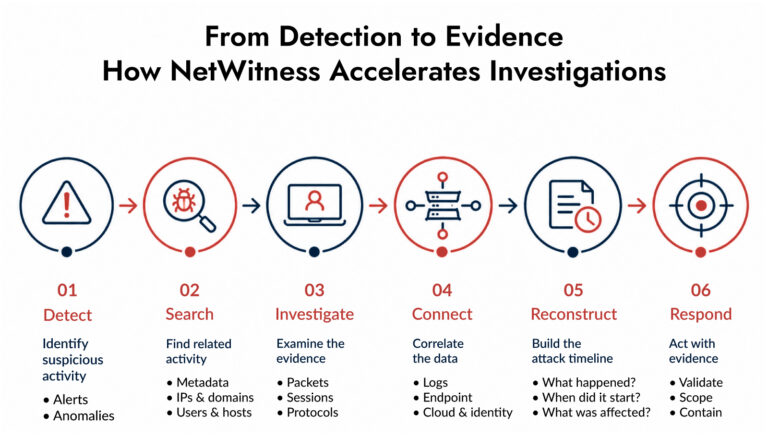
NetWitness also supports investigation workflows covering alert triage, metadata pivoting, session reconstruction, host and user correlation, threat intelligence lookup, timeline creation, evidence export, case creation and response action.
Benefits of Combining Threat Detection and Forensic Evidence
The value of combining these capabilities shows up in the investigation itself.
Faster alert validation – Analysts can examine the packets, metadata, sessions, users, hosts, protocols and destinations associated with a detection. That provides evidence for deciding whether the activity is malicious or requires further investigation.
Less manual investigation – Capture-time metadata, indexed search, enrichment and investigation pivots reduce the work involved in finding related evidence across separate sources.
Better incident scoping – Correlating network activity with logs, endpoint insights, identity, cloud telemetry and threat intelligence helps analysts determine which systems and users may be involved.
More precise threat hunting – Rich metadata, protocol parsing, behavioural analytics and threat intelligence give analysts more context when searching for suspicious behaviour.
Fewer blind spots – Network forensics can extend across on-premises infrastructure, cloud, SaaS, endpoint and OT/ICS environments, giving investigators more places to look when an incident crosses boundaries.
Stronger incident response – Retained packets, metadata, logs, NetFlow and endpoint telemetry provide evidence for investigation, timeline review, reporting, compliance and post-incident analysis.
NetWitness Solutions Supporting the Investigation
NetWitness brings these capabilities together across its product portfolio.
NetWitness Network provides the core network forensics capabilities, including packet and metadata capture, protocol parsing, enrichment, session reconstruction, payload reconstruction, encrypted traffic analysis and threat hunting.
NetWitness Platform provides the broader investigation foundation across network traffic, logs, NetFlow, endpoint insights, cloud, OT/ICS, threat intelligence, analytics and orchestration.
NetWitness SIEM provides log collection, parsing, enrichment, indexing, retention and reporting, allowing network activity to be investigated alongside firewalls, proxies, DNS, VPN, identity systems, servers, cloud platforms and other security data.
NetWitness OT extends forensic visibility into industrial environments through passive OT/ICS monitoring and IT/OT correlation.
Conclusion
Threat detection starts an investigation. Forensic threat detection evidence gives analysts the detail needed to take it further.
NetWitness connects the two through full-packet capture, enriched metadata, protocol analysis, session and payload reconstruction, encrypted traffic analysis and retrospective investigation. Analysts can then correlate that network evidence with logs, endpoint insights, cloud telemetry, identity data and threat intelligence.
That gives security teams a clearer way to validate detections, reconstruct activity, investigate what happened before an alert and determine the scope of an incident.
For organisations looking to strengthen forensic threat detection and response, the combination of network visibility and network forensics tools can reduce investigation time while giving analysts stronger evidence for incident response.
Frequently Asked Questions
1. What are the key phases of a digital forensic investigation?
The key phases include identifying, collecting and preserving evidence, analysing data, reconstructing events, determining incident scope and documenting findings. Network forensics analysis can examine packets, sessions, logs and network activity throughout the investigation.
2. What are the top companies offering forensic threat detection services?
Leading providers include NetWitness, Palo Alto Networks, CrowdStrike, Cisco, IBM, Trellix, Netscout and ExtraHop..
3. How to choose a forensic threat detection solution for enterprises?
Look for strong network visibility, full packet capture, metadata analysis, session reconstruction, retrospective investigation and integration with existing network forensics tools and threat detection workflows.
4. Why should threat detection and forensic evidence work together?
Threat detection identifies suspicious activity, while forensic evidence helps analysts understand and validate it. Together, they enable faster investigation, incident scoping and threat detection and response.
5. How forensic threat detection helps in cybersecurity incident response?
Forensic threat detection provides evidence to validate alerts, reconstruct attacks, identify affected systems and investigate potential data exfiltration, helping teams respond faster.
6. How does forensic evidence make security investigations faster?
Forensic evidence gives analysts immediate access to packets, metadata, sessions and related activity. This reduces manual investigation and enables faster network forensics analysis, retrospective investigation and incident response.
Need enterprise-grade network visibility?
See how NetWitness combines network detection, analytics and forensic investigation.