How does NetWitness improve network threat detection and investigation?
NetWitness combines network traffic visibility, full-packet capture, metadata, behavioural analytics, and threat intelligence to identify suspicious activity across the network. Once a threat is detected, analysts can investigate the underlying sessions and packet data, trace related activity, and establish the scope of an incident. This connects network detection and response (NDR), network traffic analysis, threat hunting, and network forensics within one investigation workflow.
Introduction
Security teams rarely struggle because they have too little data. The harder problem is finding the evidence that explains an attack. IBM’s 2025 Cost of a Data Breach Report found that 70% of organizations experienced significant or very significant disruption to their operations following a breach.
An endpoint alert may show suspicious activity on a device. A SIEM may connect authentication events. A firewall may flag a connection. But when an attacker moves between systems, uses legitimate credentials, or communicates through encrypted traffic, those individual signals may leave important gaps.
Network traffic visibility can fill those gaps. The network shows how systems communicate, when that communication changes, and what happens around a suspicious event. But collecting more traffic does not automatically improve security. The real value comes from turning that traffic into detections analysts can trust and evidence they can investigate.
That is what NetWitness is designed to do. Its Network Detection and Response (NDR) capabilities that include network traffic capture, metadata, behavioural analytics, threat intelligence, and network forensics. The same network data can also be used to provide security teams with information to help them determine suspicious activity, investigate an alert, look for related activity, and create the scope of an incident reconstruction.
The question is not simply whether a platform provides network traffic visibility. It is whether that visibility helps the security team detect threats faster, investigate with better evidence, and make informed response decisions.
How NetWitness Provides Full Network Traffic Visibility
Effective network monitoring starts with knowing what is actually happening across the environment.
NetWitness collects network traffic and produces metadata from traffic activity, providing the analyst with a searchable perspective on communications throughout the environment. It’s supported by NDR for visibility across on-premises, cloud and virtual environments. When analysts have to study the communications that underlie the packet, full-packet capture offers a different level of detail.
This distinction matters when evaluating network security monitoring tools.
A solution that provides only summarized information may help identify that a connection occurred. It may not provide enough evidence to determine what happened during that connection.
NetWitness combines metadata with packet-level visibility so analysts can start with a broad view and go deeper when an investigation requires it.
That supports questions such as:
- Which devices communicated?
- Which applications or protocols were involved?
- Which external destinations did a host contact?
- Did similar activity occur elsewhere?
- What happened before or after the suspicious event?
- What data moved during the session?
For a security leader, the benefit is straightforward: network visibility becomes usable investigative data rather than another isolated monitoring feed.
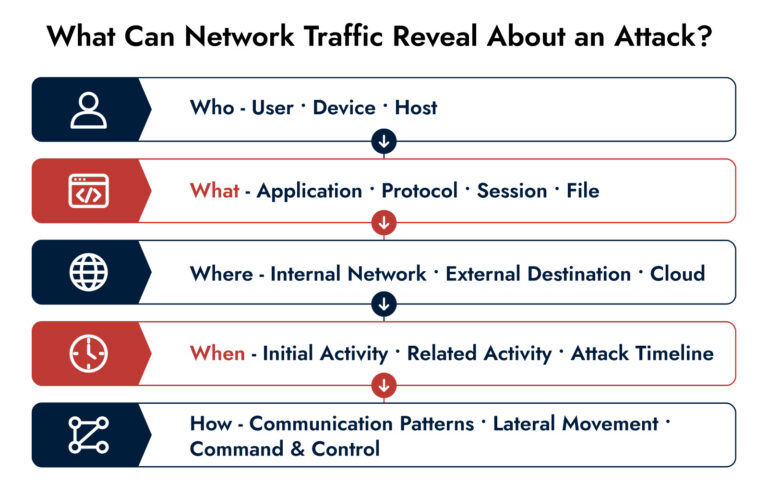
How NetWitness Turns Network Traffic into Threat Detection
Visibility provides the data. Detection determines what deserves attention.
Network traffic analysis looks for suspicious patterns, anomalies, indicators, and behaviours within network activity. NetWitness combines this analysis with behavioral analytics and threat intelligence to identify activity that may indicate a compromise.
This approach matters because not every attack produces a recognizable signature.
An attacker might use valid credentials, common administrative tools, or newly created infrastructure. They may also deliberately keep activity low and slow to avoid triggering conventional controls.
Behavioural analysis gives security teams another way to identify potential threats.
For example, a device that normally communicates with a limited set of internal services might suddenly establish connections with unfamiliar destinations. A server might begin communicating with infrastructure it has never contacted before. Several hosts might show similar patterns that point to coordinated activity.
These changes provide context for network threat detection.
NetWitness uses the network data it collects to identify suspicious behavior and help analysts determine which activity requires investigation. The result is a detection process based not only on known indicators, but also on what looks abnormal within the environment.
Need enterprise-grade network visibility?
See how NetWitness combines network detection, analytics and forensic investigation.
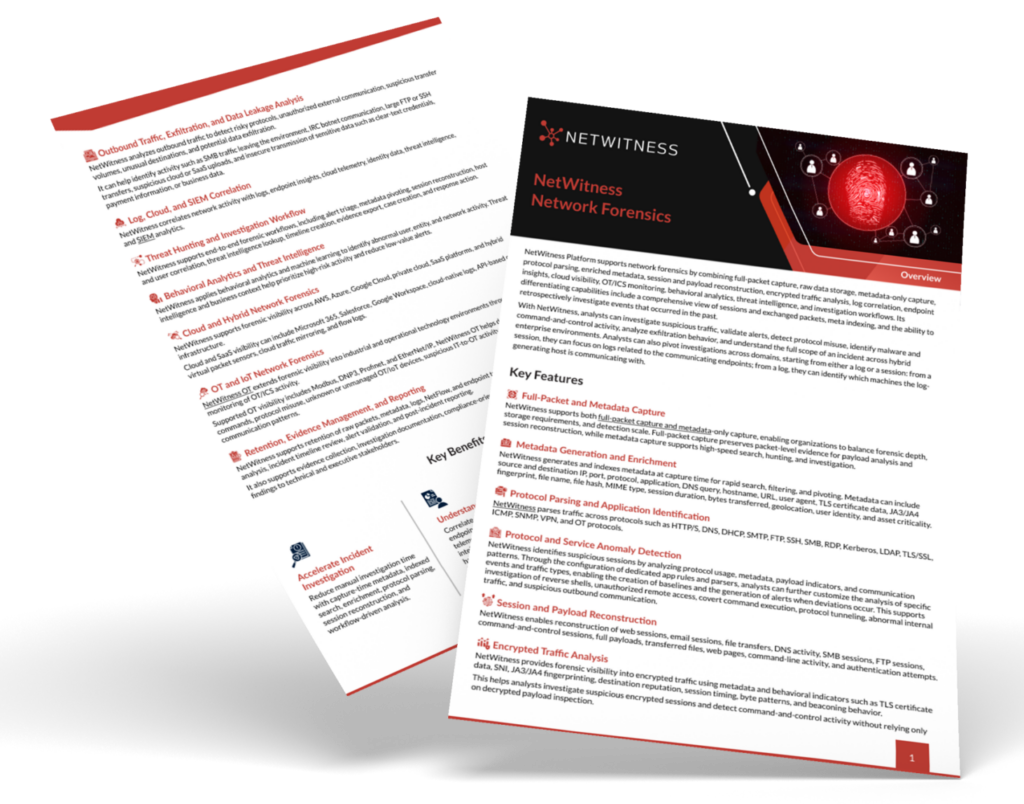
How NetWitness Moves from Detection to Investigation
Finding a suspicious event is only the beginning.
The next question is usually more difficult: What actually happened?
NetWitness connects detection with investigation by giving analysts access to the network evidence behind suspicious activity. They can pivot from a detection into associated network sessions, metadata, and packet data to examine the communication in greater detail.
This supports a practical investigation workflow:
Detection → host → session → related activity → timeline → scope
Suppose NetWitness identifies suspicious communication between an internal system and an external destination.
An analyst can investigate the host, examine its network sessions, identify other destinations it contacted, and look for related activity involving other systems. If the investigation requires deeper analysis, packet-level evidence can provide additional context.
This approach can help answer questions that an alert alone cannot:
- Was the activity actually malicious?
- Which system initiated the communication?
- Did the attacker interact with other systems?
- Was there lateral movement?
- Did the activity involve file or data transfers?
- When did the compromise begin?
- How far did it spread?
For decision-makers, this is an important distinction. A detection platform creates value when it reduces the work required to establish whether an alert represents a real threat and what the organization needs to do next.
How NetWitness Supports Threat Hunting and Network Forensics
Not every threat generates an alert at the right time.That is why threat hunting requires access to historical network activity and the ability to search it effectively.
A threat hunter might start with a suspicious IP address, domain, hostname, protocol, or behaviour and search across network data for related activity. From there, the analyst can identify other systems, sessions, and communications connected to the original finding.
NetWitness supports this approach through searchable network data, behavioural analytics, threat intelligence, and forensic capabilities.
The same data also supports network forensics.
Full-packet capture and session reconstruction allow analysts to investigate network communications in greater detail. Instead of relying solely on an alert or summarized metadata, investigators can examine the underlying traffic to build a clearer picture of an incident.
This becomes particularly valuable when investigating:
- Command-and-control activity
- Lateral movement
- Malware communications
- Suspicious file transfers
- Data exfiltration
- Internal reconnaissance
- Compromised systems
The advantage is continuity. The data used to detect suspicious activity can also support the investigation that follows.
How NetWitness Fits into the Wider Security Stack
Network data rarely exists in isolation. A modern SOC may already use EDR for endpoint activity, SIEM for security events, UEBA for user behaviour, SOAR for automation, and threat intelligence services for external context.
The challenge comes when analysts have to manually connect evidence across each system during an incident.
NetWitness takes a broader platform approach, combining NDR with capabilities including EDR, SIEM, SOAR, and UEBA. Its platform is designed to bring network, endpoint, cloud, and other security data together for detection and investigation.
That can help analysts establish relationships between events that might otherwise appear unrelated.
For example, an endpoint detection might identify suspicious activity on a workstation. Network telemetry can then show which systems the workstation contacted. Identity data can provide additional context about the account involved. Bringing those signals together can help analysts determine whether they are looking at an isolated event or part of a wider attack.
For security decision-makers, integration should therefore be evaluated alongside detection accuracy.
The question is not simply how many tools does the SOC have?
It is how quickly can analysts move between the evidence those tools provide?
Why NetWitness for Network Threat Detection and Investigation
Organizations evaluating network detection and response (NDR) solutions have plenty of options. The decision should come down to the type and depth of visibility the security team needs and how easily that visibility translates into action.
NetWitness brings together several capabilities that directly support this workflow:
Deep network visibility: Security teams can analyse network activity on-premises, in cloud and virtual environments.
Full-packet capture: Provides access to underlying network evidence when it’s needed beyond metadata.
Behavioural analytics: It can detect suspicious activities instead of just relying in known indicators.
Threat intelligence: External intelligence can help provide context to network activity and to identify potential malicious communications.
Network forensics: Analysts can review sessions and network evidence to gain insights into more details of incidents.
Threat hunting: Beyond alert-driven, searchable network data enables proactive investigations.
Unified security operations: Network information can be integrated with the rest of the NetWitness platform along with endpoint, SIEM, SOAR and UEBA capabilities.
These capabilities are important as they are related to detection and investigation. An alerting platform that doesn’t provide enough information to allow analysts to investigate results in another handoff in the SOC.
NetWitness aims to make that distance much shorter by ensuring that network monitoring, network traffic analytics, threat detection, investigation and forensics are all connected.
Conclusion: Turn Network Traffic Visibility into Action
Network traffic contains evidence that can help security teams understand attacks, but visibility alone does not solve the problem. The value comes from what security teams can do with that visibility.
NetWitness combines network traffic capture, metadata, behavioural analytics, threat intelligence, full-packet capture, and network forensics to help organizations move from seeing network activity to detecting threats and investigating them with evidence.
For decision-makers evaluating NDR, that is the capability worth measuring. Can the platform provide the visibility your environment requires? Can it identify suspicious behaviour? Can analysts move from an alert to the underlying evidence? Can the same data support threat hunting and forensic investigation?
When the answer is yes, network traffic visibility becomes more than monitoring. It becomes a foundation for threat detection and investigation.
Frequently Asked Questions
1. Why is network traffic visibility important for threat detection?
Network traffic visibility shows how users, devices, applications, and systems communicate across an environment. It can expose suspicious connections, lateral movement, command-and-control activity, and unusual data transfers. It also gives analysts network evidence that they can correlate with endpoint, identity, and log data to determine whether an event represents a genuine threat or part of a larger attack.
2. How can organizations improve network traffic visibility for better threat detection?
Organizations can improve visibility by identifying gaps across internal, external, cloud, and virtual environments. Combining network metadata with full-packet capture, behavioral analytics, threat intelligence, and historical data provides analysts with greater context. Visibility should also extend to east-west traffic, where attackers can move between internal systems after gaining an initial foothold.
3. What are the top network traffic monitoring solutions with integrated threat detection?
Leading solutions include NetWitness, ExtraHop RevealX, Vectra AI, and Darktrace. Organizations should compare network coverage, packet visibility, behavioral detection, threat hunting, network forensics, integrations, scalability, and investigation workflows. NetWitness combines network traffic monitoring with NDR, behavioral analytics, full-packet capture, threat intelligence, and forensic investigation capabilities.
4. What is the difference between network visibility and network threat detection?
Network visibility shows what is happening across network communications, while network threat detection analyzes that activity to identify potentially malicious behavior. Visibility provides the underlying evidence; detection applies analytics and intelligence to identify activity that requires attention. NDR connects these capabilities, allowing security teams to move from observing network activity to detecting and investigating potential threats.
5. How does network visibility support threat hunting?
Network visibility gives threat hunters access to network data they can search for suspicious patterns and indicators. Analysts can investigate unusual destinations, communication behavior, lateral movement, beaconing, and data transfers. Historical network data also allows hunters to look for activity that occurred before an incident was discovered, helping determine whether multiple events are connected to the same compromise.
6. What are the best tools for network traffic visibility and threat detection?
The right solution depends on the organization’s architecture, traffic volume, security requirements, and investigation model. Key evaluation criteria include network coverage, packet and metadata visibility, encrypted traffic analysis, behavioral detection, threat hunting, network forensics, integrations, scalability, and retention. NetWitness is designed to connect these capabilities across network detection, investigation, and broader security operations.
7. What does NetWitness provide for network traffic analysis?
NetWitness provides network visibility through traffic capture and metadata generation, with behavioral analytics and threat intelligence used to identify suspicious activity. Analysts can investigate detections using network sessions and packet-level evidence. These capabilities allow security teams to use the same network data for network traffic analysis, threat detection, threat hunting, and network forensics.
8. How does NetWitness support network forensics?
NetWitness combines full-packet capture, network metadata, session information, and forensic capabilities to help analysts investigate network activity. Security teams can move from a suspicious detection into associated sessions and related communications, reconstruct activity, and establish the scope and timeline of an incident. This provides deeper evidence than an alert or summary-level network telemetry alone.
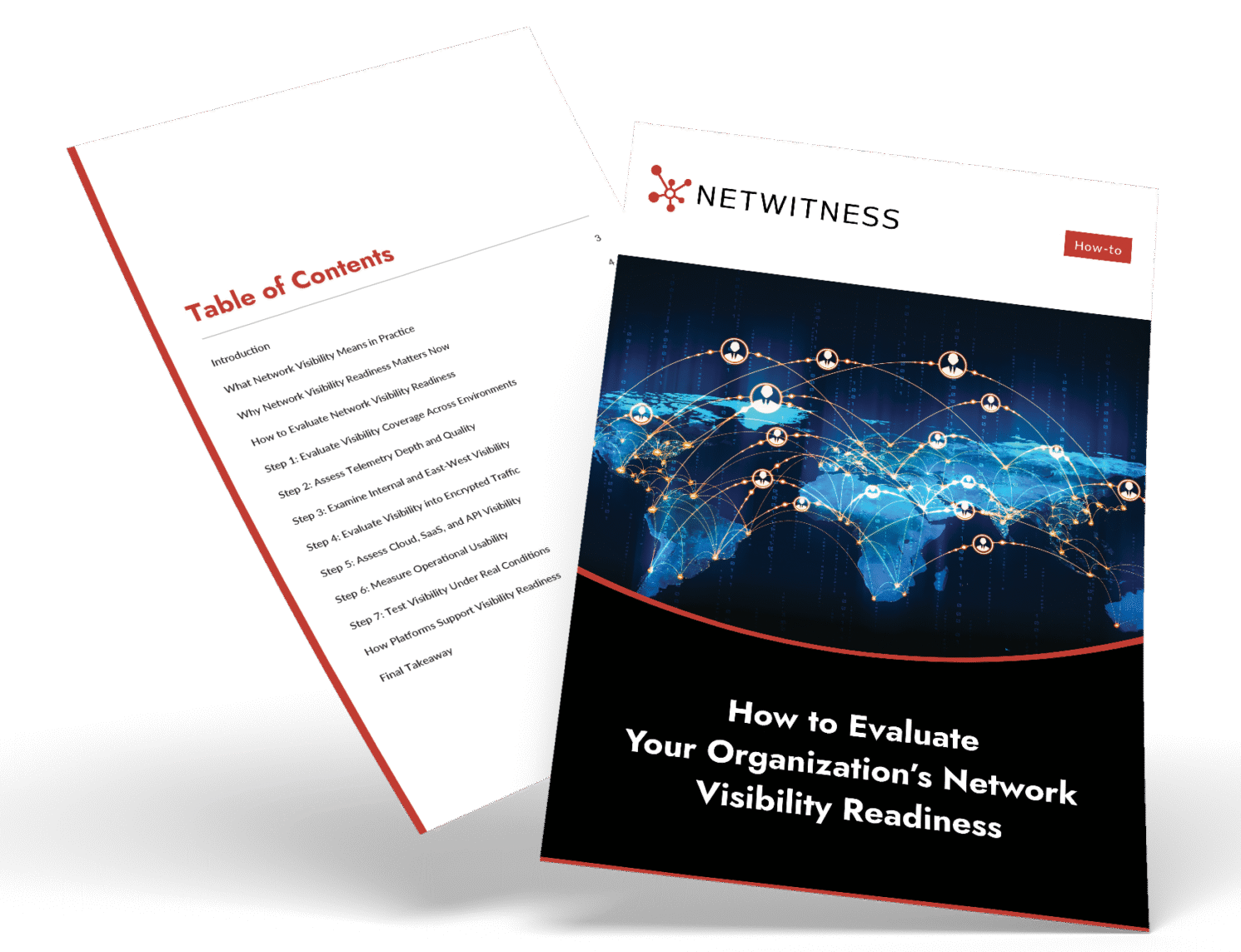
Network Visibility Readiness Guide
Discover how to identify blind spots, monitor traffic across cloud and on-prem environments, and strengthen detection with a practical 7-step evaluation framework. Download the guide to improve investigation speed and security clarity.