Introduction
Every NDR vendor claims to offer complete network threat visibility. But today’s environments are more dangerous than ever. According to industry data, cloud intrusions increased by 75% in 2023, highlighting how quickly attackers exploit visibility gaps in hybrid and multi-cloud environments. But dig deeper, and the real story shows up in implementation details.
Can their network traffic analysis engine handle encrypted traffic at scale? Does their cloud network detection and response work across your cloud providers? Will forensic detection function across VPNs, SD-WAN, and container platforms?
These aren’t any abstract questions. They decide whether your NDR solutions strengthen security or turn into expensive monitoring tools that create noise instead of insight.
Recent studies show enterprises lose an average of $4.9 million per data breach. Detection time is the biggest cost of a driver. Well-designed NDR solutions change this by delivering real-time visibility across on-prem and cloud environments. With faster detection and investigation, teams can identify threats in minutes instead of months.
Why Network Threat Visibility Solutions Breaks Down in Hybrid and Multi-Cloud
Let’s break it down. Modern environments are fragmented by design.
- Workloads run across AWS, Azure, and GCP
- Core systems remain on-prem
- SaaS apps are used daily
- Containers spin up and down constantly
- Traffic moves between VMs, clouds, and remote users
This complexity creates blind spots.
Traditional tools were built for fixed perimeters. They miss east-west traffic. They struggle with encrypted flows and short-lived connections. Attackers take advantage of this to move laterally, escalate access, and extract data quietly.
That’s why threat visibility solutions matter.
A strong network visibility solution must see traffic across:
- On-prem networks- Switches, routers, firewalls, and internal segments
- Public cloud environments- VPC traffic mirroring, virtual taps, and hybrid cloud integrations
- Containers and microservices- Dynamic container networking layers
- Remote and SaaS environments- VPNs, SD-WAN, and supported cloud APIs
If even one area is missed, visibility gaps will appear. 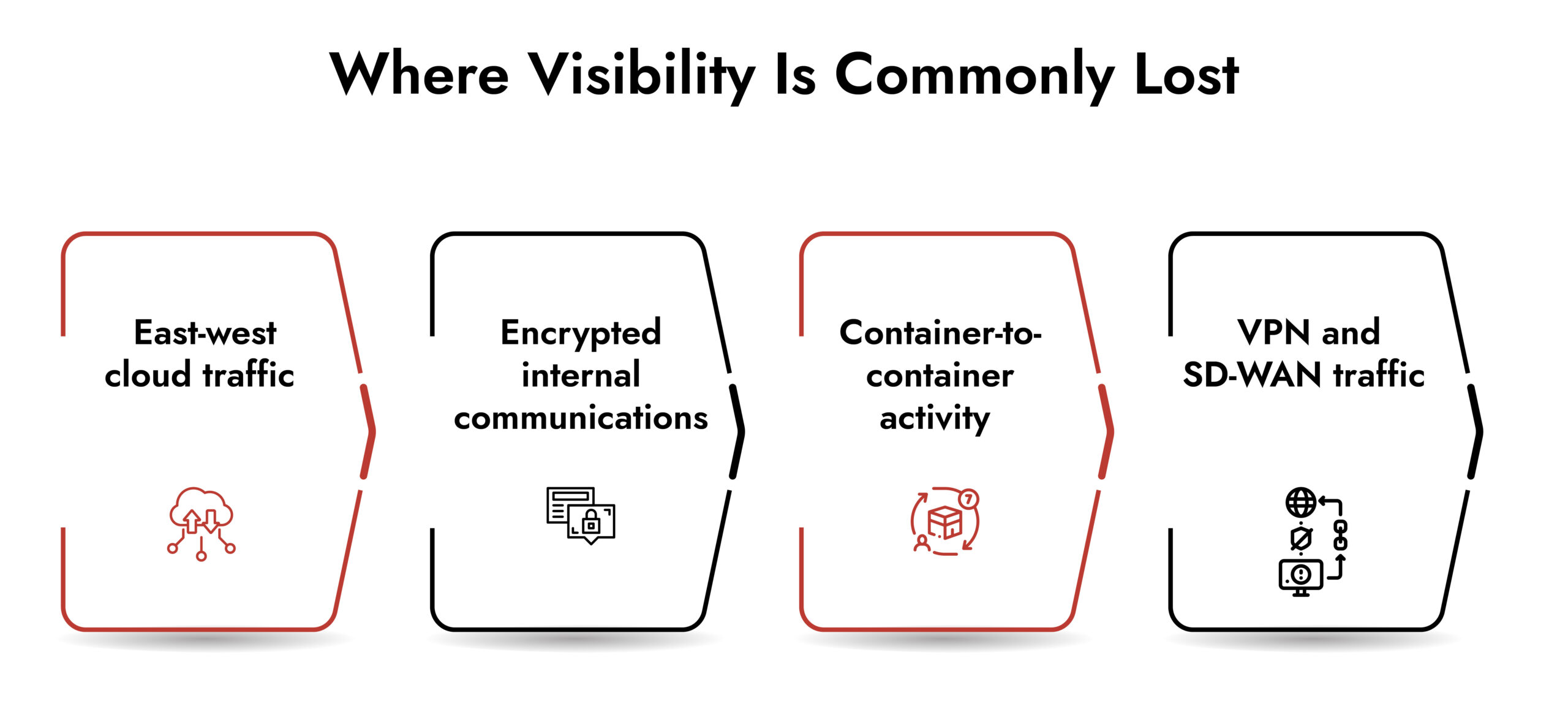
Five Capabilities to Look for in an NDR solution in 2026
The most effective top NDR solutions share a common set of capabilities that separate them from basic monitoring tools.
1. Unified network traffic visibility across all environments:
The foundation of network detection and response is visibility across on-prem, hybrid, multi-cloud, and containerized environments.
A strong network visibility solution should unify insights across all these environments without forcing separate tools.
Ask vendors: How do you centralize traffic from on-prem, cloud, and containers into a single analysis engine?
2. Cloud-native deployment and scalability:
Modern NDR solutions use cloud-native sensors that scale automatically, analyze traffic locally to reduce cloud costs, and support automated provisioning.
Ask vendors: What deployment models do you support in AWS, Azure, and GCP? How do you scale in auto-scaling environments?
3. Advanced behavioural analytics for east-west traffic:
Signatures alone are not enough. Effective NDR tools use behavioral baselining to detect lateral movement, command-and-control traffic, and data exfiltration, even when traffic is encrypted or uses uncommon protocols.
Ask vendors: How do you detect threats in encrypted east-west traffic without high false positives?
4. Strong integrations with your existing security stack:
Network detection should not operate in isolation. Your threat visibility solution should integrate with SIEM platforms, SOAR tools, EDR, XDR, and ticketing systems.
This allows for faster investigation and coordinated response.
Ask vendors: Can we automate response actions from network detections?
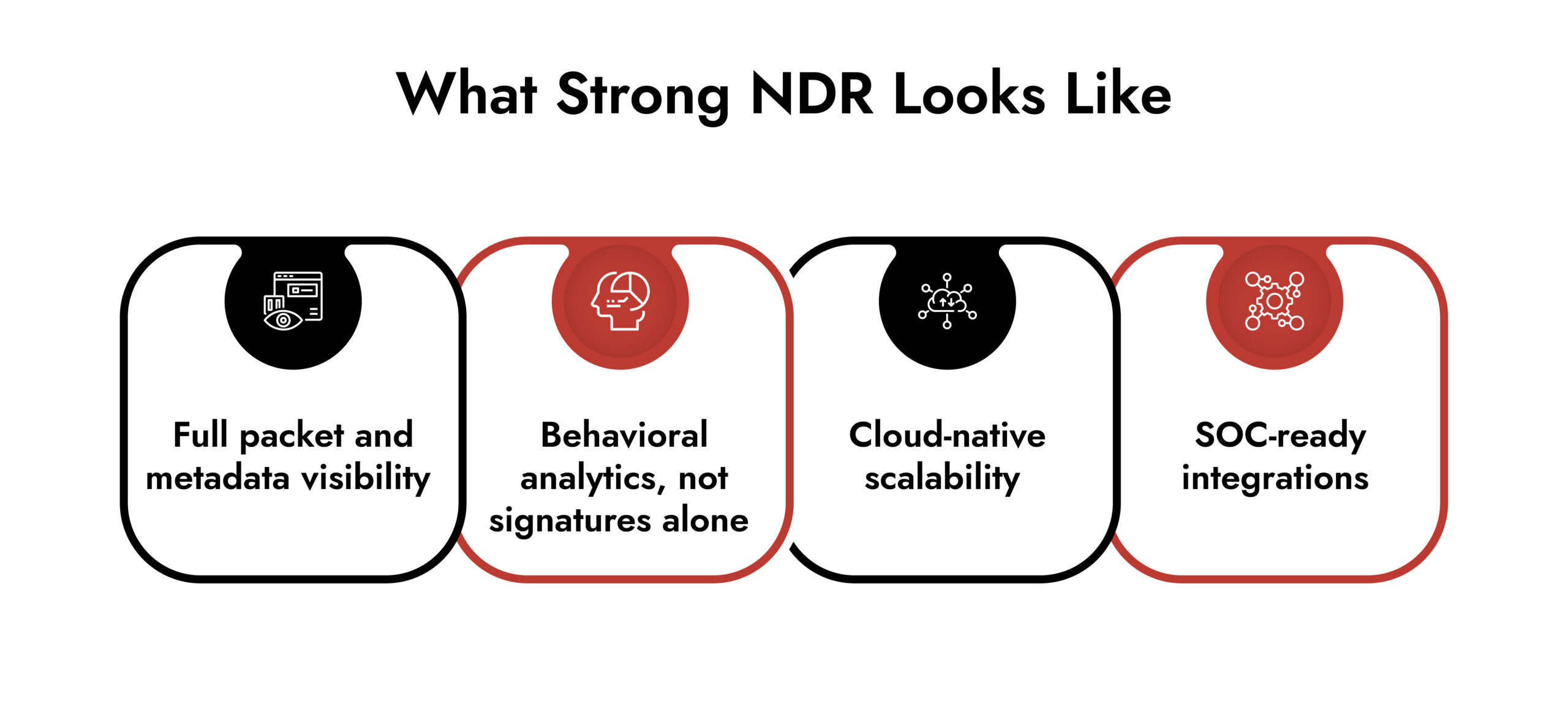
5. Encrypted network traffic analysis without full decryption:
Cloud-ready NDR solutions can analyze encrypted traffic using TLS fingerprinting, metadata analysis, and behavioral correlation without requiring full decryption.
Ask vendors: How do you analyze encrypted traffic at scale without decryption?
Best Practices for NDR in Hybrid & Cloud Environments
- Prioritize east-west visibility
Most attacks move laterally. If you miss internal traffic, youmiss the attack. - Use cloud-native sensors,not lifted appliances
Legacy approaches don’t scale in dynamic environments. - Integrate NDR with your security ecosystem
NDR should feed into SIEM, SOAR, and XDR for faster response. - Focus on behavioral detection, not signatures
Static rules cannot keep up with modern threats. - Continuouslyvalidatevisibility coverage
Hybrid environments change constantly. Your detection coverage should too.
Implementing NDR in Hybrid or Cloud-Native Environments
Selecting an NDR platform is only the first step. Implementation should begin by mapping critical traffic flows and identifying visibility gaps across data centers, branches, cloud workloads, SaaS, and east-west traffic.
A practical deployment should:
- Establish a visibility baseline.
- Deploy sensors based on critical traffic requirements.
- Connect NDR with SIEM, SOAR, and EDR workflows.
- Validate detections against realistic scenarios.
- Continuously reassess coverage as the environment changes.
The goal is not simply to deploy more sensors. It is to establish measurable visibility across the traffic paths where an attacker could move, communicate, or exfiltrate data.
First 90 Days of NDR Deployment
Phase | Focus | Key Activities |
Days 1–30 | Visibility | Map traffic flows and prioritize critical environments |
Days 31–60 | Deployment | Deploy sensors and integrate security tools |
Days 61–75 | Validation | Test cloud, east-west, encrypted traffic, and suspicious activity |
Days 76–90 | Optimization | Tune detections and validate investigation workflows |
NDR Visibility Requirements by Environment
Environment | What to Validate |
Data center | North-south and east-west traffic across critical segments |
Branch | Branch-to-cloud, branch-to-data-center, and SD-WAN traffic |
Cloud workload | Workload-to-workload, ingress, and egress visibility |
SaaS | Supported SaaS telemetry and related network activity |
East-west | Lateral movement across servers, VMs, containers, and cloud workloads |
Five NDR Validation Scenarios
Security teams should test an NDR platform against realistic investigations rather than relying only on demonstrations.
- Cloud-to-Network Correlation:Test communication between a cloud workload and an on-premises system. Validate whether the platform connects cloud activity with related network sessions and provides a usable timeline.
- Suspicious East-West Communication:Test unusual internal communication todetermine whether NDR tools can identify behavioral anomalies and potential lateral movement.
- Encrypted Traffic Investigation:Test suspicious encrypted activity. Validate whether the best NDR solutions provide useful metadata, fingerprints, behavioral indicators, and investigation context without full decryption.
- Alert Context and Investigation Evidence:Start with an NDR alert anddetermine whether analysts can understand what happened, which systems were involved, and what additional evidence is available without switching between disconnected tools.
- Multi-Cloud Activity:Test communication between workloadsoperating across different cloud environments. Validate cross-cloud visibility, related detections, source and destination context, and investigation timelines.
Things To Avoid While Selecting NDR Solution
- Assuming cloud visibility is included- Many NDR vendors require separate licenses for each cloud provider
- Overlooking deployment complexity- Sensors should not require weeks of professional services
- Ignoring cost models- Bandwidth-based pricing can spike in multi-cloud environments

Best Packet Capture Strategy for Enterprise NDR
Full packet capture is still one of the most powerful capabilities in NDR, but only when used strategically.
The best approach combines:
- Selective packet capture for critical segments
- Metadata-first analysis for scale
- On-demand deep packet inspection for investigations
Why this matters: storing everything is expensive, but capturing nothing leaves gaps. The right NDR platform balances both.
Modern platforms integrate packet capture with behavioral analytics so teams can move from detection to forensic investigation without switching tools.
How to Choose the Best NDR Solution for Network Threat Detection
Choosing an NDR solution is not about feature lists. It’s about outcomes.
The right NDR specialist evaluates how detection works under real traffic loads, across clouds, and during live incidents. Strong NDR vendors prioritize scalable visibility, low operational overhead, and actionable intelligence over noisy alerts.
Start by mapping critical data flows across on-prem, hybrid, and cloud environments. Identify existing gaps. Then evaluate NDR solutions based on their ability to deliver:
- Proven scalability
- Low operational overhead
- Actionable intelligence
- Fast, contextual detections
An experienced NDR specialist will focus on how detection works in real conditions, not just in demos.
Why NetWitness NDR solution stands out
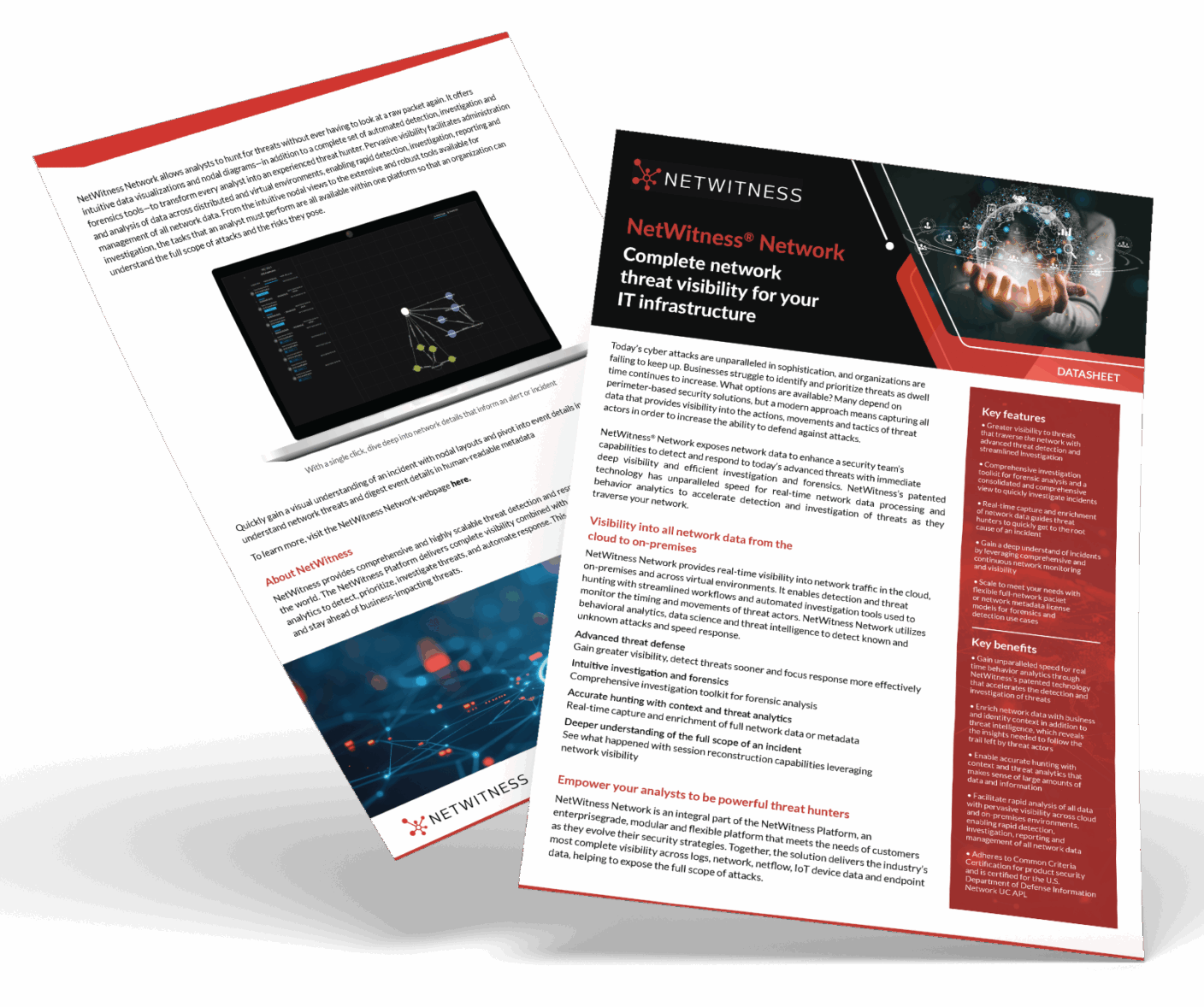
NetWitness delivers enterprise-grade NDR cybersecurity by combining pervasive traffic collection, behavioral analytics, and forensic investigation in a single NDR solution.
Among top NDR solutions, NetWitness stands out by providing consistent network threat visibility across on-prem, virtual, hybrid, and public cloud environments, enabling security teams to detect and respond faster with confidence.
In a world where hybrid and multi-cloud are the norm, your cloud NDR network should be the backbone of your detection strategy, not just another tool adding to the noise.