What should I use for unified endpoint and network visibility across my organization?
Unified endpoint and network visibility solutions requires a platform that combines network visibility solutions, network detection and response (NDR), and endpoint detection and response (EDR) into a single view. Organizations should look for SOC visibility tools that correlate endpoint, packet, log, and network telemetry in real time to improve threat detection and response. A strong unified visibility approach helps security teams detect lateral movement, reduce blind spots, strengthen network security, and accelerate investigations through centralized monitoring and analytics.
Introduction
Security teams today are drowning in data but starving for context. Alerts pile up, tools multiply, and somewhere in the gap between an endpoint event and a network anomaly, attackers find their window. The problem is not that organizations lack security tools. The problem is that those tools do not talk to each other, and the blind spots in between are exactly where threats live.
Unified endpoint and network visibility solutions are not a trend. It is the structural shift that modern threat detection actually demands.
The Network Visibility Gap Still Exist
Most organizations run endpoint detection and response (EDR) tools on their devices and separate network security tools watching traffic. On paper, that sounds like coverage. In practice, it creates two siloed views of the same environment.
An EDR tool sees what happens on a device: process executions, file changes, registry modifications, lateral movement attempts. Network visibility solutions see what crosses the wire: unusual traffic patterns, suspicious DNS queries, data exfiltration attempts, command-and-control callbacks. Neither one alone tells the full story.
When a threat actor moves laterally across a network, they touch both layers. They compromise an endpoint, then pivot using the network, then land on another endpoint. If your SOC visibility tools are not correlating both sources in real time, analysts are manually piecing together a puzzle with half the pieces missing. That takes time. Attackers count on that time. Without integrated network visibility solutions, security teams struggle to correlate endpoint and network activity in real time
What Unified Network Visibility Solution Means
Unified security, in the sense of threat detection, is the integration of endpoint telemetry and network telemetry into a single correlated view. It’s not a replacement for EDR or network detection and response (NDR) tools. It’s about getting them to collaborate.
Let’s see what this means in practice. An alert is triggered if a process on the endpoint is making an unusual outbound connection. The SOC analyst can immediately view the entire chain as well, including the user account initiating the process, what the process has been doing on that account in the past, where all network traffic is headed, and if the same traffic has been observed on other endpoints in the environment. That’s a full set. Without unification, then it would take time to switch between tools, export logs, and manually do the correlation; this is time consuming and prone to error.
Unified visibility is also what makes reactive security different from proactive threat hunting. If the network and endpoint data have a shared data model, then threat hunters can write queries across both layers. They can search for patterns that cross device and network characteristics, just like advanced persistent threats and ransomware operators do. Modern network visibility solutions help organizations monitor encrypted traffic, analyze network behavior, and strengthen enterprise network security
Why Network Detection and Response Alone Is Not Enough
Network detection and response is capable of great things. It reveals threats which are not caught by endpoint controls at all, such as attacks on unmanaged devices, IoT assets, and attacks on the network infrastructure. It detects encrypted traffic anomalies, unusual lateral movement, and exfiltrations of data being staged. These are all things an EDR will never see.
However, NDR has a fundamental drawback, it doesn’t have any process-level context. When NDR suspects an outbound connection, it will know the IP address, the port, the protocol, and possibly the reputation of the destination. It is unaware if that application was already detected running on the endpoint with suspicious behavior, or if it is an unknown application it has never seen before.
What you’re missing is that high fidelity alert with all the context. If there is no endpoint context, NDR alerts are difficult to investigate manually and can either be ignored or lead to false-positive alerts. If there is no endpoint context, an alert will need a lot of manual investigation to differentiate between a legitimate business activity and a real threat. This both increases analyst workload and mean time to respond.
Why Endpoint Detection and Response Alone Falls Short
EDR gives deep process-level visibility, but it has its own blind spots. It only sees what happens on managed, enrolled devices. Unmanaged endpoints, network devices, OT assets, and cloud infrastructure are completely invisible to traditional EDR deployments.
Beyond asset coverage, EDR also struggles with network-layer context. An endpoint may be involved in a multi-stage attack where much of the activity happens at the network layer between initial compromise and the final payload execution. EDR catches the beginning and the end but misses the middle.
Threat detection and response that relies solely on endpoint telemetry will consistently miss the network-layer indicators that could have enabled earlier detection.
What Unified Threat Detection Looks Like in Practice
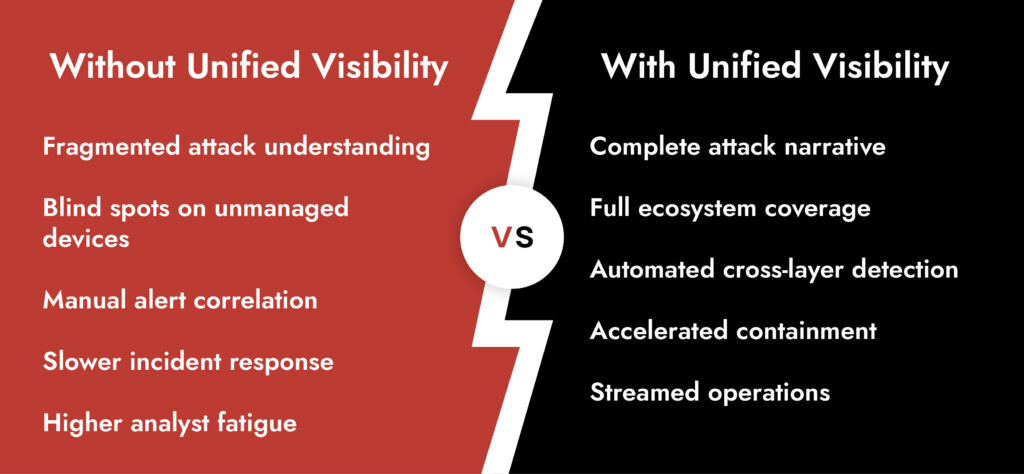
Organizations that have moved toward unified security architectures describe a concrete operational shift. Analysts stop context-switching between tools and start working from a correlated timeline. Investigations that previously took hours get resolved in minutes because the relevant data is already assembled.
The key capabilities that unified network and endpoint visibility enables include:
Correlated detections: When a threat indicator appears on an endpoint and correlates with anomalous network traffic, the detection fires with both data points already linked. Analysts get a higher-confidence alert with the context they need to act.
Faster containment: When a compromise is confirmed, response actions can target both the endpoint and the network simultaneously. Isolating the device while also blocking the associated network traffic reduces dwell time significantly.
Improved threat hunting: Hunting across unified data means queries can span process trees, network connections, and user behavior in a single search. Hunters can express more precise hypotheses and get more meaningful results.
Reduced alert fatigue: Correlation reduces duplicate alerts and low-fidelity noise. When network and endpoint signals reinforce each other, the resulting alert is more actionable than either signal would be alone.
The SOC Visibility Problem
For SOC teams specifically, the lack of unified visibility is a daily operational burden. Analysts manage an average of dozens of tools in a mature environment. The cognitive overhead of correlating across disconnected systems slows investigations, increases error rates, and contributes directly to analyst burnout.
SOC visibility tools that unify endpoint and network data address this at the workflow level. Instead of building correlation manually, the platform does it automatically. Analysts start their investigation at the point where context already exists, not at the point where raw alerts require hours of enrichment.
This is especially important for organizations that run lean security teams. Not every organization can staff a large SOC. Unified visibility makes smaller teams significantly more effective by reducing the time and expertise required to investigate complex, multi-stage threats. SOC teams rely on network visibility solutions to simplify investigations and reduce alert fatigue across complex environments.
Why Unified Visibility Matters for Security Teams
When talking about the return on the investment in unified network/endpoint visibility, security leaders should not just talk about the capabilities of the technology but the operational outcomes it can enable.
The questions are: What is the wait for a true positive today? How many man hours does an analyst spend on one investigation? What is the current MTTR? How many threats are not detected due to the lack of cross-layer correlation?
Companies that perform these baselines before and after the unified threat detection implementation consistently realize improved detection accuracy, investigation speed and analyst efficiency. Investing in network visibility solutions improves operational efficiency, accelerates investigations, and supports faster threat detection and response. The investment pays off both in terms of security results and operational capacity.
The Bottom Line
Attackers do not operate in silos. They traverse endpoints and networks seamlessly, finding gaps between unconnected security solutions. Those defenders that want to compete with this flow must be as visible.
Unified endpoint and network visibility is the key to making threat detection and response fast and effective, as needed by today’s threats. Those organizations that persist in using disjointed tools will persist in losing time with investigations and will be unable to detect what they need to be alerted to at the moment. Organizations adopting unified network visibility solutions gain stronger visibility, faster response times, and improved cybersecurity resilience.
The infrastructure for better security exists. The question is whether organizations are willing to connect it.
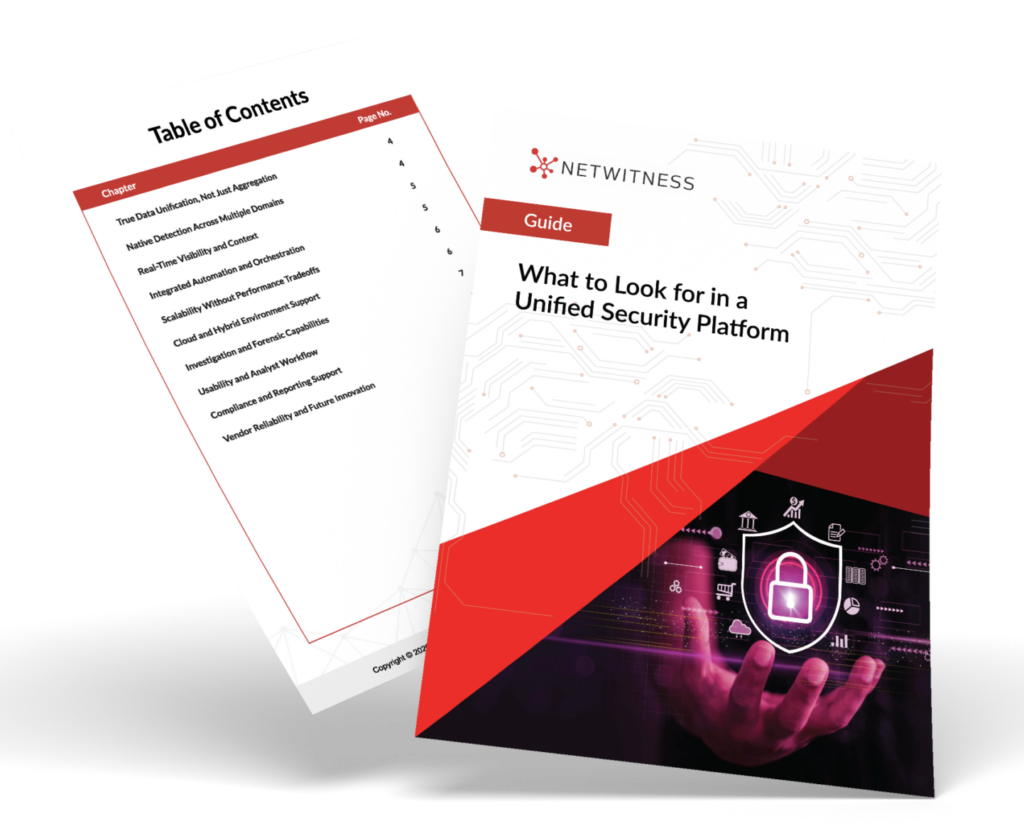
What to Look for in a Unified Security Platform
- Cut through tool sprawl with a practical evaluation framework.
- Compare platforms based on visibility, detection accuracy, and automation.
- Validate real-world performance across hybrid and cloud environments.
- Make confident, risk-aligned security decisions.
Frequently Asked Questions
1. Why is unified visibility important for threat detection?
Unified visibility connects endpoint, network, and log data in one platform, improving threat detection, reducing blind spots, and enabling faster incident response across the organization.
2. How to improve network performance with visibility tools?
Advanced network visibility solutions help teams monitor traffic patterns, identify bottlenecks, detect anomalies, and optimize infrastructure performance while supporting stronger network security.
3. What features should organizations look for in visibility solutions?
Organizations should prioritize real-time monitoring, integrated network detection and response, endpoint detection and response, centralized dashboards, automation, analytics, and scalable SOC visibility tools.
4. How can organizations implement unified visibility effectively?
Organizations can implement unified visibility by integrating endpoint, network, cloud, and security telemetry into a centralized platform that supports automated threat detection and response workflows.
5. What role does unified visibility play in SOC operations?
In SOC environments, unified security and visibility provide analysts with correlated alerts, faster investigations, improved incident prioritization, and better coordination across security operations.