How does NDR detect lateral movement?
NDR detects lateral movement by analyzing network traffic, metadata, and communication behavior across internal systems. A strong NDR solution also builds behavioral baselines to detect anomalous activity.
NetWitness NDR adds deeper investigation value through full-packet capture, metadata enrichment, behavioral analytics, network forensics, and session reconstruction.
The first compromised endpoint is rarely the real target. Attackers usually need to move from one system to another, find privileged accounts, access file shares, reach domain controllers, discover backups, and eventually get closer to sensitive data or business-critical systems.
Thus, lateral movement is where many serious attacks become dangerous.
Hence, NDR detects lateral movement is better than many traditional controls. Lateral movement often hides inside ordinary-looking network behavior: RDP, SMB, SSH, WMI, WinRM, Kerberos, LDAP, DNS, file-share access, and remote administration tools. Network detection and response gives security teams visibility into internal traffic patterns, especially east-west traffic between systems.
Advanced attackers know the protocols that belong in enterprise networks. Therefore, they use that familiarity to blend in.
A strong NDR solution does not only look for known malicious indicators. It also watches how systems normally communicate, identifies unusual behavior, enriches traffic with context, and gives analysts the evidence needed to investigate quickly. For enterprise SOC teams, that combination is the difference between chasing isolated alerts and reconstructing the actual attack path.
What is Lateral Movement?
MITRE ATT&CK describes lateral movement as the set of techniques adversaries use to enter and control remote systems on a network. In practice, this usually happens after initial access. The attacker scans the environment, hunts for valuable systems, then pivots through accounts, hosts, and services until they reach the objective.
The objective may be a database, a file server, a privileged admin workstation, a cloud workload, a backup platform, or an OT segment.
The problem is that lateral movement may look like:
- A user connecting to a server through RDP.
- A workstation reaching out to multiple file shares.
- A service account authenticating from an unusual host.
- A helpdesk tool opening a remote session.
- A server making LDAP queries it does not normally make.
- A host scanning internal IP ranges before attempting SMB connections.
None of these behaviors automatically proves compromise. But together, and in the right sequence, they can show an attacker moving through the network.
Endpoint tools can show what happened on a host. Identity tools can show authentication events. But NDR’s direct visibility into the conversations happening between systems helps connect the dots.
Why is lateral movement difficult to detect?
Lateral movement is difficult because attackers often use what already exists.
They do not always bring obvious malware into the environment. They use valid credentials, approved administrative protocols, native operating system tools, and legitimate remote access paths.

“Lateral movement detection is not about finding one strange connection. It is about understanding intent from a chain of network behaviors. A single RDP session may be normal. A first-time RDP session after internal discovery, followed by SMB access and privileged authentication, is a different story. This is where NDR becomes valuable. It connects those behaviors, gives analysts the evidence to act with confidence, and moves the investigation beyond packet visibility.
At that point, NDR becomes an investigation acceleration layer. Instead of forcing analysts to manually correlate disconnected events, it helps them quickly reconstruct the attack path across users, hosts, protocols, and sessions. When integrated with UEBA, it adds another layer of context by helping distinguish user-driven activity from machine-driven movement, improving confidence in separating real compromise from legitimate administrative behavior.”
— Ibrahim Badawi, Sales Engineer, NetWitness
Lateral movement detection needs context, sequence, and behavior. It is rarely about one perfect alert. It is about seeing the pattern early enough to stop the attacker from expanding control.
How NDR Detects Lateral Movement
NDR detects lateral movement by continuously analyzing network traffic, metadata, and communication behavior across internal and external network paths. The goal is to identify abnormal movement between users, hosts, servers, and services.
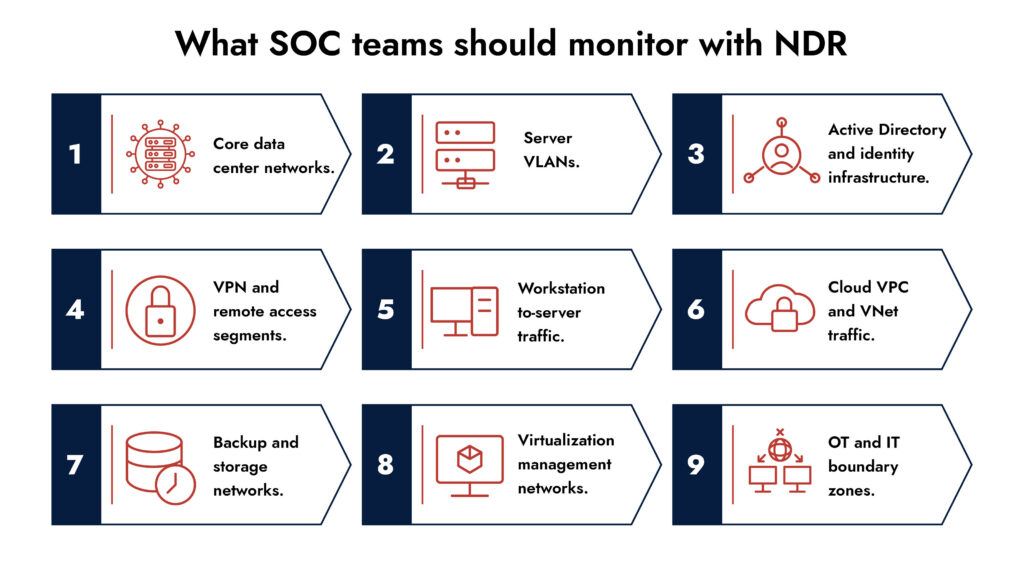
For lateral movement detection, NDR’s east-west visibility can show:
- Which hosts are communicating internally.
- Which protocols are being used.
- Whether a connection is normal for that system.
- Whether an account is moving across unusual assets.
- Whether internal traffic is increasing before ransomware deployment.
- Whether traffic suggests discovery, staging, or exfiltration.
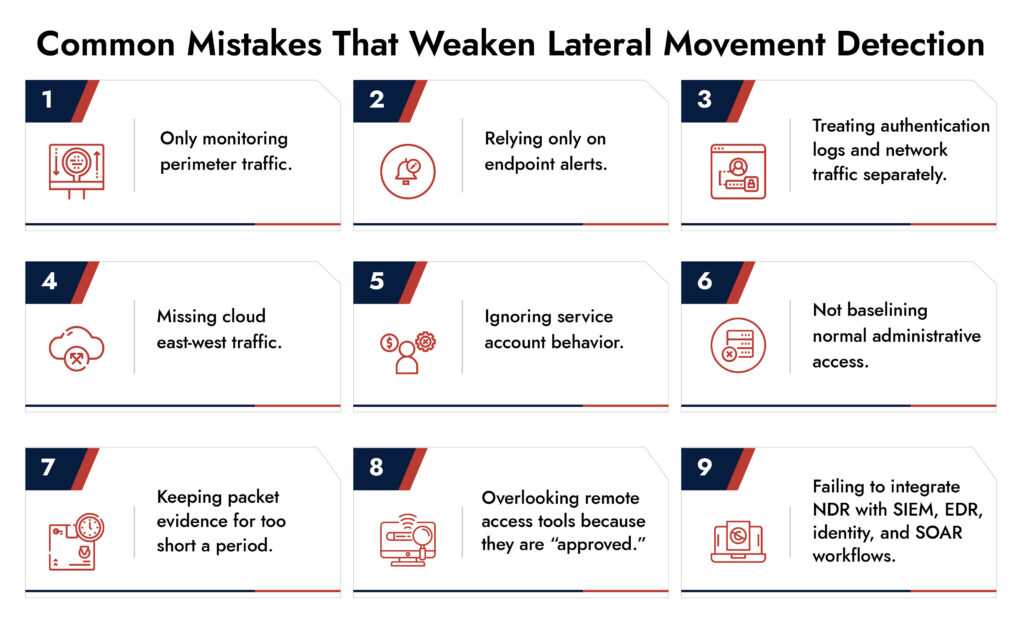
NetWitness is built around full-packet capture, metadata enrichment, behavioral analytics, threat intelligence, network forensics, session reconstruction, and response workflows. That means the platform is not limited to telling analysts that something looks suspicious. It helps them investigate what actually happened.
What Network Behaviors Can Indicate Lateral Movement?
Not every unusual network event is malicious. But certain patterns deserve attention because they often appear during lateral movement.
- First-time administrative protocol use
If a workstation suddenly initiates RDP, SMB, SSH, WinRM, WMI, or RPC traffic to systems it does not normally access, analysts should take a closer look.
This is especially important when the source host is not an admin workstation.
- Internal scanning before authentication attempts
Attackers often perform discovery before moving. They may scan for open ports, enumerate hosts, query Active Directory, or look for file shares.
A scan followed by login attempts is more concerning than a scan alone.
- Service accounts behaving like users
Service accounts should usually behave predictably. If a service account logs in interactively, authenticates from a new host, or starts touching unrelated systems, that may indicate credential misuse.
- Workstations talking to many servers
A normal user workstation does not usually need to connect to a wide range of servers over administrative protocols. A sudden fan-out pattern can indicate reconnaissance, remote execution, or ransomware lateral movement.
- Unusual access to domain controllers
Domain controllers, identity infrastructure, and directory services are high-value targets. Abnormal LDAP, Kerberos, SMB, or RPC activity involving these systems should be prioritized.
- Remote access tool proliferation
Attackers often use legitimate remote access tools because they blend into business operations. NDR can help identify when these tools appear in unusual places, communicate with unusual systems, or are used at unusual times.
- Large internal file access
Before exfiltration or encryption, attackers may collect data internally. Large file-share traversal, archive creation, or movement toward staging systems can indicate that lateral movement has progressed into impact preparation.
Detailed Lateral Movement Detection Workflow
A good NDR-driven lateral movement detection workflow usually looks like this.
Step 1: Baseline normal communication
The platform learns how systems, users, services, and network zones normally communicate. This includes communication between
- peer groups
- protocols
- timing
- traffic volume
- authentication paths
- common destinations
Step 2: Detect abnormal movement
The NDR solution flags behavior that falls outside the baseline. This may include
- rare source-destination pairs
- unusual protocol use
- abnormal internal scanning
- unexpected access to sensitive assets
Step 3: Enrich the signal
The alert becomes more useful when enriched with asset criticality, identity context, DNS, DHCP, threat intelligence, endpoint telemetry, and SIEM logs.
Step 4: Reconstruct the session
This is where full-packet capture and metadata matter. Analysts can reconstruct the session to validate what happened rather than relying only on summary logs.
Step 5: Trace the attack path
The SOC pivots across related hosts, users, sessions, and time windows to understand whether the activity is isolated or part of a larger movement pattern.
Step 6: Respond and contain
Once the behavior is validated, response can include
- host isolation
- credential reset
- session termination
- firewall rule changes
- SOAR playbook execution
- deeper forensic review.
This workflow is why NDR does not replace SIEM, EDR, or identity security. It makes them more effective by adding the network layer of evidence.
How NetWitness NDR helps in Lateral Movement Detection
NetWitness NDR is built for investigation-driven detection. Its value is not only that it detects suspicious traffic, but also that it gives analysts the network evidence behind the detection. That is critical when attackers use legitimate credentials and standard protocols.
NetWitness NDR supports lateral movement detection through:
- Full-packet capture for deep forensic validation.
- Metadata enrichment so analysts can search and pivot quickly.
- Behavioral analytics to detect abnormal internal movement.
- Threat intelligence correlation to prioritize known attacker infrastructure and techniques.
- Session reconstruction to understand what happened during suspicious communication.
- Network forensics to support investigation and response.
- Hybrid visibility across on-premises, cloud, and virtual environments.
- Integration with SIEM, EDR, SOAR, identity logs, DNS, DHCP, and asset context.
NetWitness has a clear advantage over lighter NDR solutions that focus mostly on alerting. Lateral movement investigations need proof. Analysts need to know which system talked to which system, which protocol was used, which account was involved, whether the behavior was normal, and what happened before and after.
Frequently Asked Questions
1. Why is lateral movement difficult to detect?
Lateral movement is difficult to detect because attackers often use legitimate credentials, native tools, and approved protocols. This makes the traffic look normal unless it is analyzed in context.
2. What network behaviors can indicate lateral movement?
Network behaviors that can indicate lateral movement include
- first-time administrative connections,
- unusual RDP or SMB sessions,
- workstation-to-server fan-out,
- internal port scanning,
- LDAP or Active Directory enumeration,
- abnormal Kerberos activity,
- service accounts logging in interactively,
- rare host-to-host communication,
- remote access tool usage,
- large file-share access.
The strongest indicators usually appear as a sequence, not a single event.
3. What role does network visibility play in lateral movement detection?
Network visibility is central to lateral movement detection because attackers move across systems through network communication. Without east-west visibility, the SOC may see an endpoint alert or authentication event but miss the actual path the attacker used.
4. Why is rapid lateral movement detection important?
Rapid lateral movement detection is important because attackers use movement time to expand access, steal credentials, reach sensitive systems, stage data, disable defenses, and deploy ransomware.
The faster the SOC detects lateral movement, the faster it can contain affected hosts, reset credentials, block malicious paths, and reduce the blast radius.
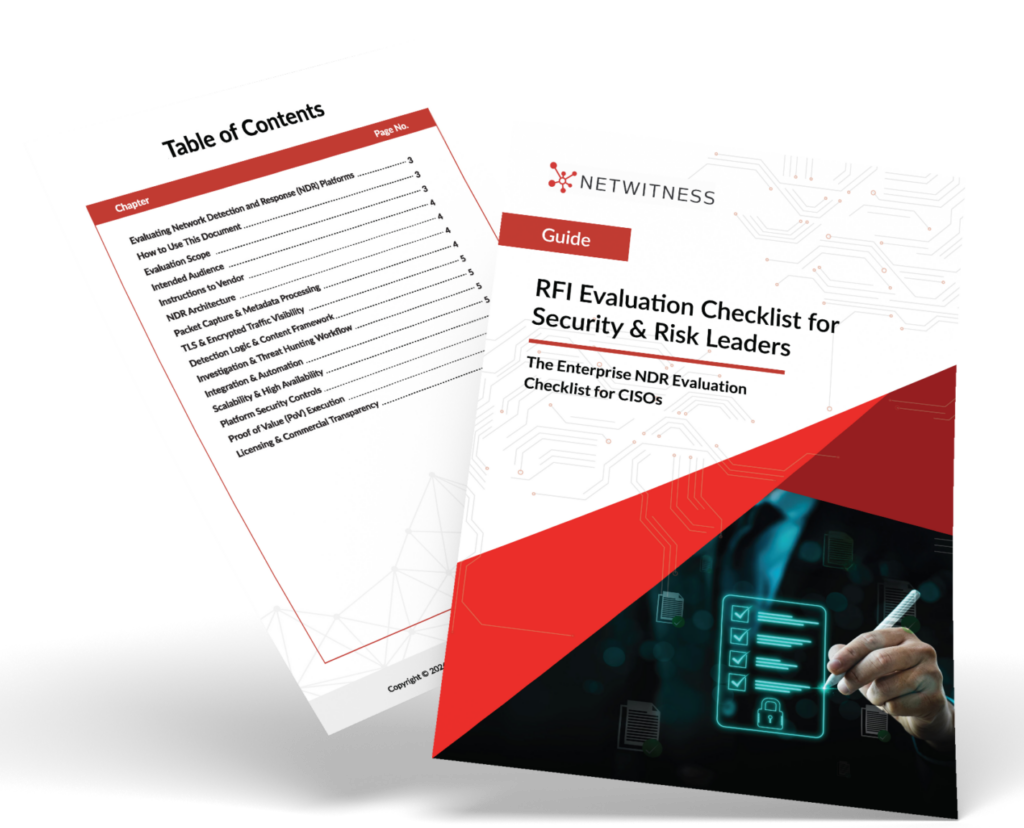
Make Smarter Security Investments—Faster
- Standardize vendor evaluation with a comprehensive RFI checklist.
- Compare platforms based on real-world detection, visibility, and response capabilities.
- Reduce risk by identifying gaps before deployment.
- Empower security leaders with actionable insights from NetWitness.