Introduction
In 2026, enterprise risk is defined by relentless cyber threats. Ransomware, APTs, and supply chain attacks continue to evolve, pushing organizations to rethink their cybersecurity incident response strategies. The attack surface has expanded into cloud platforms, remote workforce, and third-party integrations, making response speed as critical as prevention.
Incident response tools are technologies that help security teams detect, analyze, contain, and recover from cyber threats. They support cybersecurity incident response by automating workflows, improving cross-system visibility, and enabling faster, coordinated action and they’re now a core part of how mature security operations centers function.
For CISOs and IT security leaders, the question isn’t whether an incident will occur, but how effectively the organization can detect, contain, and recover. Every hour of downtime can cost upward of $250,000, while customer trust depends on transparency and response quality. Yet most incident response teams still spend hours manually triaging alerts instead of containing threats. The real challenge is not detection, but speed and coordination. Without the right incident response tools, security teams lose valuable time in manual triage, increasing business impact and recovery costs.
The difference between chaos and control often comes down to the right incident response solutions: integrated, automated, and built on proven frameworks. This is where modern incident response management comes in. The right combination of tools and processes transforms reactive firefighting into structured, efficient incident response in cybersecurity.
What are Incident Response Tools ?
Incident response tools are technologies that help security teams detect, investigate, contain, eradicate, and recover from cybersecurity incidents. Depending on their function, these tools may collect security telemetry, correlate alerts, automate response actions, manage cases, preserve forensic evidence, or coordinate communication between responders.
A modern incident response software stack typically includes technologies such as:
- SIEM for centralized monitoring and log analysis
- SOAR for workflow orchestration and automation
- EDR for endpoint detection and containment
- XDR for broader cross-environment detection and response
- Network traffic analysis for forensic visibility
- Threat intelligence platforms for investigation context
- Incident management tools for case tracking and coordination
The most effective incident response solutions do not operate in isolation. They connect security data, investigation workflows, and response actions so analysts can move from detection to containment with less manual effort.
This integrated approach is increasingly important for cloud and hybrid environments, where evidence can be distributed across workloads, identities, endpoints, networks, and applications. Automated evidence collection, centralized telemetry, and context-aware mitigation can significantly reduce delays during cloud incident response.
Building a Strong Foundation for Incident Response
Before selecting tools, enterprises need a structured foundation. Incident response frameworks such as NIST and SANS provide consistency, reduce decision fatigue, and define the incident response steps needed to contain a breach.
NIST Framework:
- Preparation – Plans, playbooks, and team training.
- Detection & Analysis – Monitoring, alerting, and prioritization.
- Containment, Eradication, Recovery – Limiting impact, removing threats, and restoring operations.
- Post-Incident Activity – Lessons learned and resilience improvements.
SANS Framework: Expands further with detailed identification and lessons-learned phases, making it particularly valuable in compliance-heavy industries.
These frameworks anchor the incident response process, ensuring technology investments fit within structured, repeatable workflows.

Essential Incident Response Tools Powering Modern Security Teams
1. Security Information and Event Management (SIEM)
A SIEM in cybersecurity centralizes log data from endpoints, networks, applications, and cloud systems.
Advanced SIEMs use analytics and machine learning to detect anomalies, helping analysts prioritize threats.
- Enterprise Need: Hybrid-cloud compatibility, customizable dashboards, and integration with orchestration platforms.
- Value: Reduces alert fatigue by correlating and enriching events into actionable insights.
One thing worth understanding about SIEM is that it’s only as effective as the data it ingests. Poorly normalized logs, weak correlation rules, or excessive noise can all lead to alert fatigue which is one of the most common pain points in modern SOC environments. This is why tuning matters as much as deployment. A SIEM that’s generating hundreds of low-quality alerts isn’t protecting you; it’s exhausting your team.
2. Security Orchestration, Automation, and Response (SOAR)
SOAR tools automate repetitive steps and orchestrate responses across systems. When integrated with SIEM, they execute playbooks that contain threats in minutes.
- Example: A phishing outbreak triggers automated workstation isolation, credential resets, and malicious domain blocks without analyst intervention.
- Advanced Capability: Dynamic playbooks that evolve with intelligence feeds.
When evaluating SOAR platforms, integration breadth is critical the platform needs to connect deeply with your existing SIEM, EDR, threat intelligence feeds, ticketing systems, and cloud platforms. Broad API coverage and bidirectional integrations are what make orchestration actually work in practice. A SOAR tool that only connects to half your stack adds coordination overhead rather than removing it.
3. Endpoint Detection and Response (EDR)
Endpoint Detection and Response provides continuous endpoint monitoring, flagging malicious processes and enabling quick isolation. With remote workforces expanding the attack surface, EDR has become essential.
- Key Features: Continuous real-time monitoring, advanced threat detection, automated response, and forensic investigation capabilities to protect endpoints against sophisticated cyberattacks.
- CISO Priority: Allows for assumed breach posture, enterprise reach, helps with encrypted traffic.
Here’s why EDR sits at the top of most CISOs’ priority lists: endpoints are frequent attack targets, and EDR gives analysts visibility into exactly what happened on a device — which file ran, which process spawned it, and what network connections were made. That’s the level of detail you need for root cause analysis. Without it, you’re reconstructing an attack chain from incomplete evidence.
4. Network Traffic Analysis for Deep Incident Response Visibility
Network visibility is critical once attackers are inside. Packet capture tools help reconstruct attack chains, track lateral movement, and assess data exfiltration.
- Use Case: Better understand attacker behaviors even when they are subverting other tools and defenses or using LotL techniques.
- Enterprise Value: Forensic-grade evidence that satisfies regulators and supports legal action.
5. Extended Detection and Response (XDR) for Unified Visibility
As environments grow more complex spanning cloud, on-prem, and remote endpoints XDR has emerged as a natural evolution beyond standalone EDR. XDR platforms provide comprehensive threat detection and response by integrating data across endpoints, networks, cloud services, and other security layers, correlating events from multiple sources to identify advanced threats that span different parts of the IT environment.
The practical difference from EDR is scope. By automating the aggregation, analysis, and response to incidents, XDR reduces noise from disparate tools and helps security teams take coordinated action quickly with features like automated investigation, guided remediation, and continuous monitoring. For organizations with mature security stacks looking to consolidate telemetry, XDR is worth serious consideration alongside or instead of stitching together standalone tools.
SIEM vs SOAR vs EDR vs XDR: Understanding Their Roles in Incident Response Process
Security teams often evaluate multiple incident response tools together, but each serves a different purpose within the incident response process.
- SIEM centralizes and correlates logs to identify suspicious activity across the environment.
- SOAR automates workflows and orchestrates response actions across security tools.
- EDR focuses on endpoint visibility, threat detection, and device-level containment.
- XDR unifies telemetry across endpoints, networks, cloud, and security layers for broader threat detection and response.
Used together, these technologies create a more connected and efficient incident response strategy with stronger visibility, automation, and faster containment.
6. Incident Management Tools for Coordinated Response
Technology alone will not contain an incident; teams need coordinated communication. Incident management platforms provide standardized workflows, audit trails, and real-time updates.
- Impact: Executives stay informed, legal teams access compliance documentation, and responders focus on remediation rather than reporting.
- Outcome: Aligned decision-making across departments and geographies.
When choosing an incident management platform, look for time-stamped audit trails, role-based access, and the ability to link related alerts into a single case. Effective incident management extends to tracking mitigation actions, preserving forensics for post-incident analysis, and integrating with ticketing or ITSM solutions to align with broader business workflows. These aren’t nice-to-haves for compliance-heavy industries they’re requirements.
7. Threat Intelligence Platforms for Proactive Incident Response
Real-time threat intelligence enriches investigations by providing context on indicators of compromise (IOCs) and attacker tactics.
- Benefit: Turns reactive response into proactive defense by identifying threats before they escalate.
- Result: Faster triage, reduced false positives, and smarter prioritization.
Top Incident Response Tools Every Security Analyst Should Know
The best incident response software depends on an organization’s environment, existing security stack, automation requirements, and investigation needs. Most mature SOCs use multiple technologies rather than relying on a single platform.
Here are ten categories and platforms commonly considered when building an enterprise incident response capability:
Incident Response Tool | Primary Capability | Best For |
NetWitness Platform | Unified detection, investigation, network, log, and endpoint visibility | Enterprises requiring deep investigation and forensic visibility |
Microsoft Sentinel | Cloud-native SIEM and security analytics | Microsoft and cloud-heavy environments |
Splunk Enterprise Security | SIEM and advanced security analytics | Large enterprises with extensive data sources |
Palo Alto Cortex XSOAR | Security orchestration and automation | SOC workflow automation and response playbooks |
Google Security Operations | SIEM, SOAR, threat intelligence, and investigation | Large-scale cloud and hybrid security operations |
CrowdStrike Falcon | Endpoint detection and response | Endpoint-focused threat detection and containment |
SentinelOne Singularity | AI-assisted endpoint security and response | Automated endpoint investigation and remediation |
IBM QRadar Suite | Security analytics and incident investigation | Enterprises with complex security environments |
ServiceNow Security Operations | Security workflow and case management | Security incident coordination and enterprise workflows |
TheHive | Incident response case management | Teams requiring collaborative case management and investigation |
Important: This is not a one-size-fits-all ranking. The best incident response tool depends on whether your primary challenge is detection, investigation, endpoint containment, workflow automation, forensic analysis, or security incident coordination.
Modern security operations increasingly combine centralized telemetry, automated playbooks, case management, and contextual investigation rather than treating each security product as an isolated system.
Best Incident Response Tools for Cloud Security
Cloud incident responses introduce challenges that traditional on-premises workflows do not always address. Workloads can be temporary, infrastructure can change automatically, and critical forensic evidence can disappear when instances are terminated or replaced.
The best incident response tools for cloud security should support:
- Multi-cloud and hybrid visibility
- Centralized cloud log collection
- Identity and access monitoring
- Automated evidence preservation
- Snapshot and forensic data collection
- Cloud-native containment actions
- Integration with SIEM and SOAR workflows
Cloud environments require faster and more automated evidence collection because logs, workloads, and other artifacts may be ephemeral. Security teams should prioritize tools that can preserve evidence, enrich alerts with cloud context, and support automated mitigation workflows.
For enterprises operating across cloud and on-premises environments, the strongest approach is usually a combination of SIEM, EDR/XDR, network visibility, and incident response automation tools.
Incident Response Automation Tools
Incident response automation tools reduce the manual work involved in investigating and responding to security incidents. They use playbooks, integrations, workflows, and predefined actions to automate repetitive response tasks.
Common automated actions include:
- Enriching alerts with threat intelligence
- Opening and assigning security cases
- Isolating compromised endpoints
- Blocking malicious IP addresses or domains
- Resetting compromised credentials
- Collecting forensic evidence
- Sending notifications to relevant stakeholders
- Escalating incidents based on severity
SOAR platforms are among the most widely used incident response automation tools because they connect SIEM, EDR, threat intelligence, IAM, email security, firewalls, and other systems into repeatable workflows.
Modern automation should not mean removing analysts from every decision. High-impact actions, particularly those affecting production systems, often require validation and human approval. The strongest automation strategies combine machine speed with analyst oversight.
SIEM vs SOAR vs EDR vs XDR: Understanding Their Roles in Incident Response
Security teams often evaluate multiple incident response tools together, but each serves a different purpose within the incident response process.
- SIEM centralizes and correlates logs to identify suspicious activity across the environment.
- SOAR automates workflows and orchestrates response actions across security tools.
- EDR focuses on endpoint visibility, threat detection, and device-level containment.
- XDR unifies telemetry across endpoints, networks, cloud, and security layers for broader threat detection and response.
Used together, these technologies create a more connected and efficient incident response strategy with stronger visibility, automation, and faster containment.
How Incident Response Tools Work Together to Accelerate Threat Containment
The mistake many organizations make is treating these tools as independent purchases. They’re not the value compounds when they’re integrated. Here’s the practical picture:
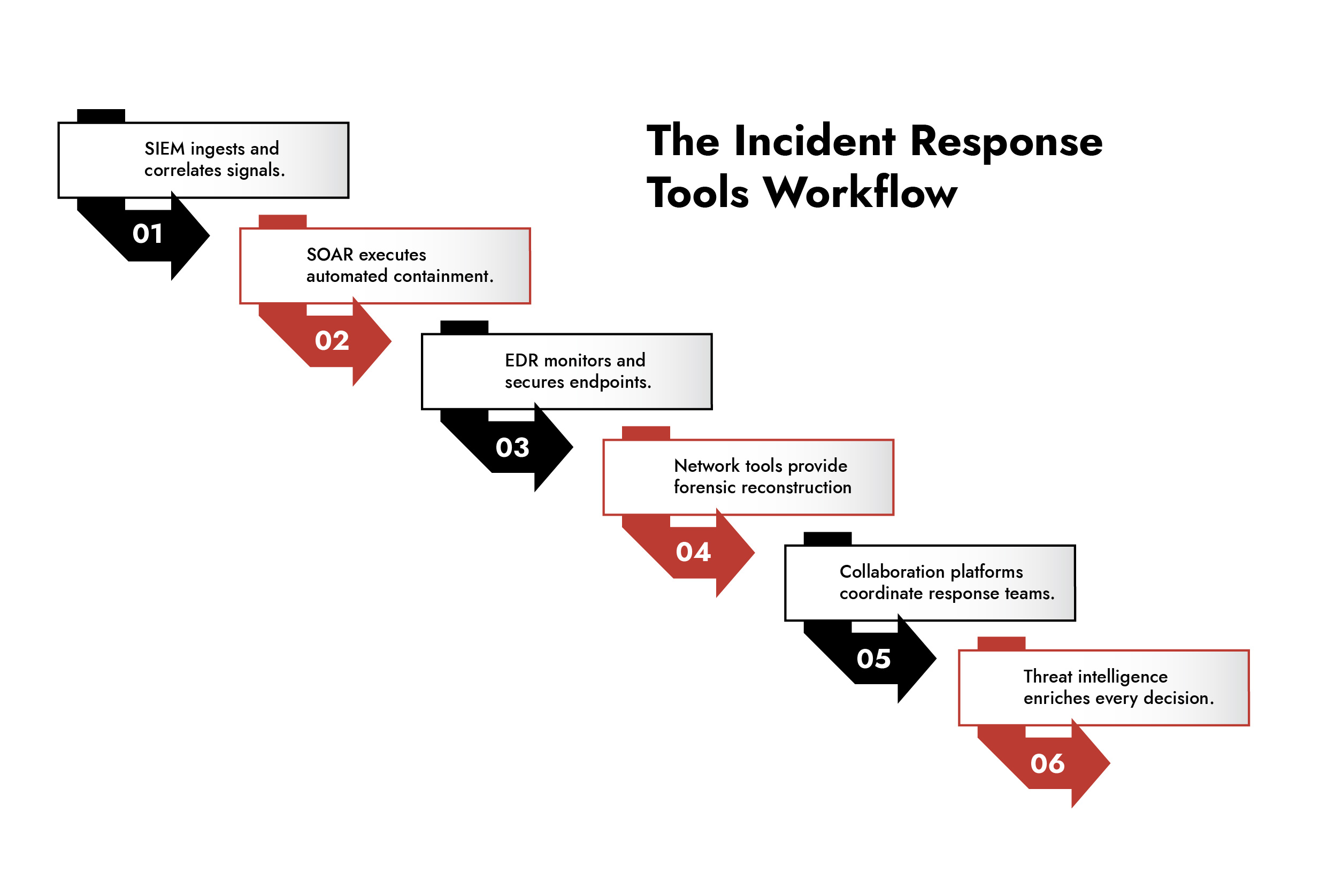
SOAR ties everything together with SIEM, EDR, ticketing, and more to automate incident response workflows using playbooks. This reduces manual effort, speeds containment, and implements remediation without waiting for analyst intervention. A SIEM detects and prioritizes threats. EDR provides endpoint-level forensic detail. SOAR executes the response playbook, isolating a host, resetting credentials, blocking a domain in minutes.
Using EDR, SIEM, and SOAR in conjunction provides comprehensive security coverage: EDR secures individual endpoints, SIEM provides network-wide visibility through log aggregation, and SOAR automates the incident response process itself. Threat intelligence enriches the whole chain by giving analysts and automated systems the context needed to prioritize what actually matters.
The goal isn’t the most tools it’s the right tools talking to each other.
Best Incident Response Tools for Combining Packet Data, Logs, and Endpoint Alerts
The most effective incident response platforms combine packet data, log analytics, and endpoint telemetry into a unified investigation workflow. This gives analysts complete visibility across the attack lifecycle instead of forcing them to pivot between disconnected tools.
SIEM platforms centralize and correlate logs from networks, applications, cloud environments, and security tools. Endpoint Detection and Response (EDR) solutions provide device-level telemetry, process tracking, and forensic evidence. Network traffic analysis and packet capture tools reveal lateral movement, command-and-control communication, and potential data exfiltration attempts.
When integrated through XDR or unified security operations platforms, these tools allow analysts to connect alerts with full packet evidence and endpoint activity in a single investigation timeline. This significantly reduces investigation time, improves threat correlation, and accelerates containment during cybersecurity incident response.
For mature SOC environments, the best approach is not isolated tooling but integrated visibility across network, endpoint, and log data sources.
How to Choose the Best Incident Response Tool
Choosing the best incident response tool starts with understanding where your current response process breaks down.
If your team struggles with alert volume, SIEM correlation and automation may be the priority. If endpoint investigations take too long, EDR capabilities may matter more. If analysts constantly switch between disconnected platforms, unified visibility and integration should be central to the evaluation.
Consider the following factors:
- Integration Capabilities: The tool should integrate with your existing SIEM, EDR, cloud platforms, threat intelligence feeds, IAM systems, and ticketing tools.
- Automation and Playbooks: Evaluate whether the platform supports repeatable workflows and automated actions for common incidents.
- Investigation and Forensic Visibility: Look for the ability to correlate logs, endpoint activity, network traffic, and threat intelligence during investigations.
- Case Management and Coordination: A strong security incident management software platform should help teams assign cases, track actions, document decisions, and maintain audit trails.
- Cloud and Hybrid Environment Support: The platform should provide visibility across cloud, on-premises, endpoint, and network environments.
- Scalability: The incident response management software should handle growing telemetry volumes, users, integrations, and distributed infrastructure.
- Analyst Experience: Complex tools that slow down investigations can create as many problems as they solve. Evaluate how quickly analysts can investigate, pivot between evidence sources, and execute response actions.
The best incident response software is ultimately the one that fits your environment and improves the entire workflow from detection through containment and recovery.
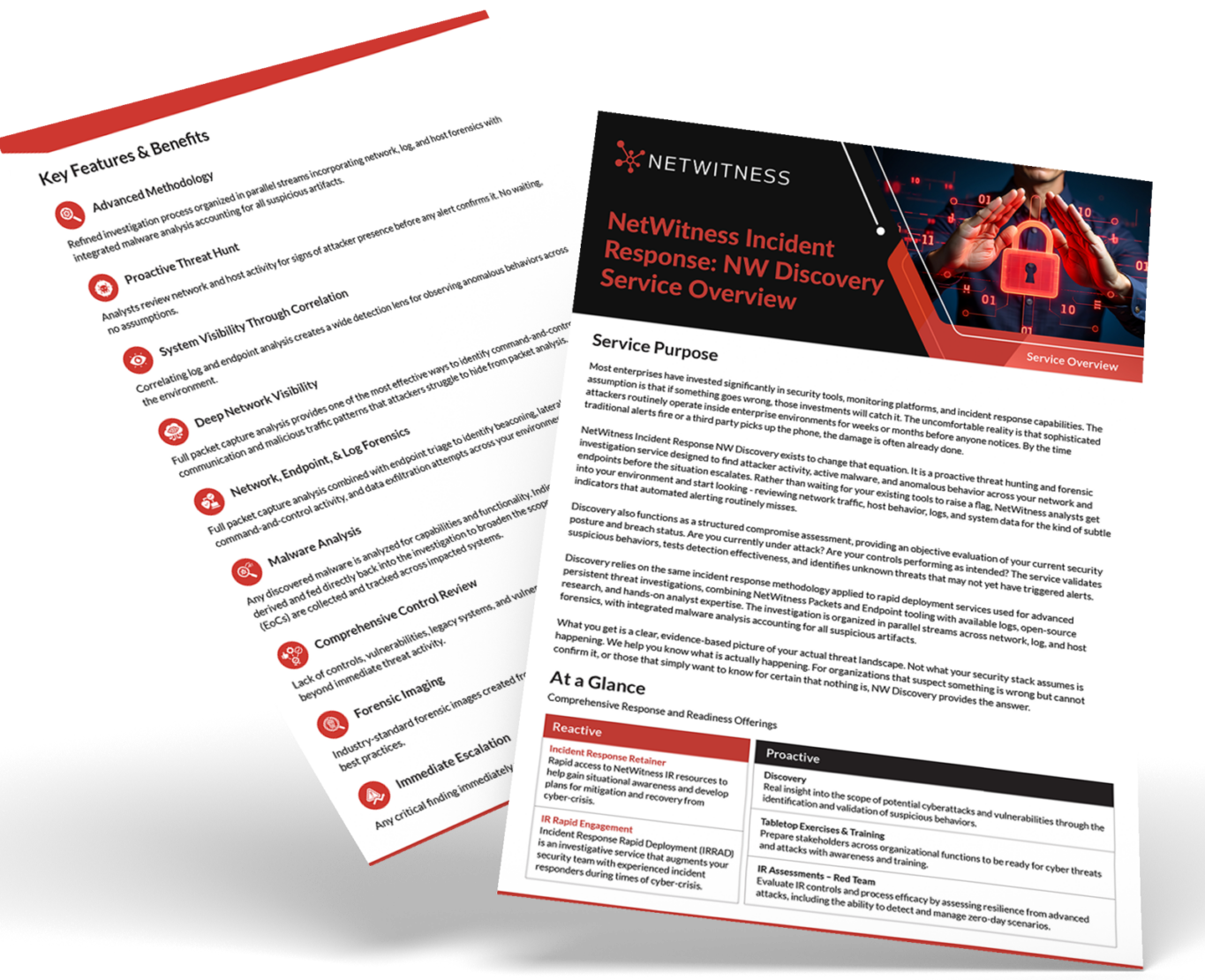
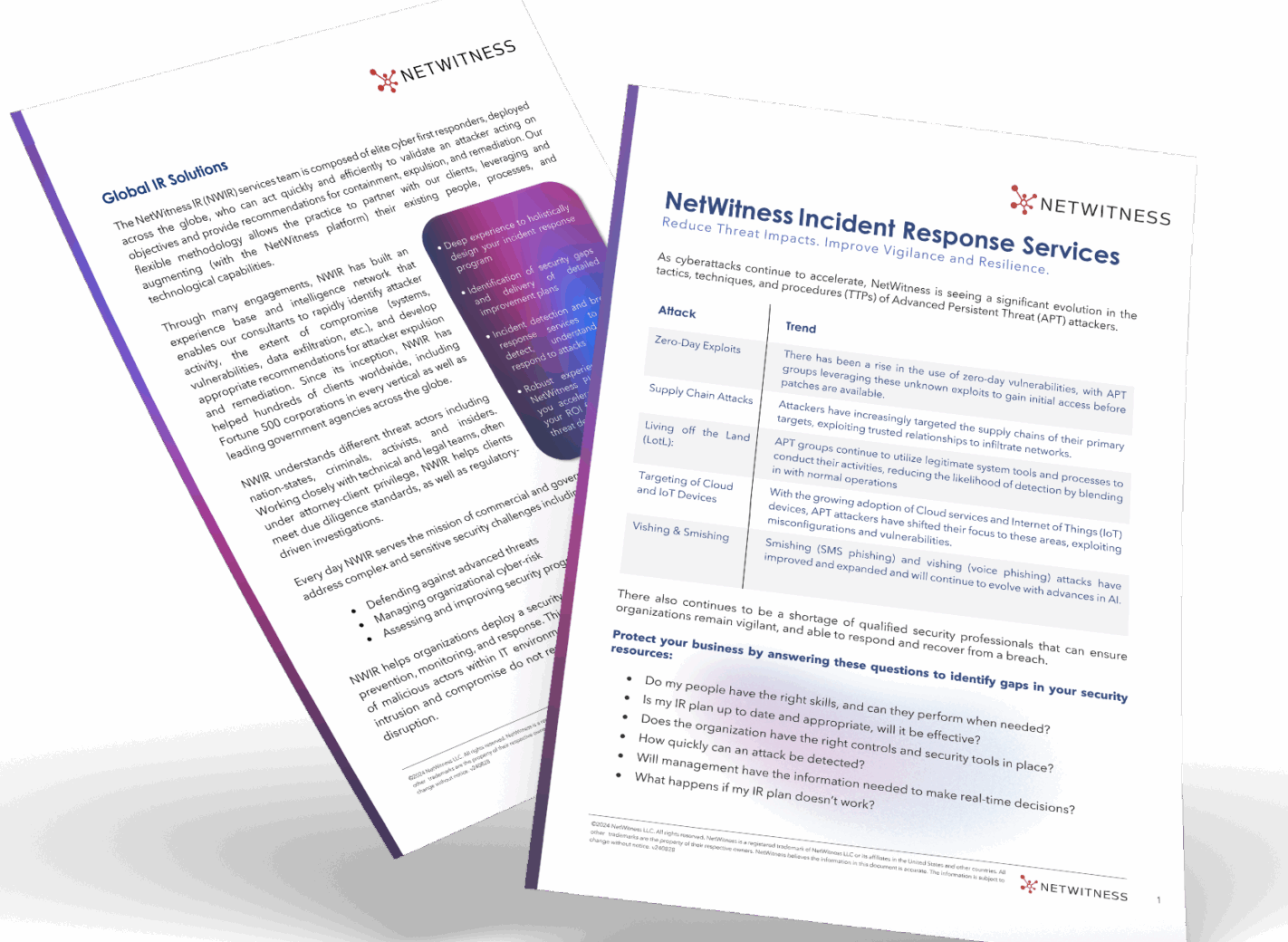
How NetWitness Enhances Incident Response Services and Security
NetWitness Incident Response does not just plug into your stack; it empowers your incident response team at every critical stage with enterprise-grade capabilities:
- Unmatched Visibility: NetWitness captures comprehensive endpoint and network activity, providing the deep visibility needed for precise cyber threat hunting and rapid incident response across hybrid environments.
- Unified Analytics Platform: All critical incident response data – across SIEM functionality, packet capture, endpoint telemetry, and threat intelligence – are accessible through a single console, streamlining analysis and accelerating containment decisions.
- Expert-Led Response: NetWitness combines advanced technology with seasoned incident response professionals who deploy within hours, delivering in-depth forensics, remediation guidance, and continuous improvement recommendations aligned with established incident response frameworks.
- Seamless Integration: The platform integrates with existing security tools and workflows, enhancing rather than replacing current investments while providing the advanced analytics needed for sophisticated threat detection.
NetWitness augments your incident response process at every phase, bridging capability gaps and accelerating response times, ensuring your organization is always prepared for evolving threats.
Conclusion: Incident Response as Competitive Advantage
Modern incident response services go beyond tools. They combine technology, intelligence, and expertise to deliver faster, more effective outcomes.
NetWitness strengthens incident response cyber security by unifying visibility, analytics, and expert-led response into a single platform. This approach ensures organizations can detect, contain, and recover from threats with speed and precision.
For organizations evaluating the best incident management tools, the focus should be on integration, automation, and expert support. Because in today’s threat landscape, effective incident response security is not optional, it is business-critical.