What are the most important incident response lessons from real cyberattack investigations?
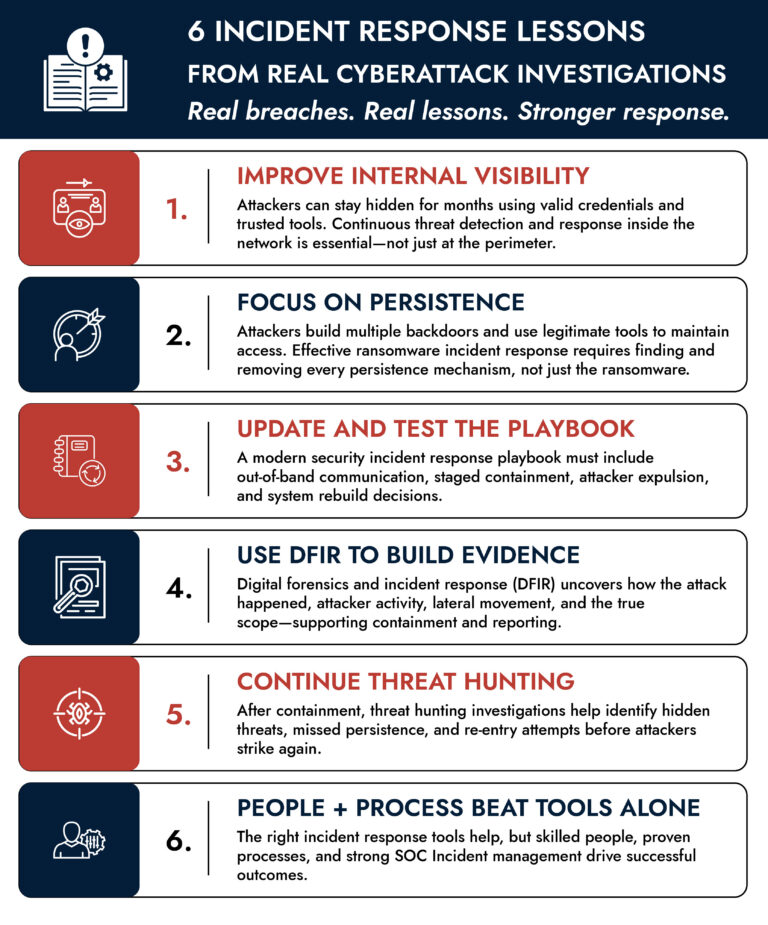
Real-world cyberattack investigations show that attackers often remain undetected for months, making continuous threat detection and response essential. Effective cybersecurity incident response incorporates network, endpoint, and log visibility as well as structured digital forensics and incident response (DFIR), proactive threat hunting investigations, and disciplined SOC incident management. Organizations with a tested security incident response playbooks, the right incident response tools, and access to an experienced incident response service are better equipped to contain ransomware attacks, eliminate persistence, and reduce recovery time.
Introduction
The most useful incident response lessons come from actual cyberattack investigations, not theoretical frameworks. Cybersecurity Incident Response teams develop irreplaceable experience by working against real-world attackers. Cybersecurity incident response in the field consistently surfaces patterns that formal cybersecurity incident response programs miss entirely. This blog pulls directly from documented cyberattack investigations across military, gaming, banking, and critical infrastructure sectors. Every incident response lesson here is grounded in evidence. Every cybersecurity incident response recommendation reflects what actually worked.
These investigations span APT28 activity against an EU military organization, a prolonged ransomware campaign targeting a gaming company, and composite cases built from years of DFIR experience. Despite their differences, the incident response lessons are strikingly consistent.
Cyberattack Investigations Expose How Long Attackers Really Stay Hidden
The most consistent finding across cyberattack investigations: attackers are patient. In a military sector case involving APT28 (Russia’s GRU military unit 26165), the attacker operated undetected for over five months inside a network with segmented architecture, smart card access, physically separated secret and standard networks, and regular patching. The cybersecurity incident response team had to displace an entrenched adversary with five months of environmental knowledge.
The attack began with a spear-phishing campaign exploiting MS Word vulnerability CVE-2015-2424, targeting seven air show attendees and compromising two. The attacker then used stolen OWA credentials to enumerate additional victims, accessed internal calendars and meeting data, and distributed malware inside the organization’s own perimeter.
Threat detection and response capability failed here not because tools were absent but because internal network visibility was limited. The attacker adapted continuously, modifying their dropper after observing which connections the internal proxy blocked. They deployed CORESHELL, EVILTOSS, CHOPSTICK, and Mimikatz in sequence based on what the environment allowed.
The incident response lessons from this class of cyberattack investigations are clear: incident response lessons around visibility consistently show that threat detection and response must operate inside the network continuously, not just at the boundary. Perimeter controls and threat detection and response at the edge will not catch an attacker who is already using your internal trust relationships as a highway. Threat detection and response needs internal telemetry, not just boundary monitoring. These are the incident response lessons that separate organizations who contain attackers early from those who discover them five months in.
Ransomware Incident Response: Why It Takes 45 Days
Ransomware incident response is rarely a quick process. This gaming sector ransomware case delivers some specific incident response lessons on attacker persistence. It is one of the clearest examples of why ransomware incident responses take far longer than organizations expect. Understanding what drives ransomware timelines reframes how organizations prepare. Here, the breach began in December via CVE‑2021‑42321 on an Exchange server, using compromised subcontractor credentials. The ransomware detonated in April yet response and recovery still required 45 days.
By the time ransomware incident response began, the attacker had encrypted backup servers with a separate ransomware variant and infected 50 ESXi servers via SSH, taking down approximately 2,000 virtual machines. The Incident Response team found layer after layer of persistence. Ransomware incident response in cases like this is not just about decryption. It is about dismantling a multi-month operational infrastructure.
- Two webshells on Exchange servers, one spawning PowerShell via w3wp.exe, one supporting arbitrary command execution via a cadataKey parameter and redirecting to a 404 error page when the parameter was absent
- A malicious lsass.dll credential harvester on multiple domain controllers, capturing hundreds of clear-text passwords into C:\windows\temp\tmpQWER.tmp, then distributed across additional servers including domain controllers
- Atera IT management agent and Splashtop remote desktop installed to survive EDR and antivirus, a deliberate technique to avoid triggering cybersecurity incident response tooling
- A distinct second attacker phase beginning February 18th, systematically uploading credential harvesters and remote access tools to Exchange and domain controller systems
The ransomware incident response lesson: attackers use legitimate tools precisely because your cybersecurity incident response tools treat them as clean. Ransomware incident response requires finding every persistence layer, not just the ransomware binary. Skipping this in ransomware incident response means facing the same attack again within months. These incident response lessons around persistence hunting are some of the most operationally important in any ransomware case.
What a Security Incident Response Playbook Misses
Most organizations have cybersecurity incident response playbooks written for a simple, linear breaches. Real cyberattack investigations expose four incident response lessons that standard security incident response playbook templates consistently miss. These incident response lessons come directly from gaps observed in the field.
- Out-of-band communication: In data breach cyberattack investigations, attackers routinely have access to internal email. A security incident response playbook that uses internal channels to discuss the investigation tells the attacker they have been found. Move to out of band, secure communication immediately.
- Staged containment: While the instinct is to isolate immediately, premature action in advanced investigations can tip off the attacker and compromise evidence. The better approach is to establish situational awareness first—mapping ingress, persistence, and timeline—followed by a coordinated, simultaneous expulsion across all access points.
- Expulsion Day protocol: Effective cybersecurity incident response builds toward a single coordinated event where every known access point closes at once. Your security incident response playbook needs an expulsion protocol, not just a containment checklist.
- Law enforcement integration: In cyberespionage cyberattack investigations, law enforcement agencies are often involved alongside the incident response service. Your security incident response playbook must address evidence preservation standards that comply with local law and maintain integrity for legal proceedings.
These are incident response lessons drawn from actual cyberattack investigations. Each incident response lesson exposed a specific gap in how security incident response playbooks are typically written.
Digital Forensics and Incident Response: How Investigators Build the Timeline
Digital forensics and incident response converts suspicion into evidence. In the gaming sector case, digital forensics and incident response work showed two webshells created milliseconds apart in different directories, confirming a chained exploit rather than manual upload. That single digital forensics and incident response finding changed the entire remediation strategy.
DFIR across cyberattack investigations focuses on:
- Actionable IOCs: The NetWitness IR Team’s digital forensics and incident response methodology builds AIOCs from network, host, log, and malware data simultaneously. Unlike atomic indicators, AIOCs capture attacker behavioral patterns and are reused across future cyberattack investigations for faster attribution.
- Lateral movement mapping: Every system the attacker touched, in what sequence, and when. This is the core output of digital forensics and incident response work and the backbone of any attack timeline.
- Credential abuse reconstruction: Which accounts were compromised, when privilege escalation occurred, and how. In the APT28 case, forensic analysis tracked the attacker adapting tools in real time to bypass controls as they encountered them.
- Exfiltration scope: By the third phase of the gaming sector attack, evidence confirmed data exfiltration. DFIR efforts centered on defining what left the network, via which channels, and when—critical inputs for remediation and regulatory obligations.
Threat detection and response is only as effective as the forensic foundation beneath it. Digital forensics and incident response establishes that foundation. Without it, teams operate on incomplete visibility, making decisions without the full evidence base. Detection and response accuracy ultimately depend on the depth and quality of the forensic groundwork.
Incident Response Doesn’t Stop at Expulsion – Threat Hunting Necessary
Expulsion day closes the active incident. It does not close the risk. Consistent incident response lessons across sophisticated cyberattack investigations show that advanced actors return. This is one of the most critical incident response lessons from APT-level cases. Threat hunting investigations after expulsion are how you catch them before they re-establish access.
Threat hunting investigations in the post-incident phase look for anomalous device connections, traffic patterns matching the attacker’s prior behavior, unauthorized account or policy changes, and reappearance of known malware families in new locations. Threat hunting require active, human-led analysis, not passive alerting.
In cyberespionage cases, threat hunting investigations continue well beyond formal incident closure because sophisticated actors will attempt re-entry once expelled. Network monitoring and ongoing threat hunting are the primary mechanisms for detecting this. Following major breaches including the UN agency compromise and large-scale supply chain attacks only proactive threat hunting detected re-entry attempts, while automated alerting mechanisms failed to do so.
The incident response lesson is direct: threat hunting investigations are not optional in advanced cybersecurity incident response. This is one of the incident response lessons most commonly learned too late. In sophisticated cyberattack investigations, threat hunting investigations are how you confirm the environment is actually clean, not just how you react to obvious alerts.
Incident Management and Active Directory Attacks
Active Directory (AD) compromise demands different incident management than most other incidents. AD controls network-wide access. An attacker with AD control has escalating freedom across every connected system, which means incident management for AD attacks cannot take the observational approach that works in data breach scenarios.
SOC incident management teams regularly encounter AD compromise as part of ransomware and APT cyberattack investigations. Common tools in these cases include Mimikatz for credential harvesting, Pass-the-Hash and Kerberoasting for privilege escalation, group policy modification, and creation of hidden admin accounts. Proper incident management must account for all of these and more.
Effective incident management in AD cases requires immediate account auditing and privilege revocation, forensic identification of every system that accessed AD servers during the attack window, continuous traffic monitoring targeting AD infrastructure, and verification that all modified components are cleaned before restoration. ncident management teams that restore AD without completing this verification risk leaving shadow admin accounts the attacker created and can return through.
Incident response lessons for AD attacks differ significantly from traditional playbooks. AD compromise is almost never the end goal; it is a means to a broader objective. IR teams must therefore handle AD incidents as a dedicated investigation track while concurrently mapping them to the wider attack campaign.
Incident Response Tools Are Not the Gap
The instinct after a breach is to buy new incident response tools. The gaming sector case shows why that logic is incomplete. EDR and antivirus were both in place. The attacker bypassed both using Atera, legitimate IT management software. The incident response tools were not the problem. Visibility into how legitimate software was being used was.
Incident response tools only produce value when correlated. Individual incident response tools generating isolated alerts, without cross-referencing network, endpoint, and log data together, produce noise. Incident response tools generating isolated alerts, without cross-referencing network, endpoint, and log data together, produce noise. Incident response tools are foundational infrastructure detection value is ultimately driven by the processes and human expertise applied to them.
After remediation, the gaming organization added enhanced network visibility, dedicated daily monitoring staff, banned Splashtop, TeamViewer, and AnyDesk, removed hardcoded credentials from scripts, and built new cybersecurity incident response procedures. None of these required new incident response tools. All of them addressed the actual gaps.
The incident response lessons on tooling are consistent across these cyberattack investigations: incident response tools need integrated visibility and human oversight to function as intended. Incident response tools alone, without methodology, are incomplete.
What an Incident Response Service Brings to the Investigation
In the APT28 case, early attribution shortened the entire investigation timeline. That attribution was possible because the outside Incident Response (IR) service provider brought Actionable IOCs from prior cyberattack investigations involving the same threat actor. Pattern recognition accumulated across dozens of cyberattack investigations is something individual organizations cannot build from a single breach.
An experienced incident response service working across APT campaigns, ransomware cases, and data breaches across multiple sectors brings that library from day one. The incident response service recognizes tool combinations, behavioral patterns, and attacker objectives that expand the investigation scope in the right direction immediately, rather than discovering those connections over weeks.
NetWitness IR in the APT28 case combined parallel host forensics and malware analysis, systematic AIOC cataloguing, and mass-triage using EDR loaded with investigation-specific IOCs. That incident response service methodology displaced an attacker with five months of environmental access.
The lessons around professional incident response service engagement are among the most important in this document: speed of attribution from an experienced IR Provider reduces total incident duration. Experienced IR providers apply advanced, field-tested methodology drawn from similar investigations, eliminating guesswork in prioritization and ensuring expulsion day closes all attacker access not just a portion of it.
Improve incident response effectiveness with rapid assessment and expert guidance.
- Investigate suspicious events and indicators of compromise
- Determine attack scope and potential business impact
- Support containment and remediation efforts
- Deliver clear recommendations for next steps
Final Incident Response Lessons
These final incident response lessons synthesize what every cyberattack investigation in this set consistently showed. Attackers are patient. They use your tools against you. They target credentials, backups, and AD because those are the highest-leverage objectives. And they plan around the assumption that cybersecurity incident response will be reactive.
The organizations that achieved the fastest incident resolution combined integrated visibility, rigorous digital forensics methodology, continuous threat hunting, and disciplined incident management, all supported by playbooks built for adaptive adversaries. In the most successful cases, experienced IR providers accelerated outcomes through cross-case pattern recognition that enabled early attribution.
These incident response lessons from documented cyberattack investigations are actionable today. Whether these incident response lessons reshape how you build your cybersecurity incident response capability before the next incident starts is the only question that matters.
Frequently Asked Questions
1. What Are Incident Response Lessons Learned?
Incident response lessons learned are the insights gained after a security incident to identify what worked, what failed, and how to improve future cybersecurity incident response efforts. These findings help strengthen the security incident response playbook and overall security posture.
2. How Do Cyberattack Investigations Improve Incident Response?
Cyberattack investigations reveal how an attack occurred, what systems were affected, and where security gaps exist. This information helps teams improve threat detection and response, refine processes, and prevent similar incidents.
3. What Are Common Incident Response Lessons Learned From Recent Cybersecurity Breaches?
Common lessons include the need for faster threat detection and response, stronger communication, regular ransomware incident response testing, and improved visibility through digital forensics and incident response capabilities.
4. Which Incident Response Tools Offer Integrated Lessons Learned Reporting Features?
Many SIEM, SOAR, XDR, and digital forensics and incident response platforms include reporting features that document findings, track remediation efforts, and support continuous improvement after incidents.
5. How Do Industry Leaders Incorporate Lessons Learned Into Their Incident Response Plans?
Industry leaders review findings from incidents and cyberattack investigations to update their security incident response playbook, improve SOC incident management, and enhance future response readiness.
6. Why do attackers remain undetected for extended periods?
Key Insight: Visibility gaps not tool gaps—enable persistence.
Real-world cyberattack investigations consistently show that attackers can operate undetected for months, even in well-defended environments. This persistence is driven by limited internal visibility and insufficient continuous monitoring. Attackers exploit trusted internal pathways, adapt their techniques in response to controls, and operate within normal system behavior. Effective threat detection and response must extend beyond the perimeter and operate continuously across network, endpoint, and identity layers.
7. Why does ransomware incident response take longer than expected?
Key Insight: Ransomware is the end of a campaign not the beginning.
Ransomware incidents represent the final stage of prolonged attacker activity, often involving multiple layers of persistence, compromised backups, and use of legitimate tools to evade detection. Incident response is not just about restoring encrypted systems—it requires dismantling the underlying attacker infrastructure. Without full persistence identification and removal, organizations face a high probability of reinfection.
8. What do standard incident response playbooks miss?
Key Insight: Playbooks fail when adversaries adapt.
Traditional incident response playbooks are often built for linear, observable breaches, but real-world investigations reveal adaptive adversaries who monitor and respond to defensive actions. Critical gaps include lack of out-of-band communication, premature containment actions, absence of coordinated expulsion strategies, and insufficient legal and evidence handling considerations. Effective playbooks must anticipate adversary awareness and operate accordingly.
9. Why are incident response tools alone insufficient?
Key Insight: Tools require methodology and human expertise to deliver value.
Cyberattack investigations consistently demonstrate that tools are not the limiting factor usage is. Even with advanced EDR and antivirus in place, attackers bypass controls using legitimate software and trusted processes. Without integrated visibility, structured methodology, and human-led analysis, tools generate noise rather than actionable detection. Effective incident response depends on correlating data across sources and applying disciplined operational processes.
Measure how effectively your organization detects and responds to cyber threats.
- Controlled attack simulations tailored to your environment
- Validate security controls and response workflows
- Assess team coordination and decision-making
- Improve readiness with detailed findings and guidance