Why incident response in healthcare matters more than ever
Healthcare organizations can’t just treat incident responses as a compliance exercise anymore. Today’s attacks simultaneously target patient records, connected medical devices and clinical operations. The best response to an incident in healthcare is a combination of fast detection, forensic visibility, coordinated containment and recovery planning to reduce patient safety risk, limit operational disruption and meet regulatory obligations before small incidents become major crises.
Cyberattacks in Healthcare: A Critical Issue Beyond IT
Healthcare organizations do not determine downtime in the same way as other industries do. Any minute of disruption leads to a delay in treatment, cancellation of surgeries, disruption to drug delivery, or clinicians being unable to access patient information.
This situation has resulted in incident responses in healthcare becoming one of the most important features of contemporary cyber security systems. Protecting electronic health records, connected medical devices, imaging instruments, cloud-based applications, and hybrid infrastructure requires more than prevention. Security departments need to detect attacks quickly, know what happened, and eliminate potential threats.
The problem is continuously getting more acute. The IBM Cost of a Data Breach Report for 2024 indicates that healthcare has had the highest average expense due to breaches for the fourteen years in a row – $9.77 million. At the same time, ransomware attacks continue to be one of the biggest threats to healthcare, to which the FBI, CISA, and HHS still keep issuing warnings.
How Incident Response in Healthcare Protects Patient Care
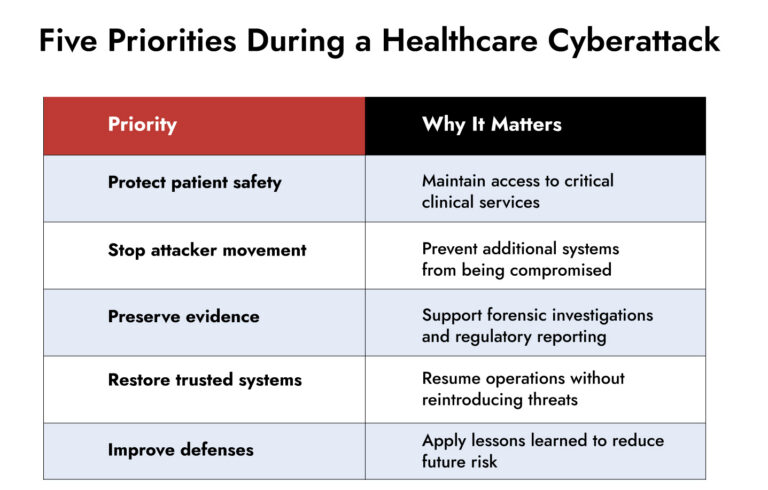
An effective incident response in healthcare minimizes the impact of cyberattacks before they disrupt clinical services or compromise sensitive data.
Unlike traditional response processes, healthcare cyber incidents require security teams to balance technical containment with patient safety. Disconnecting a compromised system may stop malware, but it could also interrupt diagnostic equipment or delay emergency care.
An effective healthcare incident response plan should focus on:
- Detecting threats before they spread
- Prioritizing critical clinical systems
- Protecting electronic health records
- Preserving forensic evidence
- Restoring operations safely
- Meeting HIPAA and regulatory reporting requirements
But imagine this scenario: You’ve received a report of ransomware on your imaging server. To contain the threat appropriately, you need to understand if it’s moved to your PACS system, medical devices, Active Directory, or cloud workloads. If you lack complete visibility, you’ll either over-react or give attackers opportunities to stay within your environment.
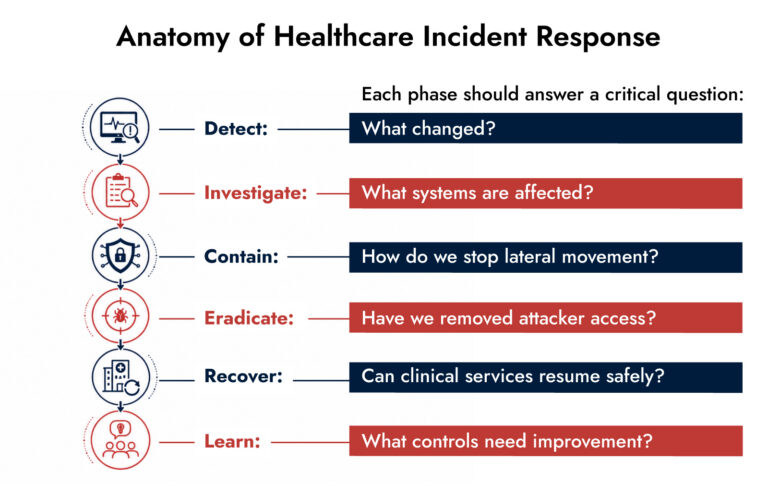
Why Traditional Security Tools Miss Modern Healthcare Attacks
Many healthcare environments operate dozens of security products, yet attackers still remain undetected for days or weeks.
The problem isn’t always a lack of security tools. It’s fragmented visibility.
Today’s healthcare environments include:
- On-premises EHR platforms
- Multi-cloud workloads
- Remote clinical staff
- IoMT (Internet of Medical Things) devices
- Legacy medical equipment
- Third-party vendors
Each generates telemetry independently.
This means attackers are taking advantage of those blind spots, moving laterally from system-to-system while evading detection.
In today’s environment, incident response in healthcare increasingly involves security platforms that can correlate various types of data sources – including network traffic, endpoints, identities, clouds and threats – together during an investigation.
According to Verizon’s most recent report about data breaches (the 2025 Data Breach Investigations), “Ransomware played a significant role in breach investigations across all critical infrastructure sectors,” he said, adding this highlights the need for speedier detection and investigation.
Best Practices for Incident Response in Healthcare
Strong incident response in healthcare starts long before an attack occurs.
Organizations should build repeatable processes that security teams can execute under pressure.
Key best practices for incident response in healthcare include:
- Develop and regularly test a healthcare incident response plan.
- Classify systems based on clinical importance.
- Continuously monitor endpoints, network traffic, cloud workloads, and identities.
- Practice ransomware tabletop exercises with IT, legal, compliance, and clinical leadership.
- Maintain offline and immutable backups.
- Preserve forensic evidence before restoring affected systems.
- Review every incident to strengthen future response.
Consider a ransomware attack against a regional hospital. If responders isolate compromised systems within minutes, validate backup integrity, and confirm that attackers never reached clinical databases, patient care continues with minimal disruption. Without rehearsing procedures, the same attack could halt admissions for days.
Tools Used in Incident Response for Healthcare Providers
In the healthcare sector, effective incident response necessitates not only alerts but also improved environmental situation awareness, threat context and coordination within the organization’s various departments. The most efficient tools of incident response usually consist of several cooperating devices, which include:
- NDR technology that is used to track any suspicious network activities or movements throughout the network, as well as communications inquiring about control over networks.
- EDR technologies that are used to trace devices that have been compromised and processes that can be defined as malicious, as well as any unauthorized operations with computers or servers.
- SIEM technology that gathers logs in one place coming from different security products, programs, and infrastructure.
- SOAR program that helps in saving time on tasks that are too repetitive for professionals and assisting them during investigations.
- Threat intelligence resources provide information related to attacks and types of covering malware, as well as indicators of compromise.
- Digital forensics technologies that provide the ability to save evidence for subsequent investigation, reporting for follow control, and review of incidents.
We’re not building out additional tools – instead we want them to work together to help reduce your investigation time and enhance your decisions during an active incident.
How NetWitness Strengthens Incident Response in Healthcare
Technology alone doesn’t stop cyberattacks, but it can give responders the visibility they need to act decisively.
NetWitness helps healthcare organizations strengthen incident response in healthcare by combining network telemetry, endpoint visibility, log analytics, threat intelligence, and automated investigation workflows into a unified platform.
Its capabilities help security teams:
- Detect threats across hybrid healthcare environments.
- Investigate incidents using deep forensic evidence.
- Correlate network, endpoint, and log data to reduce false positives.
- Track attacker movement across clinical and enterprise systems.
- Support compliance investigations with detailed forensic records.
- Accelerate recovery while maintaining operational continuity.
Rather than forcing analysts to investigate disconnected alerts, NetWitness helps them understand the complete attack story – from initial compromise to remediation.
Strong Incident Response Protects More Than Data
All healthcare institutions anticipate cyber threats to some extent. However, differences can arise regarding how such threats are detected, investigated, and recovered from.
A strong incident response program enables patient data protection, thereby sustaining patients’ trust and allowing medical practitioners to perform their job effectively otherwise. By employing time-tested procedures, skilled responders, and consolidated techniques of cyber security, a healthcare institution can avoid operational disturbances and increase its response efficiency.
Assess your visibility, run drills on how to manage threats, and acquire technology tools that will help you with managing threats.
Frequently Asked Questions
1. What are the best software solutions for incident response in healthcare?
Top solutions merge SIEM, NDR, EDR, SOAR, threat intelligence, and forensics. With integrated systems, security teams can identify problems, investigate events, and react quickly while keeping an eye on what’s happening in healthcare and other organizational environments.
2. What are the steps for creating an incident response plan in healthcare?
In developing an incident response plan for health care, important steps must be taken to understand vital elements in planning including identifying key assets, establishing response night, implementing communication processes, and the documenting containment and recovery processes, as well as identifying regulatory reporting needs.
3. How do healthcare organizations implement incident response plans?
Organizations must ensure that technical controls conform to clinical priorities, run simulations, integrate security tools, keep updated asset inventory parameters, and improve procedures based on real-life learnings.
4. What key features should healthcare incident response tools include?
Use of specialized tools offers hospitals many advantages, including ability to gain centralized visibility, conduct forensic investigations, implement threat intelligence, track endpoints, enhance network detection capabilities and fully automate the response process.
5. What are the best practices for managing a ransomware attack in a hospital?
Key actions to effectively manage incidents in hospitals are these: isolate infected systems, protect crucial and sensitive business processes, gather information about the incident, make sure the backup is clean prior to restoration, inform involved parties, and learn the lessons from the incident.
6. What incident response services are most valuable for hospitals and clinics?
Hospitals utilize many different services, including readiness assessments, responses to ransomware attacks, forensic analyses, vulnerability assessments, proactive threat hunting, and tabletop exercises, to deal with cybersecurity.
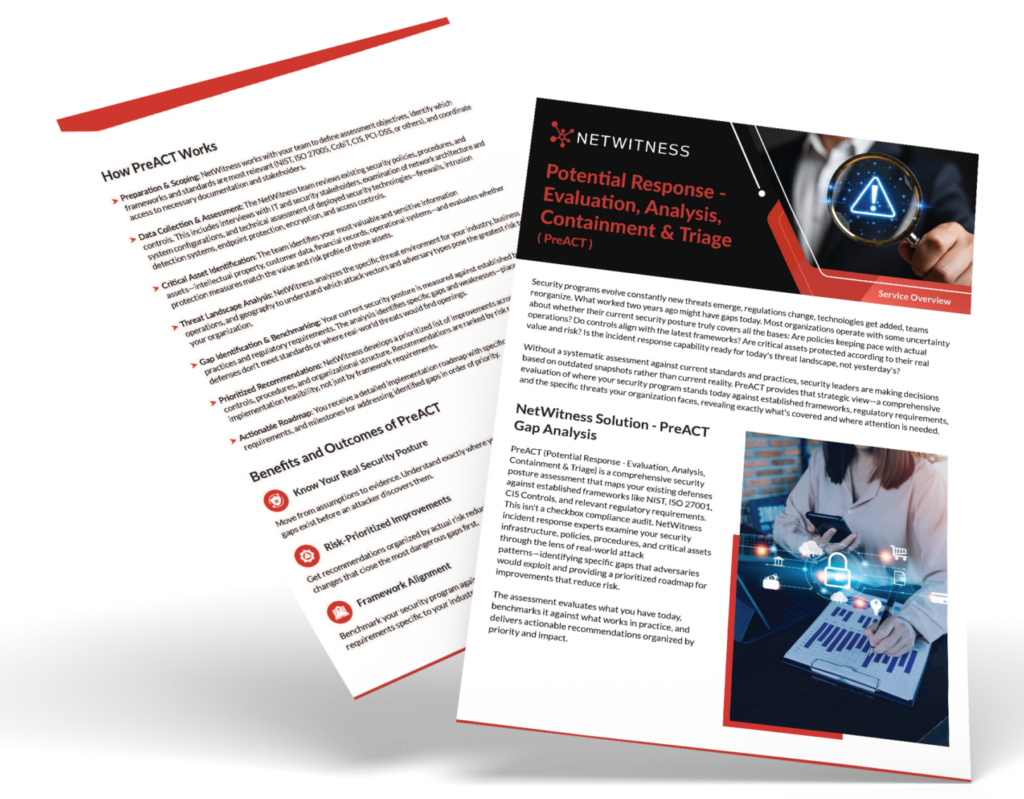
Improve incident response effectiveness with rapid assessment and expert guidance.
- Investigate suspicious events and indicators of compromise
- Determine attack scope and potential business impact
- Support containment and remediation efforts
- Deliver clear recommendations for next steps