Why Evidence Retention Matters in Incident Management?
Incident response can still fail even after quick detection by the security staff. In case where the required logs had been rolled, no packet was recorded, or any evidence from the endpoint is not retained due to the incident response process, then the investigators cannot determine the level of compromise and secure a successful conclusion to the problem. Evidence retention policies give instructions on what needs to be collected, retained, and protected.
Incident Management Needs Evidence that Survives the Incident
An incident ticket could indicate that a compromised account has accessed a sensitive server at 02:13. So the timestamp is just a clue and not a complete explanation. Security teams must also determine how the account was compromised and what has been accessed because it is crucial to find out whether any data has left this environment and if the same actions were repeated somewhere else.
This must be done based on different evidence that can be gathered from various systems, such as user identity logs, endpoint monitoring systems, DNS information, firewall logs, network traffic, cloud auditing records, and application logs. Each of these sources has its methods of data collection, data retention periods, and access measures. In case teams begin to collect this evidence only after declaring an incident, then it is quite possible that the most valuable evidence can be lost.
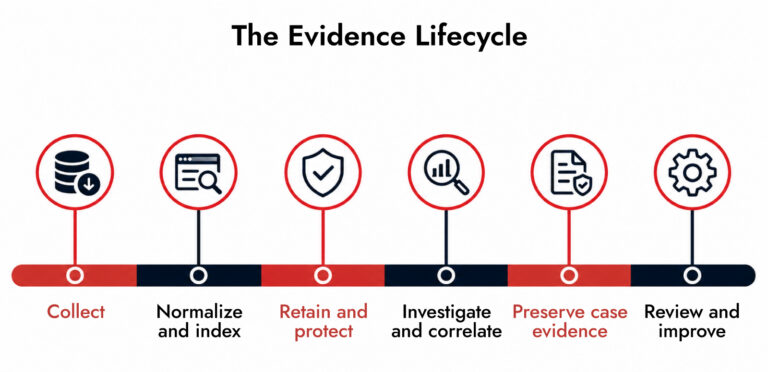
Therefore, the process of incident management presupposes that evidence retention should be treated as an operation process rather than an administrative measure to be conducted after a containment. Detection strategies can change. Systems can be built again. Credentials can be blocked. All the necessary information must be kept in its original form to be helpful for investigation conduct.
What Goes Wrong when Evidence is Missing
The most damaging retention gaps are often invisible until an investigation asks a question the available data cannot be answered.
- Expiration of logs: A SIEM tool might detect an incident that started weeks ago, but the corresponding logs might not be available because they have already expired.
- Containment alters evidence: If a device gets reimaged or an infected file deleted before preserving evidence, forensic artifacts will no longer be available.
- Insufficient network records: While flow logs can indicate communication between systems, they cannot show protocol interaction and payload details necessary to understand what really happened. Full packet evidence might help if it is captured and saved.
- Clock skew: Drift in timestamps on endpoints, identity systems, cloud infrastructures, and network sensors might make incidents look unrelated.
- Unclear chain of custody: An incomplete chain of evidence (including capture, handling, access, and integrity checks) will make it harder to use collected data legally.
- Variable retention period: One system might store one type of evidence for a long time, while others retain it for a short period only.
Consequently, the impact on operations is clear: more effort will go into recreating information that is recoverable. However, key questions will still go unanswered. Incident management will be hard to complete. There will be no way to separate verified information from assumptions.
Define What Must be Retained before an Incident Occurs
Retention strategies should start by identifying the investigation questions and mapping them to the data sources. For example, what proof will need to be obtained when the attacker gains access to the system through the use of stolen credentials, accessing a production database, or interrupting an industrial process? The second step should focus on the period that the data sources will need to be retained in order to answer the question.
It is unlikely that all records can be kept forever, while keeping only alerts leaves you open to weaknesses in your strategy. What will be best depends on business risk, investigative requirements, legal requirements, privacy concerns, and cost of collecting and retaining data.
| Evidence source | What it can help establish | Retention considerations |
| Identity and access logs | Authentication, privilege changes, unusual access and account misuse | Include identity-provider and privileged-access records; preserve relevant events before short source-side windows expire |
| Endpoint telemetry | Process execution, persistence, file changes and host activity | Define what agents collect, which events are retained centrally, and how evidence is captured before rebuilding |
| Network metadata and flow records | Communication patterns, destinations, volume and timing | Useful for broad historical searches, but may not answer content-level questions |
| Full packet capture | Protocol exchanges and recorded communications, subject to capture coverage and encryption | Prioritize high-risk network segments and define capture filters, capacity, access and retention periods |
| DNS, firewall and proxy logs | Name resolution, connection attempts, allowed or blocked traffic | Keep enough context to link a host, user, destination and time window |
| Cloud and SaaS audit logs | API activity, workload changes, access and configuration changes | Check provider-specific retention, export delays, tenant coverage and regional requirements |
| Application and database logs | Actions against business services and sensitive records | Ensure the logging level can answer investigation questions without collecting unnecessary sensitive data |
| Incident records and forensic artefacts | Decisions, collection history, findings and response actions | Preserve original copies, document handling, and restrict changes to the investigation record |
Retention time of logs should be determined by how much time attackers require to be identified and how far the investigation of their actions can go. As indicated in M-Trends 2026 report by Mandiant, median time required for investigations of actions taken in 2025 was 14 days worldwide while for 2024 it was 11 days. It is important to note that the 14 days do not represent a retention requirement but is only a median, and there were cases where attacks lasted longer than this.
Preserve Evidence without Compromising its Integrity
Data retention only helps when investigators can trust the data they retrieve. A record may be present but still be difficult to use if its origin is unclear, its timestamp is unreliable, or someone modified it without a record of the change.
An enterprise evidence-handling procedure should define:
- Synchronization of time: Log time sources and consider clock skew when correlating events between systems.
- Checking integrity: Apply appropriate hash functions or similar controls to identify alterations made to the exported evidence or forensic image.
- Chain of custody: Maintain records of those collecting, transferring, accessing, and storing the evidence, along with the date, time, and reason.
- Restriction on access: Control access based on the role and maintain logs for access to investigative material.
- Separate work copy: Maintain a controlled original copy and conduct analysis on its copy if the nature of the evidence allows so.
- Retention and hold: Coordinate regular deletions with legal, regulatory, privacy, contractual, and investigation needs. Suspend regular deletions if a proper hold is in place.
The NIST incident-handling guidance emphasizes the necessity of documenting preservation of evidence and information on how evidence was transferred from one handler to another. It is crucial for organizations to determine the methods for this transfer of evidence beforehand.
Make Retention Useful to Incident Responders
The value of retained evidence is measured by what an analyst can do with it during an investigation. A long retention window is of limited use if the team cannot search for the data, understand its source, or correlate it with other events.
Cyber Incident Management should therefore connect retention decisions to the workflow responders actually follow:
- Validate the alert. Retrieve the underlying event and the surrounding telemetry, not just the alert summary.
- Build the timeline. Normalize timestamps and correlate identity, endpoint, network, cloud, and application activity.
- Scope the incident. Search for the same account, destination, process, file indicator, or behavior across other systems and earlier time periods.
- Preserve relevant evidence. Export or isolate the records and artifacts needed for deeper forensic analysis, documenting collection, and integrity checks.
- Verify containment and recovery. Search retained data for signs of continued access, repeated command-and-control activity, or related systems that were missed.
- Record the conclusion. Separate confirmed facts from hypotheses, document evidence gaps, and identify which retention controls need improvement.
It also helps improve decision making for leadership. In case the investigators are unable to establish whether the sensitive information was compromised or not, then they must be in a position to clearly state what they have and what they lack.
Account for Operational Constraints and Business Risk
Retention policy cannot ignore cost or production impact. Full packet capture, detailed endpoint telemetry, and verbose application logging can generate substantial data volumes. Manufacturing and OT environments add another constraint: collection changes must not jeopardize availability, safety, or support arrangements for critical systems.
A workable Incident Response Strategy should assign retention tiers based on the consequences of losing the evidence.
- High-priority sources: Preserve data needed to investigate privileged access, critical business systems, regulated environments, and high-risk network segments.
- Broad historical telemetry: Keep searchable logs, metadata, and flow records for cross-environment scoping and trend analysis.
- Incident-specific evidence: Place relevant logs, packet records, endpoint artefacts, and analyst notes under controlled preservation when an incident warrants it.
- Restricted or sensitive data: Apply access controls, data minimization, encryption, residency requirements, and approved deletion schedules.
Test the design with realistic questions. Can the team reconstruct activity before an alert? Can it investigate a remote site if its local device has already overwritten older logs? Can it link an identity event to network communications? Can it explain what the sensors did not capture? The answers expose gaps that a policy document alone will not.
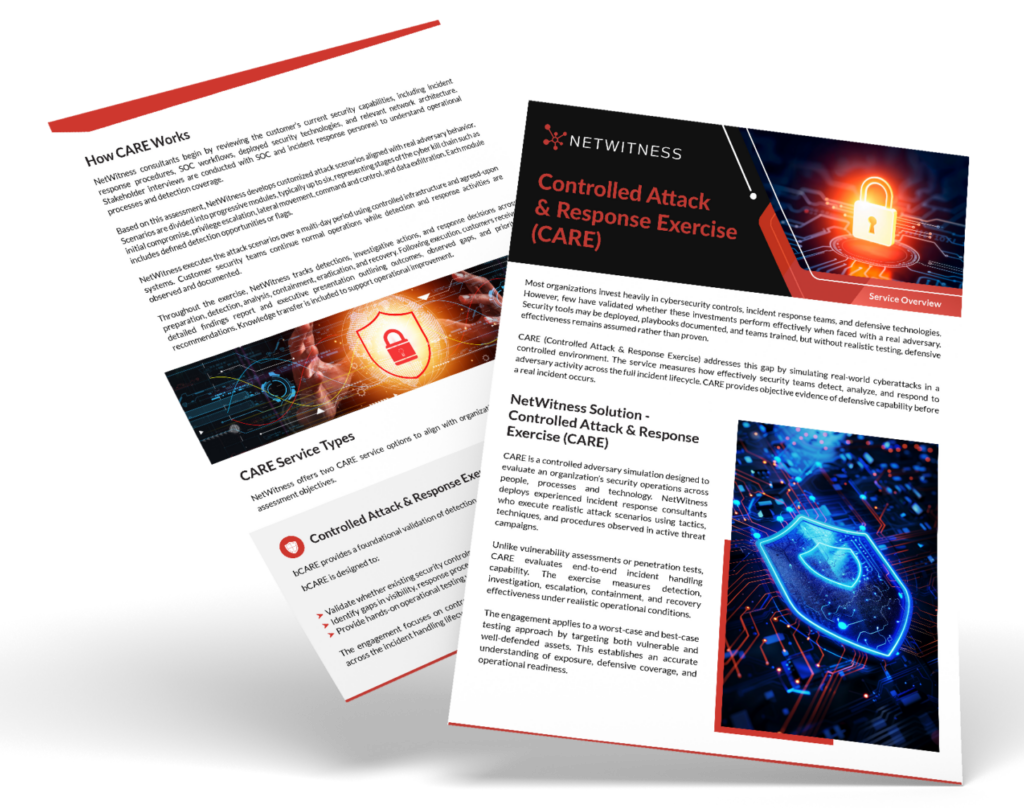
Measure how effectively your organization detects and responds to cyber threats.
- Controlled attack simulations tailored to your environment
- Validate security controls and response workflows
- Assess team coordination and decision-making
- Improve readiness with detailed findings and guidance
How NetWitness Supports Evidence-led Incident Management
While the problem for enterprise defenders is not only growing telemetry storage, but also keeping enough context. This helps investigations after detection, so teams can trace an attack across all its parts. NetWitness brings all of these together:
- NDR: Network metadata, NetFlow, and packet capture allow investigators to analyze communications and analyze suspicious sessions. How far back a retrospective investigation can go depends on the information collected by the deployment.
- SIEM: Log management and analysis enable investigation teams to correlate events across interconnected systems and look for activities that occur within the timeline of the incident.
- EDR: Endpoint telemetry provides additional host-level context that enables analysts to connect network activities with process executions and other endpoint activities recorded by the system.
- UEBA and behavioral analytics: Behavioral information might enable investigation teams to detect other anomalies and expand the investigation based on the findings from the original alert.
- SOAR: Incident response workflows can facilitate consistent investigation processes and record the activities during investigation and response, based on the set up of integrations and playbooks.
- Network forensics: Network data collection and session reconstruction can help analysts analyze past communications and conduct investigations of activities that cannot be explained by an alert.
These functions can be applied to many stages of the evidence lifecycle. They do not ensure that evidence remains preserved in all cases, as the coverage that they provide depends on implementation, configured data sources, collection parameters, storage capacities, retention period, and available historical data.
In addition, NetWitness also provides services related to incident response, such as rapid containment and forensic analysis, compromise assessment, and incident response retainer services. These services can support customers who need specialized investigation services or want to check their preparedness for large-scale incident response requirements.
For CISOs and security specialists trying to determine the success of the current strategies, the right question would be: Are we able to gather and correlate all evidence to understand what happened during an incident even after the situation is already under control regarding the involved system? Please do it not based solely on the features of the solutions that you use but considering your actual coverage of the different types of environments (i.e., network, endpoint, logs, cloud, and OT).
Evidence Readiness Scorecard
Can your team reconstruct a cyber incident after the evidence is gone?
Score each evidence source based on whether responders can retrieve and trust the data during an investigation.
Score your evidence readiness
Evidence source | 0 – Unavailable | 1 – Partial | 2 – Investigation-ready | Score |
Network | No relevant traffic records | Flow or metadata only; limited history | Relevant records searchable; packet evidence retained where required and captured | /2 |
Endpoint | No usable endpoint history | Basic alerts or short retention | Historical telemetry and relevant forensic artefacts retrievable | /2 |
Identity | Authentication and privilege events unavailable | Incomplete logs or limited retention | Login, access, and privilege-change records searchable over the required period | /2 |
Cloud | Audit events unavailable | Partial services, accounts, or time coverage | Relevant cloud audit records centrally accessible and retained | /2 |
Applications | No useful application or database logs | Basic events without sufficient context | Logs support investigation of relevant user actions and system activity | /2 |
OT / Manufacturing | No usable security evidence | Limited monitoring or restricted historical access | Available OT evidence can be retrieved without compromising operational safety | /2 |
Interpret your score
Maximum score: 12
- 0-4 | Critical evidence gaps: Investigations may lack the records needed to establish scope or verify containment. Prioritize high-risk sources with a score of zero.
- 5-8 | Partial readiness: Some evidence is available, but gaps in coverage, retention, or retrieval may delay investigations.
- 9-12 | Stronger readiness: Most assessed sources support investigation. Validate the result through a realistic incident exercise; a high score does not guarantee complete visibility.
Turn the score into action
- Prioritize: Identify score-zero sources supporting critical business systems or high-impact incident scenarios.
- Remediate: Extend retention, enable missing collection, improve integrations, or preserve incident-specific evidence as appropriate.
- Test: Run a tabletop exercise and ask responders to reconstruct an incident timeline using historical records.
- Verify: Confirm that evidence is searchable, access-controlled, and protected against unauthorized changes.
Retention is only effective when responders can retrieve the right evidence, correlate it across systems, and establish what happened.
Scoring guidance: This is a practical self-assessment, not a formal certification or compliance rating. Set retention periods according to business risk, investigation needs, and applicable legal and regulatory requirements.
Build and Test the Strategy before the next incident
Evidence retention must have an owner, must have a documented rationale and a test plan. While the security operations define investigative needs, the IT and OT teams should determine the feasibility of collection. Afterwards, the legal team reviews obligations, and leadership approves trade-offs regarding retention, cost, and risk.
Choose a real-life incident and walk through the investigation using your team’s resources only. Take note of the gaps in the timeline, missing packets, the failure of analysts to determine if a containment action was successful, etc. Finally, address the most critical gaps in the process.
An effective incident management process relies not on an analyst for memorizing the necessary records to save during the incident, but rather on a retention program designed for events that must be collected at the time of occurrence.
Frequently Asked Questions
1. What is an evidence retention strategy in incident management and response?
An evidence retention strategy is an incident response plan element that determines what security data the organization will gather, retain for how long, ensure its integrity, and protect it from any unauthorized access. In this way, incident response teams can have access to the records necessary for determining the incident timeline, scope, impact, and resolution.
2. What are the essential features of an enterprise incident management system?
Enterprise incident management system must provide for alert triaging, case management, event correlation, investigation timeline creation, evidence preservation, access control, documentation of responses, and reporting. Integration with the network, endpoints, identities, cloud services, and logs allows connecting all events for investigators.
3. How does incident management help reduce downtime in manufacturing industries?
Effective incident management helps teams identify affected systems, coordinate containment, and validate recovery without making unnecessary changes to production environments. In manufacturing and OT, teams must also account for safety, process continuity, and the operational impact of collecting evidence or isolating equipment.
4. What types of evidence should organizations retain during a cyber incident?
Depending on the incident and requirements, evidence may include identity and access logs. It may include endpoint telemetry, network metadata, and packet captures. It may include DNS and firewall records, and cloud audit trails. It may also include application logs, forensic images, and malware samples. Evidence may include incident notes and records of response actions. The required evidence depends on the investigation questions and available data.
5. How does evidence retention improve incident investigations?
Retained evidence lets investigators search for earlier activity, correlate events across systems, test competing explanations, and check whether suspicious activity continued after containment. It also helps distinguish confirmed findings from assumptions and supports later technical, legal, compliance, and business reviews.
6. How should organizations build an effective evidence retention strategy?
Start by identifying high-impact incident scenarios and the evidence needed to investigate them. Map each requirement to a data source, verify collection and search capabilities, set retention periods based on risk and obligations, establish integrity and access controls, and test retrieval through realistic incident exercises. Review the strategy when infrastructure, threats, or regulatory requirements change.
Strengthen incident response readiness with on-demand expert support and rapid response capabilities.
- Gain immediate access to incident response experts
- Accelerate investigation, containment, and recovery
- Conduct proactive assessments and tabletop exercises
- Improve resilience against ransomware and advanced threats