What is incident response readiness?
Incident Response Readiness is an organization’s capability to proactively prepare for, effectively detect, contain, and recover from cyber threats before they escalate into major incidents. It requires a coordinated combination of people, processes, and technology. A mature readiness capability provides comprehensive visibility across critical data sources including logs, endpoints, and network traffic paired with well-defined, repeatable processes and trained personnel who can act decisively during an incident.
A complete Incident Response Readiness program is typically structured around an established framework that includes four progressive stages:
- Compromise Assessment – Identify any existing threats or indicators of compromise (IOCs) within the environment.
- Gap Assessment – Evaluate current detection and response capabilities to uncover visibility and process deficiencies.
- Red Team Simulation – Emulate real-world adversary tactics to test detection, response, and coordination effectiveness.
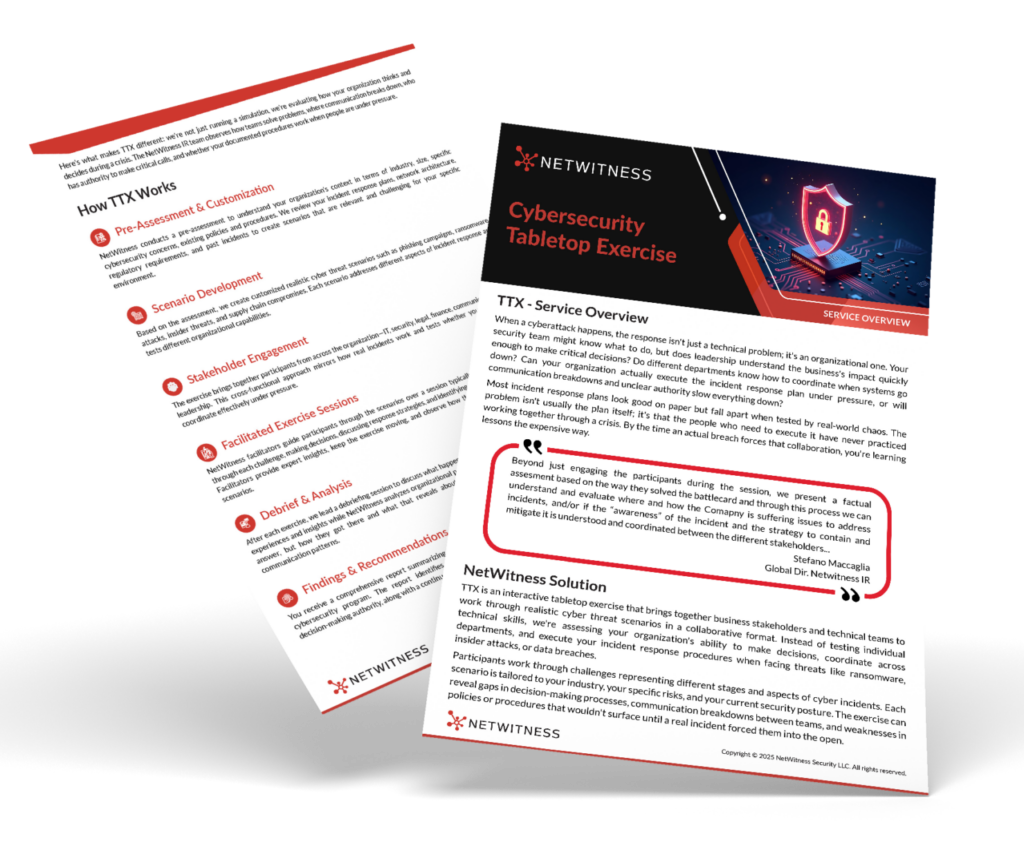
- Tabletop Exercises – Validate roles, decision-making, and communication workflows through scenario-based discussions.
Each stage builds upon the previous one, enabling organizations to systematically strengthen their security posture, improve operational resilience, and reduce response times during real-world incidents.
Introduction
Most organizations believe they are prepared for a cyberattack. They have tools deployed, policies written, and a SOC running. But when you actually go in and examine the network traffic, the endpoint behavior, the log quality, and how people communicate under pressure, the gaps become obvious fast.
The question is not whether your organization will face a cyber incident. It is whether you will be ready when it happens.
This blog breaks down what a practical, mature approach to incident response readiness looks like, covering the four core services that together build a complete incident response framework: compromise assessment, gap assessment, red team exercises, and tabletop simulations.
What Is Incident Response Readiness and Why Does It Matter
Incident response readiness is the state of being technically, organizationally, and operationally prepared to detect, contain, and recover from a cyberattack. It is not a one-time certification. It is not an annual compliance audit. It is an ongoing, active program.
The cost of not being ready is significant and measurable. Organizations that go through a serious breach typically come out on the other side with a completely different view of what it means to be ready to defend their organization. They have seen what visibility gaps cost in lost data, operational disruption, regulatory penalties, and recovery time. The goal of cybersecurity incident response readiness is to reach that level of understanding without paying that price.
There are four capabilities together that drive cybersecurity incident response readiness programs They are not alternatives to each other. They are a progression, and each one builds on the last.
The Four-Step Framework for Incident Response Readiness
Incident response readiness is not achieved through a single assessment or security tool. It is built through a structured progression that helps organizations understand their current risk, identify weaknesses, test their defenses, and prepare stakeholders to respond effectively during a real cyber incident. The four stages below form a practical framework for strengthening both technical capabilities and organizational resilience.
Step 1: Compromise Assessment – Find Out What Is Already in Your Environment
What a Compromise Assessment Is
The foundation of any serious incident response strategy is visibility. Not theoretical visibility, but the actual, technical ability to see what is moving through your network, what is running on your endpoints, and what your logs are capturing.
A compromise assessment is the most direct way to establish that picture. It applies the same methodologies used during reactive cybersecurity incident response, the same tools, the same analytical techniques, deployed proactively before a breach has been confirmed. Think of it as a technical snapshot of your current security posture.
Analysts examine three pillars of cybersecurity: network traffic, endpoint behavior, and log data. The goal is to establish what is normal in the environment, identify what is anomalous, and surface anything that could indicate an active threat or a serious vulnerability.
How the Assessment Works
The process begins with establishing a comprehensive baseline of the environment by collecting and analyzing as much telemetry as possible. This baseline provides a clear understanding of normal network, endpoint, and user behavior.
From this foundation, the team systematically identifies deviations and anomalies, such as unusual protocols, unexpected external communications, and behavioral patterns that diverge from the norm across systems.
Our approach enables deep visibility from low-level protocol analysis to the identification of tools and applications operating within the environment that may not be formally known or managed by security teams. This includes exposure of shadow IT and emerging risks such as shadow AI, which can introduce unmanaged data flows and potentially unmonitored attack surfaces.
Common Findings You Should Know About
Multiple remote access tools running simultaneously. When four or five different RDP applications are in use across an organization, an attacker using any one of them blends in with legitimate traffic. The fix is straightforward: standardize on one approved tool, remove the rest. Any remote access application that is not the approved one immediately becomes an anomaly worth investigating.
Uncontrolled cloud storage applications. When employees use several different personal or unapproved cloud storage services, attackers have easy, encrypted exfiltration paths that are nearly impossible to inspect from inside the network. These applications transmit traffic in ways that make it very difficult to determine what data is actually leaving the environment.
Legacy protocols are still active. SMBv1 is unauthenticated, unencrypted, and over two decades old. It still runs in a surprising number of enterprise environments. An attacker with a single foothold can silently scan an entire subnet through this protocol, access file shares without credentials, and map out the environment without triggering a single alert. It is a direct accelerator for lateral movement.
Malware beaconing to external command-and-control infrastructure. This is the finding no one wants but everyone needs to know about. Active implants communicating with attacker infrastructure are discovered during compromise assessments more often than organizations expect.
Weak or misconfigured log collection. Logs may be running but not capturing the fields that would actually matter during an investigation. This is one of the most common mid-term findings and one of the most impactful to fix.
Why External Analysts Catch What Internal Teams Miss
Internal SOC teams often become accustomed to their own environments. Over time, activities or protocols that have been routinely permitted may no longer register as noteworthy, even when they could indicate risk. External practitioners, however, approach the environment without prior assumptions. They treat all activity as potentially suspicious until it is fully understood and validated against expected behavior.
This unbiased perspective, combined with investigative methodologies developed through extensive incident response and digital forensic engagements, enables the identification of threats and misconfigurations that familiarity overlooks.
What Happens If an Active Attack Is Found Mid-Assessment
When an active attack is discovered during a compromise assessment, the engagement pivots immediately. Remaining efforts are redirected toward active investigation. The team moves from assessment mode into a full incident response engagement, following attacker traces, supporting containment decisions, preparing for expulsion and remediation. Some of the longest-running security partnerships between organizations and external IR providers started exactly this way.
What the Deliverable Looks Like
The output is a prioritized findings report with short-term tactical recommendations, mid-term improvements, and long-term strategic guidance. It is not just a list of problems. It is a sequenced roadmap that tells the organization what to fix first, what to plan for next, and where to invest over time to build stronger detection and response capability.
Tooling Flexibility
The assessment is designed to adapt to the customer’s environment and can leverage existing security tools, deploy a specialized platform for engagement, or combine both approaches. When a detection or monitoring platform is already in place, the assessment integrates directly with those technologies to analyze telemetry, validate existing capabilities, and identify gaps in visibility and coverage.
In environments where such capabilities are limited or absent, the deployment of a dedicated platform like NetWitness as part of the engagement provides immediate, high-fidelity visibility across the environment. This not only enables a more comprehensive assessment but also makes existing visibility gaps tangible.
Step 2: Gap Assessment – Evaluate Your Overall Security Program
What a Gap Assessment Is
Technical visibility tells you what is happening within your environment. A gap assessment determines whether the organization surrounding that environment is equipped to effectively manage, respond to, and sustain control over those activities.
This is the inverse of a compromise assessment. Instead of starting at the technical layer and working up, a gap assessment starts at the top of the organization and works systematically downward. It is a top-down analysis of your entire security program: people, processes, policies, configurations, and culture.
Together, these assessments create a complete picture:
- The compromise assessment answers: “What is happening right now?”
- The gap assessment answers: “Are we capable of handling it?”
This dual approach bridges the gap between technical reality and organizational readiness. The compromise assessment exposes real-world threats and visibility gaps, while the gap assessment identifies weaknesses in people, processes, policies, and controls that could prevent effective response.
When combined, they provide both evidence and context—enabling organizations not only to uncover hidden threats, but also to understand why those threats may persist and how to systematically improve their security posture.
How the Assessment Works
The process begins with stakeholder and management interviews. What does leadership believe the security program looks like? What are the stated goals? What is documented in the incident response plan? From there, the analysis works progressively deeper through SOC team discussions, IT interviews, and actual review of configurations including firewall rules, SIEM alert logic, security incident response playbooks, documentation, and application log settings.
At its core, the assessment is designed to answer a critical question:
Do the organization’s stated practices align with what it actually does, and do both meaningfully advance its ability to reach the level of security it truly requires?
This approach challenges whether policies, processes, and controls are not only defined, but consistently executed, and whether that execution is sufficient to meet the organization’s real risk, threat landscape, and operational objectives.
What Gets Discovered
This is where disconnects between policy and practice become visible. An incident response plan that looks comprehensive on paper but has not been tested in three years. Alert thresholds that were configured at initial deployment and never tuned. Log collection that is technically running but not capturing the data fields that would matter during a real investigation. Security tools deployed in silos that do not share information with each other.
The technology over-reliance problem also surfaces here consistently. Organizations often invest heavily in best-of-breed tools that operate independently of each other. When those tools do not share context, do not trigger coordinated responses, and require separate analyst workflows; they provide far less protection than a smaller number of well-integrated tools with strong human processes built around them. A gap assessment identifies these silos.
Some Additional Time Needed
A thorough gap assessment on a mid-to-large organization typically runs twenty days or more and involves multiple specialists with domain expertise across various areas. You cannot shortcut it. The value is in the depth, particularly at the configuration and workflow level where most management consultancies stop short.
Large advisory firms can map high-level program structure. What they typically do not do is validate actual firewall configurations, test whether SIEM alert logic reflects real threat patterns, or verify whether the IR plan’s use cases correspond to threats the organization actually faces. That technical depth is where the most significant findings live, and it is the primary differentiator between a proper gap assessment and a high-level strategic review.
Regulatory Complexity and Multi-Jurisdiction Organizations
For organizations operating across multiple countries or in regulated sectors such as financial services, healthcare, or critical infrastructure, the assessment must account for different regulatory frameworks applying simultaneously to different parts of the same business. Some assessments of large financial institutions may take more time because of this complexity.
The deliverable in these cases includes country-by-country compliance recommendations alongside a strategy for building organization-wide standards that satisfy each local regulatory requirement without creating contradictory obligations across different business units.
What the Deliverable Looks Like
The output is a structured improvement plan organized by time horizon. It covers both the human dimension, which includes skills, processes, communication flows, and organizational design, and the technology dimension, which includes configurations, integrations, and tool rationalization. It also provides a roadmap for building the kind of ecosystem-based security posture that replaces siloed tool deployments with genuinely integrated threat detection and response capability.
Step 3: Red Team Exercise – Test Your Defenses Against a Real Attack Scenario
What a Controlled Attack and Response Exercise Is
If a compromise assessment answers the question of what is in your environment, and a gap assessment answers whether your program is properly structured, a red team exercise answers the most important question of all: what actually happens to your people and your processes when a real attack occurs?
This is where the mindset shifts from asking “what if?” to preparing for “when.”
A proper red team exercise is not a penetration test. A pen test asks whether someone can break in. The answer is almost always yes, and knowing the answer does not tell you how to improve your response capability. A controlled attack and response exercise asks a different question: when a specific, known threat actor targets your organization using their actual techniques and tooling, can your team detect it, attribute it correctly, and respond effectively?
How the Exercise Works
Preparation takes two to three weeks. The execution phase runs four to eight hours. The red team simulates a realistic adversary from start to finish, using the same tools, protocols, communication patterns, and evasion techniques associated with that specific threat actor. The simulation is close enough that, without prior knowledge of the exercise, a defender would confidently attribute the activity to an actual attack.
After the execution phase, the defending team has 48 hours to document everything they detected, when they detected it, how they responded, and what conclusions they drew about the nature and source of the attack.
What You Learn That You Cannot Learn Any Other Way
How your people actually behave under stress. Red Team simulations reveal something that no policy or audit can: how people actually behave under pressure. Under typical operations; an incident response plan is a document. When you’re under attack, an incident response plan is something entirely different.
Whether your detection capability is genuine. Does your team see the attack unfold? Can your team attribute the attack to a specific actor? Can they identify the malware family being used? Can they trace the kill chain? These questions have correct answers during a real incident. You want to find out how effective the team is before the clock starts ticking.
Precise and actionable forensic data. The red team video-records every single action taken during the exercise, every console, every tool, every command. The final report establishes exact timing correlations between attacker actions and defender detections or missed detections. An proven incident response methodology is applied to a controlled scenario, producing specific evidence your team can study and learn from rather than general observations about detection quality.
Where incident response playbooks break down under pressure. A gap assessment validates your playbook on paper. A tabletop exercise tests it in practice. Under pressure, teams often diverge from documented procedures; escalation paths are skipped, roles become unclear, and decisions are delayed. This gap between what is documented and what actually happens is critical, and it can directly impact the effectiveness of response during a real incident.
Choosing Which Threat Actor to Simulate
Organizations should select adversaries from the threat landscape most likely to target their vertical. Financial services firms should consider financially motivated actors. Defense contractors and government-adjacent organizations should focus on state-sponsored APT groups. Healthcare organizations may wish to prioritize ransomware-focused actors. The exercise delivers the most value when it tests the organization against threats it is realistically likely to face, not generic attack patterns.
The tooling used in each exercise also evolves over time to reflect how real threat actors develop their capabilities. An APT group that used one malware family three years ago may have completely replaced that tooling today. A properly run exercise stays current with those evolutionary changes.
The Goal Is Not to Catch the Red Team
One important point about how to frame the exercise internally: the goal is not to demonstrate that the red team can be stopped. At some point during execution, the red team will intentionally begin making more noise, escalating their activity to ensure that a defensive response is triggered. The measurement is not whether the attacker was caught. It is the quality, speed, and accuracy of the defender’s response once they know something is happening.
The Continuous Improvement Loop
Repetition drives incident response readiness. Organizations that repeat this exercise over time see measurable gains. Response times improve, escalation becomes more consistent, and situational awareness is more evenly distributed across teams.
Most importantly, these exercises build real, repeatable capability, not just documented processes. That progression is the foundation of a continuous improvement approach to incident response readiness.
Step 4: Tabletop Exercise – Prepare the Whole Organization, Not Just the Technical Team
What a Tabletop Exercise Is
Not every part of a breach response happens in the SOC. Legal has to assess regulatory exposure and advise on notification obligations. Finance has to authorize emergency spending. Communications has to manage external messaging to customers, partners, and media. Executives have to make high-stakes decisions under time pressure with incomplete information. Cybersecurity may need to coordinate a physical security response alongside the cyber investigation.
A tabletop exercise is how you prepare all of those people, and how you test whether the organization can function as a coordinated unit when a real incident requires it.
The format is a facilitated simulation, where participants respond to a narrative attack scenario in real time. A narrator presents the scenario and introduces new developments as the session progresses. A facilitator manages the flow. Observers from the security team take notes, tracking decisions, gaps in communication, and moments where documented procedures do not match what people actually do when put on the spot.
Who Should Participate
The session can include technical staff alongside executive leadership, legal counsel, finance, communications, and HR. The composition depends on what the organization needs to test. Technical-only sessions test SOC and IR team coordination. Cross-functional sessions test the broader organizational response. Both have value, and organizations with mature programs typically run both over time.
What Makes a Tabletop Exercise Effective
The value comes from the preparation behind it. Before the session, facilitators review the organization’s policies, incident response plans, network diagrams, and documented use cases. The scenario is then built specifically to target the weak points in those documents, creating situations where participants cannot simply look up the answer in the playbook.
The most useful output is usually the conflict that surfaces in the room. A CISO and an IT manager who hold incompatible views on escalation criteria. A legal team that has never aligned with the security team on breach notification timing. A business continuity plan built on assumptions the IR team cannot actually fulfill. These gaps are painful to discover during a real incident with regulators and customers watching. They are valuable to discover in a structured session where the only consequence is a report.
What the Deliverable Looks Like
The report following a tabletop exercise does not score individuals on their performance. It evaluates the organization’s collective response: communication effectiveness, decision quality, alignment between stated policies and actual behavior under pressure, and specific procedural gaps that need to be addressed before the next exercise or before a real incident occurs.
Why Tabletop Exercises Help Prioritize Cybersecurity
Tabletop exercises are the most accessible entry point for non-technical leadership, and they consistently create the organizational buy-in that security programs need to get properly staffed and funded. Executives who have sat through a realistic breach scenario, wrestled with the decisions it forces, and seen firsthand where their organization’s response breaks down are significantly more committed to meaningful security investment afterward.
This is one of the most practical reasons to run tabletop exercises regularly, separate from the direct readiness value. They make the case for cybersecurity incident response services in a way that no written report or sales presentation can match.
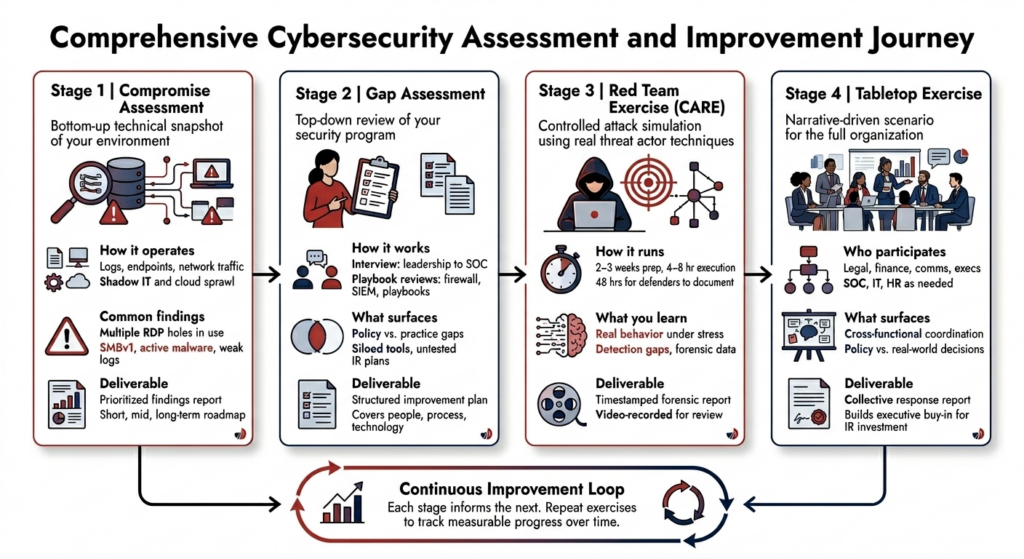
How These Four Capabilities Work Together
Here is the practical progression and why the sequence matters.
Start with a compromise assessment. Get an honest technical picture of what is in the environment right now. Establish baseline visibility, identify active risks, and create a foundation for everything that follows.
Build on that with a gap assessment. Understand whether the program managing that environment is actually organized to handle what the assessment found. Align policy to practice. Map where tools, processes, and people are not integrated with each other.
Test the whole system with a red team exercise. Put the program under controlled attack conditions using a realistic adversary simulation. Find out what the security incident response playbook looks like when it is actually being executed under pressure rather than described in a document.
Extend readiness to the full organization through tabletop exercises. Bring leadership, legal, finance, and communications into the room. Test whether the organization can coordinate across functions when a real incident demands it.
Each step informs the one that follows. Compromise assessment findings shape what the gap assessment focuses on. Gap assessment findings determine what a red team exercise should stress-test. Red team results give tabletop scenarios their most realistic and relevant foundation.
This is what a genuine, operational incident response framework looks like. This is how we build readiness. Not a one-time audit. Not a compliance checkbox. A cycle of assessment, testing, and improvement that builds measurable organizational capability over time.
Where Should Your Incident Response Readiness Journey Begin?
The right entry point depends on where your organization stands today.
No clear picture of your current environment: Start with a compromise assessment. It is the fastest way to establish baseline visibility and determine what is already present in the network, including threats that may be active right now.
Reasonable visibility but uncertainty about your program’s quality: A gap assessment will show whether tools, people, and processes are integrated in a way that could actually handle a real incident, and where the most significant organizational weaknesses are.
A solid program that has never been stress-tested: A red team exercise will produce specific, evidence-based data on where your detection and response capabilities perform well and where they fail under realistic attack conditions.
Need to build executive and cross-functional support for security investment: A tabletop exercise is the right starting point. It is accessible to non-technical audiences, generates genuine organizational engagement, and consistently creates the leadership commitment that security programs need to grow.
None of these services requires any particular technology platform to be in place first. They are designed to work with what already exists, surface what is missing, and help organizations make better-informed decisions about where to invest going forward.
Why NetWitness for Incident Response Readiness
Most organizations evaluate security incident response services on price and certifications. The differentiator that actually matters is whether the team advising you has faced the same attackers you are going to face. Here is what sets NetWitness apart:
- Practitioner-informed delivery. The same practice who runs active breach investigations help design and deliver assessments and simulations. NetWitness IR has investigative experience going back to 2012.
- Threat intelligence from live casework. Red team simulations are built on current attacker behavior, not published reports. When NetWitness mimics a threat actor, it reflects how that actor operates today, including their latest tooling and evasion techniques.
- Full-spectrum platform visibility. We have full access to the NetWitness platform which covers logs, endpoints, and network traffic. The exact three pillars every serious cybersecurity incident response investigation depends on. Available for deployment during an assessment the NetWitness platform is a true force multiplyer giving customers a proof of what proper visibility actually looks like.
- Agnostic findings, honest recommendations. Assessments are conducted with or without NetWitness tooling. The report reflects what is actually in the environment, not a path toward a product sale.
- Built for continuous improvement. Unlike a one-time audit, NetWitness cyber incident response services are structured for ongoing partnership, tracking measurable improvement across repeated exercises and building a progressively sharper picture of your security posture over time.
The Bottom Line on Incident Response Readiness
The organizations that perform best during real incidents are the ones that practiced before it happened. They assessed their environment honestly, evaluated their program critically, tested their team under realistic conditions, and brought their entire organization into the readiness process.
You cannot improve what you have not honestly measured. Cybersecurity incident response capability is not only built by purchasing tools or writing plans. It is built by looking at what is actually happening, testing how your people and processes perform under pressure, and systematically improving based on real evidence.
The four-stage roadmap (compromise assessment, gap assessment, red team simulation, and tabletop exercises) provides a structured path from current state to true incident response readiness.
Each stage builds on the last, strengthening both technical visibility and organizational capability. Together, they form a continuous improvement loop that transforms reactive practices into a resilient, repeatable security posture.
Frequently Asked Questions
1. What is incident response readiness?
Incident response readiness is the ability to detect, respond to, and recover from cyber threats, enabled by the right people, processes, technology, and tested playbooks.
2. What are the best tools for incident response readiness in cybersecurity?
Effective incident response readiness depends on a combination of tools that provide broad visibility, deep investigation capability, and integrated analytics across the environment.
Key categories include:
- Full Packet Capture / Network Visibility Platforms
Provide deep, session-level visibility into network traffic, enabling detection of anomalies, lateral movement, and unauthorized communications. - Endpoint Forensic and Detection Tools
Deliver detailed insight into host activity, including process execution, persistence mechanisms, and indicators of compromise across endpoints. - SIEM and Log Analytics Platforms
Aggregate and correlate logs from across the environment, enabling centralized monitoring, alerting, and timeline reconstruction for incident investigation.
Together, these tools create a comprehensive visibility layer across network, endpoint, and log data, which is essential for effective detection, investigation, and response
3. How do tabletop exercises improve incident response readiness?
Tabletop exercises strengthen incident response readiness by testing the security incident response playbook, validating the incident response strategy, and identifying gaps before a real incident occurs.
4. What are the best incident response readiness platforms with automation features?
The best incident response readiness platforms combine threat detection and response, incident management automation, and investigation capabilities. These platforms help automate alert triage, incident workflows, and containment actions, improving cyber incident management and strengthening overall cybersecurity incident response readiness.
5. How does automation improve incident response readiness?
Automation improves incident response readiness by accelerating threat detection and
response, reducing manual tasks, and supporting faster incident response and forensics
workflows.
Test your organization's readiness to manage cyber incidents with expert-led tabletop exercises.
- Simulate ransomware, data breach, and insider threat scenarios
- Assess response processes across security, IT, legal, and executive teams
- Validate roles, responsibilities, and incident escalation paths
- Improve cyber resilience with detailed findings and remediation guidance