What is DDoS mitigation?
DDoS mitigation is the process of detecting, absorbing, filtering, redirecting, or blocking malicious traffic during a distributed denial-of-service attack, with the goal of keeping legitimate users connected while cutting the impact of the attack traffic. In an enterprise setting, that means combining technical controls with provider coordination, SOC investigation, communication workflows, and a solid post-incident review.
A good enterprise DDoS mitigation plan should answer, “how do we keep critical services running when traffic turns hostile?” And that usually includes details about what has to stay online, what “normal” traffic actually looks like, which DDoS mitigation methods kick in first, who owns the response, how outside providers get looped in, and what the SOC needs to preserve while it’s all happening.
The SOC needs all this data because a DDoS attack rarely stays in its lane. It can take down customer portals, APIs, DNS, authentication services, VPN access, cloud workloads, payment systems, partner integrations; sometimes all at once. And it generates enough noise that a security team can miss something else going on underneath it.
CISA sorts DDoS techniques into three buckets:
- volumetric
- protocol
- application-layer
Therefore, enterprise DDoS protection can’t lean on a single control or a single provider. Akamai’s 2026 State of Internet Report says Layer 7 DDoS attacks jumped 104% over two years, and attackers are increasingly chaining web application, API, and DDoS attacks together specifically to slip past narrow defenses.
Why Do Enterprises Need a Formal DDoS Mitigation Plan?
A DDoS mitigation plan gives security, network, cloud, application, and incident response teams a shared playbook before the outage starts. Without a plan, teams end up debating basics in the middle of a crisis.
A solid DDoS response plan helps:
- Teams move faster
- Avoid blocking legitimate users by accident
- Coordinate cleanly with outside providers
- Understand the full blast radius of the event
What are the Steps to Build a Robust DDoS Mitigation Plan for Enterprises
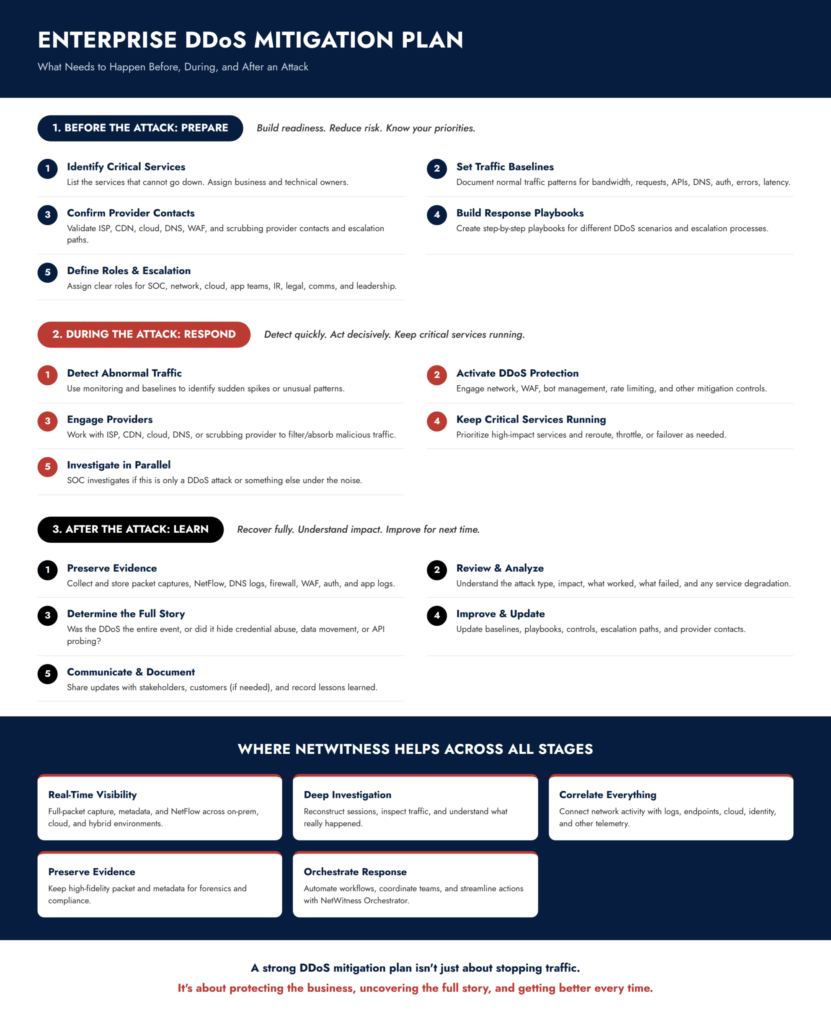
Step 1: Prioritize What to Protect
Start by deciding which services the business truly cannot afford to lose. This could include a customer login portal, payment system, key API, DNS service, or remote access gateway.
For each one, note:
- Who owns it
- Where it is hosted
- Which providers it depends on
- What normal traffic looks like
- How quickly it needs to be recovered
The team should agree on those priorities before a DDoS attack happens. It makes response much easier during an attack. A marketing page, a customer portal, and a payment API do not carry the same level of urgency.
Step 2: Determine the Baselines
You can’t detect an anomaly if you don’t know the baseline. A traffic spike during a big product launch versus a spike at 2 AM from unfamiliar geographies are very different.
Security and network teams should be baselining:
- Bandwidth usage
- Request rates
- DNS query behavior
- API call volumes
- Protocol usage
- Geographic traffic sources
- Authentication traffic
- Error rates
- Latency
- User-agent behavior
- The seasonal or campaign-driven spikes that are just part of doing business
Step 3: Defend Every Layer
DDoS protection needs to cover every layer of the environment, because attacks do not follow one fixed path. Large traffic floods should be handled before they reach your systems, usually with help from your ISP, cloud provider, CDN, or DDoS scrubbing service. At the application level, protection becomes just as important because many application-layer DDoS attacks look like normal user traffic at first. This is where controls such as WAF policies, bot management, rate limiting, request validation, API security, and behavior-based detection help reduce the impact.
DNS also needs attention because it can become a major point of failure during an attack. Resilient architecture, strong monitoring, secure configuration, and failover planning can help keep services reachable. At the same time, the SOC needs visibility into what else is happening across the environment. A DDoS event may be only an availability attack, but it could also overlap with unusual login activity, reconnaissance, exploitation, or lateral movement.
Step 4: Allocate Responsibilities
A DDoS attack moves too fast for anyone to be figuring out ownership on the fly. Your response plan needs clear roles for SOC analysts, network operations, cloud operations, application owners, incident response, legal and compliance, customer support, corporate communications, executive leadership, and your ISP, CDN, DNS, cloud, and DDoS mitigation providers.
It also needs escalation thresholds spelled out in advance. Network operations gets pulled in once traffic crosses a defined threshold. Incident response takes the lead the moment customer-facing services start degrading. The SOC kicks off a parallel investigation the second authentication traffic looks suspicious. Legal and communications get looped in as soon as regulated services or contractual commitments are on the line.
Step 5: Write Playbooks That People Can Follow Under Pressure
A DDoS mitigation plan that lives only as a high-level policy document won’t help anyone at 3 a.m. It needs real playbooks for:
- Volumetric attacks
- Protocol attacks
- Application-layer DDoS
- DNS attacks
- Api abuse
- CDN failover
- ISP escalation
- Cloud provider escalation
- Scrubbing activation
- Customer communication
- Post-incident investigation
Every playbook should list out the detection signals, the first actions to take, escalation steps, who needs to approve what, provider contacts, rollback steps, and what evidence has to be collected along the way.
Step 6: Protect APIs and Application Logic
Modern enterprises run on APIs, and attackers know it. Hence, they attack the APIs where a small amount of malicious traffic can cause an outsized amount of damage.
API-specific mitigation should include rate limits set per endpoint, authentication-aware throttling, bot detection, schema validation, request size limits, geo-based controls where they make sense, and monitoring for error rates that don’t look right. Akamai’s 2026 State of the Internet report points to exactly this convergence: application security, API threats, and DDoS attacks overlapping more than ever, with average API attacks up 113% year over year.
Step 7: Assume DDoS-for-Hire is Already in Play
Enterprises need to plan around a simple reality: attackers don’t need sophisticated infrastructure anymore. DDoS-as-a-service, or DDoS-for-hire, lets someone with almost no technical skill rent attack capacity and point it at a target.
DDoS protection isn’t just for organizations bracing for nation-state actors or advanced criminal groups. Any visible brand or customer-facing service can also become a target. It is important to stop a DDoS attack from turning into a prolonged outage or a customer trust problem.
Step 8: Line Up Your External Providers Now, Not During the Incident
Most enterprises can’t block DDoS attack traffic with internal infrastructure alone. Your plan should include emergency contacts for your ISP, escalation paths for your CDN, support contacts for your cloud and DNS providers, contacts for your scrubbing provider, WAF and bot management support, account IDs and support references, contracted SLAs, traffic rerouting requirements, and whatever evidence providers will ask for during escalation.
CISA’s guidance on volumetric DDoS mitigation emphasizes risk-informed use of mitigation services for large-scale attacks against web services. And don’t wait for a live incident to find out whether your provider contacts still work. Test them during tabletop exercises.
Step 9: Preserve Evidence
Keeping services up is priority one during the attack. The harder questions come after: what type of attack was it, which systems were hit, which controls worked and which didn’t, was any legitimate traffic blocked by mistake, did the attack coincide with anything suspicious elsewhere, and what needs to change before next time?
To answer those, you need to preserve packet data, network metadata, NetFlow records, DNS logs, firewall logs, WAF logs, CDN logs, cloud provider logs, authentication logs, application logs, incident timelines, provider communications, and a record of every mitigation action taken.
Step 10: Put the Plan to Test
Run tabletop exercises at least once or twice a year for your most critical services, and use them to understand:
- How quickly teams detect the issue
- Identify what’s affected
- Get providers on the phone
- Activate mitigation
- Communicate internally
- Keep customers informed
- Preserve evidence
- Get back to normal
It also lets you check whether your team can tell a DDoS attack apart from a legitimate demand spike.
Step 11: Keep Revisiting the Plan
Enterprise environments are dynamic; hence, the mitigation plan should be revisited and upgraded. It is good practice to upgrade after major application launches, cloud migrations, DNS or CDN changes, provider changes, new API deployments, real incidents, tabletop exercises, and any business event likely to drive an unusual traffic spike.
How NetWitness Helps in DDoS Mitigation for Enterprises
What NetWitness does is strengthen visibility, investigation, forensics, and response coordination. With NetWitness in place, SOC teams can spot:
- Abnormal network behavior
- Dig into suspicious traffic patterns
- Understand exactly which services took the hit
- Reconstruct sessions
- Correlate network evidence against logs, endpoint, cloud, and identity telemetry
- Confirm whether a DDoS attack was an isolated event or part of something bigger
- Preserve forensic evidence that holds up
- Sharpen playbooks after the event
Understand today's most active ransomware groups, their tactics, and how to strengthen your defenses.
Frequently Asked Questions
1. How does a DDoS attack work?
A DDoS attack overwhelms a target by directing traffic from many distributed sources, often compromised devices or rented attack infrastructure, simultaneously. Depending on the technique, that traffic might flood available bandwidth, exhaust network resources, exploit protocol weaknesses, or hammer a specific application function until it fails.
2. How should an enterprise choose a DDoS mitigation service?
Base the decision on your architecture, traffic volume, critical services, latency needs, support model, and how exposed you actually are. Look for:
- Always-on and on-demand options
- Protection at both the network and application layers
- Real global scrubbing capacity
- API and DNS protection
- Integration with your existing CDN, cloud, and WAF controls
- 24/7 support
- Clear SLAS
- Solid reporting and forensic data
- Support for hybrid or multi-cloud environments
3. What features should enterprises look for in a DDoS mitigation solution?
DDoS mitigation solution for enterprises should have:
- Coverage across volumetric, protocol, and application-layer attacks, plus bot detection
- API protection
- DNS protection
- Rate limiting
- Traffic scrubbing
- Behavioral detection
- Automated mitigation
- Low-latency routing
- Responsive provider support
- Solid reporting
- Integration with your SIEM, SOAR, and broader SOC workflows
4. What's the difference between on-premise and cloud-based DDoS protection?
On-premise DDoS protection sits close to your network, so it can detect and respond to attacks quickly. It gives your team more local control, but it may not be enough when a very large traffic flood hits.
Cloud-based DDoS protection works earlier in the traffic path. It filters attack traffic through a provider before it reaches your environment, which makes it better suited for large attacks.
Many enterprises use both. On-premise protection helps with quick local response, while cloud-based protection helps absorb large attacks before they overwhelm the network.