What Enterprise Security Teams Still Get Wrong About Cloud Security Tips
Most cloud breaches do not start with zero-day exploits. They start with identity gaps, unmanaged assets, weak visibility, and delayed response. Strong cloud security tips today go beyond CSPM dashboards or alert overload. Enterprise teams need continuous cloud threat detection, full-fidelity telemetry, identity-aware monitoring, and investigation workflows that connect cloud, network, endpoint, and user activity in one place. This blog breaks down the cloud security tips that actually reduce risk in hybrid and multi-cloud environments without slowing the business down.
Introduction
Cloud adoption moved faster than most security programs expected. Now security teams inherit sprawling SaaS environments, unmanaged workloads, temporary cloud assets, and identities that multiply faster than policy updates.
That creates a dangerous gap.
Cybercriminals no longer require advanced malware to infiltrate corporate systems. They take advantage of open storage buckets, compromised API keys, overly privileged identities, and incorrectly set up cloud services. IBM’s 2024 Cost of a Data Breach Report says cloud-related breaches are still among the most costly to fix worldwide.
This is why practical cloud security tips matter more than ever.
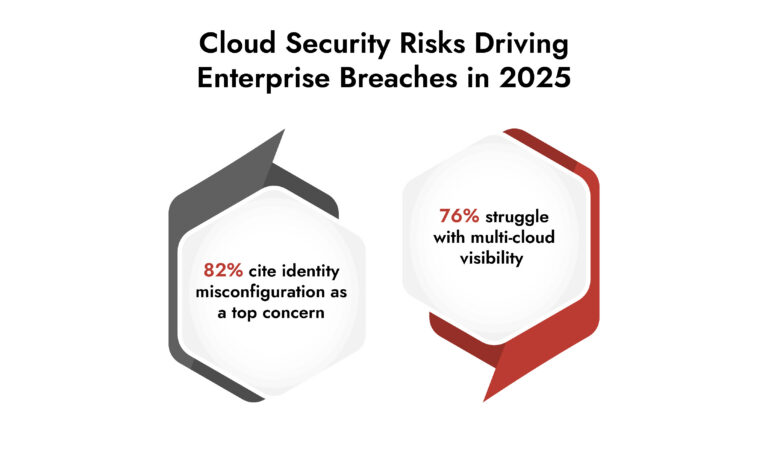
The problem is not a lack of tools. Most enterprises already use multiple cloud security solutions. The issue is fragmented visibility. Teams struggle to connect activity across cloud workloads, users, endpoints, and east-west traffic before attackers move laterally.
Strong enterprise cloud security requires operational clarity, not just more alerts.
Why Cloud Security Tips Must Start With Visibility
You cannot secure what you cannot see.
That sounds obvious, yet many enterprises still operate with partial telemetry across cloud environments. Security teams often monitor workloads, but miss packet-level visibility, identity relationships, or lateral movement inside hybrid infrastructure.
The result:
- Threats stay hidden longer
- Analysts lose investigation context
- Response time increases
- Compliance exposure grows
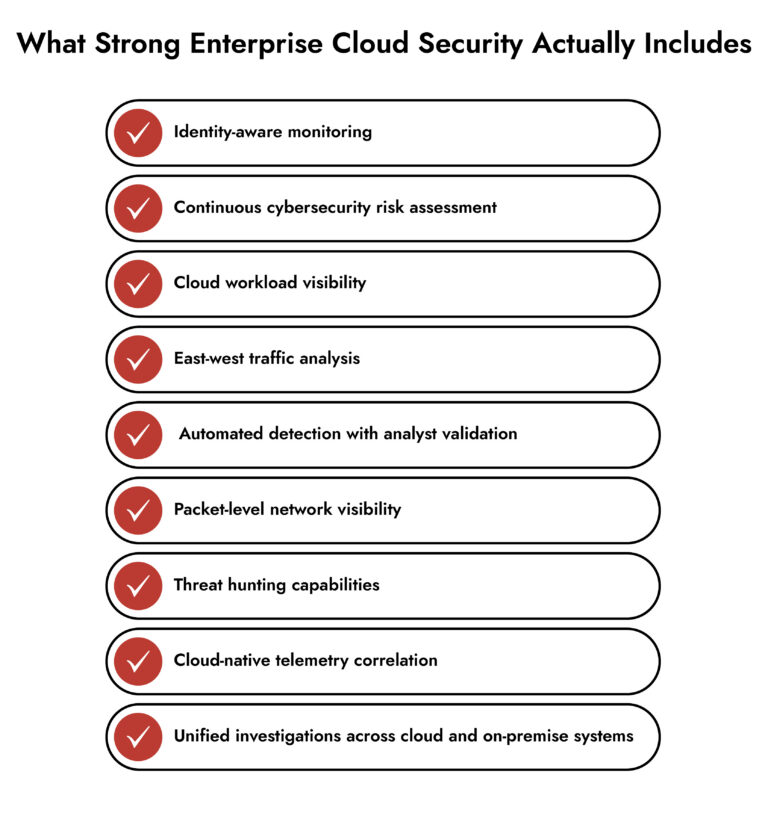
The most effective cloud security tips begin with unified visibility across:
- Public cloud environments
- SaaS applications
- Containers and Kubernetes
- Remote users
- Hybrid infrastructure
- East-west network traffic
- Identity and access activity
Many enterprises operate hybrid and multi-cloud environments across multiple regions. Security teams need a unified view across cloud and on-premises infrastructure while supporting data residency and regulatory requirements in different geographies.
This is where many traditional cloud security solutions fall short. They detect isolated events but fail to connect them into a coherent attack story.
Modern cybersecurity solutions must help analysts investigate attacks across environments instead of forcing teams to pivot between disconnected dashboards.
Cloud Security Tips for Reducing Identity-Based Attacks
Identity has become the new attack perimeter.
Attackers increasingly target privileged access, cloud tokens, service accounts, and federation weaknesses because identity compromise creates direct access without noisy malware execution.
One of the most important cloud security tips is to treat identity telemetry as a primary detection source instead of an IAM-only problem.
Security teams should:
Enforce least-privilege access aggressively
Many organizations still assign broad permissions for operational convenience. That creates unnecessary exposure across cloud workloads and SaaS applications.
Review:
- Service account permissions
- Dormant identities
- Third-party integrations
- Temporary access privileges
- Cross-cloud trust relationships
Monitor abnormal identity behavior
Cloud threat detection must include behavioral analytics for:
- Impossible travel
- Privilege escalation
- Unusual API activity
- Access outside normal working patterns
- Excessive failed authentication attempts
Correlate identity activity with network and endpoint data
This matters more than most teams realize.
A suspicious login alone rarely tells the full story. But when combined with packet data, endpoint telemetry, and workload behavior, analysts can determine whether the activity represents compromise or legitimate use.
This correlation capability is increasingly important for enterprise cloud security operations.
Why Continuous Cybersecurity Risk Assessment Matters in Cloud Environments
Annual reviews no longer work.
Cloud infrastructure changes daily. Containers spin up and disappear in minutes. Developers deploy services continuously. New APIs connect business-critical systems without long security review cycles.
Static assessments cannot keep up.
Modern cybersecurity risk assessment programs must operate continuously.
Security teams should evaluate:
- Misconfigurations
- Excessive permissions
- Unencrypted storage
- Vulnerable workloads
- Publicly exposed services
- Third-party SaaS integrations
- Cloud-to-on-premise trust paths
NIST’s updated cloud security guidance continues to emphasize continuous monitoring and risk-based visibility as critical operational requirements for enterprise defense programs.
The strongest cloud security tips combine automated assessment with human investigation workflows. Automation identifies anomalies quickly. Analysts provide context and prioritization.
That balance matters.
Learn why full packet capture is critical for modern threat detection and faster incident response.
Inside you’ll find:
- Clear guidance on where log-driven security falls short
- Ways to uncover threats hidden in network traffic
- How to reconstruct attacks from end to end
- Practical insight to investigate incidents with packet-level proof
Cloud Security Tips for Detecting Lateral Movement Early
Most cloud attacks become dangerous after initial access.
Once attackers gain a foothold, they move laterally across workloads, identities, APIs, and hybrid infrastructure searching for sensitive data or operational disruption opportunities.
This is where many cybersecurity services fail. They detect entry points but miss attacker movement after compromise.
Effective cloud threat detection requires visibility into east-west activity.
Security teams should monitor:
- Unusual workload-to-workload communication
- API abuse patterns
- Internal reconnaissance
- Unexpected data transfers
- Suspicious administrative activity
- Privilege escalation attempts
- Abnormal container communication
Packet-level visibility plays a major role here because logs alone often miss the full attack sequence.
This is one area where NetWitness brings distinct value for enterprise cloud security teams.
NetWitness combines packet data, logs, endpoint telemetry, network visibility, and behavioral analytics into unified investigations. This helps security teams investigate threats across hybrid and multi-cloud environments from a single view, including environments subject to regional data residency requirements. It also gives analysts deeper context during cloud incident response instead of isolated detections spread across multiple tools.
For enterprises operating hybrid infrastructure, that visibility becomes especially important because attackers rarely stay confined to one environment.
Why Alert Fatigue Weakens Cloud Security Solutions
Security teams do not suffer from a detection problem anymore.
They suffer from a prioritization problem.
Most enterprises already ingest enormous volumes of telemetry across cloud platforms, endpoints, networks, and SaaS environments. The challenge is determining which alerts represent real risk.
Poorly tuned cloud security solutions generate noise that slows investigations and increases analyst fatigue.
Better cloud security tips focus on detection quality instead of detection quantity.
That means:
- Correlating alerts automatically
- Prioritizing high-risk behaviors
- Mapping activity to attack chains
- Reducing duplicate detections
- Enriching alerts with contextual telemetry
The difference matters operationally.
An isolated alert creates work. A correlated investigation path creates action.
This is why unified cybersecurity solutions continue gaining traction among enterprise security teams. Analysts need workflows that accelerate decisions, not more disconnected dashboards demanding attention.
Building Cybersecurity Awareness Beyond Phishing Training
Cybersecurity awareness often gets reduced to annual compliance exercises.
That approach no longer matches enterprise risk reality.
Modern cloud environments require operational cybersecurity awareness across development, infrastructure, operations, and security teams.
Developers should understand:
- Cloud misconfiguration risks
- Secrets management
- API exposure issues
- Container security basics
Infrastructure teams should understand:
- Identity sprawl
- Hybrid cloud trust risks
- Network segmentation weaknesses
- Telemetry blind spots
Security teams should continuously educate leadership on how cloud risk affects business resilience, compliance exposure, and operational continuity.
Strong cybersecurity awareness programs create shared accountability instead of isolating security responsibility within the SOC.
How Enterprise Teams Should Evaluate Cloud Security Solutions
Not all cloud security solutions solve the same problem.
Some focus heavily on posture management. Others prioritize compliance reporting. Some specialize in workload protection or identity governance.
The best approach combines visibility, detection, investigation, and response capabilities.
When evaluating cybersecurity solutions for enterprise cloud security, teams should ask:
- Can analysts investigate across cloud and hybrid environments from one workflow?
- Does the platform correlate network, identity, endpoint, and log telemetry?
- Can it detect lateral movement effectively?
- Does it support packet-level investigation?
- Can teams retain and search historical telemetry quickly?
- Does it reduce investigation time for analysts?
This is where integrated cybersecurity services become operationally valuable.
NetWitness, for example, focuses heavily on deep visibility and threat detection correlation across cloud, network, endpoint, and hybrid infrastructure environments. That approach helps analysts investigate sophisticated attacks more efficiently, particularly when attackers move laterally across environments.
For mature enterprise programs, investigation speed matters as much as prevention.
Organizations should also consider cost predictability. Unlike some cloud-native security platforms that can introduce variable ingestion, storage, and query costs, NetWitness provides a more predictable cost model as visibility requirements grow.
Cloud Security Tips That Will Matter Most Over the Next Two Years
The cloud security conversation is changing.
Security leaders increasingly recognize that visibility gaps create greater risk than tool shortages. AI-assisted attacks, identity abuse, cloud-native malware, and supply chain compromises will continue increasing pressure on enterprise security operations.
The cloud security tips that matter most now include:
- Prioritize unified visibility over isolated tools
- Treat identity telemetry as a core detection layer
- Monitor east-west traffic continuously
- Validate cloud posture continuously, not quarterly
- Correlate cloud, endpoint, and network activity
- Invest in investigation speed, not just prevention
- Reduce analyst fatigue through contextual detections
Enterprises that operationalize these practices will respond faster and reduce exposure more effectively.
Those that rely only on fragmented alerts and periodic reviews will continue struggling with blind spots.
Final Thoughts
Cloud security for the enterprise is no longer something that rests in one control, platform, or policy.
Cloud security now relies on visibility and context.
The best tips for cloud security tend to revolve around providing help to enterprise security teams to be able to discover and react to threats more quickly within a more and more complicated environment. This goes beyond the idea of posture management, relying upon telemetry, risk assessment, cloud threat detection, and analyst-friendly incident management.
NetWitness provides support for this method by giving enterprise security teams visibility into their networks, clouds, endpoints, and logs to conduct investigations and mitigate potential problems.
In today’s cloud environments, acting quickly means nothing without visibility. Having visibility means nothing without context.
Frequently Asked Questions
1. What is meant by cloud security?
Cloud security means technologies, policies, controls, and cybersecurity services to secure cloud infrastructure, applications, identities, workloads, and data against threats.
2. What are the most common cloud security risks?
Identity theft, misconfigurations, exposed APIs, insecure workloads, ransomware attacks, insider threats, and weak visibility of cloud threat detection represent the main risks to consider when implementing cloud security.
3. What are the best cloud security platforms for small business?
The best cloud security solutions for small businesses combine identity protection, endpoint monitoring, workload security, and threat detection. They are also easy to manage with limited resources.
4. What are top cloud security services with threat detection features?
Leading cybersecurity services often include behavior analytics, network visibility, SIEM tools, endpoint monitoring, and packet inspection.
5. How to choose cloud security provider for healthcare data?
Healthcare organizations should choose enterprise cloud security providers that meet compliance needs. They should offer strong encryption, identity governance, and clear audit visibility. They should also support continuous monitoring and fast incident investigations.
6. What are the pillars of cloud security?
The core pillars include identity and access management, data protection, and visibility and monitoring. They also include cloud threat detection, compliance management, and workload security. They include continuous cybersecurity risk assessment.
Threat Intelligence: The Key to Higher Security Operation Performance
Unlock the full potential of your Security Operations Center with deeper visibility, faster detection, and smarter response. This whitepaper explores how modern threat intelligence elevates SOC maturity and helps organizations stay ahead of evolving adversaries.