What tools are best for analyzing encrypted network traffic?
The most useful enterprise tools combine NDR, TLS metadata, behavioral analytics, fingerprinting, certificate context, and packet evidence rather than relying on decryption alone. For a SOC, the real test is whether encrypted traffic analysis can turn a suspicious session into evidence an analyst can investigate and defend.
Why Encrypted Traffic is a SOC Problem
Encryption solved an important security problem: it stopped intermediaries from casually reading sensitive communications. It also changed the evidence available to defenders.
The SOC can no longer assume that inspecting payloads will expose the threat. An attacker using HTTPS for command and control can look very similar, at the content level, to an employee accessing a legitimate SaaS application. TLS protects both conversations equally.
That does not mean the traffic is invisible.
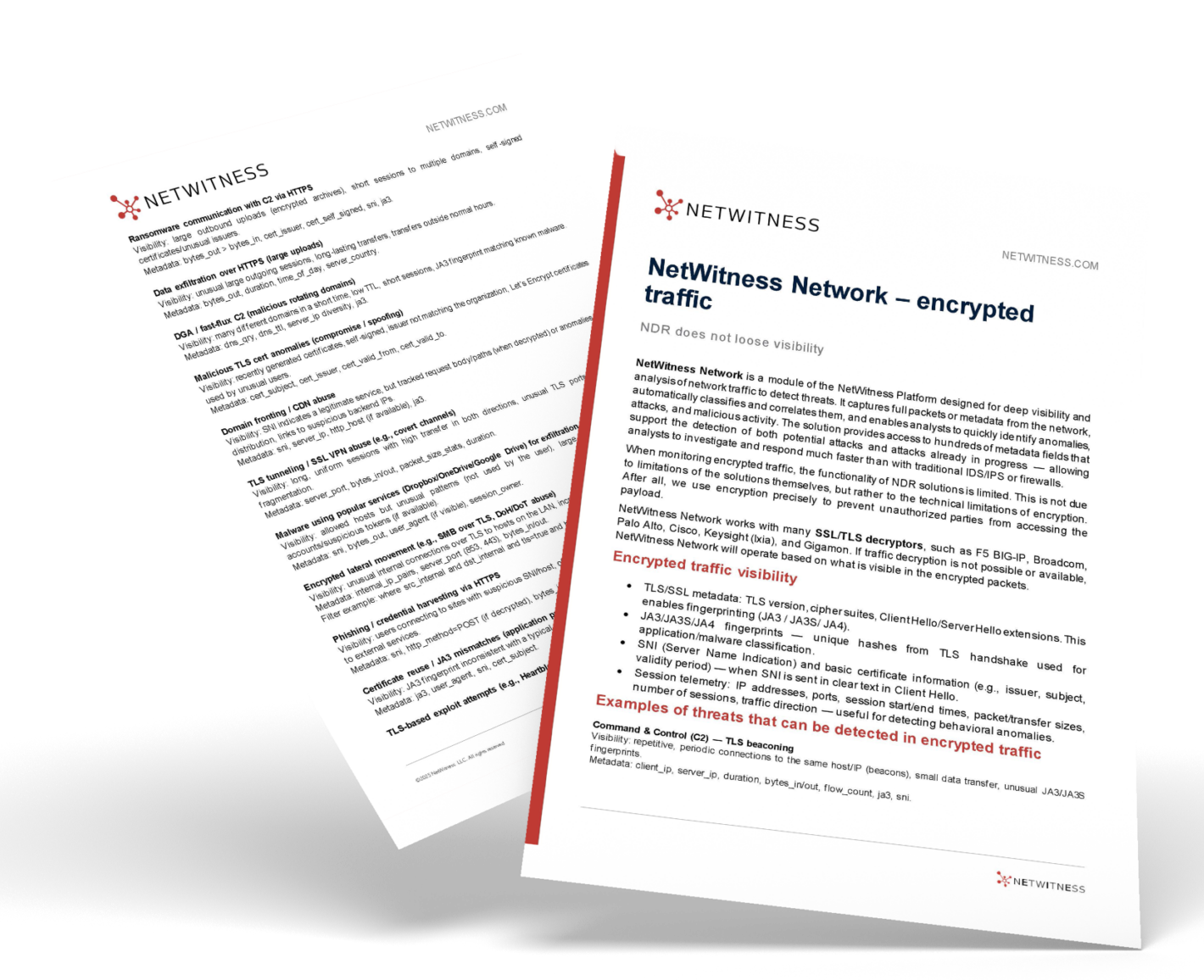
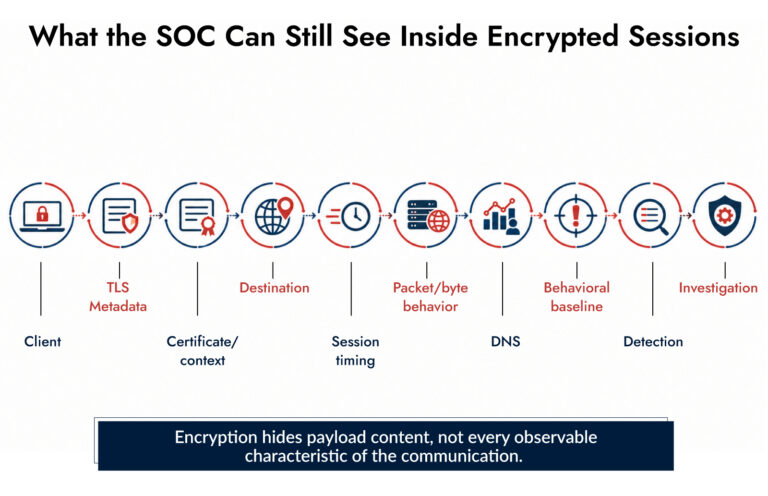
A TLS session still has observable characteristics. The client and server establish a connection. Certificates are exchanged. Sessions have timing, duration, direction, packet sizes, byte ratios, destinations, and recurrence patterns. DNS activity may precede the connection. The same host may communicate with other systems before or after it.
Those details become the working material for encrypted traffic analysis.
The scale of the problem is not theoretical. Cloudflare reported that HTTPS accounted for more than 95% of observed requests by the end of 2025. At the 2025 RSA Conference, the conference SOC also found that 40% of encrypted traffic it observed used weak TLS 1.0 or 1.1, showing why encrypted traffic monitoring needs to examine security properties, not simply mark traffic as encrypted.
The operational question is no longer whether traffic is encrypted. It is whether your SOC can still explain what that traffic is doing.
What to Inspect During Encrypted Traffic Analysis
A practical encrypted traffic analysis workflow should start with signals that remain available without breaking the connection.
| Investigation signal | What the SOC can learn | What it cannot prove alone |
| TLS metadata | Version, session characteristics, protocol details | That the session is malicious |
| JA3/JA4-style fingerprints | Groups traffic by TLS client characteristics | Exact application or attacker identity |
| Certificate context | Certificate relationships, anomalies, reuse | Malicious intent by itself |
| Session timing | Periodicity, duration, beacon-like behavior | That periodic traffic is C2 |
| Byte and packet ratios | Direction and shape of data movement | What the encrypted payload contains |
| DNS context | Domains queried before communication | That a newly observed domain is malicious |
| Full packet evidence | Session-level forensic evidence where capture exists | Plaintext when traffic remains encrypted |
This distinction matters. Fingerprints are useful pivots, not verdicts. A fingerprint can group similar TLS implementations, but legitimate software can share the same underlying libraries, and attackers can modify their network characteristics.
The strongest encrypted traffic analysis therefore combines multiple weak signals until the investigation produces a coherent explanation.
How NetWitness Turns Encrypted Traffic into Investigable Evidence
NetWitness approaches encrypted traffic from an investigation-first architecture.
Its NDR capabilities combine full-packet capture, metadata enrichment, behavioral analytics, threat intelligence, session reconstruction, and network visibility across on-premises, virtual, and cloud environments.
That combination changes what happens after detection.
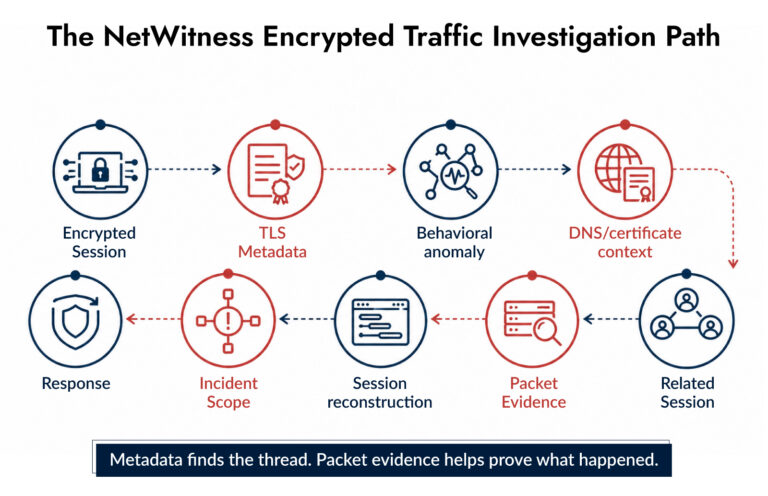
Consider a workstation generating an unusual TLS connection. A metadata-only platform may tell the analyst that the connection occurred. A stronger investigation needs to answer what happened around it.
Was the destination rare for that host? Did the system query the associated domain through DNS shortly beforehand? Did the connection recur at regular intervals? Did the host communicate with an unusual internal peer immediately afterward? Did the same certificate or fingerprint appear elsewhere? Was data moving predominantly outbound? Is there packet evidence available for the session?
NetWitness lets analysts move through these questions using network metadata and packet-backed evidence rather than treating each signal as a separate alert. Its network forensics capabilities support protocol analysis and session reconstruction, giving investigators a way to validate suspicious activity instead of stopping at an anomaly score.
That is the part of encrypted traffic analysis that matters most in an enterprise SOC: detection should lead naturally into investigation.
A Practical Decision Framework for Enterprise SOCs
When evaluating tools for encrypted traffic analysis, avoid the trap of comparing feature checkboxes in isolation.
Ask what happens when an analyst receives a suspicious encrypted-session alert.
A platform that offers TLS fingerprints but no historical network evidence can identify a useful pivot and then leave the analyst searching elsewhere. A decryption-heavy architecture can expose payloads, but inspection may not be appropriate for every network segment, workload, privacy boundary, or encrypted protocol.
A practical enterprise architecture needs both breadth and depth.
For broad coverage, prioritize:
- TLS and session metadata at scale
- Behavioral baselining
- Certificate and destination context
- Fingerprinting capabilities
- Historical search
- East-west and north-south visibility
- Cloud and hybrid network coverage
For investigation depth, prioritize:
- Full packet capture where justified
- Protocol parsing
- Session reconstruction
- Metadata enrichment
- Cross-session pivots
- Evidence retention
- Correlation with endpoint, log, identity, and cloud telemetry
NetWitness explicitly supports both metadata-driven analysis and full-packet investigation. Its NDR architecture captures network traffic and generates enriched metadata in real time, while its forensic capabilities allow analysts to move deeper when investigation warrants packet-level evidence.
That is a more useful model for network security monitoring than treating decryption as the single measure of visibility.
Worked Investigation: From Anomalous TLS Session to Incident
Here is where encrypted traffic analysis becomes operational rather than theoretical.
1. The anomaly appears
A finance workstation begins making outbound TLS connections to a destination it has never contacted before. The sessions are short, regular, and occur every few minutes.
None of those characteristics proves compromise. The analyst starts with a hypothesis: Could this be encrypted command and control?
2. The analyst checks the surrounding context
The SOC searches historical network data for the workstation.
The destination is rare across the environment. DNS activity occurred shortly before the first TLS session. The TLS characteristics differ from the workstation’s normal browser traffic. The connection pattern also continues outside the user’s normal working hours. Now the evidence is stronger.
3. The analyst pivots across the network
The same destination is searched across other hosts. Two systems show related communication, but only one exhibits the same periodic behavior.
The analyst then checks internal traffic from the original workstation. Shortly before the TLS sessions began, the workstation established an unusual connection to an internal server it does not normally access.
The investigation has moved from one suspicious encrypted connection to a potential attack path.
4. Packet evidence validates the timeline
Where full packet capture is available, the analyst reconstructs the relevant sessions and examines the surrounding communications.
The goal is not simply to find a malicious string inside a packet. It is to establish sequence and scope: initial communication, internal movement, recurring external communication, and potential data transfer.
NetWitness supports this type of investigation by combining packet capture, metadata, protocol analysis, session reconstruction, and cross-domain investigation.
5. The SOC reaches an incident conclusion
The final conclusion does not rest on the TLS fingerprint alone.
It rests on the combined evidence:
- anomalous destination
- unusual DNS activity
- abnormal TLS characteristics
- repeated session timing
- deviation from the host baseline
- suspicious internal communication
- packet-backed session evidence
- related activity across other telemetry
That is the difference between saying this encrypted connection looks unusual and demonstrating this host participated in a coordinated malicious communication pattern.
How SOC Teams Should Operationalize Encrypted Traffic Analysis
The most effective approach is not to create another isolated monitoring workflow.
Build encrypted traffic analysis into the existing hunt and investigation process.
Start with a small number of hypotheses that map to real attacker behavior:
- encrypted C2 with periodic callbacks
- unusual TLS from privileged systems
- certificate reuse across unrelated hosts
- unexpected encrypted protocols or ports
- outbound data movement from sensitive systems
- encrypted communication following suspicious authentication
- new external destinations followed by east-west activity
Then preserve enough historical network data to test those hypotheses.
This is where architecture matters. NetWitness supports historical network investigation alongside real-time detection, allowing analysts to search for related activity rather than investigating every alert as a one-off event. Its broader platform can also correlate network activity with endpoint, log, cloud, and user-related telemetry.
The result is a SOC workflow in which encryption changes the evidence available to the analyst, but does not remove the evidence entirely.
What Encrypted Traffic Analysis Should Deliver to the SOC
Encrypted traffic analysis is not about forcing every connection through decryption. In an enterprise environment, that approach quickly runs into practical limits: performance, privacy requirements, certificate management, unsupported protocols, blind spots outside inspection points, and the sheer volume of traffic an analyst would have to interpret.
The better question is what evidence remains available when the payload does not.
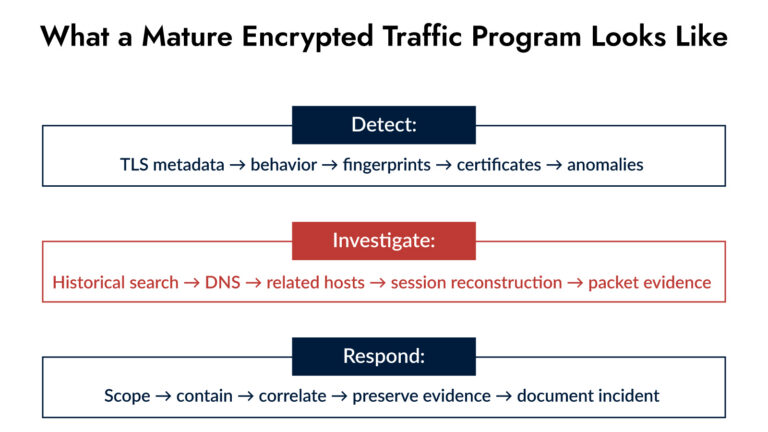
TLS metadata can establish how a session behaves. DNS can connect the session to preceding activity. Certificates can add context. Fingerprints can expose relationships between communications. Behavioral analysis can identify deviations from what a host normally does. Historical network data can show whether the activity is isolated or part of a larger pattern. Packet evidence can then give the investigator the depth needed to reconstruct what happened.
NetWitness brings those layers into the same investigation workflow.
That matters because SOC analysts rarely start an investigation with a perfectly labeled attack. They start with something that does not fit: an unusual destination, a recurring TLS session, a strange certificate, an unexpected connection, or a detection that needs validation. The value of network detection and response is determined by what the analyst can do with that first clue.
With NetWitness, encrypted traffic can remain encrypted while still becoming actionable evidence. Analysts can detect suspicious network behavior, pivot across related activity, search historical traffic, and move from metadata into packet-backed investigation when the case requires it.
For enterprise threat hunting, that is the real objective: not reading every encrypted conversation but retaining enough network evidence to determine which conversations matter, why they matter, and what happened around them.
Frequently Asked Questions
1. Why is encrypted traffic a challenge for SOC teams?
Encryption removes direct access to payload content. SOC teams must therefore rely more heavily on metadata, session behavior, TLS characteristics, certificates, timing, destinations, and related network activity. The challenge is separating legitimate encrypted communication from attacker behavior without treating any single signal as definitive. NetWitness supports this approach through metadata analysis, behavioral analytics, and packet-backed investigation.
2. What are the best tools for encrypted traffic analysis in enterprise networks?
Look for NDR and network security monitoring platforms that combine TLS metadata, behavioral analytics, fingerprinting, certificate context, historical search, and packet evidence. The important distinction is whether the tool can move an analyst from encrypted-session detection into evidence-backed investigation.
3. How can encrypted traffic analysis be implemented in cloud security?
Start by ensuring network telemetry covers the actual communication paths between cloud workloads, users, services, and external destinations. Then apply the same investigation model used on-premises: metadata, behavior, TLS context, historical search, and packet evidence where available.
4. How does encrypted traffic analysis improve network threat detection?
It gives analysts signals that remain available even when payloads cannot be inspected. Timing, destination behavior, TLS metadata, certificates, traffic shape, and baseline deviations can expose suspicious communication and provide pivots for deeper threat hunting.
5. What encrypted traffic analysis techniques are used by leading cybersecurity teams?
Common techniques include TLS metadata analysis, JA3/JA4-style fingerprinting, certificate analysis, behavioral baselining, session timing analysis, destination analysis, DNS correlation, and packet-level validation. The strongest investigations combine these techniques rather than relying on fingerprinting or decryption alone.
6. How can SOC teams detect threats in encrypted traffic?
Start with behavior rather than payload content. Look for unusual destinations, periodic connections, unexpected TLS characteristics, certificate anomalies, protocol mismatches, abnormal data movement, and deviations from the host’s normal communication pattern. Then pivot into historical network data and packet evidence to validate the finding. NetWitness NDR is designed around this progression from detection to investigation and response.
NetWitness Network Encrypted Traffic
- Inspect Encrypted Traffic
- Reveal Hidden Threats
- Maintain Complete Visibility
- Detect Attacks with Confidence