What are the best cybersecurity tools for SOC investigations?
The best cybersecurity tools for SOC investigations are the ones that let an analyst move from a suspicious ping to a defensible conclusion without switching between five browser tabs to piece it together. That usually means SIEM, NDR with full packet capture, threat intelligence, SOAR, case management, and UEBA working as one stack instead of six separate purchases. The right mix depends on your environment, but for enterprise SOCs that need real network forensics and the ability to prove what actually happened, NetWitness earns a spot near the top of that list.
Most vendors will tell you their tool “detects threats.” That’s not the interesting question anymore. The interesting question is what happens on the fifteenth minute of an investigation, once the alert has already fired and someone senior is asking what actually occurred. If your tools can’t answer that cleanly, you don’t have a SOC stack. You have a pile of dashboards.
What Should Your SOC Investigation Tools Stack Actually Look Like?
You don’t need every category on the market. You need the right evidence layers, wired together well enough that an analyst isn’t retyping an IP address into four different consoles before lunch.
Here’s roughly how the pieces should divide the labor:
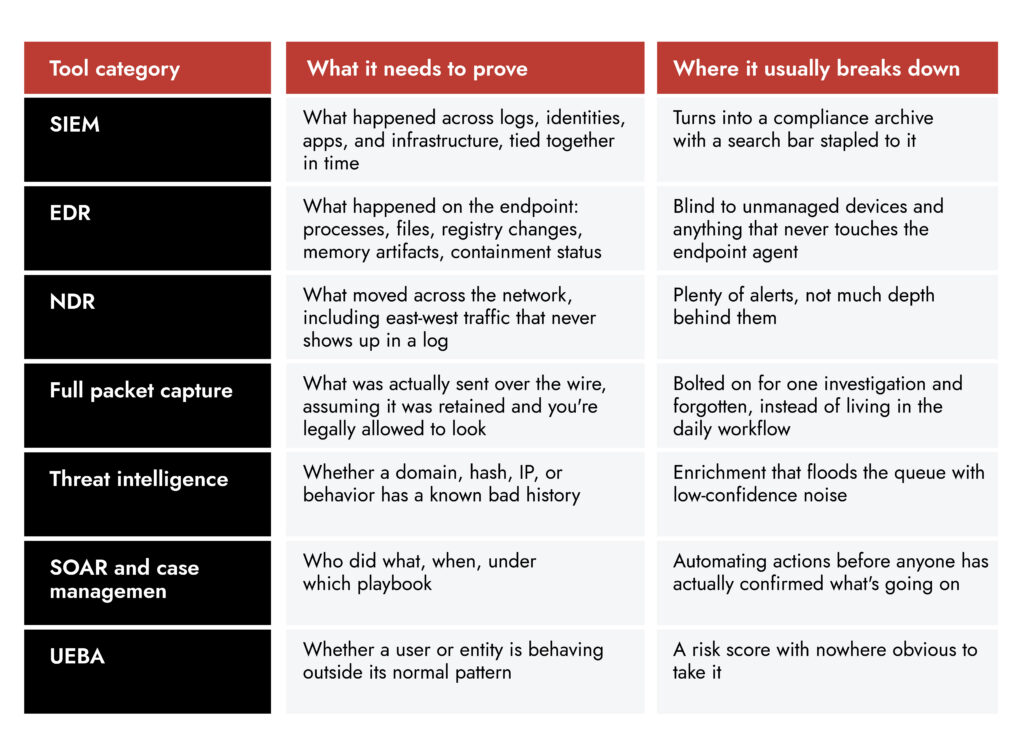
None of these carry the investigation on their own. A SIEM alert tells you a login looked odd. NDR tells you a host started talking to somewhere it shouldn’t. EDR tells you PowerShell fired on that same host ninety seconds later. It’s the correlation across all three that turns “huh, weird” into “this is lateral movement, and here’s the credential that got misused to do it.”
NetWitness is built around that correlation rather than around any one layer, pulling log, network, endpoint, and cloud data into a single platform so an analyst isn’t the one manually stitching a timeline together from four exports.
Why Full Packet Capture Changes What You Can Actually Prove
Metadata tells you a workstation reached out to a domain nobody’s ever heard of. A log tells you a user authenticated at 2:14 a.m. Each of those is a clue. None of them, on their own, tells you what actually left the building.
Say your NDR flags a beaconing pattern, regular callbacks every ninety seconds to an IP that just came online last week. That’s a decent indicator of C2 activity, but it’s still a guess until you pull the actual session and look at what’s inside it. Full packet capture is what lets you confirm whether that beacon carried command output, a staged archive of finance files, or nothing more than a dead connection some old script forgot to close. In a ransomware case specifically, this is usually the whole ballgame: did the attacker exfiltrate data through that C2 channel before detonating the payload, or did they run out of time? Leadership doesn’t want a probability on that answer. They want a session reconstruction that shows exactly what moved and when.
This is the gap NetWitness leans into. Forensic-grade capture, deep session reconstruction, and analytics that sit on top of both, so an investigator can rebuild an attacker’s session, files, emails, and web pages included, and replay it the way it actually happened rather than reconstructing it from memory and log fragments.
How to Actually Evaluate Cybersecurity Tools
Most vendor evaluations are too polite to tell you anything useful. Everyone gets a demo slot, everyone gets asked about their dashboard, everyone hands over an architecture diagram that looks reassuring on a slide. Then the buyer picks whichever option looks least risky on a spreadsheet, and eighteen months later the SOC is sitting on six figures of shelfware nobody trusts when it actually matters.
Give the vendor a real scenario and make them work the case in front of you. Something like this: a user opens a phishing email, clicks the link, a payload runs, the endpoint starts calling out to infrastructure that’s never been seen before, and a privileged account gets reused somewhere it shouldn’t be twenty minutes later.
Then watch what the tool actually does with it.
- Does it connect that first alert to the follow-on activity without an analyst manually chasing indicators from console to console?
- Can it pull identity, endpoint, log, and network evidence into one view?
- Does it find every system that got touched, or just the laptop where the phishing email landed?
- Can it hand you a reconstructed session, not a summary, when someone asks what the attacker actually did?
- Does it produce something you can hand to legal or an auditor without a week of cleanup first?
- Can it take response action without turning automation into its own risk?
This is where NetWitness’s workflow is built to hold up. Packet capture, metadata enrichment, protocol parsing, session reconstruction, behavioral analytics, and threat intel correlation are stitched together in sequence, not bolted on as separate modules an analyst has to remember to check.
How to Choose Cybersecurity Tools When Compliance is Also in Play
Compliance teams tend to buy for retention windows, report templates, access control, and audit trails. Reasonable instinct, wrong starting point. A report template doesn’t matter if the evidence sitting behind it can’t survive someone actually asking hard questions about it.
Before compliance requirements drive the purchase, SOC and GRC should agree on what’s actually non-negotiable: how long evidence is retained, whether it can be tampered with, who has access to it, whether the audit trail holds up, and whether an analyst can pull a supporting artifact in minutes instead of days when someone asks for one. Everything else is secondary.
NetWitness fits this well because the SIEM handles log visibility and compliance reporting on its own, while the broader platform covers incident response, digital forensics, and compliance across network, log, and endpoint data at once. Deployment runs on-premises, in the cloud, or hybrid, depending on what the regulatory and infrastructure reality actually demands, not what’s easiest to sell.
Evaluate unified security platforms with confidence using a practical guide to essential capabilities.
Do Open-Source Tools Still Have a Place?
Yes, and anyone who tells you otherwise probably hasn’t spent much time with Wireshark or Zeek. These tools are how analysts actually learn what evidence looks like. They belong in labs, in threat hunts, in malware teardown work, and in the kind of specialized incident response where you need to see raw packets right now and don’t have time to wait on a platform license.
Where it gets genuinely risky is when a large enterprise SOC lets a stack of open-source tools quietly become the backbone of daily operations, with no platform strategy behind it. For instance: three analysts know how to keep Zeek and Suricata tuned and talking to each other, retention policy lives in someone’s head, and the moment one of those three analysts leaves, nobody else can explain why a detection stopped firing.
- Who owns tuning the detection logic over time?
- Who’s accountable for chain of custody when an auditor actually asks for it?
- Who keeps performance stable when traffic doubles?
Open-source tooling answers none of that by itself, and pretending it does is how SOCs end up with a detection layer that only works as long as specific people stay employed.
For a mature SOC, open-source belongs alongside a platform, filling in specific gaps, not standing in for one.
The Cybersecurity Tools Buying Mistake Worth Avoiding
The mistake that costs teams the most is buying for detection and stopping there. Detection without investigation just produces a bigger alert queue. Investigation without response produces delay while the attacker keeps moving. Response without solid evidence produces risk nobody can actually put a number on when the board asks about it later.
“Threat detection and response” isn’t a category label vendors invented for a slide. It’s a reminder that the job isn’t done when the alert fires, it’s done when someone can explain, with evidence, what happened and what was done about it.
NetWitness pulls network traffic, endpoint telemetry, cloud data, and threat intelligence into one place and runs machine learning and behavioral analysis across all of it to catch known and unknown threats alike. That covers SOC threat detection reasonably well on its own. But the stronger case for NetWitness isn’t the detection piece.
If your team actually cares about reconstructing sessions, pulling real evidence instead of inferring it, and having a workflow analysts can run under pressure without a manual, NetWitness deserves a real look.
The Bottom Line
Cybersecurity tools earn their keep by closing the gap between “something looks wrong” and “here’s exactly what happened, and here’s the proof.” An alert backed by real evidence, endpoint context, log history, network metadata, and a clean case record is worth infinitely more than a clean-looking dashboard nobody trusts when it counts.
Smaller teams can get a lot of mileage out of tightening SIEM content, adding better EDR coverage, and pulling in open-source network forensics tools where they genuinely fit. Larger, regulated enterprises are usually better served by one platform that covers SIEM investigation, network detection and response, full packet capture, cyber threat hunting, and digital forensics together, instead of stitching six tools into something that only sort of works on a good day. Pick whichever path fits your team. Just don’t confuse a detection tool for an investigation platform. They are not the same purchase, and the difference shows up exactly when you can least afford it to.
Frequently Asked Questions
1. How does full packet capture improve threat investigations?
It gives you the actual bytes that moved, not just a summary saying they moved. Instead of trusting a log entry or a risk score, an analyst can open the session itself, see what was sent, and confirm whether files, emails, or web traffic actually crossed the wire. SANS treats full packet capture this way too, as an after-the-fact investigative tool that earns its keep in malware analysis, exploit investigation, and exfiltration cases specifically. The catch is retention: it’s only useful if you captured the traffic in the first place, so this only pays off if it’s already part of your standing workflow, not something you wish you’d turned on after the fact.
2. What are the main tools of cybersecurity?
SIEM, EDR, NDR, network forensics, firewalls, identity and access management, vulnerability management, threat intelligence platforms, SOAR, cloud security tools, data loss prevention, email security, and digital forensics tools cover most of the category. For a SOC specifically doing investigation work day to day, the ones that actually carry the weight are SIEM, EDR, NDR, network forensics, full packet capture, and case management. Everything else is support cast.
3. How do you choose a cybersecurity tool for compliance needs?
Look past whatever report template the vendor shows you in the demo. Check evidence retention, audit trail integrity, access controls, deployment flexibility, and how fast you can actually pull an investigation artifact when someone asks for one under pressure. A tool that’s compliance-ready should help you prove what happened, not just prove that some logs exist somewhere. NetWitness fits well for regulated environments for this reason, since forensics, incident response, and compliance reporting run off the same underlying data instead of three separate systems that don’t quite agree with each other.
4. How do you evaluate the effectiveness of cybersecurity tools?
Test them against a real scenario, not a canned demo. Track mean time to acknowledge, mean time to investigate, how much of the “detection” is actually false positive noise, how deep the evidence goes once you dig in, and how usable the workflow is for an analyst who’s tired and it’s 3 a.m. Don’t let a vendor get away with showing you alert creation and calling it a wrap. Make them show triage, scoping, timeline reconstruction, and how the evidence gets packaged for whoever needs it next, whether that’s IR, legal, or an auditor.
5. How do you compare cybersecurity tools for compliance needs?
Score each option on retention length, reporting quality, how many data sources it actually covers, auditability, access control, deployment flexibility, and how easily evidence exports out when you need it to. Two vendors can both claim compliance support and mean very different things by it. The one worth paying for is the one that can tie a compliance finding back to evidence that would actually hold up if someone challenged it. For SOC-driven compliance work specifically, pairing SIEM with network forensics and full packet capture puts you in a noticeably stronger position than running SIEM by itself and hoping the logs are enough.
Understand today's most active ransomware groups, their tactics, and how to strengthen your defenses.