What is the core difference between threat hunting and traditional security monitoring?
Traditional security monitoring is usually alert-driven. A rule, signature, or detection condition fires, and the SOC investigates.
Threat hunting is proactive. The hunter starts with a hypothesis, weak signal, adversary behavior, or environmental concern, then searches across data to find activity that may have bypassed normal detection.
Cyber threat hunting has a simple idea behind it: do not wait for the perfect alert.
Real attackers rarely move in ways that are obvious or neatly packaged. Instead, they aim to use valid credentials. They try to blend into normal traffic. They quietly abuse administrative tools. They move slowly. They leave behind small clues that may not look dangerous until someone connects them.
That is where advanced threat hunting becomes essential.
Threat hunting in cybersecurity is not just searching for known indicators. It is the disciplined process of asking, “What would an attacker do here, and what evidence would they leave behind?”
Such active threat hunting needs good data. At NetWitness, we bring network, endpoint, and log data together so analysts can move from a weak signal to a complete attack story. The value is not just that we collect more data. The value is that we make the data usable for SOC threat hunting, investigation, and response.
Cyber Threat Hunting Starts Where Alerts Stop
Traditional security monitoring is built around alerts. A rule fires. A signature matches. A threshold is crossed. Someone investigates.
Attackers know how to avoid obvious detection. They use PowerShell, WMI, RDP, PsExec, scheduled tasks, cloud tokens, stolen credentials, and encrypted traffic. None of those are malicious by default. In many organizations, they are part of everyday operations.
So, the job of a threat hunter is different from the job of a traditional monitoring tool.
When a monitoring tool says, “This event matched a known condition,” the hunter asks, “But, does this behavior make sense?”
That question requires context. It requires network traffic analysis, endpoint threat detection, log analysis, cybersecurity practices, identity visibility, asset awareness, and a repeatable threat hunting framework.
If those signals live in separate tools, analysts spend too much time switching screens and translating field names. If those signals are unified, the investigation moves faster and the story becomes clearer.
Why One Data Source Is Not Enough for Threat Hunting
Every telemetry source has blind spots. Network data may show a suspicious outbound connection but not the process that created it. Endpoint data may show a suspicious process but not the full communication path or payload movement. Log data may show a valid login but not whether that login led to lateral movement, command execution, or data access.
That is why effective threat detection and response depends on correlation.
When network, endpoint, and log data come together, analysts can answer the questions that matter:
- Who logged in?
- From where?
- To which system?
- What process ran?
- What did it connect to?
- Did it move laterally?
- Was data accessed or transferred?
- Did the same behavior appear elsewhere?
- Was the target system business-critical?
This is the core of advanced threat hunting. It turns scattered evidence into a defensible narrative.
How NetWitness Uses Network Data for Advanced Threat Hunting
Network data is often where the hunt becomes real.
Attackers have to communicate. They have to move. They have to reach infrastructure, touch internal systems, transfer tools, authenticate to services, or send data somewhere. Even when malware is fileless or credentials are valid, network behavior can expose the pattern.
NetWitness uses network data for deep network threat hunting, especially when logs or endpoint tools do not show enough detail. Network visibility helps analysts detect lateral movement, command-and-control behavior, unusual peer-to-peer activity, SMB/RDP/LDAP/Kerberos anomalies, suspicious DNS or TLS behavior, and traffic between systems that normally should not communicate.
This is where network traffic analysis earns its place in the SOC. For example, a suspicious connection to a rare external domain may not be enough on its own. But when that connection follows an unusual login, a PowerShell execution, and internal RDP activity, the picture changes.
Network data helps answer:
- Where did the host connect?
- Was the destination rare or known-bad?
- Was the timing beacon-like?
- Did the host communicate with unusual internal peers?
- Was there data movement?
- Did the session include suspicious files, domains, certificates, or URIs?
- Did activity occur before or after the alert that other tools missed?
For packet-backed evidence, session reconstruction can also help analysts look beyond derived alerts and examine what actually happened in a session, including web transactions, emails, or other communications available.
How NetWitness Uses Endpoint Data for Advanced Threat Hunting
Network data tells us that something was communicated. Endpoint data tells us what caused it.
An outbound HTTPS session may be normal browser traffic. Or it may be PowerShell calling out after a malicious document is opened. Or it may be a renamed binary, a script, a living-off-the-land tool, or a process launched by an attacker using stolen credentials.
Endpoint threat detection gives the hunter host-level visibility into process creation, process ancestry, file metadata, hashes, registry activity, user context, kernel behavior, memory activity, and other signs of compromise. Endpoint telemetry is the layer that helps determine what process caused network activity, what file executed, what user was involved, and what changed on the machine.
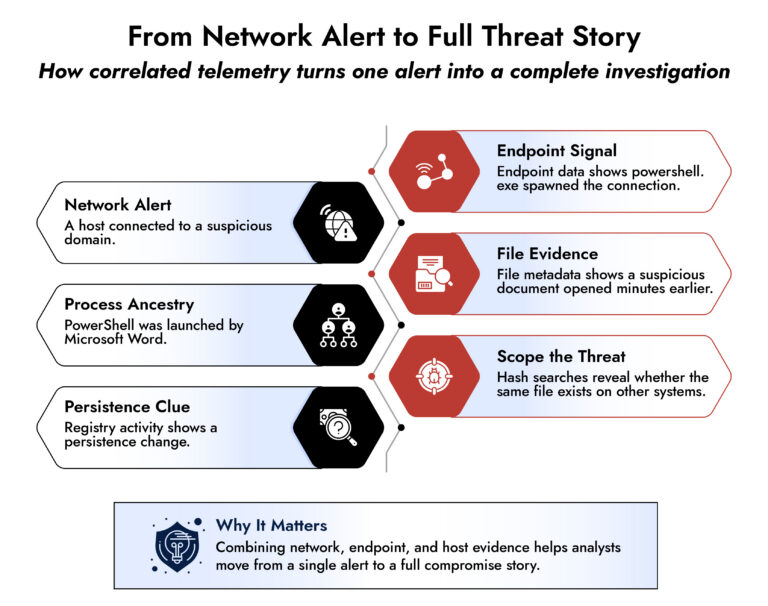
Endpoint data is also essential for scoping. If one file hash, process, or behavior appears across 200 hosts, the response is very different from an isolated event on one workstation.
How NetWitness Uses Log Data for Advanced Threat Hunting
Logs are the control-plane evidence of the enterprise. They tell us who authenticated, what changed, which systems were accessed, which policies allowed traffic, what cloud activity occurred, and whether business applications were abused.
This is especially important for credential-based attacks.
A lateral movement campaign may look like normal login activity if analysts only see authentication success. But when that login is correlated with unusual access time, new geography, abnormal host access, privilege changes, endpoint execution, and suspicious network movement, the hunt takes shape.
NetWitness uses log data to bring in identity, authentication, infrastructure, application, and cloud context. The research highlights sources such as Active Directory, LDAP, Kerberos, VPN, SASE, firewall, proxy, DNS, cloud, SaaS, application, operating system, and security logs.
That matters because many modern attacks are not malware-first. They are identity-first.
The Real Hunting Layers in NetWitness Solution
Unified Metadata
The most important part of cyber threat hunting is not collecting data. It is pivoting through it.
We use a metadata-first investigation model so analysts can pivot across telemetry sources without constantly switching tools or translating every field by hand. Packets, logs, endpoint events, NetFlow, and other telemetry are converted into enriched metadata using a unified taxonomy.
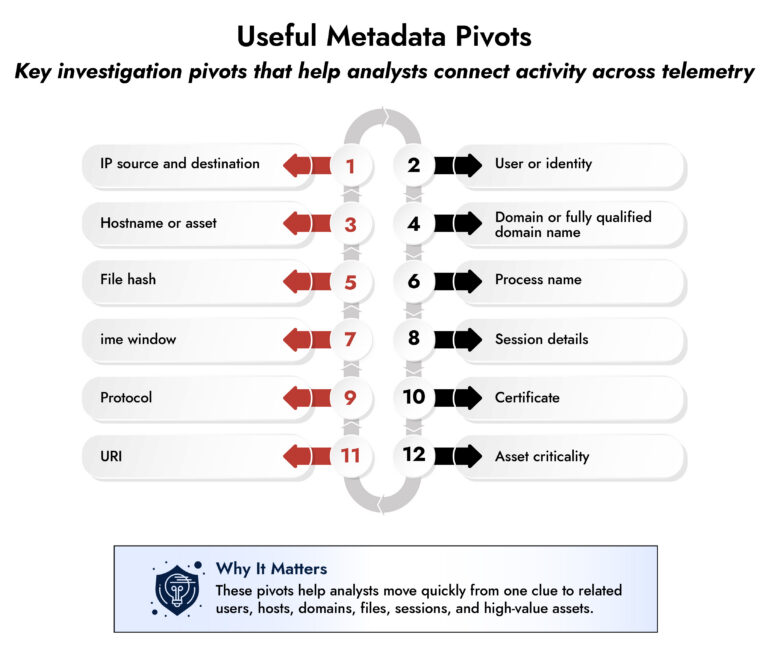
Threat hunting is often a chain of pivots. The faster analysts can move through that chain, the faster they can understand the attack.
Data Enrichment
Not every suspicious event deserves the same level of urgency.
A strange PowerShell command on a test machine may matter. The same command on a privileged administrator’s workstation matters more. Suspicious outbound traffic from a lab host is one thing. Suspicious outbound traffic from a domain controller or finance server is another.
That is where enrichment becomes essential.
NetWitness enriches telemetry with business and security context so hunters can prioritize what matters. The research notes enrichment with asset criticality, identity information, threat intelligence, incident context, custom lists, and endpoint details such as machines, processes, and files.
That context helps analysts distinguish between:
- A low-value host and a critical server
- A standard user and a privileged administrator
- A rare domain and a known malicious C2 domain
- A one-off process and the same hash across many endpoints
- A suspicious login and a suspicious login followed by lateral movement
Context turns event correlation into risk-based hunting. It helps the SOC focus on what can hurt the business fastest.
Behavioral Analytics
Attackers often use legitimate tools in illegitimate ways. PowerShell, WMI, RDP, PsExec, rundll32, cloud admin consoles, and remote access utilities can all be part of normal IT operations. They can also be part of an intrusion.
Behavioral analytics help identify activity that does not match expected patterns. The research describes how behavioral analytics and UEBA can help detect stolen credentials, insider threats, living-off-the-land behavior, fileless attacks, and slow lateral movement by looking across logs, network packets, endpoint data, and enriched metadata.
This is especially useful when the login is valid but the behavior is wrong.
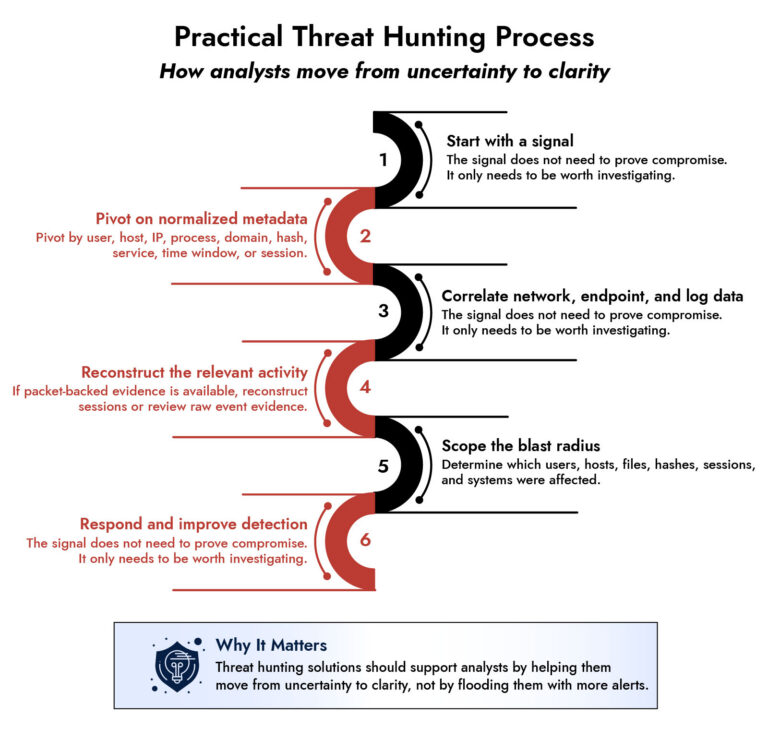
Example Hunt: Credential Theft and Lateral Movement
Suppose, a SOC sees multiple failed logons followed by a successful VPN login for a privileged user from an unusual source.
On its own, that may look like suspicious authentication. But the hunt does not stop there.
The analyst pivots to the user, source IP, destination host, and time window. Log data shows the login pattern is unusual. Endpoint data shows suspicious child processes such as PowerShell or rundll32 on the user’s workstation. Endpoint telemetry shows signs that may point to credential theft or post-exploitation behavior, such as LSASS access, registry changes, malicious scripting, or memory-related activity.
Then, network metadata shows the workstation initiating SMB, RDP, or WinRM connections to servers it does not normally access. Packet or session data shows outbound HTTPS activity to a rare domain or a suspicious certificate. Context enrichment shows that one of the targets is a high-value server.
Now the SOC has a much stronger story.
This is not just a suspicious login. It may be credential theft, endpoint compromise, lateral movement, and external command-and-control activity happening in sequence.
The research describes this exact value: we do not force the hunter to decide from one telemetry type; we use network, endpoint, and logs together to build a defensible compromise narrative.
That is the point of unified cyber threat hunting.
Final Thoughts
Cyber threat hunting works best when analysts can see the full attack path, not just isolated alerts. That is where NetWitness brings real value to the SOC.
With NetWitness Threat Detection and Response, analysts can examine movement, communications, command-and-control behavior, lateral traffic, suspicious protocols, and session-level evidence. They can see the process, file, registry, memory, user, and host activity behind that network behavior. They can connect the investigation to identity, authentication, infrastructure, cloud, application, and policy-relevant activity.
But the real strength is not simply collecting all three data types. It is bringing them together.
NetWitness normalizes, enriches, correlates, and makes this evidence searchable through a common investigation workflow. That means analysts can start with a weak signal, pivot across users, hosts, IPs, domains, processes, hashes, sessions, and log events, then reconstruct the attack path with far more confidence.
Instead of forcing the SOC to jump between disconnected tools, NetWitness helps analysts connect the evidence, understand the scope, and move from investigation to response faster.
Why Trust Has Become the New Attack Surface
- Expanding digital attack surface across cloud and OT
- Unmonitored identities and excessive privileges
- Disconnected security tools lacking context
- Blind spots in east-west network traffic
Frequently Asked Questions
1. What are the best platforms for cyber threat hunting in an enterprise environment?
The best platforms for cyber threat hunting are the ones that give enterprise SOC teams broad telemetry, strong correlation, fast investigation, and response capabilities.
Common enterprise options include:
- NetWitness,
- Microsoft Sentinel and Defender XDR,
- Google Security Operations,
- CrowdStrike Falcon,
- Palo Alto Networks Cortex XDR,
- Splunk Enterprise Security,
- Elastic Security,
- Exabeam,
- Securonix,
- SentinelOne,
For enterprise threat hunting, do not choose only by market category. Choose based on visibility, data quality, investigation depth, scalability, openness, analyst workflow, and response integration.
2. How does combining network, endpoint, and log data improve threat detection?
Combining these data types gives analysts a fuller attack story.
Network data shows communication, movement, C2 behavior, lateral traffic, and possible data transfer. Endpoint data shows process execution, file activity, registry changes, user activity, and host behavior. Log data shows authentication, identity, cloud, infrastructure, application, and policy events. Together, they help the SOC connect cause and effect.
3. What role does network traffic analysis play in threat hunting?
Network traffic analysis helps hunters see behavior that may not appear clearly in endpoint or log data.
It can reveal
- lateral movement,
- unusual internal communication,
- beaconing,
- suspicious DNS activity,
- abnormal TLS attributes,
- unauthorized data movement,
- attacker infrastructure reuse.
It also helps analysts understand what happened before and after an alert by examining source, destination, timing, protocol, payload metadata, certificates, domains, URIs, and file transfer evidence.
For advanced investigations, network data can provide the movement and communication layer that turns isolated endpoint or identity events into a complete attack path.
4. How can organizations improve their threat hunting capabilities?
Organizations can improve cyber threat hunting by building a repeatable process.
- Start with clear hypotheses tied to business risk and adversary behavior.
- Map hunts to frameworks such as MITRE ATT&CK.
- Make sure hunters have access to network, endpoint, log, identity, cloud, and application data.
- Normalize that data so analysts can pivot quickly.
- Add enrichment such as asset criticality, user context, threat intelligence, and incident history.
- Track outcomes such as confirmed findings, new detections created, false positives reduced, and coverage gaps closed.
Most importantly, feed every useful hunt back into the SOC. It improves detection logic, response playbooks, analyst knowledge, and future hunting priorities.