What Security Leaders Need to Know Before Choosing an OT Monitoring Platform ?
OT and IT cannot be treated as discrete environments anymore by organizations to protect them from cyber threats. Attackers today can move between IT and OT quickly, so an integrated approach to visibility and detection are paramount. The most effective tools for monitoring OT security provide continuous visibility of OT, as well as monitor industrial communications, detect risk in real-time, and share telemetry data with a wider security operation across IT. A good platform will allow a security team to identify risk faster, investigate incidents across IT and OT environments, and improve resilience without disruption to critical business processes.
Introduction
The production line stopped unexpectedly. An engineering workstation begins communicating with an unfamiliar external destination. A legacy PLC starts receiving commands outside its normal operating schedule.
The question is no longer whether these events originated in IT or OT.
The issue is whether your security team is capable of seeing the full attack path.
With the rise of connections in industry, the lines between the enterprise network and operational technology continue blurring. Modern industrial enterprises depend on remote access, cloud connectivity, IoTs, third-party vendors, and other interconnected business systems. With all of these new opportunities, increased possibilities of attacks have come.
This evolution has caused the importance of OT security monitoring tools to evolve from an auxiliary tool to a vital component of any cybersecurity strategy.
Some of the best platforms today not only monitor the activity in the industrial environment. Instead, they ensure comprehensive OT security monitoring, correlation of OT and IT activities, support investigations, and allow businesses to detect any threat before it impacts operations.
This guide looks into various types of OT security monitoring solutions and what features are crucial.
Why OT Security Monitoring Tools Matter More Than Ever
Industrial environments face a unique challenge. Most OT assets were designed for reliability and availability, not cybersecurity.
Most organizations rely on old systems which cannot be made compatible with new-age security solutions or patching. On the other hand, the threat of ransomware groups and nation-states targeting critical infrastructures, manufacturing companies, utility firms, transportation systems, and energy firms is growing.
As per CISA, attacks on industrial control systems and critical infrastructures pose a big risk to national security of the United States. In addition to this, NIST keeps emphasizing the significance of continuous monitoring and visibility of assets in cybersecurity of industrial environments.
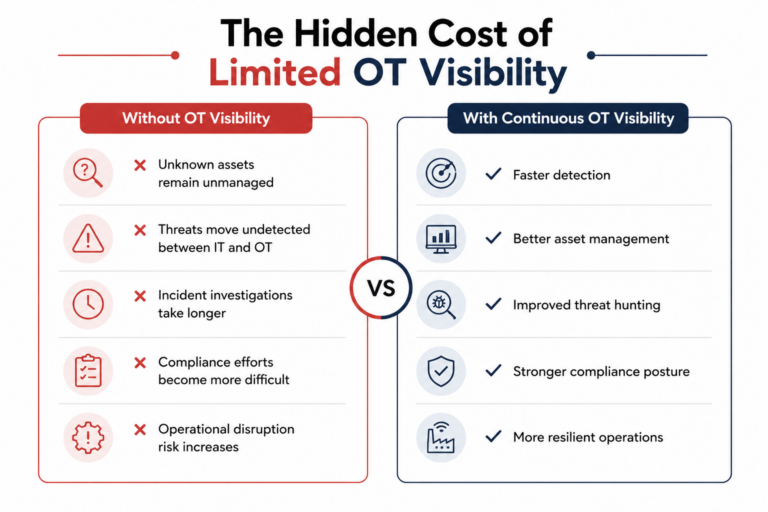
Lack of specialized OT security monitoring tools usually makes it difficult for organizations to:
- Identify unmanaged industrial assets
- Detect unauthorized communications
- Monitor industrial protocols
- Investigate lateral movement between IT and OT networks
- Respond to incidents before operational disruption occurs
Effective operational technology security begins with visibility. Security teams cannot protect assets they cannot see.
The Core Capabilities Every OT Security Monitoring Tool Should Provide
Not all OT security tools deliver the same level of protection.
The strongest solutions combine asset intelligence, network monitoring, threat detection, and security analytics into a single operational framework.
Key capabilities include:
1. Complete OT Visibility – Organizations need a continuously updated inventory of:
- PLCs
- RTUs
- HMIs
- SCADA systems
- Industrial servers
- Engineering workstations
- Network infrastructure
Comprehensive OT visibility provides the foundation for every security decision.
2. Deep OT Network Monitoring – Industrial environments communicate using protocols that traditional IT security tools often cannot interpret.
Effective OT network monitoring platforms analyze:
- Modbus
- DNP3
- IEC 61850
- PROFINET
- EtherNet/IP
- OPC UA
Understanding these communications allows teams to identify abnormal activity quickly.
3. Behavioral OT Threat Detection – Traditional signature-based approaches are insufficient for industrial environments.
Modern OT threat detection platforms establish behavioral baselines and identify:
- Unauthorized command execution
- Configuration changes
- Network scanning
- Suspicious remote access
- Lateral movement attempts
4. IT and OT Security Integration – Perhaps the most important capability is IT and OT security integration.
Industrial incidents rarely remain isolated within OT networks. Security teams need visibility across the entire attack lifecycle, from initial compromise to operational impact.
Categories of OT Security Monitoring Tools Used Today
Organizations evaluating OT security monitoring tools typically encounter several categories of solutions.
Network-Based OT Security Monitoring Tools
These platforms passively monitor industrial traffic and identify assets, vulnerabilities, and abnormal activity without disrupting operations.
Best suited for:
- Manufacturing
- Energy
- Utilities
- Critical infrastructure
Strengths include:
- Low operational risk
- Continuous monitoring
- Protocol awareness
- Broad asset visibility
Security Analytics Platforms
These solutions aggregate logs, network telemetry, endpoint data, and security events from both IT and OT environments.
Benefits include:
- Centralized investigations
- Threat hunting
- Cross-domain visibility
- Faster incident response
Organizations often use these platforms as the foundation for enterprise-wide OT security solutions.
Threat Detection and Response Platforms
These tools focus on identifying adversary activity and accelerating investigations.
Capabilities often include:
- Threat intelligence correlation
- Attack path analysis
- Incident prioritization
- Automated workflows
For mature security programs, this category significantly strengthens OT threat detection capabilities.
Unify IT and OT security with complete visibility and faster threat detection.
- Correlate IT and OT threats
- Gain deep industrial visibility
- Accelerate incident investigations
- Strengthen cyber resilience
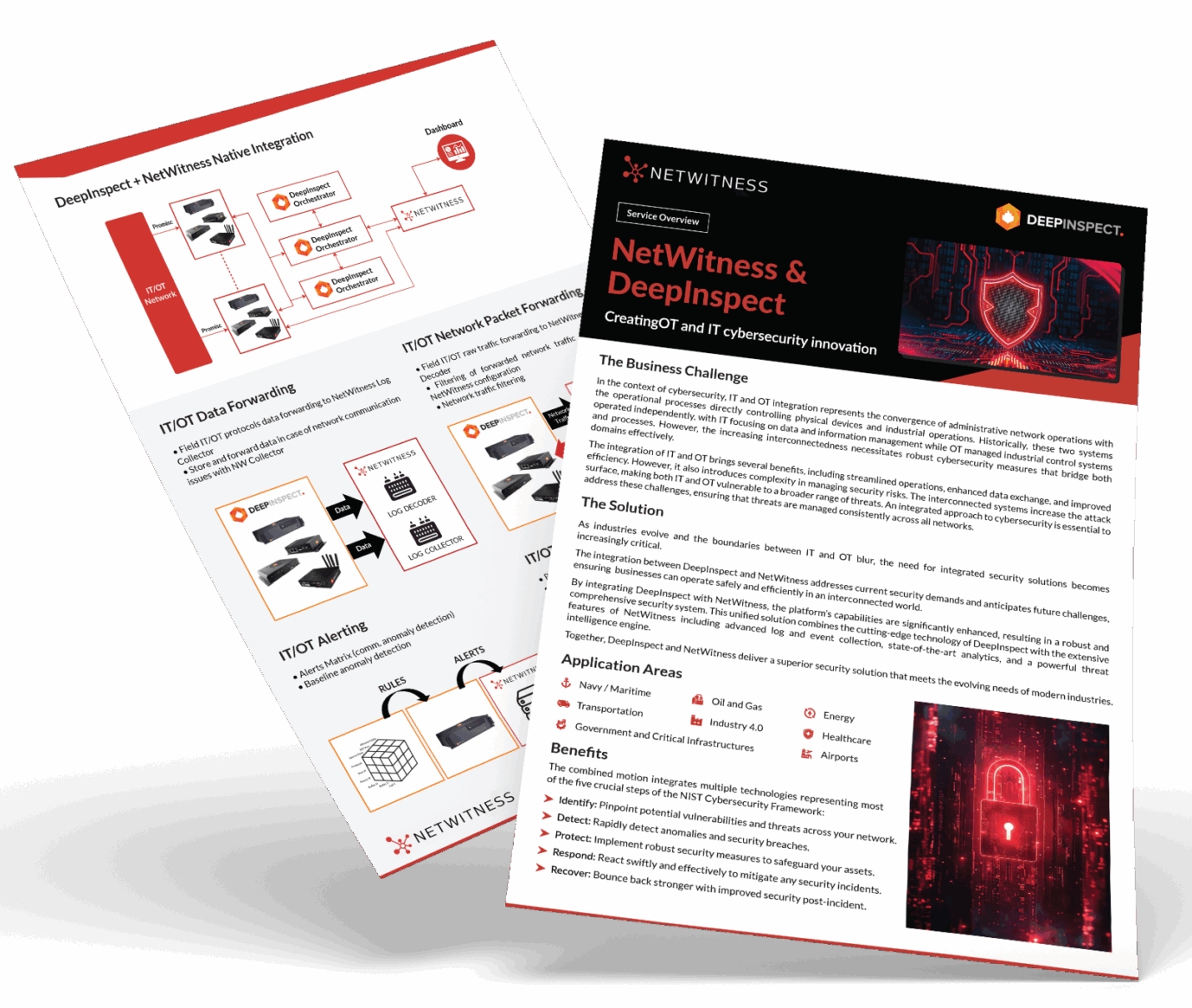
How IT and OT Security Integration Changes Incident Response
Security operations teams often face a familiar challenge. An alert appears in the SIEM. An endpoint shows suspicious behavior. Network traffic appears abnormal.
But the investigation stops at the IT boundary. Integrated OT security monitoring tools remove that blind spot.
Consider a real-world scenario: An attacker compromises an employee’s workstation through phishing. The attacker steals credentials, gains access to engineering systems and attempts to modify industrial processes.
Traditional security monitoring may identify the phishing attack.
Integrated monitoring reveals the entire chain:
- Initial compromise
- Credential misuse
- Lateral movement
- Access to OT assets
- Industrial protocol activity
- Operational impact
This broader context significantly improves response speed and accuracy.
How NetWitness Supports OT Security Monitoring
Many organizations already operate mature IT security programs but struggle to extend those capabilities into industrial environments.
This is where integrated visibility becomes essential.
NetWitness OT security helps organizations unify security monitoring across both operational and enterprise environments.
The platform supports:
- Continuous OT asset visibility
- Industrial network monitoring
- Threat detection across IT and OT domains
- Investigation workflows with contextual telemetry
- Threat hunting and security analytics
- Risk identification across interconnected environments
NetWitness doesn’t treat OT as an independent security discipline but rather provides organizations with the capability to see industrial threats as part of their enterprise security operations.
This way, it is possible to achieve better integration of IT and OT security, investigation, and decision-making processes.
Choosing the Right OT Security Monitoring Tools
Selecting the right platform requires balancing operational requirements, security goals, and organizational maturity.
Look for solutions that can:
- Scale across multiple facilities
- Support industrial protocols
- Provide continuous asset visibility
- Integrate with existing security operations
- Enable threat hunting and investigations
- Deliver actionable intelligence
- Strengthen OT and IT collaboration
Most importantly, choose a platform that helps security teams understand how threats move across the entire environment rather than treating OT and IT as separate worlds.
Conclusion
The era of industrial cybersecurity is entering a new phase.
The enterprise does not require isolated visibility solutions that cause siloed visibility and blind spots between the enterprise and OT network environments. The enterprise requires OT security monitoring solutions that have context, correlation, and visibility.
Some of the most successful OT security solutions integrate asset discovery, OT network visibility, threat detection, and investigation capabilities into one operation.
The more interconnected the industrial environment becomes, the better it will be for an enterprise to have integrated OT security monitoring solutions for earlier threat detection and incident investigation purposes.
If your enterprise is considering ways to improve its OT security posture, it is time to evaluate your visibility solutions’ ability to see both sides of the environment.
Frequently Asked Questions
1. What are OT security monitoring tools?
OT security monitoring tools are platforms that provide visibility to industrial networks, assets, communications, and threats. They help organizations monitor operational technology environments, identify security risks, and support incident responses.
2. What are the top OT security monitoring tools used in industrial environments?
Leading solutions typically include network-based monitoring platforms, security analytics systems, threat detection platforms, and integrated OT security solutions that combine asset visibility, monitoring, and investigation capabilities.
3. What are the essential features of an effective OT security monitoring platform?
Core features include asset discovery, OT visibility, industrial protocol analysis, OT network monitoring, behavioral analytics, threat detection, security analytics, and IT and OT security integration.
4. Which companies provide OT security monitoring tools for manufacturing plants?
Several cybersecurity vendors provide OT-focused monitoring solutions. Organizations should prioritize platforms that offer industrial protocol support, continuous monitoring, threat detection, and integration with enterprise security operations.
5. Can you recommend OT security monitoring solutions suitable for critical infrastructure?
Critical infrastructure operators typically require solutions that deliver comprehensive OT visibility, support industrial protocols, detect threats in real time, and integrate with broader security monitoring environments.
6. Why should OT security monitoring tools integrate with IT security platforms?
Threat actors frequently move between IT and OT environments during attacks. Integrating OT security monitoring tools with IT security platforms enables complete attack visibility, faster investigations, improved threat detection, and more effective incident response.
Choose the Right OT Cybersecurity Solution with Confidence
- Assess critical security capabilities
- Compare OT security platforms
- Reduce operational risk
- Improve security visibility