What’s the Role of Threat Detection and Response in Strengthening Compliance Readiness?
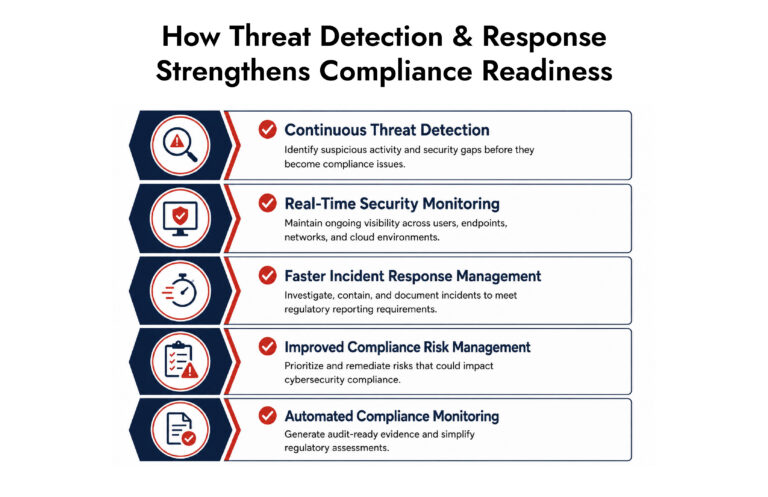
Threat detection and response plays a critical role in compliance readiness by helping organizations continuously identify, investigate, and contain security threats before they become compliance violations. Modern threat detection solutions support cybersecurity compliance through real-time security monitoring and compliance visibility, while incident response management ensures that incidents are properly documented and addressed. Combined with compliance monitoring tools, compliance risk management, and cybersecurity risk management practices, threat detection and response helps organizations meet regulatory requirements, reduce risk, and maintain a stronger security posture.
Introduction
Most security teams treat compliance as a separate workstream. Threat detection lives in the SOC. Compliance lives in GRC. They occupy the same org chart, maybe, but rarely the same workflow. That separation is exactly where organizations start losing audits, contracts, and customer trust.
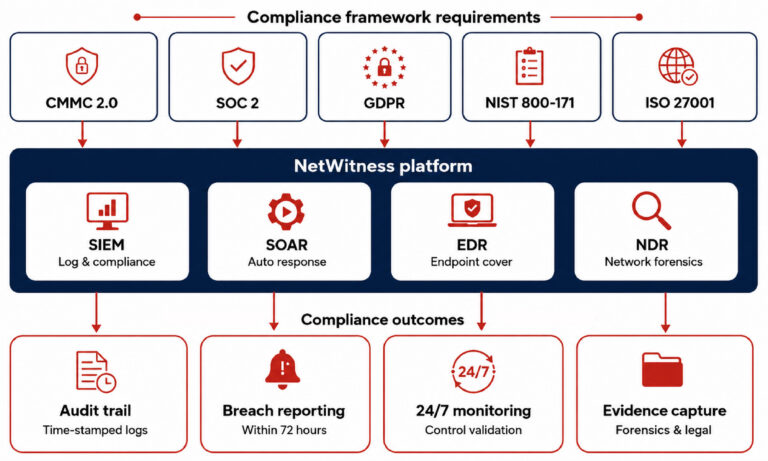
Threat detection and response (TDR) has evolved from a purely technical security function into the operational backbone of compliance readiness. Regulatory frameworks like NIST SP 800-171, ISO 27001, SOC 2, GDPR, and CMMC 2.0 now embed specific incident handling requirements directly into their control sets. If your threat detection and response program cannot produce documented evidence of how you detect, classify, contain, and report incidents, policy documents alone will not protect you when regulators come knocking.
Bridging the Gap Between Security Operations and Regulatory Obligations
The link between incident response management and regulatory compliance is tighter than most organizations expect. These frameworks do not just want you to have security controls. They want proof those controls work.
Three examples that show how precise this gets:
- CMMC 2.0 Level 2 mandates three specific incident response controls: incident handling (IR.L2-3.6.1), incident reporting (IR.L2-3.6.2), and incident response testing (IR.L2-3.6.3)
- SOC 2 ties nine principles to incident response planning, each requiring documented evidence that controls are actively implemented and understood by the teams responsible for them
- GDPR sets breach notification windows as tight as 72 hours, while several U.S. states now require reporting within 24 hours
Cybersecurity compliance has become operationally demanding. Vague security postures do not hold up under scrutiny. What regulators want to see is your threat detection and response program in action, documented and measurable.
Threat Detection and Response Functions That Directly Support Compliance Readiness
Real-Time Detection and Automated Documentation
Manual updates and spreadsheet-based tracking will not pass a compliance audit. Modern threat detection solutions integrate directly into the security stack to capture evidence, logs, and incident updates automatically.
Auditors reviewing cybersecurity compliance need time-stamped actions, preserved artifacts, and documented decisions across every phase of response: preparation, detection, analysis, containment, eradication, recovery, and post-incident review. Automated TDR tooling closes the gap between responding to an incident and proving you responded correctly. Frameworks like SOC 2 and ISO 27001 require exactly this kind of audit trail, and generating it manually at scale is not realistic.
Incident Classification and Escalation Workflows
Regulations require organizations to classify incidents to determine reporting obligations. Without structured classification, teams miss thresholds and deadlines, both of which are direct compliance violations. Compliance risk management depends on getting this right at speed. Threat detection and response systems enable:
- Automated severity scoring based on data sensitivity, regulatory scope, and business impact
- Routing to appropriate stakeholders, whether legal, privacy teams, or executive leadership, based on incident classification
- Escalation workflows designed to meet specific regulatory timelines, such as the DoD’s 72-hour CUI breach reporting requirement to the DIB CS program
Forensic Evidence Preservation
Cloud environments create a specific compliance challenge: logs can disappear quickly, making forensic investigations harder and evidence chains easier to break. TDR solutions address this through:
- Immutable log storage and chain-of-custody preservation
- Integration with SIEM and endpoint detection platforms
- Automated evidence collection that satisfies legal hold requirements
NIST SP 800-61 outlines the coordination and role definitions required for proper evidence handling. Organizations that cannot meet these standards are left exposed during regulatory investigations and litigation.
Using Threat Detection and Response to Proactively Test Compliance Readiness
Tabletop Exercises
Tabletop exercises have become one of the most practical methods for validating compliance readiness before an auditor arrives. These discussion-based simulations let organizations identify gaps in existing controls while producing documentation that demonstrates a genuine commitment to compliance.
TDR capabilities make tabletop exercises substantive rather than theoretical. With historical incident data to ground scenarios in reality, teams can:
- Simulate detection and response workflows against actual threat patterns
- Test communication chains and escalation paths under realistic conditions
- Generate after-action reports that map directly to regulatory control frameworks
CMMC 2.0 explicitly requires periodic testing of incident response capabilities, including tabletop and live simulations, with documented results feeding directly into updated response plans.
Continuous Control Monitoring
Traditional cybersecurity risk management relied on point-in-time audits. Prepare for three months, survive the audit, drift until the next cycle. That model no longer fits what regulators and enterprise customers expect.
Modern security monitoring and compliance demands continuous validation. Mature threat detection and response programs support this shift through:
- Around-the-clock monitoring that validates control effectiveness between formal audits
- Metrics dashboards tracking mean time to detect (MTTD), mean time to respond (MTTR), and vulnerability backlog trends
- Automated alerting when control deviations are detected
The expectation has shifted from audit-ready to always-ready. Organizations that build continuous monitoring into their TDR program reflect that shift operationally.
Compliance Challenges in Complex Environments
Cloud deployments introduce shared responsibility confusion that creates real compliance gaps during incidents. Clear role delineation is not optional. TDR implementations in cloud environments need to account for:
- Precise boundaries between what the organization handles versus what the cloud provider handles
- Cross-border data sovereignty requirements that balance GDPR compliance against U.S. legal holds
- Third-party coordination protocols that account for limited forensic access and vendor response delays
Effective TDR implementations include cloud security posture management (CSPM) and cloud-native log aggregation to maintain visibility across distributed environments. Compliance monitoring tools that do not extend into cloud infrastructure leave organizations with blind spots that auditors will find.
Supply chain risk adds another layer. Modern compliance programs now expect:
- Vendor incident notification requirements embedded in SLAs and data processing agreements
- Software supply chain monitoring that includes SBOM tracking and dependency vulnerability management
- Third-party risk assessments that specifically cover incident response procedures
How NetWitness Supports Compliance-Ready Threat Detection and Response
NetWitness operates as an end-to-end threat detection and response platform, combining SIEM for log management, SOAR for automated incident orchestration, EDR for endpoint visibility, and NDR for network-layer detection.
The SIEM component ingests logs from over 350 sources including AWS, Azure, Office 365, and on-premises systems, with prebuilt compliance templates for SOX, PCI-DSS, HIPAA, NERC, FISMA, and ISO 27002. One organization reported reducing HIPAA audit prep from three weeks to three days.
The SOAR component enables audit-ready, repeatable response processes across the SOC, auto-documenting all actions during investigation and maintaining a full audit trail for compliance reporting. With over 500 available integrations, it connects across SIEM, EDR, cloud, and identity tools.
The NDR component captures, parses, and enriches every packet across on-premises, cloud, and virtual environments, with robust forensics that facilitate incident disclosures and compliance reporting without delay.
The Detect AI module surfaces high-risk anomalies in real time, reduces false positives, and accelerates response by turning every alert into actionable insight. Together, these capabilities give compliance teams something they’ve historically struggled to build: an investigation-first platform that generates regulatory evidence automatically as part of normal operations.
The Business Case for Mature Threat Detection and Response
Organizations that build compliance readiness into their threat detection and response program gain more than a clean audit report. They gain access to markets where trust is a qualifier, not a differentiator.
Here is what the risk-reward calculation looks like in practice:
- Defense contractors who fail to meet CMMC 2.0 incident response controls risk losing eligibility for government contracts entirely
- GDPR violations tied to missed breach notifications carry penalties up to 4% of global annual revenue
- Slow incident response leads to prolonged downtime, data loss, and customer churn that outlasts the incident itself
- Transparent, documented response preserves customer trust and demonstrates operational maturity to partners and prospects
Compliance risk management, when tied to a mature threat detection and response program, stops being overhead and starts becoming a business advantage in regulated markets.
A Practical 90-day Roadmap to Compliance-Ready Security Operations
Phase 1: Foundation (Days 1 to 30)
- Map compliance requirements from NIST 800-171, ISO 27001, SOC 2, and GDPR against your current TDR capabilities
- Establish incident classification criteria aligned to regulatory reporting thresholds
- Deploy centralized logging with immutable storage
Phase 2: Integration (Days 31 to 60)
- Integrate TDR tooling with SIEM, SOAR, and ticketing systems to automate evidence capture
- Develop cloud-specific incident response playbooks that address shared responsibility boundaries
- Build automated breach notification workflows
Phase 3: Validation (Days 61 to 90)
- Conduct tabletop exercises mapped to SOC 2 principles or CMMC’s incident response controls
- Run a gap analysis between your practiced response and your documented procedures
- Build a metrics dashboard tracking MTTD, MTTR, and compliance KPIs
From there, maintain momentum with quarterly agreement reviews, annual penetration testing, and continuous monitoring as regulatory requirements evolve.
Final Thoughts
Threat detection and response is the operational expression of compliance. That is not a metaphor. It is how auditors, regulators, and enterprise customers evaluate whether your security program is real or performative.
As compliance frameworks shift toward continuous validation, organizations need TDR capabilities that generate documentation, automate evidence preservation, and support rapid incident classification by default, not as an afterthought added before audit season. The organizations that build this now will not just avoid penalties. They will earn the kind of demonstrable security assurance that opens doors in markets where security is a business prerequisite.
Frequently Asked Questions
1. Why is threat detection important for compliance readiness?
Threat detection solutions help organizations identify security incidents early, reducing compliance risks and supporting cybersecurity compliance requirements. Continuous security monitoring and compliance efforts also provide the visibility needed to demonstrate regulatory readiness.
2. How does incident response support compliance requirements?
Effective incident response management enables organizations to investigate, contain, and document security incidents in line with compliance obligations. It also strengthens cybersecurity risk management by ensuring timely response and reporting.
3. What compliance frameworks require threat detection and monitoring?
Frameworks such as NIST Cybersecurity Framework, ISO/IEC 27001, and PCI DSS require ongoing threat detection, security monitoring, and compliance monitoring tools to identify and address potential risks.
4. How do threat intelligence integrations improve compliance readiness?
Threat intelligence integrations enhance threat detection solutions by providing real-time insights into emerging threats. This improves compliance risk management by helping organizations detect, prioritize, and respond to risks more effectively.
5. What best practices improve compliance readiness with threat detection solutions?
Organizations should combine continuous security monitoring, automated compliance monitoring tools, documented incident response management processes, and proactive cybersecurity risk management to maintain strong compliance readiness and reduce audit challenges.
Reduce alert fatigue with smarter detection strategies that help analysts focus on real threats.