What Is the Role of Security Automation Tools in Faster Threat Detection and Response?
Security automation tools help organizations accelerate Threat Detection and Response by automating repetitive security tasks, correlating alerts, and streamlining investigations. Through Security Automation in Cybersecurity, teams can identify threats faster, reduce manual workloads, and improve response accuracy. Technologies such as Security Orchestration and Automation and SOAR Solutions integrate data from multiple security tools to automate incident handling and remediation. By enabling Security Operations Center (SOC) Automation and enhancing Cyber Threat Detection, security automation reduces response times, minimizes alert fatigue, and helps organizations contain threats before they cause significant damage.
Introduction
Most organizations detect breaches in 181 days. Attackers move in minutes. That gap is where security automation tools make their sharpest impact.
Without automation, you’re relying on analysts to manually investigate threats and coordinate responses across multiple tools. With automation, detection triggers containment in seconds. When a breach happens, speed determines scope. Every hour an attacker stays active costs you more data and money.
Security automation tools removes the bottleneck. Analysts spend their days in triage hell, wading through false positives because they can’t process alerts fast enough. Automation takes that routine work and executes it at machine speed, freeing analysts to actually think strategically.
How Threat Detection and Response Works in Practice
Walk into most SOCs and you’ll see analysts trying to correlate data from SIEM logs, endpoint detection tools, network sensors, and email security logs. All of it lands in different places. Out of 10,000 daily alerts, maybe 50 are legitimate threats. The rest is noise.
Threat Detection and Response (TDR) platforms handle this differently. Instead of alerting on individual events, they correlate massive data volumes and apply behavioral analytics. A user logging in from an unusual location at 3 AM while accessing files they’ve never touched and moving data to an unfamiliar cloud service? That’s a threat TDR catches.
The workflow:
- Raw data comes from network, endpoints, cloud services, and security tools
- The platform parses and normalizes it for analysis
- Behavioral analytics establish baselines for normal activity
- Deviations trigger correlation analysis
- Threat intelligence matches activity against known adversary techniques
- High-confidence threats surface with context and suggested actions
Result: mean time to detect drops from days to hours. Mean time to respond drops from hours to minutes.
How Security Automation Tools Accelerates Threat Detection
You don’t need more analysts. Good luck finding them anyway. What you need is a SOC that operates faster. Security Automation Tools in Cybersecurity means automating triage and response so analysts spend time investigating instead of processing alerts.
Take a suspicious login from a new location. Manually, an analyst checks if the user was traveling, reviews what that user did after logging in, and determines if it’s legitimate. With automation, the system already compared the location to the user’s baseline, checked their calendar, evaluated subsequent actions, and made a determination in seconds.
What changes when you automate:
- You process every log entry, not samples. Sampling means you miss attacks. Automation makes analysis economically viable.
- Threat intelligence updates automatically. New malicious IPs deploy across detection systems instantly.
- Baselines improve continuously. Automation learns what normal looks like for each user and host.
- Alert volume to analysts drops significantly. You filter noise programmatically instead of manually.
The payoff: analysts freed from hours of false positive triage per week can hunt threats proactively instead of reacting to alerts.
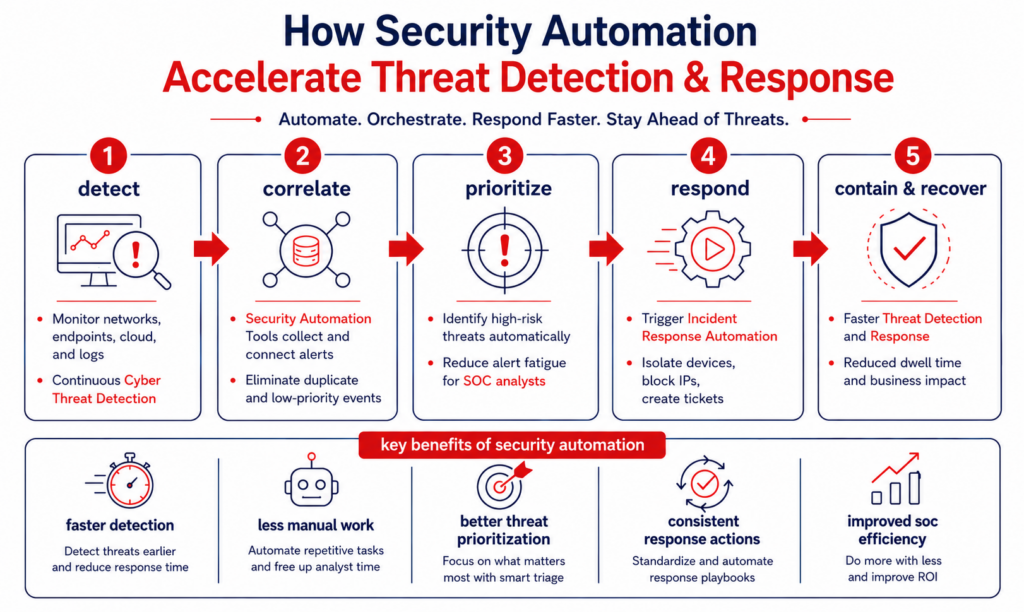
Key Technologies Behind Faster Threat Detection
Security automation combines multiple technologies to reduce manual effort and speed up security operations. The following sections explain how Security Automation, SOAR, Incident Response Automation, and SOC Automation work together to strengthen Threat Detection and Response.
How Incident Response Automation Speeds Up Threat Containment
Not every threat needs debate. Incident Response Automation codifies standard responses and executes them at machine speed.
A file matches known malware hash? Quarantine it and block it everywhere. Credentials compromised? Reset the password and revoke all sessions. Command and control communication detected? Block the connection and isolate the endpoint.
Here’s what it looks like: A detection fires showing suspicious Windows process execution with a randomized name from the temp directory, making outbound connections to a known malicious IP, and attempting credential access. Normally, an analyst reads the alert, opens a ticket, contacts the business unit, and waits for approval.
With automation, your system executes your defined playbook immediately. The process gets killed and quarantined. The IP gets blocked. The endpoint gets isolated. All within a minute. The analyst reviews the automated response later to determine if additional investigation is needed.
The economics are straightforward. An analyst costs about $200 per hour. A sophisticated incident takes 4-8 hours of investigation. That’s $800-1,600 per incident. If your SOC responds to 50 incidents monthly with half being routine threats, you’re spending $20,000-40,000 monthly on labor automation could handle. Incident Response Automation pays for itself quickly.
How Security Orchestration and Automation Connects Security Tools
Here’s the frustrating reality in most organizations: your security tools don’t talk to each other. You’ve got a SIEM, endpoint detection software, a firewall, threat intelligence feeds, ticketing systems, messaging platforms. Each one operates independently. Integration is either nonexistent or bolted together through manual processes.
Security Orchestration and Automation means building a central nervous system that connects these isolated tools so they function as one system. Detection in tool A triggers investigation in tool B, which triggers response in tool C. Information flows automatically. Decisions compound.
Without orchestration, information stops at tool boundaries. A firewall detects suspicious traffic but has no way to know if your endpoint detection platform already identified that endpoint as compromised. Your SIEM picks up a potential data exfiltration but can’t automatically tell your cloud access platform to deny that user’s logins.
With orchestration, tools inform each other. One tool’s detection becomes another tool’s context becomes another tool’s action.
The technical foundation is usually REST APIs and webhook integrations. When one tool detects something significant, it notifies the orchestration platform. The platform evaluates what happened, applies business logic, and triggers actions in connected tools.
SOAR Solutions: Enabling Automated Security Workflows
SOAR in cybersecurity stands for Security Orchestration, Automation and Response. It’s essentially a platform that acts as the central hub for your entire security operation. Think of it as the traffic controller directing information and actions between all your security tools.
A SOAR platform typically includes several key components. There’s a playbook builder where you visually define workflows. There are prebuilt connectors to dozens of security tools and business applications. There’s an alert enrichment engine that automatically pulls context from multiple sources. There’s a case management system that routes incidents and tracks resolution. And there’s reporting and analytics that measure whether your response process is actually working.
The power of SOAR emerges when you start building sophisticated playbooks. Simple example: When phishing is detected, a SOAR platform can automatically extract the sender’s domain, query your threat intelligence databases to determine if it’s malicious, scan your email system to find other similar messages sent to other users, block the sender at the email gateway, quarantine all the messages, and notify users to report the email to your security team. This entire sequence happens in seconds without touching an analyst.
Organizations implementing SOAR solutions typically see measurable improvements:
Response time to incidents drops by 50% or more. You’re not waiting for analysts to manually investigate and coordinate actions.
Alert volume to analysts decreases by 40% through smarter automated filtering and grouping.
Response automation coverage increases to 60% of incidents. Most routine threats get handled entirely without analyst intervention.
Analyst time per incident shrinks because investigation and basic containment is already done when the analyst engages.
But SOAR isn’t a set and forget solution. It requires thoughtful playbook design and constant refinement based on what you’re actually seeing in your environment.
Modernize Security Operations with SOAR
- Orchestrate Security Tools
- Automate Repetitive Tasks
- Standardize Incident Response
- Reduce Mean Time to Remediation (MTTR)

How SOC Automation Accelerates Threat Detection and Response
You can’t just hire your way out of alert volume. Good security analysts cost 120,000 to 180,000 dollars annually in salary and benefits. Adding headcount is expensive and slow. But automating alert triage and response? That scales instantly.
When your SOC is properly automated, analysts stop being alert processors and start being threat hunters. The shift is fundamental.
Automation handles initial triage. When an alert fires, the system automatically determines if it’s noise or something real. It enriches alerts with context from threat intelligence, asset databases, and historical data. It groups related alerts into incidents so analysts see a coherent picture rather than fragmented alerts. It calculates risk scores and priorities.
What used to take 30 minutes of analyst time takes 5 seconds of machine processing.
Because automation is consistent, analysts inherit better information. They see alerts that have already been triaged, enriched, and prioritized. They know roughly how many other similar events occurred. They can see the attack chain if there is one. They engage with investigations that have already been partially completed by the automated process.
This matters more than it sounds. Analyst burnout is largely driven by alert fatigue. When you reduce the number of false positives an analyst deals with, when you reduce the context switching, when you reduce the feeling that nothing they do makes a dent in the alert queue, retention improves. People stay in security roles longer.
The analyst’s job becomes better too. Instead of “here’s 150 alerts, find the bad ones,” the job becomes “here are 20 confirmed suspicious activities, investigate which ones matter most.” That’s strategic work. That’s problem-solving.
SOC automation achieves this through:
- Automated triage that sorts wheat from chaff in seconds
- Enrichment that automatically adds context from every relevant data source
- Escalation logic that routes complex investigations to the right analysts
- Documentation that maintains automatic records of investigation and response
- Learning systems that improve future detections based on analyst feedback
Best Practices for Implementing Security Automation
Modern networks generate staggering amounts of data. A mid-size organization with 2,000 employees might generate 50 to 100 million security events daily. This comes from firewalls logging every connection, endpoints logging process execution and file access, cloud systems logging API calls and user activities, and applications logging authentication and important transactions.
Humans can’t analyze this. It’s not that it’s tedious. It’s that it’s mathematically impossible. Even if you dedicated 100 analysts to reviewing data, they couldn’t process 100 million events in a day.
Cyber Threat Detection at scale requires automation. Machine learning identifies patterns that would take humans months to surface. Behavioral analytics establish baselines for normal activity and automatically detect deviation. Threat intelligence feeds provide context that no human can possibly maintain manually.
The detection platforms most effective at cyber threat detection combine multiple approaches simultaneously:
Signature-based detection catches known threats. When you have a hash of known malware, you can detect it instantly. Signatures are fast and reliable but only catch things you’ve already seen.
Behavioral analysis catches unknown threats based on suspicious activity patterns. A process that spawns child processes at unusual rates, or connects to command and control infrastructure, or attempts credential dumping can all be detected behaviorally even if it’s never been seen before.
Threat intelligence correlation catches attacker-attributed activity. If threat intelligence identifies that a particular IP or domain belongs to a known threat actor, you can detect when your network interacts with them.
Machine learning models catch novel attack techniques by identifying statistical anomalies. These models get trained on what normal activity looks like in your environment, then flag activity that deviates significantly from baseline.
No single approach catches everything. A sophisticated attacker might avoid signatures by customizing malware, avoid behavioral detection by moving slowly and using legitimate tools, and avoid threat intelligence by using previously unknown infrastructure. But when you layer all four approaches, coverage becomes quite good. The attack has to evade all of them simultaneously, which is much harder.
The detection pipeline in a mature cyber threat detection system processes every event, evaluates it against all four approaches in parallel, correlates results across a time window, and surfaces real threats. This happens continuously and automatically.
Why NetWitness for Security Automation?
NetWitness helps security teams move from manual, reactive operations to automated, intelligence-driven threat detection and response. By combining comprehensive visibility, advanced analytics, and orchestration capabilities within a unified platform, organizations can reduce response times and improve security outcomes.
- Automate Detection and Response: Accelerate threat identification and containment through automated workflows that reduce manual effort and response delays.
- Unified Security Visibility: Correlate network, endpoint, log, cloud, and user activity data from a single platform to uncover threats that isolated tools can miss.
- Reduce Alert Fatigue: Prioritize high-risk incidents with advanced analytics and contextual threat intelligence, helping analysts focus on what matters most.
- Faster Investigations: Leverage rich metadata, full-packet capture, and forensic evidence to quickly understand attack scope, impact, and root cause.
- Improve SOC Efficiency: Streamline security operations with integrated detection, investigation, and response capabilities that help teams do more with fewer resources.
Why Automation Tools Matters Now
The threat landscape has changed fundamentally. Attacks aren’t getting slower or simpler. They’re getting faster and more varied. Your security team is under pressure to defend more surface area with the same headcount. The only realistic path forward is automation.
Organizations that implement security automation tools effectively aren’t replacing human expertise. They’re redirecting it. Instead of analysts grinding through thousands of alerts daily, they’re hunting threats proactively. Security teams move from reactive firefighting to strategic defense. Your security posture stops being limited by how many alerts your team can manually process.
The organizations winning in talent competition are the ones that have automated away the repetitive work and created space for interesting, strategic security work. That’s where careers actually develop. That’s where you attract people who could work anywhere.
Start with your biggest pain point. For most organizations, that’s either alert fatigue or response speed. Deploy security automation tools that directly address that problem first. Build from there. You don’t need perfect automation across your entire environment immediately. You need smarter, faster security operations that make your team more effective and significantly reduce your actual breach risk.
The goal is simple: detect threats faster than attackers can move. Respond faster than damage can spread. Automation makes that possible.
Frequently Asked Questions
1. What are the top-rated security automation tools for enterprise use?
Leading security automation tools include SOAR solutions, Security Operations Center (SOC) automation platforms, and Threat Detection and Response systems that streamline investigations and response workflows.
2. What are the core benefits of implementing security automation?
Security Automation in Cybersecurity reduces manual effort, accelerates Cyber Threat Detection, improves response times, minimizes alert fatigue, and increases operational efficiency.
3. Which companies offer cloud-based security automation services?
Many cybersecurity vendors provide cloud-based Security Orchestration and Automation platforms that support scalable threat detection, incident response, and compliance management.
4. What types of tasks can security automation software handle?
Security automation tools can automate alert triage, threat investigation, Incident Response Automation, threat intelligence enrichment, case management, and remediation workflows.
5. How does security automation contribute to compliance efforts?
Security automation improves compliance by maintaining consistent processes, automating audit trails, supporting policy enforcement, and simplifying reporting requirements.
6. What security automation tools integrate best with existing IT infrastructure?
SOAR Solutions and open-integration Security Automation Tools typically offer the broadest compatibility, connecting with SIEM, EDR, cloud, identity, and network security technologies.
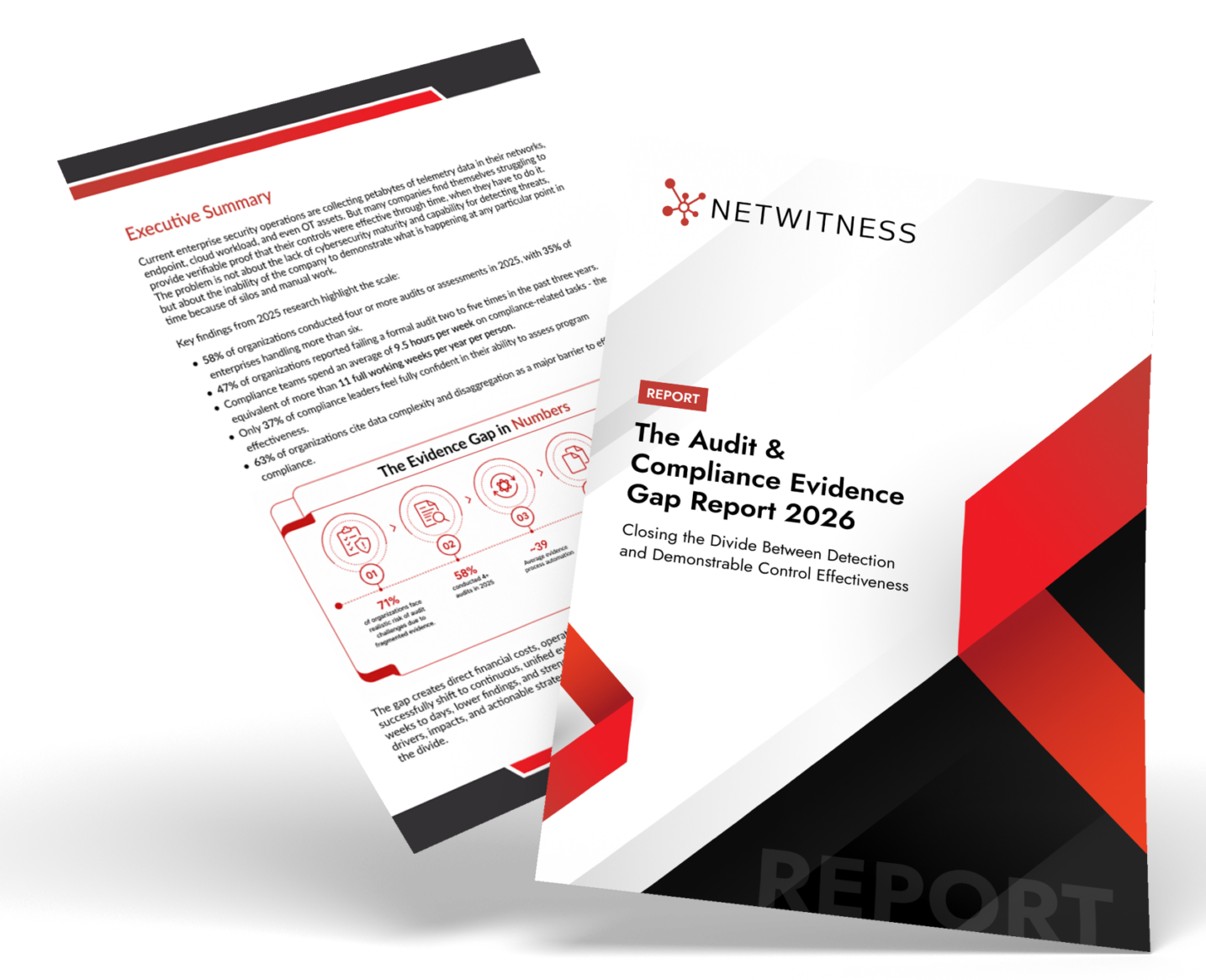
Simplify audit readiness with complete security evidence and visibility. Discover where compliance gaps exist.