Introduction
Security teams aren’t short on alerts. They’re short on context.
Every day, Security Operations Centers (SOCs) process thousands of alerts from SIEM, endpoint, cloud, identity, and network security tools. While automation helps reduce manual effort, it doesn’t solve the biggest challenge: determining which alerts represent genuine threats and what actions should be taken first.
This is where the best SOAR solutions stand apart. Instead of simply automating repetitive tasks, they combine security orchestration automation with real-time threat intelligence to enrich alerts, prioritize incidents, and coordinate response across the security ecosystem.
In this article, you’ll learn why threat intelligence is the foundation of an effective SOAR solution, how it strengthens security operations, what capabilities to evaluate when selecting a platform, and how NetWitness Orchestrator helps organizations automate incident response with greater accuracy.
Why SOAR Security Needs More Than Just Automation
IT teams are increasingly adopting security orchestration automation and response (SOAR) tools to improve security operations’ efficiency. Often, when debating SOAR solutions, security personnel focus on the automation and orchestration aspects. However, some of the best SOAR solutions fall short by not properly leveraging the vast amount of threat intelligence available. Open-source threat feeds, subscribed threat feeds, abstracting data from blogs or research data, internally acquired threat intelligence and even crowdsourced intelligence can all be used to guide security operations and train SOAR security to properly identify, prioritize, investigate and resolve potential incidents.
Applying threat intelligence to decision-making helps security teams become more predictive, empowering them to see the likeliest threats and use that visibility to prioritize how they’ll protect their organization using intelligent SOAR security. When a previously unseen threat presents itself, it places your security team in reactive mode. But if you’re only reacting, analysts are stuck playing a never-ending game of catch-up and clean-up.
When you strategically introduce threat intelligence into a security program and integrate it with advanced SOAR solutions, it gives you a more holistic view of what’s happening outside your organization and allows you to map that external information to your organization’s own threat landscape.
Another way of putting it is finding threat intelligence about current threats, aggregating it, analyzing it, and using it to identify the most relevant threats is applicable to your business. 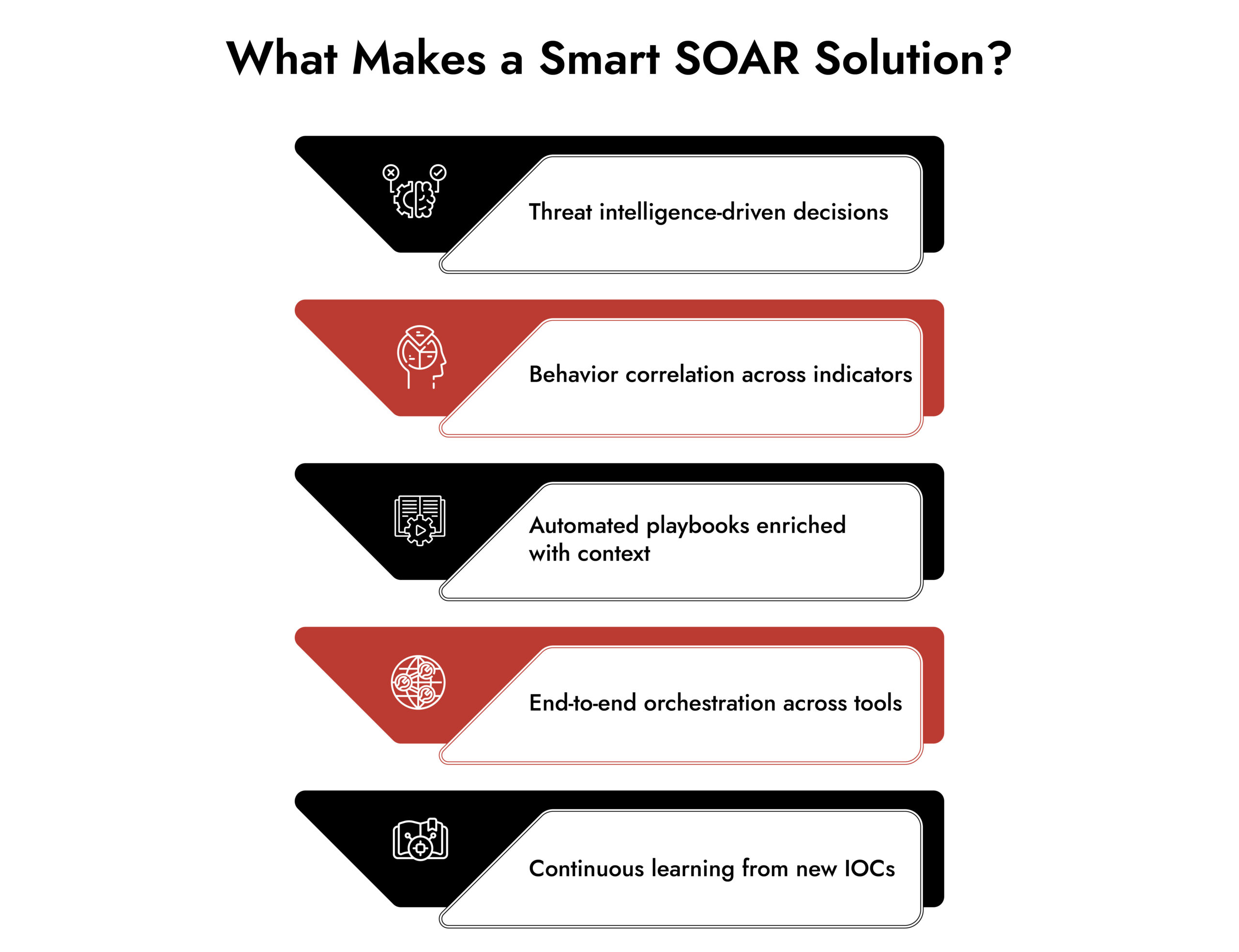
How Threat Intelligence Strengthens SOAR for Detection and Response
Threat intelligence gives SOAR the context it needs to move from alert handling to decisive action. Instead of treating every alert the same, it helps security teams understand what truly matters and respond with speed and confidence.
- Enriches alerts with contextual threat intelligence so analysts can validate incidents instead of reacting to raw IOCs.
- Helps prioritize alerts by linking IPs, domains, and file hashes to known threats, actors, and campaigns.
- Embeds intelligence directly into the analyst workflow, enabling faster decisions on severity and impact.
- Supports accurate automation by allowing validated indicators to trigger predefined SOAR responses.
- Feeds new intelligence back into the security program, improving future detections and response logic.
- Automatically informs security controls such as firewalls, proxies, and antivirus systems to prevent repeat attacks.
- Reveals relationships between related indicators, expanding investigations beyond a single alert.
- Helps uncover the full scope of an attack by identifying connected behaviors across the environment.
How SOAR Solutions Improve Security Operations
Today’s Security Operations Center (SOC) often manages thousands of alerts generated by dozens of disconnected security products. Switching between tools wastes valuable investigation time and increases operational complexity.
The best SOAR solutions improve security operations by centralizing alerts, orchestrating workflows, and automating routine response activities across the entire security ecosystem.
Organizations benefit from:
- Faster alert triage and prioritization
- Automated evidence collection
- Standardized incident response playbooks
- Reduced manual investigations
- Improved collaboration between security and IT teams
- Better compliance reporting and audit readiness
- Lower mean time to detect (MTTD)
- Lower mean time to respond (MTTR)
Combined with cyber security automation, these capabilities allow analysts to focus on complex investigations instead of repetitive operational tasks.
How Does SOAR Integrate with Network Security Operations?
One of the biggest advantages of modern SOAR security solutions is their ability to connect existing security technologies instead of replacing them.
A SOAR platform integrates with:
- SIEM platforms
- XDR and EDR solutions
- Firewalls
- Identity and Access Management (IAM)
- Email security gateways
- Threat intelligence platforms
- Cloud security platforms
- Vulnerability management tools
- IT service management platforms
A typical workflow looks like this:
- A SIEM or XDR platform detects suspicious activity.
- The SOAR platform automatically enriches the alert with endpoint, user, and threat intelligence data.
- Related indicators are correlated across the environment.
- Automated playbooks isolate endpoints, disable compromised accounts, block malicious IPs, or create IT tickets.
- Analysts review high-confidence incidents instead of manually collecting evidence.
This seamless integration helps answer an important question many organizations ask: How does SOAR integrate with network security operations? The answer lies in orchestrating every security technology into a coordinated, intelligence-driven response.
Practical SOAR Use Cases for Security Automation Teams
Modern organizations leverage SOAR solutions and other security automation and orchestration tools for versatile tasks across cybersecurity. Common SOAR security use cases include:
- Phishing detection and response.
- Endpoint detection and response.
- Incident alert triage.
- Vulnerability management.
- Threat hunting.
- Case management.
- Automated playbooks.
SOAR tools continually increase the efficiency and effectiveness of these operations by blending automation, orchestration, and threat intelligence.
Key Capabilities to Look for in a SOAR Platform
Not every platform delivers the same level of intelligence or flexibility. When evaluating the best SOAR platforms, organizations should consider capabilities that improve both operational efficiency and long-term scalability.
Important features include:
- Extensive third-party integrations
- Threat intelligence enrichment
- Low-code or no-code playbook creation
- Automated investigation workflows
- Case management
- Collaboration capabilities
- Workflow customization
- Compliance reporting
- Cloud and hybrid deployment support
- Scalable orchestration across distributed environments
The best SOAR tools don’t simply automate actions. They intelligently orchestrate investigations across the entire security ecosystem.
Challenges Organizations Should Consider Before Deploying SOAR
While SOAR security solutions deliver measurable operational benefits, successful implementation requires preparation.
Organizations commonly face challenges such as:
- Integrating legacy infrastructure
- Inconsistent incident response processes
- Poor-quality threat intelligence
- Excessive false positives
- Limited automation expertise
- Resistance to operational change
Automating inefficient workflows rarely produces good results. Organizations should first standardize incident response procedures before expanding automation across the SOC.
Best Practices for Successful SOAR Implementation
Organizations achieve better outcomes by implementing automation gradually instead of attempting to automate every workflow immediately.
Recommended best practices include:
- Begin with repetitive, low-risk use cases such as phishing response and alert enrichment.
- Build standardized response playbooks before introducing automation.
- Continuously validate threat intelligence sources.
- Monitor KPIs such as MTTR, MTTD, analyst productivity, and automation success rates.
- Regularly update playbooks as attacker techniques evolve.
- Maintain analyst oversight for high-impact incidents while automating repetitive tasks.
- Integrate SOAR with SIEM, XDR, EDR, identity, cloud, and ticketing platforms for end-to-end visibility.
Following these practices helps organizations maximize the value of cyber security automation while maintaining control over critical response decisions.
What makes NetWitness SOAR’s Threat Intelligence Different
- Built on a strong foundation – evolved from a proven threat intelligence platform with deep heritage and knowledge base.
- Continuously adapts in real time – threat intelligence loses value as it ages, so the system constantly updates with emerging indicators, actors, and campaigns at scale.
- Provides full context for accuracy – analysts see not just what’s suspicious, but how and who reported it, since not all intelligence carries equal weight.
- Enables automated threat hunting – analysts can hunt based on known threat actors and campaigns without manual effort.
- Connects intelligence directly to action – the system sweeps environments for behaviors tied to threat intelligence and surfaces high-value alerts worth investigating.
- Automates end-to-end workflows – from remediation to IT ticketing to implementing preventative controls.
SOAR Benefits for Modern Security Teams
Organizations deploying SOAR solutions enjoy clear benefits, including:
- Accelerated incident response.
- Reduction in manual effort.
- Lowered risk and human error.
- Unified threat intelligence.
- Enhanced visibility across tools.
- Compliance and audit readiness.
- Improved collaboration.
These SOAR benefits make a substantial impact on both the effectiveness and the efficiency of security teams.
 Final Thoughts
It is a critical piece of the incident detection and response puzzle, but the way TI is applied can vary from solution to solution. SOAR solutions will continue to evolve to better leverage threat intelligence throughout the incident response lifecycle to detect and properly prioritize incidents and speed analysis and evidence collection – which ultimately equates to faster resolutions and more efficient security operations. Learn more about NetWitness SOAR.