How can organizations measure the ROI of network forensics?
Organizations can measure the ROI of network forensics by comparing annual ownership costs against verified financial benefits such as:
- Reduced investigation labor
- Lower external forensic spending
- Attributable reductions in business interruption
They should establish a baseline, evaluate comparable investigation scenarios, and avoid counting the same productivity benefit more than once.
When a cyber incident occurs, the security team needs to find out what happened and how far the attack has spread. Otherwise, leadership may have to make decisions without all the facts, which can get expensive.
For example, the organization might shut down more systems than necessary, take longer to restore operations, or spend days piecing together evidence before it can determine what needs to be reported.
This is where the business case for network forensics solutions becomes interesting.
The return on investment comes from helping organizations:
- Establish what happened
- Understand what is affected
- Make consequential business decisions with stronger evidence
Where Network Forensics Solutions Deliver Measurable Value
There are several ways to translate forensic capabilities into business value. However, it is important to note that not everything produces direct cost savings, and enterprises should distinguish between hard financial benefits and operational improvements.
NetWitness experts advise measuring value in the following ways:
1. Reduced Time and Effort Spent Reconstructing Incidents
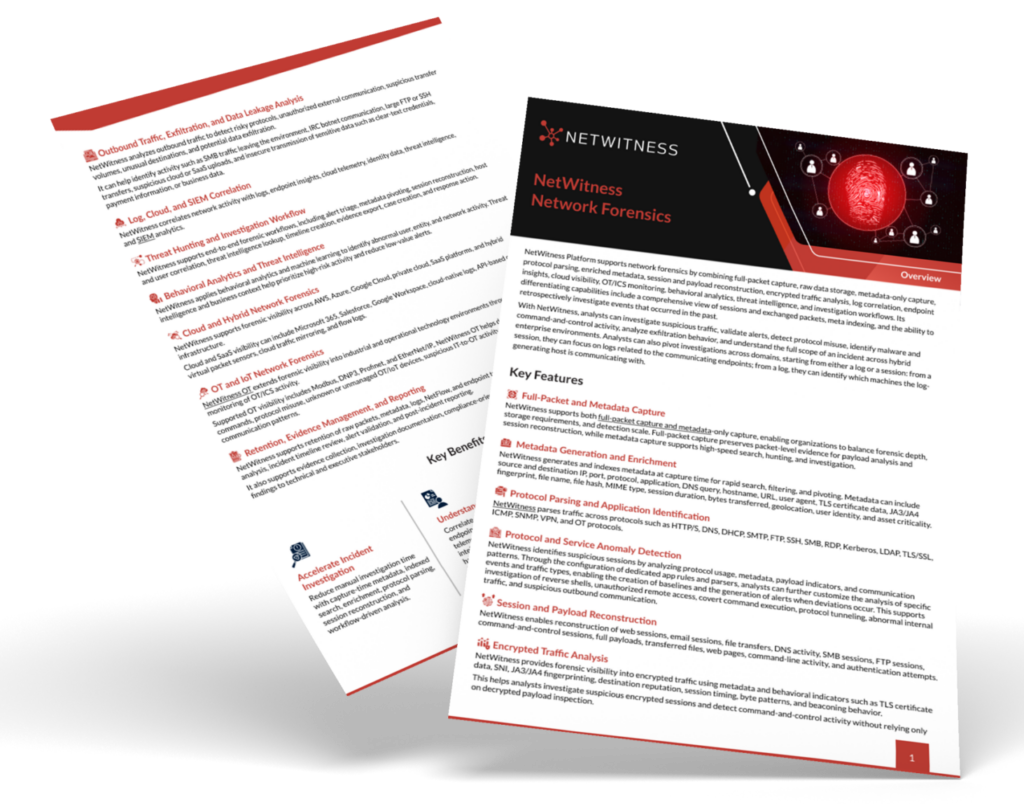
When the data is scattered across different solutions and requires manual effort to correlate them, a large chunk of analyst time is wasted in the process. Some of the repetitive work can be handled with network forensics tools such as NetWitness that provide features such as:
- Searchable metadata
- Historical network visibility
- Session reconstruction
To calculate the ROI, organizations should measure analyst hours required to investigate comparable incidents to understand the value.
2. More Targeted Containment and Recovery Decisions
Every suspicious event needs to be handled differently; some need immediate and complete isolation, whereas others can be contained once the threat’s scope is understood.
Network threat detection and forensic investigation can help establish:
- Which systems communicated with a compromised host
- What protocols were involved
- Whether suspicious activity extended into other network segments
That evidence can help analysts make containment decisions as per the observed threat.
The financial metric is the cost of disruption demonstrably avoided through better-informed decisions.
3. More Efficient Regulatory and Legal Investigations
Regulators and legal teams frequently need information about the nature, timing, scope, and impact of a cyber incident.
In fact, US public companies are required to disclose material information about cybersecurity incidents within 4 business days after a materiality determination, under the applicable SEC cybersecurity disclosure rules.
In such cases, network forensic solutions contribute evidence about:
- Affected systems
- Network communications
- Possible data movement
Such tools help reduce repeated information requests, reporting revisions, and the external effort needed to resolve technical questions.
4. Better Use of Existing Security Investments
Most enterprises already have cybersecurity tools in place, and network forensic tools should strengthen these investments rather than become another isolated repository of security data.
An integrated system like NetWitness improves SOC efficiency and threat hunting, in turn saving analyst work hours.
This is, however, counted as a separate financial benefit when it creates demonstrable value and has not already been included in investigation labor savings.
How to Calculate the ROI of Network Forensics
The most credible business case starts with the organization’s own incident history and operating costs.
A standard ROI calculation is:
ROI (%) = [(Annual financial benefits − Annual ownership cost) ÷ Annual ownership cost] × 100
For network forensics, benefits may include:
- Reduced internal investigation effort
- Lower external forensic expenditure
- Verified reductions in business interruption
Ownership costs should include
- Software
- Infrastructure
- Packet storage
- Deployment
- Integrations
- Maintenance
- Training
- Ongoing operational support
If network forensics extends an existing platform, the business case should focus on the incremental investment and benefits.
An Illustrative Enterprise ROI Calculation
Consider an organization evaluating an enterprise network forensics capability.
Note: The following numbers are hypothetical. They illustrate the financial model and are not NetWitness customer results or industry benchmarks.
| Annual benefit category | Assumption | Financial value |
| Internal investigation savings | 60 investigations × 6 hours saved × $120 fully loaded hourly cost | $43,200 |
| External forensic savings | 120 consulting hours avoided × $200 per hour | $24,000 |
| Reduced business interruption | 4 verified hours of disruption avoided × $20,000 per hour | $80,000 |
| Total annual benefit | $147,200 | |
| Annual ownership cost | Licensing, infrastructure, storage, support, training | $110,000 |
| Net annual benefit | $37,200 |
The calculated annual ROI is approximately 33.8%.
Note: The positive return depends heavily on the assumption that four hours of business interruption can actually be avoided and attributed to forensic capabilities.
Remove that benefit, and the ROI becomes negative.
| Annual disruption reduction | Total annual benefit | Estimated ROI |
| 0 hours | $67,200 | -38.9% |
| 2 hours | $107,200 | -2.5% |
| 4 hours | $147,200 | 33.8% |
A credible investment proposal should show:
- Where the financial return comes from
- Which assumptions carry the greatest uncertainty
- How those assumptions will be tested
Uncover the Full Truth Behind Every Cyberattack
- Reconstruct Network Activity
- Trace Attacker Behavior
- Recover Critical Evidence
- Strengthen Incident Investigations

What Should CISOs Measure to Prove Network Forensics ROI?
Traditional detection metrics remain important, but they do not fully capture the value of an investigation capability. A more useful board-level measurement is time to defensible incident scope.
This measures the time from an incident’s initial investigation to the point when responders can support a documented decision about potentially affected systems, relevant activity, and the remaining uncertainty.
A practical scorecard can include:
| Metric | What it tells leadership |
| Time to establish incident scope | How quickly security teams can support decisions about potentially affected systems |
| Analyst hours per investigation | Whether comparable cases require less investigative effort |
| Investigations closed with sufficient evidence | How often the team reaches a supported conclusion |
| Inconclusive investigation rate | How frequently evidence gaps prevent necessary findings |
| External DFIR expenditure | Whether internal forensic readiness reduces consulting costs |
| Recovery delays caused by uncertain scope | How much operational disruption is associated with incomplete investigations |
| Historical evidence availability | Whether the organization retains the network evidence needed for priority scenarios |
These measures should be assessed together.
As John Pirc, Chief Product and Technology Officer at NetWitness, observed while discussing AI in cybersecurity:
“Speed without context and trust just creates more noise.”
The same principle applies to network forensic investigations. Faster analysis is valuable when it produces findings that security and business leaders can trust.
What Makes a Network Forensics Solution Worth the Investment?
When evaluating network forensics solutions, CISOs should focus on the following capabilities.
Network Visibility Across Critical Attack Paths
Network visibility solutions should cover the communication paths that matter to the organization’s risk profile. These may include:
- North-south traffic
- East-west communications
- Cloud workloads
- Remote-access infrastructure
- Data-center interconnections
- IT/OT boundaries.
The evaluation should begin with business-critical environments and likely investigation scenarios.
Searchable Metadata and Packet-Level Evidence
Network metadata helps investigators discover and correlate activity at scale. It is generally more economical to store over longer periods.
Full packet capture provides deeper evidence for session-level examination. It can be prioritized for higher-risk environments or supported through selective capture policies.
The right balance depends on the organization’s investigation requirements, network volume, and storage budget.
Investigation Across Network, Endpoint, and Log Data
Attackers do not target a single security domain; therefore, the best threat investigation tools enable smooth transitions between different domains.
Retention, Security, and Evidence Governance
Forensic readiness also requires appropriate data retention, access controls, integrity protections, and evidence-handling procedures.
Packet data may contain sensitive information. Encrypted traffic analysis can reveal valuable metadata and behavioral context, but encrypted payloads are not automatically readable.
Capture infrastructure also cannot provide evidence from traffic it never observed.
A deployment should be judged on its:
- Actual visibility
- Coverage
- Retention
- Investigative limitations
The UK NCSC guidance specifically recommends considering network metadata and packet capture as incident-response evidence sources, with shorter-term full packet capture as an additional capability.
Why NetWitness Takes an Evidence-Driven Approach to Network Forensics
We at NetWitness believe that network security should extend beyond identifying suspicious activity. Threat investigation must establish the context and evidence necessary to support incident response.
The NetWitness network forensics approach combines:
- Packet capture
- Enriched network metadata
- Protocol analysis
- Session reconstruction
- Behavioral analytics
- Investigation workflows
NetWitness value is particularly relevant to organizations managing complex environments where evidence is distributed across network, endpoint, identity, and log sources.
The business relevance comes from several capabilities working together:
- Historical network evidence helps investigators examine activity that predates an alert.
- Packet and metadata analysis supports a deeper understanding of network communications.
- Cross-domain correlation helps connect network activity with relevant endpoint, log, and identity context.
- Session reconstruction provides deeper investigation of captured communications, subject to encryption and evidence availability.
- Integrated investigation workflows help security teams move from suspicious activity to findings that can inform response.
For organizations with demanding investigation requirements, especially those operating across hybrid infrastructure, this combination is worth evaluating.
Frequently Asked Questions
1. What are the top network forensics solutions available today?
Enterprise network forensics solutions include
Open-source options such as Arkime also support packet capture and network investigations.
These products do not offer identical capabilities. Organizations should evaluate them against:
- Capture depth
- Retention
- Integration
- Operational complexity
- Coverage
- Incident response requirements
2. What are the core components of a robust network forensics platform?
A robust network forensics platform should provide
- Network traffic collection
- Searchable metadata
- Packet capture
- Protocol analysis
- Session reconstruction
- Historical search
- Evidence management
Enterprise platforms should also integrate with other cybersecurity tools so investigators can connect network evidence with broader attack activity.
3. How does network forensics help reduce cybersecurity costs?
Network forensics can help:
- Reduce the analyst effort associated with reconstructing incidents
- Support more targeted containment and faster recovery decisions
The financial impact depends on how effectively the capability is deployed and whether those operational improvements produce measurable savings.
4. How does network forensics support cybersecurity risk management?
Network forensics supports cybersecurity risk management by improving the evidence available to assess:
- incident scope
- potential impact
- attacker behavior
- response effectiveness
It helps security leaders make more informed response decisions, validate assumptions about network exposure, and identify recurring visibility gaps.
The resulting insights can inform security investments, incident response planning, and broader enterprise risk decisions.
See Every Packet. Understand Every Threat.
- Capture Network Traffic
- Reconstruct Attacker Sessions
- Uncover Hidden Threats
- Accelerate Investigations