Introduction
Enterprise defenders live with too many alerts and too little proof. When a breach occurs, the first question isn’t “Did our tools flag it?” It’s “Can we prove what happened, how, and when?” That’s what detection quality in NDR tools really means.
Too many vendors talk up analytics without addressing how their tools see traffic, how they reconstruct sessions, or how they help investigators validate threats. Detection quality is about truth, not pretty dashboards.
In this context, the difference between generic NDR solutions and platforms built for true enterprise environments becomes obvious. The goal is not just to generate alerts but to deliver insights you can trust.
What Detection Quality Really Means in NDR
Detection quality is the confidence you have that an alert reflects a real threat and not noise. It rests on three pillars:
- Comprehensive visibility – seeing all relevant network traffic, not just summaries or sampled flows.
- Contextual understanding – linking events across sessions, users, and time.
- Evidence for investigators – giving analysts artifacts and reconstructed sessions, not just scores.
Strong detection quality helps teams respond faster, validate incidents confidently, and avoid chasing false positives.
Where Generic NDR Tools Fall Short
Many NDR tools struggle with scale, context, or visibility, especially in enterprise environments that span data centers, cloud, and remote users.
Limited Visibility
Tools that rely mostly on metadata or sampled data miss payload-level indicators that matter for advanced attacks. Without deep packet inspection, detections remain superficial.
Shallow Context
Alerts based on endpoint or log signals alone can’t reconstruct lateral movement patterns across the network. Good detection needs session-level linkage.
Alert Noise Over Insight
Behavioral analytics can be useful, but without a confirmed baseline of normal activity, they generate false positives faster than security teams can handle. Gartner’s 2024 research identifies alert fatigue as a top constraint on SOC effectiveness.
Which Integrations are Essential for an Effective NDR Solution?
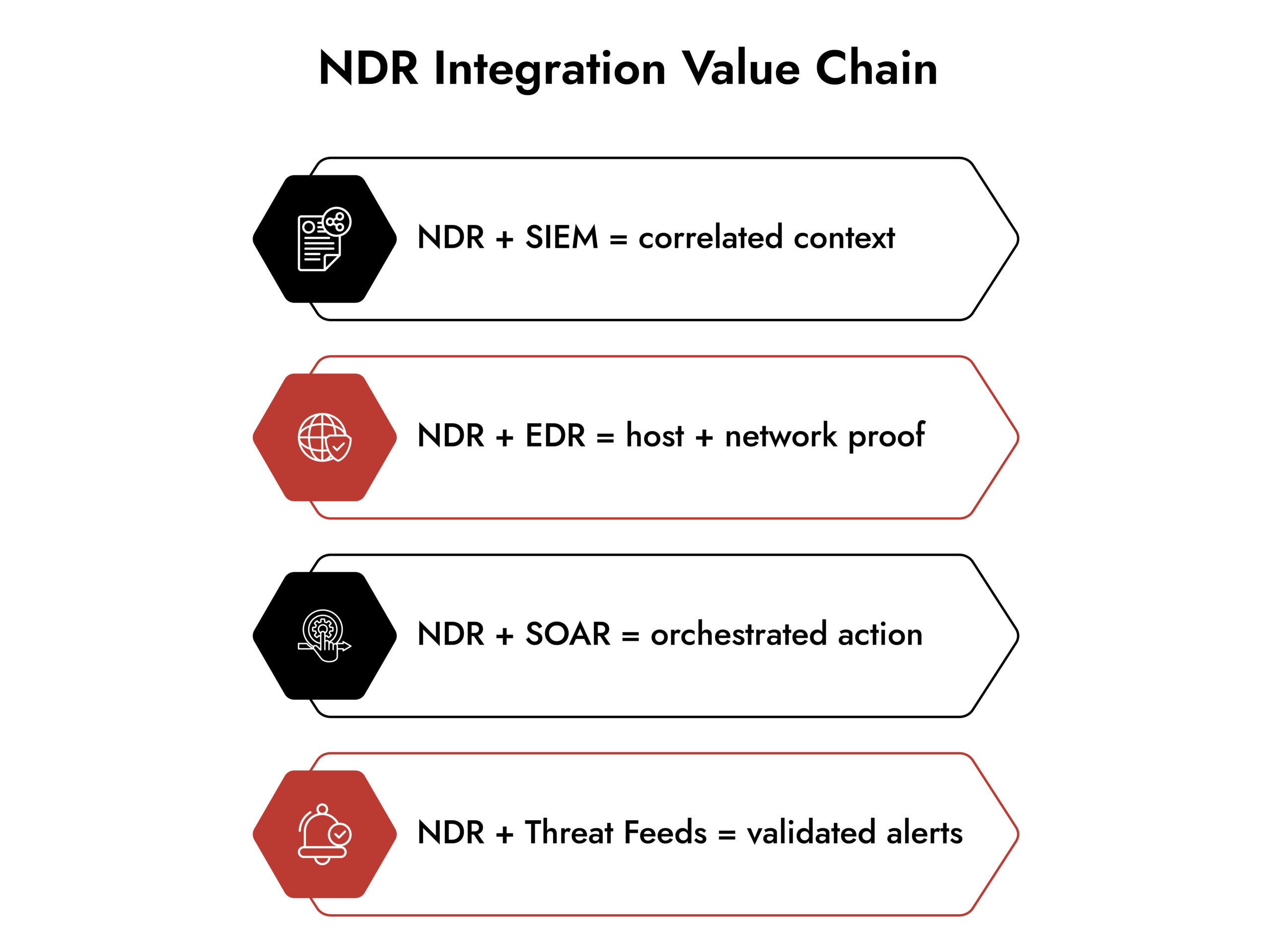
Integration significantly boosts detection quality. The most impactful ones include:
- SIEM- Correlates network alerts with logs, identities, and historical context. It sharpens prioritization.
- SOAR- Automates response actions when high-confidence NDR alerts arrive. This shortens response windows.
- EDR- Endpoint insights validate network indicators and vice versa. Together, they close gaps with no single tool covers.
- Threat Intelligence- Mapping observed network behavior against real adversary TTPs improves precision and reduces false positives.
Without these connections, an NDR tool becomes a silo that sees only part of enterprise activity.
How Does NDR Integration with SIEM Improve Threat Detection?
SIEM systems ingest logs, identity data, and application events. When NDR solutions feed SIEM high-fidelity network alerts, analysts get a multi-dimensional view of incidents. This makes it easier to see an attacker’s path instead of isolated network events.
For example, a suspicious data transfer flagged by NDR becomes more actionable when SIEM confirms it followed an anomalous third-party login. Conversely, when a SIEM alert fires, analysts can reference NDR to validate and understand the associated network behavior, demonstrating how detection quality improves through bi-directional correlation.
What is the Benefit of Integrating NDR With SOAR?
SOAR platforms take validated alerts and convert them into automated workflows. That could mean enriching an NDR alert with context, isolating affected segments, or kicking off forensic capture without manual intervention.
With high-quality network detections, SOAR doesn’t just accelerate response, it ensures actions align with real, verified threats rather than noise.
How Does NDR Work with EDR Tools?
NDR and EDR complement each other:
- EDR sees endpoints – process behavior, registry changes, suspicious binaries.
- NDR sees the network – encrypted flows, lateral moves, abnormal traffic patterns.
When NDR detects unusual east-west traffic and EDR confirms host anomalies, security teams have correlated proof. That’s far more valuable than disjointed indicators.
Why is Threat Intelligence Integration Important for NDR?
Threat intelligence provides context – known malicious IPs, domains, file hashes, and adversary techniques. When NDR tools match their network detections against verified threat feeds, they filter noise and highlight what matters.
This reduces the time analysts spend hunting and increases confidence in every alert.
How Does NDR Integration with Enterprise Tools Improve Visibility?
Integrated tools extend the scope of detection. SIEM and EDR share events that NDR alone won’t see. SOAR orchestrates response across the environment. Threat feeds validate detections.
Detection quality isn’t just about one tool. It’s about how the tools talk to each other and how much shared context they provide.
What are the Best NDR Tools Available for Enterprise Network Security Right Now?
Enterprises need NDR tools that deliver:
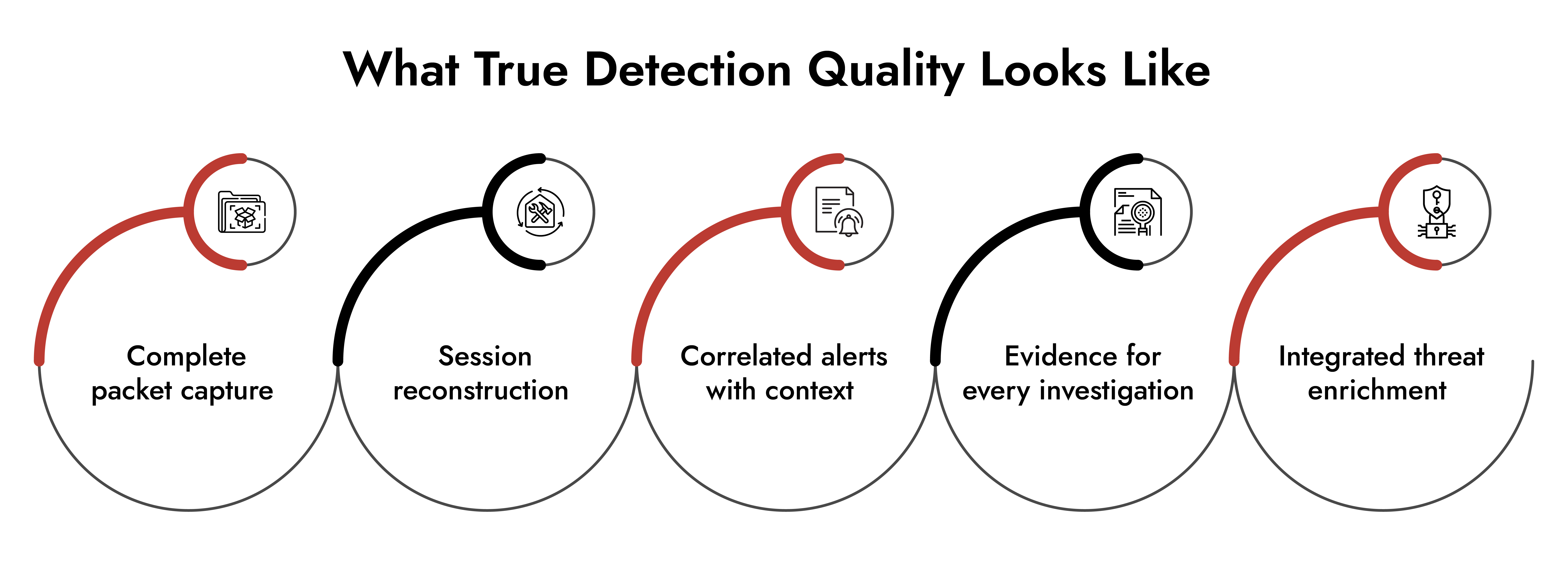
- Full packet capture with reconstruction
- Session context across users, hosts, and protocols
- Integrations with SIEM, SOAR, EDR, threat intelligence
- Scalable performance across hybrid environments
Solutions without these capabilities struggle to offer real detection quality at enterprise scale.
Listing Some Top-Rated NDR Tools for Real-Time Threat Detection
Top-rated NDR tools for enterprise environments share common traits:
- Real-time network traffic analysis
- Advanced behavioral baselines
- Integration ecosystems + Full packet capture
When evaluating, prioritize platforms that combine passive visibility with evidence-backed detection, not just anomaly scoring.
Finding Vendor Comparisons for the Newest NDR Tools on the Market
When comparing NDR solutions, focus on detection quality indicators:
- Depth of packet capture and session reconstruction
- Evidence support for investigation workflows
- Scalability for global enterprise networks
- Transparency of analytics and tuning controls
Comparisons that emphasize features without evaluating evidence of quality risk obscuring true detection capability.
A Comparison of Leading NDR Tools Based on Features and Pricing
Feature and pricing comparisons are useful but secondary to detection quality. A practical evaluation matrix should include:
| Capability | Visibility | Detection Confidence | Integration | Scalability | Pricing Impact |
| Deep Packet Inspection | High | High | Strong | Enterprise | Value tied to quality |
| Metadata-Only | Moderate | Low | Limited | Variable | Lower upfront cost |
| Behavioral Only | Low | Medium | Varies | Medium | Misleading TCO |
| Integrated Ecosystem | High | High | Excellent | Enterprise | Predictable ROI |
Don’t let sticker price drive decisions. Tools that reduce false positives and accelerate investigations deliver better ROI over time.
How NetWitness NDR Raises the Bar on Detection Quality
While many NDR tools look similar on paper, what matters in practice is how they collect, analyze, and support investigations.
Full Packet Capture with Context
NetWitness captures raw packets and builds session context automatically. Analysts don’t guess what happened, they see evidence.
Evidence-Driven Alerts
Alerts link back to packets, extracted files, and session timelines. That means investigations start with proof, not hypotheses.
Built for Scale
In large enterprise networks, scalability without loss of visibility is not optional. NetWitness maintains fidelity across complex topologies.
Integration-Ready
NetWitness plays well with SIEM, SOAR, EDR, and threat intelligence. That amplifies detection quality across the stack.
This leads to fewer false positives, faster triage, and more confident decisions.
Conclusion: Prioritize Proof Over Promises
Detection quality is the essential yardstick for any enterprise network detection and response (NDR) capability. Noise and alerts without evidence cost time, money, and weaken your overall security posture.
When you evaluate NDR tools, look beyond feature lists and marketing claims. Focus on comprehensive network visibility, visibility depth, session context, evidence support, and how well the tool integrates with your existing security tools and broader security operations.
Strong detection quality means you see attackers early, detect threats hidden in encrypted traffic and lateral movement, validate fast with forensic-grade evidence, and respond with confidence using automated response capabilities. That’s the difference between surviving and thriving in today’s evolving cyber threat environment.