Introduction
Cyber threats don’t operate in isolation, so why should your defenses? Let’s be honest, most organizations already have Endpoint Detection and Response (EDR) in place. It has become a foundational part of any security program. But as attackers get smarter, EDR alone isn’t enough. What many security teams are still missing is Network Detection and Response (NDR). And without it, you are flying blind across large parts of your network.
So, the question isn’t really, “Which is better – NDR or EDR?”
It’s this: How do you close the visibility and detection gaps that EDR can’t cover?
In this blog, we will compare NDR vs EDR for threat detection, show how they complement each other, and explain why adding NDR completes your defensive picture.
What Is EDR (Endpoint Detection and Response)?
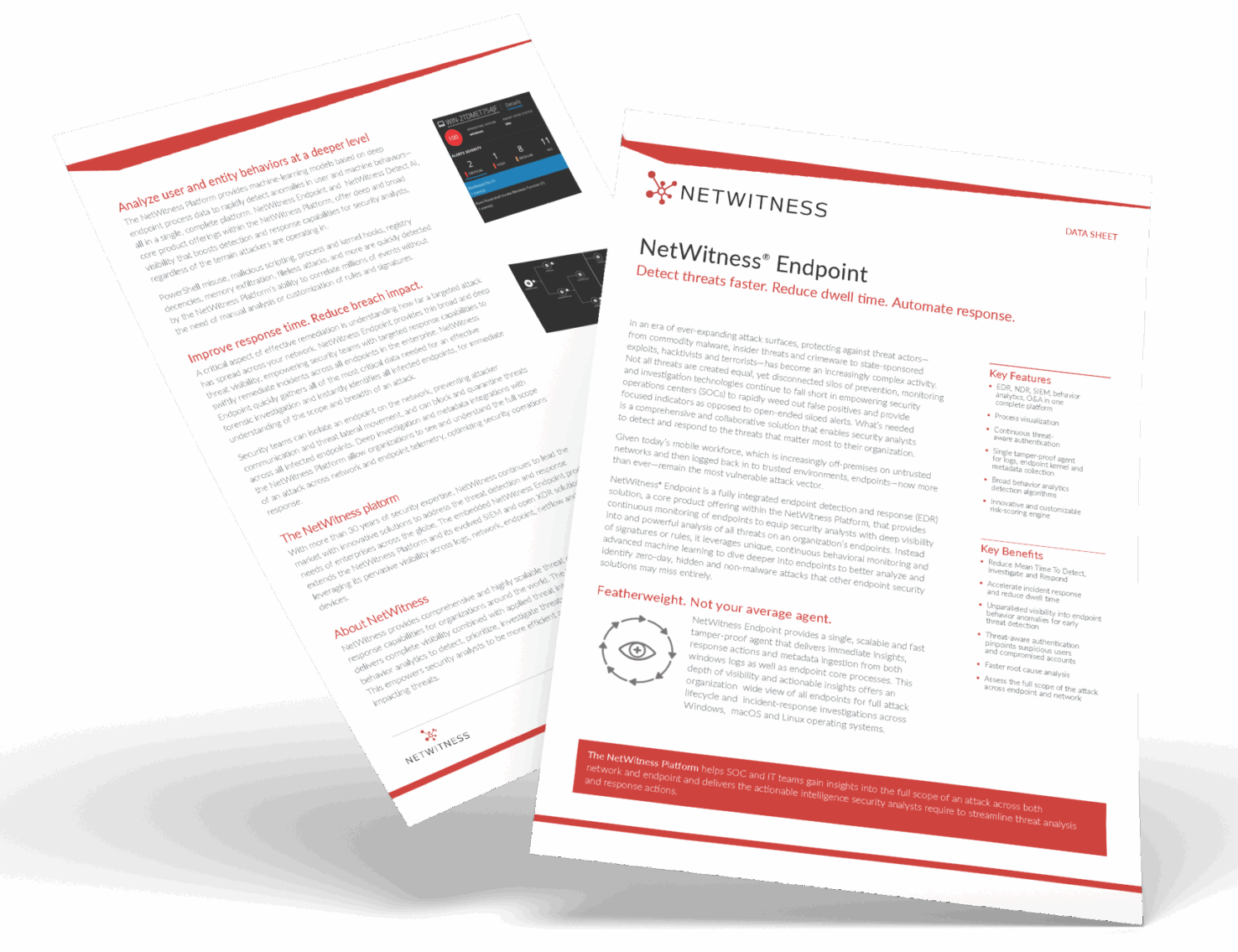
EDR tools detect and respond to threats at the endpoint level – your laptops, desktops, mobile devices, and servers. They monitor behavior, flag suspicious activity, and help contain attacks quickly.
Key Functions of EDR Solution:
- Monitors endpoint activities such as file execution, registry changes, and user behavior.
- Detects malware, ransomware, and exploits targeting endpoints.
- Supports threat hunting through historical endpoint data.
- Allows for remote remediation of compromised devices.
EDR is essential for endpoint visibility.
But here’s the catch: attackers don’t just hit endpoints. Once inside, they often move laterally – across networks, through unmanaged devices, or via encrypted traffic. That’s where EDR loses sight.
This is why EDR forensics capabilities matter so much: without strong endpoint investigation features, teams can’t fully trace an attack’s path.
What Is NDR (Network Detection and Response)?
While EDR watches what’s happening on the device, NDR watches everything between devices. It continuously analyzes network traffic- on-prem, cloud, and hybrid- to detect threats that other tools miss.
Think of it as security camera footage for your entire digital environment, not just motion sensors at the door.
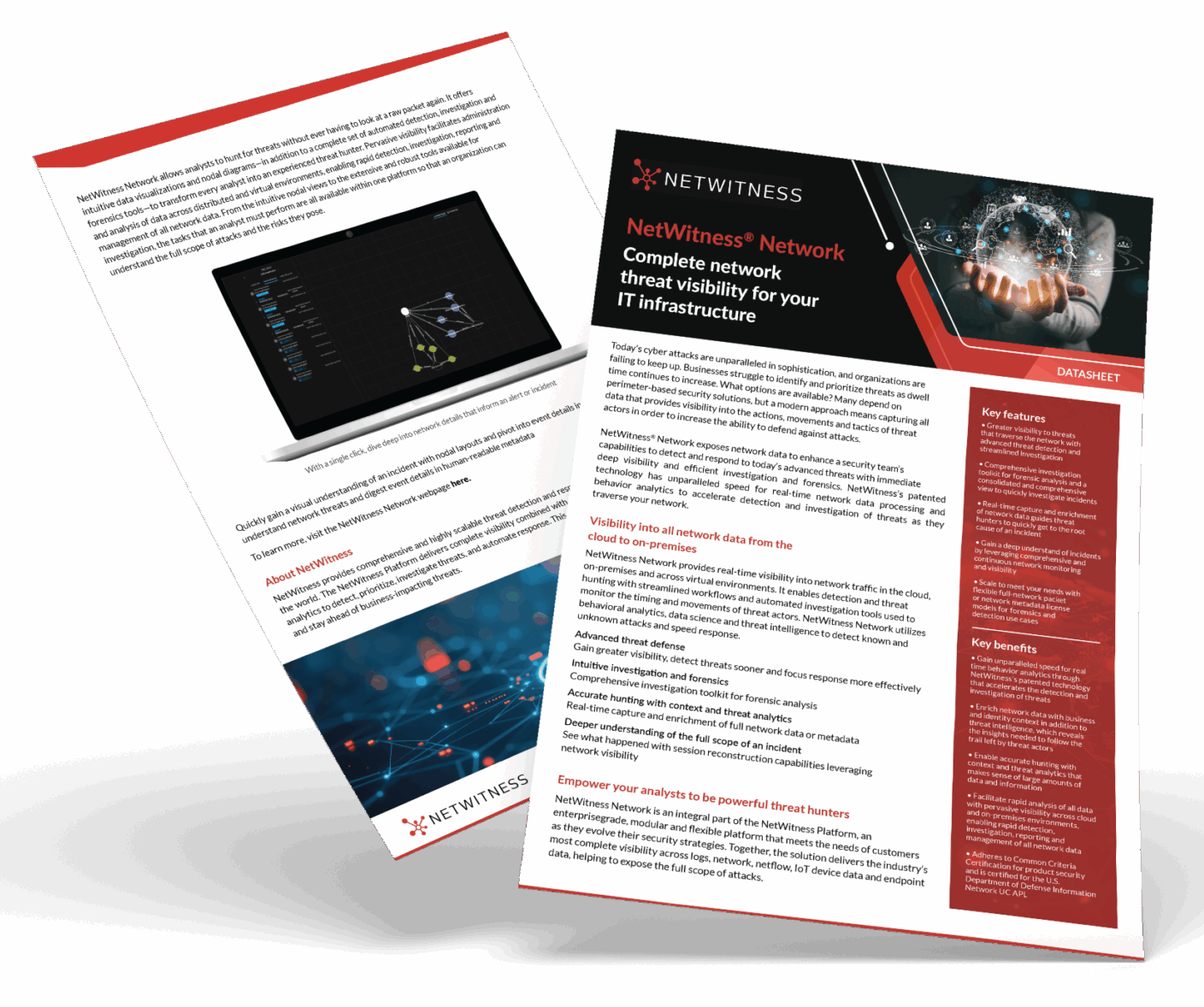
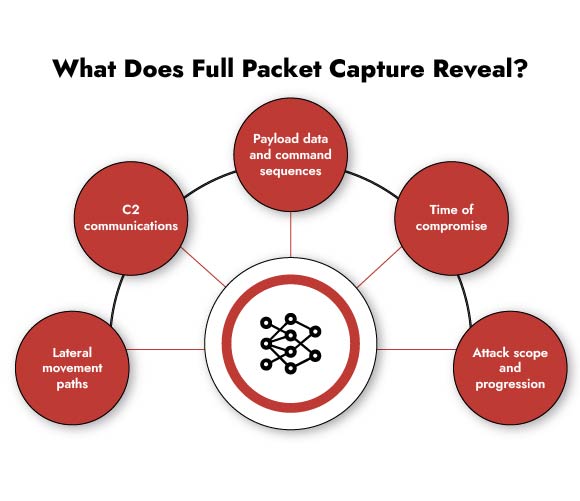
NetWitness Network Detection and Response (NDR) excels in this space. It captures full packets, analyzes metadata, and correlates behaviors with threat intelligence to identify known and unknown threats.
Key Features of NetWitness NDR:
- Full Packet Capture: Deep analysis of raw traffic data
- Threat Detection: Behavioral analytics and AI-powered insights
- Forensic Investigation: Reconstruct full network sessions
- Encrypted Traffic Analysis: Flags suspicious encrypted traffic without decryption
- SIEM & EDR Integration: Works with other tools for faster, coordinated response
NDR vs EDR: A Side-by-Side Comparison
The primary difference between NDR vs EDR is the source of security data each technology monitors. Network Detection and Response (NDR) analyzes network traffic and communications, while Endpoint Detection and Response (EDR) monitors activity on individual devices.
Comparison Factor | NDR | EDR |
Primary focus | Network traffic and communications | Endpoint activity and behavior |
Data collected | Network packets, flows, and metadata | Processes, files, memory, and system events |
Visibility | Network-wide activity across connected devices and systems | Individual devices and endpoints |
Threat detection | Lateral movement, suspicious traffic, and command-and-control activity | Malware, ransomware, and suspicious processes |
Investigation | Network sessions and communication patterns | Endpoint activity and process history |
Response | Network-level investigation and response integrations | Endpoint isolation and remediation |
Best suited for | Network-wide threat visibility | Device-level protection and investigation |
Both technologies address different visibility requirements. NDR helps security teams investigate activity moving across the network, including communications involving unmanaged devices. EDR provides detailed insight into endpoint behavior and supports actions such as isolating compromised devices.
The right choice is not necessarily one or the other. Understanding the distinction between NDR vs EDR tools helps organizations identify where their existing security controls provide visibility and where additional detection capabilities are needed.
Real-World Use Cases: When to Choose Each
Choose EDR if:
- Your infrastructure is endpoint-heavy and centralized.
- You require real-time protection from malware or insider threats.
- You need endpoint forensics and remote remediation tools.
Choose NDR if:
- Your organization has hybrid or multi-cloud environments.
- You face visibility gaps due to encrypted or east-west traffic.
- You want deeper forensic capabilities beyond the endpoint.
- You are struggling with alert fatigue and delayed response.
In reality, most organizations need both. One detects what hits the device. The other detects everything around it.
Why Endpoint Detection Needs Network Visibility
Here’s the thing: modern attackers don’t care how well you have protected your endpoints because they will just go around them.
They will:
- Use unmanaged devices.
- Exploit east-west network paths.
- Hide inside encrypted traffic.
- Live off the land using native tools.
These tactics are invisible to most EDR tools. That’s where NDR solution steps in.
Threats That Only NDR Can Catch
Studies show traditional endpoint tools miss threats like:
- Malicious lateral movement.
- Encrypted command-and-control channels.
- DNS tunneling.
- Credential theft via network tools.
- Data exfiltration from unmanaged devices.
NetWitness NDR solution fills those gaps with AI, behavioral analytics, and packet-level visibility.

Why Forensics Matter and How NetWitness Excels
Detecting a threat is step one. The next step is understanding what happened, fast.
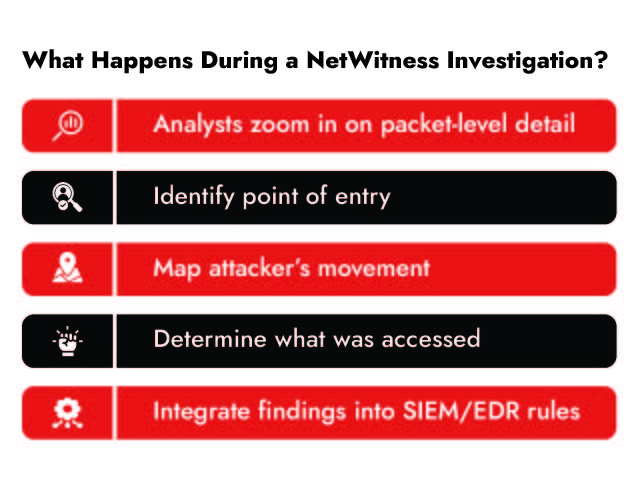
That’s where NetWitness really shines. With full-packet capture, enriched metadata, and cross-tool correlation, you don’t just spot the threat, you trace its entire path.
What NetWitness NDR solution Enables:
- Reconstruct sessions to see attacker behavior.
- Visualize the full timeline of compromise.
- Trace lateral movement and pivot points.
- Feed findings back into your detection strategy.
Still Debating NDR vs EDR? Ask Yourself This:
- Do you have BYOD (bring your own device) or unmanaged devices?
- Are you using multiple clouds or hybrid networks?
- Have you dealt with lateral movement or encrypted threats?
- Do your analysts spend hours chasing false positives?
If your answer is “yes” to two or more, NDR is essential for you.
How NDR and EDR Work Together During a Cyberattack
NDR and EDR provide different perspectives of the same security incident. EDR reveals what is happening at an endpoint, while NDR shows how that device communicates with other systems across the network. When integrated, they help security teams connect endpoint activity with network evidence and investigate the broader attack sequence.
Real-World Attack Scenario: Ransomware Spreading Across the Network
Consider a ransomware attack that begins when an employee opens a malicious attachment. The initial compromise occurs on a managed endpoint, but the attacker attempts to move laterally and access additional systems.
Here’s how both technologies contribute to the investigation:
- EDR detects suspicious endpoint activity: It identifies an unusual process of execution, suspicious file activity, or behavior associated with ransomware on the compromised device.
- NDR identifies unusual network communications: It detects unexpected connections, suspicious internal traffic, or communication patterns that may indicate lateral movement.
- Security teams correlate the evidence: Analysts connect the endpoint process history with network sessions to understand which systems communicated and whether the activity spread beyond the initial device.
- The investigation establishes the attack scope: EDR provides device-level evidence, while NDR adds network context to help identify affected systems and communication paths.
- Teams coordinate containment: Analysts can isolate the affected endpoint through supported EDR actions and use integrated network security controls to address suspicious communications.
This is where NDR and EDR work become important to incident response. Neither technology provides the complete picture independently. Their combined evidence helps analysts understand where an attack started, how it moved, and which systems may have been affected.
For enterprise security teams, integrating NDR vs EDR solutions into a coordinated detection and response workflow can improve investigation depth and reduce the time spent correlating disconnected alerts.
The Smarter Approach: NDR + EDR Together
This isn’t an either/or decision. EDR vs NDR is not a battle; they are complements. For maximum visibility and effective response, organizations should deploy both, ideally integrated into a broader detection and response ecosystem.
Together, they deliver:
- Full-spectrum visibility from device to network.
- Faster, smarter response through correlation.
- Stronger forensics for post-incident analysis.
- Reduced dwell time through early detection.
NetWitness EDR supports this unified approach by integrating NDR, EDR, SIEM, and threat intelligence, giving your team one connected view, not siloed snapshots.
What to Look for When Evaluating NDR and EDR Solutions
Choosing between NDR and EDR should begin with an assessment of existing security coverage, visibility gaps, and investigation requirements. Organizations should evaluate each technology based on the evidence it collects, the threats it can identify, and how effectively it integrates with the broader security environment.
Use these criteria when comparing NDR vs EDR solutions:
Evaluation Factor | What to Look for in NDR | What to Look for in EDR |
Visibility | Network-wide visibility across managed and unmanaged devices, hybrid environments, and network communications | Detailed visibility into endpoint processes, files, memory, and user activity |
Data collection | Network packets, flows, and rich metadata | Endpoint telemetry, process information, and system events |
Threat detection | Detection of lateral movement, suspicious communications, and command-and-control activity | Detection of malware, ransomware, malicious processes, and endpoint anomalies |
Investigation | Network session analysis, communication history, and forensic evidence | Process trees, file activity, endpoint timelines, and forensic artifacts |
Threat hunting | Ability to investigate suspicious network behavior and trace communications | Ability to search historical endpoint activity and investigate device-level indicators |
Response | Integration with network controls and incident response workflows | Endpoint isolation, process termination, and remediation capabilities |
Integration | Correlation with SIEM, EDR, and other security telemetry | Integration with NDR, SIEM, and broader detection and response workflows |
Scalability | Coverage across distributed networks, cloud environments, and enterprise infrastructure | Centralized management and monitoring across large endpoint deployments |
Should Organizations Choose NDR or EDR?
The decision depends on the visibility gaps an organization needs to address. EDR is essential for monitoring endpoint behavior and responding to device-level threats. NDR adds network-wide visibility, helping security teams investigate suspicious communications and activity that may not be visible from an endpoint alone.
Organizations with complex, hybrid, or distributed environments should assess how both technologies can work together. The objective is not simply to deploy more tools, but to connect endpoint and network evidence, so analysts can investigate threats with greater context.
Why NetWitness NDR Stands Out
NetWitness is recognized for delivering advanced capabilities that matter most to security teams:
- Deep forensics built on full-packet capture.
- Visibility into encrypted and cloud environments.
- Seamless integrations with NetWitness EDR and SIEM.
- AI-driven detection of stealthy, lateral threats.
- Actionable alerts that cut through the noise.
What sets NetWitness apart is its ability to correlate endpoint and network activity in one unified view, giving analysts the complete story, not disconnected signals.
Final Thoughts: EDR vs NDR Cybersecurity Is Not Either/Or
In the modern threat landscape, relying on endpoint visibility alone leaves your defenses vulnerable. Equally, relying solely on network-level detection might miss device-centric threats.
The smart choice? You need both. And you need them to work together.
Implement a layered detection strategy, EDR plus NDR. That means you:
- Detect threats earlier.
- Investigate faster.
- Respond smarter.
NDR complements EDR by adding deep visibility, advanced forensics, and context-aware threat detection, especially important in today’s complex, encrypted, and hybrid networks.
With NetWitness NDR and NetWitness EDR, your organization gains:
- Unmatched network visibility.
- Accelerated detection and response.
- Rich forensic analysis to guide post-incident decisions.
With NetWitness, you’re not just reacting. You’re understanding. You’re anticipating. And that’s how you stay ahead.