Introduction
When an organization experiences a cyber incident, one of the first questions leadership asks is deceptively simple: What happened?
The answer is rarely straightforward. Security teams must identify how the attacker entered, determine what affected systems, understand what actions occurred, assess whether sensitive information was accessed, and decide how to contain the threat without creating additional business disruption.
These questions sit at the intersection of three critical cybersecurity disciplines: digital forensics, threat investigation, and security incident response.
Many organizations approach these disciplines independently. Forensic teams collect evidence. Security operations teams investigate alerts. Incident responders focus on containment and recovery.
The challenge is that attackers do not operate in silos. Neither should be defenders.
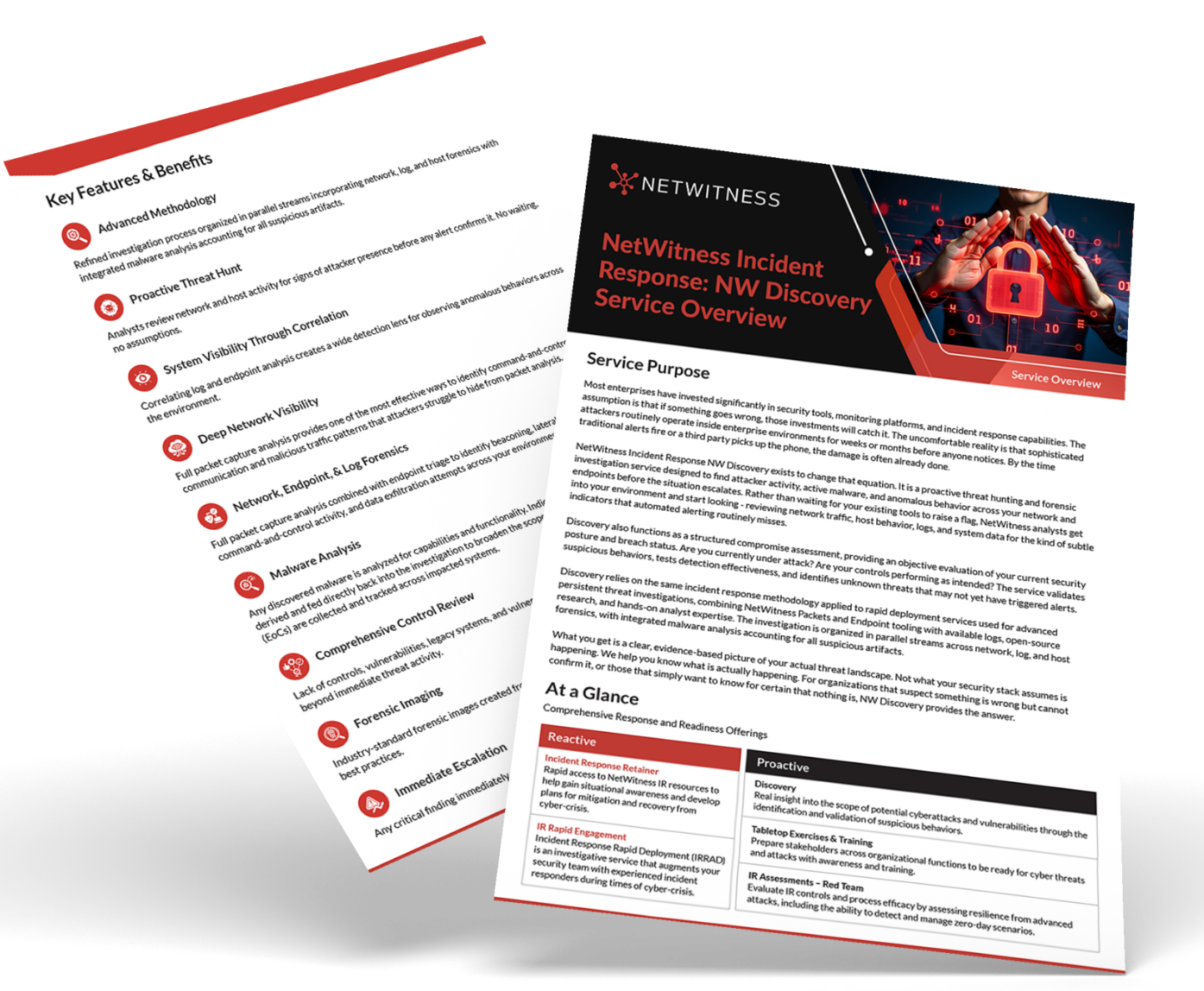
NetWitness approaches investigations by integrating Digital Forensics and Incident Response (DFIR), threat investigation into a unified methodology designed to quickly detect, analyze, and respond to cyber incidents through correlated visibility across endpoints, networks, and logs.
Why Security Teams Struggle During Investigations
Modern cyberattacks rarely leave behind a single piece of evidence. An attacker may compromise an account through phishing, move laterally using legitimate administrative tools, access cloud resources, exfiltrate data through encrypted channels, and establish persistence across multiple systems.
No single data source tells the entire story.
- The endpoint may reveal process execution.
- The network may reveal communications and network forensics/lateral movement.
- Authentication logs may reveal compromised identities via endpoint forensics.
Viewed independently, these activities can appear disconnected. Viewed together, they reveal the attack. This is why successful investigations depend on correlation rather than isolated analysis. NetWitness investigation methodology is built around combining endpoint, network, and log visibility to understand both the scope and sequence of attacker activity.
The Problem with Siloed Security Disciplines
Digital forensics and incident response (DFIR) are often discussed as if they are separate activities. In reality, they are deeply interconnected.
- Digital forensics provides evidence.
- Threat investigation provides context.
- Incident response provides action.
Without forensic evidence, response decisions may be based on assumptions. Without investigation, forensic artifacts may lack operational meaning. Without response, neither delivers meaningful risk reduction.
NetWitness investigations are designed to connect these activities by transforming evidence into actionable conclusions. Investigation outputs frequently include executive summaries, findings report, tactical recommendations, strategic recommendations, and actionable remediation guidance. The objective is not simply to collect data. The objective is to make defensible decisions.
The Three Pillars of Effective Investigation
NetWitness investigative methodology is built around three core evidence sources that are continuously correlated throughout an investigation.
1. Network Visibility: Seeing What the Adversary Is Doing
Network evidence provides insight into attacker behavior. It can reveal remote access activity, command and control communications, lateral movement, data transfers, protocol misuse, and session reconstruction. Network forensics helps investigators understand how attackers moved through the environment and what systems they interacted with.
2. Log Analysis: Understanding What Happened
Logs provide historical context. Authentication records, VPN logs, firewall events, Windows events, and other security telemetry help investigators build a timeline of attacker activity via cyber incident investigation. This evidence establishes when activity occurred, which accounts were involved, what systems were accessed, how attackers escalated privileges, and how the attack evolved over time. Logs help transform isolated events into a coherent narrative.
3. Endpoint Forensics: Understanding How and Why
Endpoint forensics focuses on systems directly involved in the attack. Investigators examine processes, memory, files, registry activity, system configurations, and persistence mechanisms. This data helps determine exactly how attackers executed their objectives and what changes occurred on compromised systems. Endpoint forensics is also essential for understanding attack scope and supporting remediation decisions.
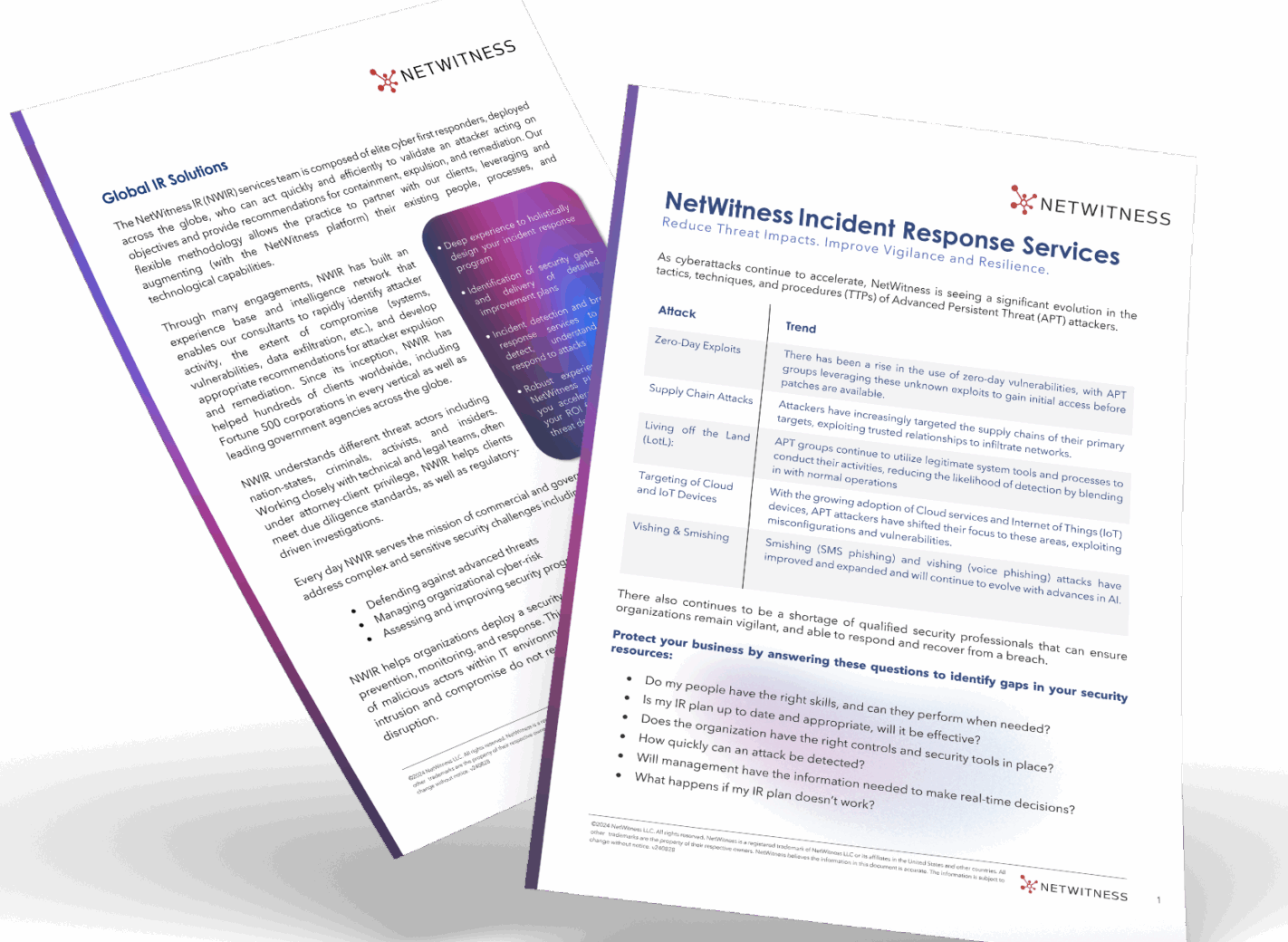
Rapid, Expert Response with NetWitness® Incident Response Services
-Accelerate threat containment with experienced IR specialists.
-Investigate effectively using advanced forensics and analytics.
-Minimize business impact with fast, guided remediation.
From Indicators to Intelligence
Indicators alone rarely tell the full story. A suspicious IP address or malicious hash may answer what was observed. It often fails to answer why it matters.
NetWitness investigation methodology focuses on building broader understanding by correlating evidence from multiple sources. In documented investigation approaches, Digital Forensics and Incident Response (DFIR) activities include lateral movement mapping, credential abuse reconstruction, attack timeline creation, and the development of actionable indicators derived from network, endpoint, log, and malware evidence. Through advanced threat hunting and cyber threat detection, this moves the investigation beyond simple detection and toward understanding attacker objectives, methods, and impact.
Connecting Investigation to Response
A successful investigation does more than explain the past. It drives decisions in the present. Digital forensics helps identify initial access methods, compromised accounts, affected systems, attacker dwell time, data access patterns, and the scope of compromise.
NetWitness forensic investigations are designed to identify attack vectors, assess compromise scope, and support strategic reporting that enables containment, remediation, recovery, and long-term improvement decisions. This connection between evidence and action is critical. Organizations facing active cyber incidents cannot afford uncertainty when making containment and recovery decisions.
Beyond Containment: Building Long-Term Resilience
Responding to an incident is important. Learning from it is important. Every investigation creates an opportunity to improve cyber resilience. By understanding how attackers gained access, moved through the environment, escalated privileges, and achieved their objectives, organizations gain valuable insights that can strengthen future defenses.
NetWitness incident response engagements are designed to support both immediate response and long-term resilience through defensible findings, threat intelligence, forensic analysis, readiness improvements, and enhanced detection capabilities. The investigation does not end when the attacker is removed. That is where improvement begins.
Why Visibility Matters More Than Ever
Today’s attackers operate across networks, endpoints, cloud services, identity platforms, and third-party environments. No single tool or telemetry source provides complete visibility.
Organizations need the ability to connect evidence, reconstruct activity, validate assumptions, and support rapid decision-making during incidents through rigorous cybersecurity forensics. This is why NetWitness investigative methodology continues to emphasize the integration of endpoint visibility, network visibility, and log analysis as the foundation for cyber investigations and security incident response.
Frequently Asked Questions
1. How does NetWitness unify Digital Forensics and Incident Response (DFIR)?
NetWitness eliminates traditional operational silos by combining real-time log analysis, network packet visibility, and endpoint telemetry into a single platform. This enables practitioners to conduct continuous threat investigation and cyber incident investigation without manually pivoting between disparate tools.
2. How does digital forensics support threat investigations?
Digital forensics provides evidence used to reconstruct attacker activity, determine compromise scope, analyze attack vectors, identify compromised accounts, and establish timelines of malicious behavior.
3. Why are network, endpoint, and log visibility all important?
Each source provides a different perspective. Network data reveals communications and movement, logs provide historical event context, and endpoints contain detailed forensic evidence. Together they create a more complete picture of the incident.
4. What information does a cyber investigation typically uncover?
Investigations commonly identify initial access mechanisms, attacker movement, affected systems, compromised accounts, persistence methods, dwell time, and the overall scope of compromise.
5. How does threat investigation improve cyber resilience?
Threat investigations reveal weaknesses in technology, processes, visibility, and response capabilities. Organizations can use those findings to improve detection, strengthen controls, validate response plans, and reduce future risk
Proactively assess your ability to detect, investigate, and respond to cyber threats.
- Comprehensive review of incident response capabilities
- Gap analysis across people, processes, and technology
- Prioritized recommendations for risk reduction
- Enhanced preparedness for future cyber incidents