What should enterprises look for when choosing a modern NDR tool in 2026?
A modern NDR tool should provide visibility across on-premises, cloud, remote, and east-west network traffic, detect threats in encrypted environments without mandatory decryption, and use explainable behavioural analytics to identify suspicious activity. It should also offer MITRE ATT&CK-mapped detections, packet-level forensics, retrospective threat hunting, and integrations with SIEM, SOAR, and EDR. Enterprises should validate these capabilities through a proof of concept using their own network traffic, measuring detection accuracy, false positives, investigation time, and scalability.
Buying an NDR tool in 2026 is harder than it looks. Nearly every vendor now claims AI detection, complete visibility, and faster response, and the demos all look impressive. The differences show up later, when encrypted traffic hides a command-and-control channel or your analysts drown in alerts nobody trusts.
Network detection and response sits in an odd spot. It’s one of the few security layers an attacker can’t simply switch off, because nothing useful happens without traffic. But that only helps if the tool you pick can actually read that traffic, explain what it finds, and hand your team something they can act on.
This guide walks through the features that separate modern NDR tools from older network security monitoring products. Skip the brochure language. Here’s what actually matters. You’ll get a practical checklist, questions to ask vendors, and a way to test claims before you commit budget.
Why Network Detection and Response Matters More in 2026
Three shifts changed what enterprises should ask for.
Encryption is now the default. Most web traffic runs over HTTPS, and internal east-west traffic is following. A tool that depends on reading payloads is working blind.
The perimeter has dissolved. Workloads sit across AWS, Azure, and on-prem data centers at once, and users connect from anywhere. Network visibility has to follow them.
Dwell time and breach costs haven’t gone away either. Mandiant’s M-Trends 2025 report put median dwell time at 11 days, so attackers still get over a week of quiet access. IBM’s 2025 Cost of a Data Breach report pegged the global average breach at about 4.44 million dollars, with 241 days on average to identify and contain. Analysts don’t need more alerts. They need fewer, better ones.
Keep those pressures in mind as you read the checklist below.
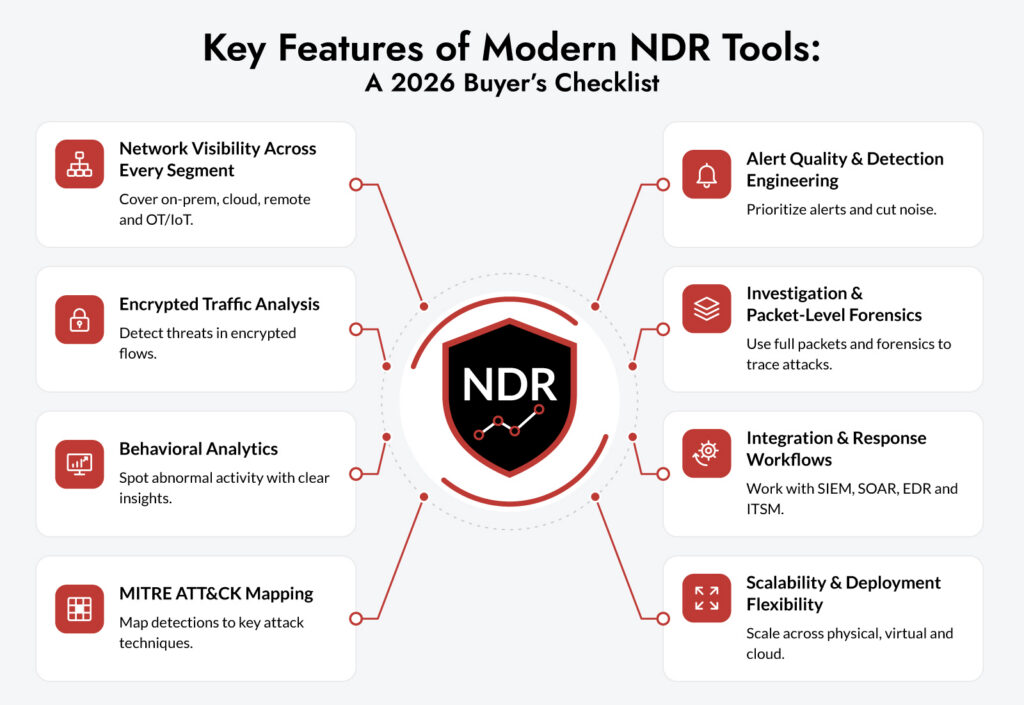
Key Features of Modern NDR Tools: The Detailed Checklist
Network Visibility Across Every Segment
You can’t detect what you can’t see. Plenty of deployments cover the internet edge and not much else, which is backwards. Lateral movement happens inside, so that’s where sensors belong.
A modern platform should cover north-south traffic, east-west traffic between internal systems, cloud workloads, remote sites, and where relevant, OT and IoT. Ask vendors how they handle physical, virtual, and cloud sensors, how they mirror traffic in AWS, Azure, and Google Cloud, and how they cover unmanaged devices that will never run an agent.
Ask what gets stored, too. Some tools keep only metadata. Others keep full packets. Metadata is cheap and works for broad detection, while full packet capture is what you want once an investigation turns serious. The better network traffic analysis setups let you pick depth per segment instead of forcing one model everywhere.
Encrypted Traffic Analysis Without Full Decryption
Decrypting everything is slow, expensive, and often off the table for privacy or compliance reasons. NDR software has to find threats inside encrypted flows without cracking them open.
That comes down to behavior and metadata: TLS handshake traits, certificate oddities, JA3 and JA4 fingerprints, session timing, packet size patterns, beaconing intervals. Command-and-control traffic often has a rhythm, even when you can’t read a byte of it.
In a demo, ask what the tool detects in encrypted traffic specifically. Ask for examples. A vague answer is an answer.
Behavioral Analytics for Network Threat Detection
Every vendor says machine learning. Far fewer can tell you what the model looks at or why it fired.
Good behavioral detection builds a baseline for users, devices, and services, then flags deviations that matter. A finance server talking to an unfamiliar external IP at 3 a.m. A workstation sweeping internal subnets. A service account logging in from somewhere new.
Explainability decides whether anyone trusts it. If an analyst can’t see why an alert fired, they’ll ignore it, and an ignored alert is just noise in a nicer interface. Look for the evidence behind each detection: what triggered it, what normal looked like, and what related activity surrounds it.
Ask how long the model needs to learn your environment. Ask how it copes with legitimate change like a migration or a big application rollout. Some tools bury teams in false positives for weeks.
MITRE ATT&CK Mapping
An alert without context leaves analysts guessing. Mapping detections to the MITRE ATT&CK framework shows where an attack sits in its lifecycle. Reconnaissance and exfiltration call for very different speeds of response.
Strong network threat detection should cover the techniques that show up on the wire most often: command and control, lateral movement, credential access, discovery, and exfiltration. Ask for a coverage map. Then ask which techniques are caught by behavior and which depend on known signatures. Good vendors show you their gaps. Weak ones claim there aren’t any.
Alert Quality and Detection Engineering
Alert fatigue is why many NDR deployments quietly die. When a tool throws hundreds of low-value alerts a day, analysts stop looking.
Check whether alerts are prioritized by risk, asset criticality, and confidence. Check whether related events get grouped into one incident, because ten alerts about a single intrusion should read as one story, not ten tickets. Your team should be able to tune detections and write custom rules without filing a support request. And the vendor should ship regular content updates backed by real threat research.
Investigation and Packet-Level Forensics
Detection is half the job. The other half is answering hard questions quickly. What did the attacker touch? How did they get in? What left?
Analysts should be able to jump from an alert to session details, rebuild what happened, and pull packets or files without switching tools. Retrospective search matters just as much. When a new indicator of compromise surfaces next month, you want to check whether it was already in your traffic last spring.
This is where stored packets pay for themselves. Metadata says a connection happened. Packets show what was said.
Response and Integration With Your Security Stack
The R in NDR gets overlooked. Some products stop at alerting and leave everything else to you.
Confirm integrations with your SIEM, SOAR, EDR, firewalls, and ticketing system. Useful response actions include isolating a host through EDR, blocking an IP at the firewall, or triggering a playbook. Open APIs matter because your stack won’t look the same in three years.
Go easy on full automation. Blocking the wrong server mid-business-day can hurt more than the threat would have. Tiered automation is safer: low-risk actions run on their own, high-impact ones wait for approval.
Hybrid and Multi-Cloud Coverage
Almost no enterprise lives in one place. Your NDR platform should give one view across data center, cloud, and remote environments without three consoles and three workflows.
Ask how cloud traffic is collected, what mirroring and processing cost at scale, and whether detections behave the same everywhere. Some vendors built a strong on-prem product and added cloud later. You’ll feel that seam every day.
Scalability and Analyst Experience
Links get upgraded from 10 Gbps to 100. Traffic doubles. A tool that ran fine in a pilot can choke in production. Ask about throughput per sensor, how the architecture scales out, and what happens to detection quality under load. Plan storage early if you’re retaining packets.
Then look at the interface, which feature comparisons tend to skip. A clumsy console kills adoption faster than a missing feature. Put a tier-one analyst in front of it during evaluation. Can they triage an alert in a few minutes? Can a hunter build a query without reading a manual? The best NDR tools for enterprises are the ones a tired team will actually open at 2 a.m.
How to Evaluate NDR Solutions Before You Buy
Feature lists only go so far. A proof of concept on your own traffic tells you more than any slide deck.
Insist on your own data, since demos built on pre-staged traffic always look good. Ask about cost beyond the license, because sensors, storage, and cloud ingestion fees can change the math. Push for specifics wherever an answer sounds soft: AI claims with no explanation of method, coverage claims with no ATT&CK mapping, no clear position on encrypted traffic. If a vendor resists a hands-on trial, ask why.
Measure what matters during the trial. Time to triage. False positive rate. How many of your own test attacks got caught. Those numbers beat feature counts every time.
NetWitness NDR for Enterprise Network Security
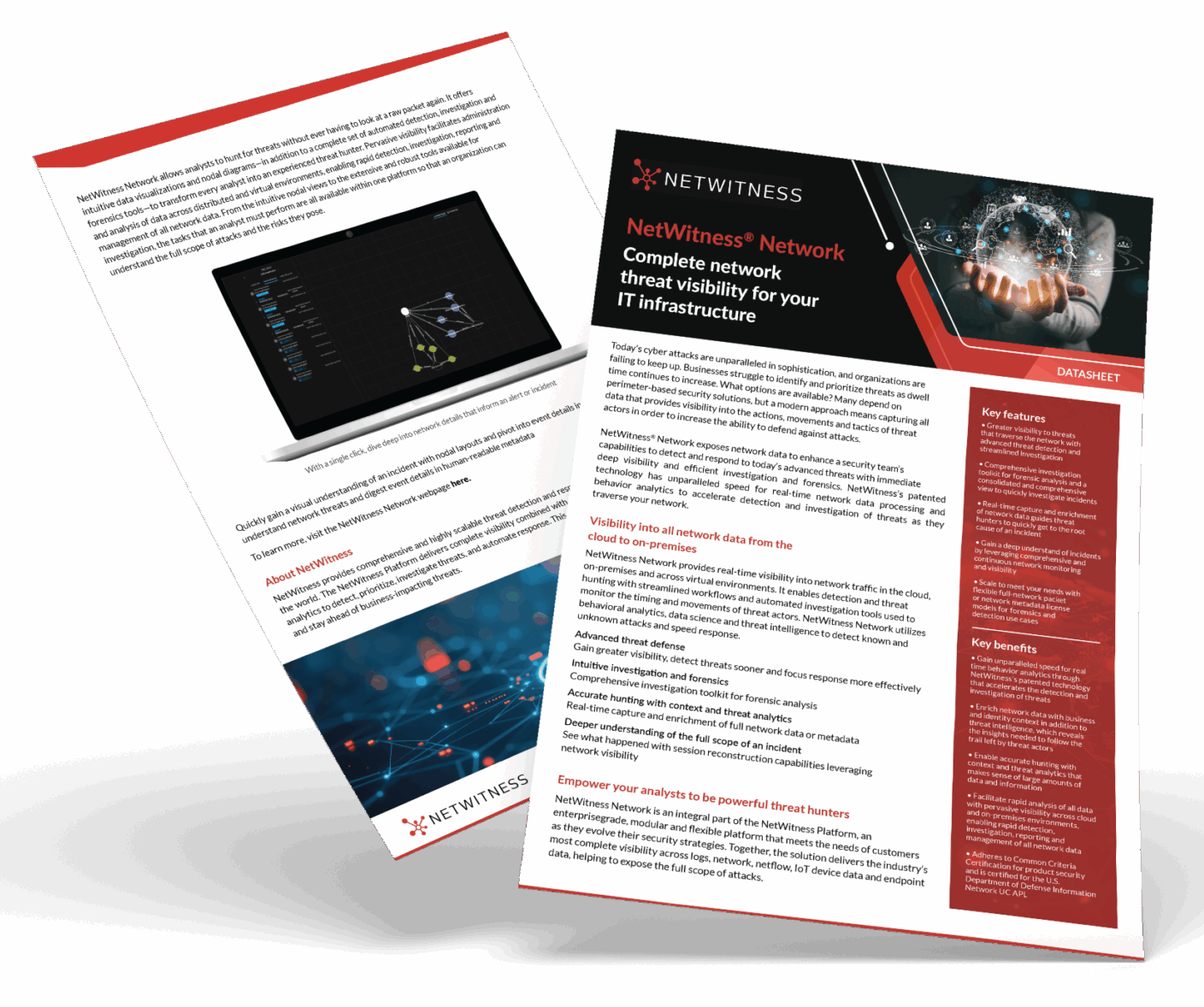
NetWitness approaches network detection and response from a forensics-first direction. The platform captures traffic as full packets plus rich metadata, then layers on behavioral analytics, threat intelligence, and ATT&CK-aligned detections. Analysts can go from an alert to session reconstruction and packet evidence without leaving the console.
That tends to suit mature SOC teams, regulated industries, and anyone who needs evidence-grade investigation and retrospective analysis. It also connects with SIEM, SOAR, and endpoint tooling, so it doesn’t turn into one more silo.
If deep visibility, investigation depth, and hybrid coverage sit high on your list, put it on the shortlist and run it through the same checklist as everything else.
2026 NDR Buyer’s Checklist at a Glance
Use this as a scoring sheet during vendor evaluations:
- Visibility across north-south, east-west, cloud, and remote traffic
- Packet capture plus metadata, with flexible retention
- Detection in encrypted traffic without mandatory decryption
- Behavioral analytics with visible, explainable evidence
- ATT&CK-mapped detections with honest coverage gaps
- Alert correlation, prioritization, and tuning controls
- Fast investigation workflows and retrospective search
- Integrations with SIEM, SOAR, EDR, and firewalls
- Consistent hybrid and multi-cloud support
- Proven scalability at your traffic volume
- An interface your analysts will use
- A real proof of concept in your own environment
Conclusion
Picture an attacker two days into your network. They’ve scanned subnets, found the file servers, and tested a few credentials. The only question that matters is whether anything on your side noticed.
Good NDR tools answer that with evidence instead of guesses. They show you traffic you couldn’t see, explain why a connection looks wrong, and give your team enough detail to act before data walks out the door. Everything else in a vendor pitch is decoration.
So build the shortlist honestly. Run a proof of concept on your own traffic, and let your analysts vote. Trust what you see in your environment over what’s promised on a slide. The tool that holds up under that test is the one worth buying.
Frequently Asked Questions
1. What are the top-rated NDR tools for enterprise cybersecurity?
Vendors that appear regularly in analyst reports and buyer shortlists include Darktrace, Vectra AI, ExtraHop, Corelight, and NetWitness. Their strengths differ. Some lean on AI-driven anomaly detection, some on open network evidence, others on packet-level forensics. Ratings matter less than fit, so check current analyst reports and test two or three tools against your own traffic.
2. What are the key benefits of implementing a modern NDR solution?
The biggest is visibility into activity other tools miss, especially lateral movement and traffic from unmanaged devices. A modern NDR platform also shortens detection and investigation time, gives analysts packet-level evidence, supports compliance work, and adds a detection layer attackers can’t easily switch off. Correlating related activity into single incidents cuts noise for SOC teams, too.
3. How do network security tools identify sophisticated cyber threats?
They combine methods. Signatures and rules catch known threats. Behavioral analytics flag activity that breaks from a learned baseline. Threat intelligence matches traffic against known malicious infrastructure. In encrypted traffic, tools study handshake details, timing, and session patterns instead of content. The better ones then correlate these signals and map them to ATT&CK techniques to show how far an attack has progressed.
4. How should enterprises evaluate NDR tools?
Start with your own environment. Map your critical assets and traffic flows, then run a proof of concept with real traffic. Score every tool on the same checklist: visibility, encrypted traffic detection, alert quality, investigation depth, integrations, and scalability. Involve the analysts who’ll use it daily, and track time to triage and false positive rates, not just features.
5. What should I look for while choosing NDR tools?
Look for broad network visibility, solid detection in encrypted traffic, explainable behavioral analytics, ATT&CK-aligned coverage, and strong investigation features. Check integrations with your current stack, cloud support, and performance at your traffic scale. Then weigh total cost, including sensors, storage, and ingestion. Finally, get a hands-on trial. A tool that shines in a demo can behave very differently on your network.
Proactive Network Threat Detection with NetWitness® NDR
- Full Packet Visibility
- Advanced Threat Detection
- Network Forensics at Scale
- Faster Incident Response