What Do Modern Security Log Management Tools Do?
Modern security log management tools collect and centralise event data from applications, endpoints, networks, cloud environments, and identity systems. They help security teams monitor activity, correlate related events, detect suspicious behaviour, and investigate potential threats. Advanced platforms enrich events with contextual information, build incident timelines, and automate alerting and response workflows. These capabilities help organisations connect isolated security events, identify attack patterns, understand the scope of an incident, and make faster, evidence-based security decisions.
Millions of logs can be collected per day by a security team and they still might have a problem trying to answer one question: What happened?
Failure to authenticate can seem a trivial incident. If you are able to log in successfully with the same account, it might not seem unusual. These may individually seem harmless, such as a DNS request, privilege change or outbound connection. Add those events and the picture can shift drastically.
An attacker might have breached the account, logged in, gained system privileges, traversed systems and initiated access to sensitive resources. There is evidence, but it is spread out in various logs and security systems.
That is where modern log analysis tools need to do more than collect and search data. The log management market is expanding quickly, projected to grow from $3.76 billion to $8.99 billion by 2031. These tools help security teams deal with the growing amount of data coming from clouds, devices, networks, user identities and applications. The problem isn’t just saving logs anymore. It’s about turning raw log data into security intelligence that can be used to protect systems.
What Are Log Analysis Tools?
These tools collect, organize, search, correlate and analyze log data from multiple sources to help security teams detect threats, investigate incidents and understand activity across their environments.
In the past traditional log management tool was, about collecting and storing information. Today’s systems need to do more. They must help analysts understand the data find patterns and act quickly when something goes wrong.
That means bringing together capabilities such as:
- Centralized log collection
- Log monitoring across different environments
- Fast search and investigation
- Log normalization and parsing
- Log correlation across users, devices and systems
- Threat detection and analytics
- Contextual enrichment
- Incident investigation and timeline analysis
- Automated alerting and response
- Compliance reporting
The important distinction is simple: the value is not in having more logs. It is in understanding what those logs mean together.
Why Are Modern Log Analysis Tools Important for Cybersecurity?
It is rare that attackers will create a single event that is easily identifiable as an attack. A compromised credential, such as an unusual authentication event, can be the first sign of an attack. The attacker can then log into another system, modify permissions, request information from the internal system and interact with an external target.
An investigation of each event can be done independently. Security teams have an issue however: analysts need to manually tie it together. Today’s analysis tools should lessen that effort. A platform can integrate various activity sources and make sense of the relationships between them and assist analysts in recognizing patterns that a single log entry can’t show.
Consider a sequence such as::
Unusual login → New device → Privilege escalation → Internal access → Suspicious outbound connection
That is much more useful than five separate alerts.
What Should Modern Log Analysis Tools Deliver?
The best way to evaluate a platform is to look at what happens after the logs are collected.
| Capability | Basic approach | Modern expectation |
| Log collection | Store events centrally | Collect across cloud, endpoint, network, identity and applications |
| Search | Find individual records | Search and pivot across related activity |
| Log analytics | Query historical data | Identify patterns and unusual behavior |
| Log correlation | Match predefined conditions | Connect activity across entities and data sources |
| Alerting | Generate individual alerts | Group related events into meaningful incidents |
| Investigation | Review raw records | Build timelines and identify attack sequences |
| Context | Display log fields | Add user, asset and threat intelligence context |
| Automation | Depend on manual analysis | Automate repetitive investigation and response tasks |
| Reporting | Basic dashboards | Provide security and compliance-focused reporting |
This is where modern log management tools need to move beyond being repositories for security data.
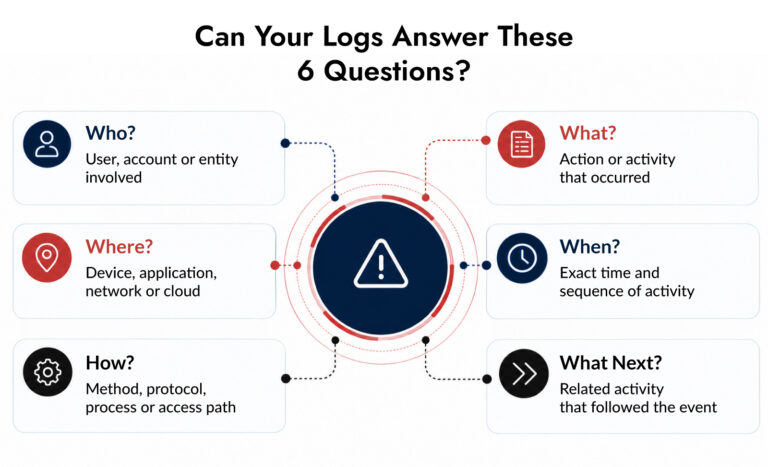
A platform should help analysts answer who, what, when, where and how without forcing them to manually reconstruct every connection between events.
How Does Log Correlation Turn Individual Events into an Attack Story?
Log correlation connects events that share meaningful relationships.
Those relationships can involve a user, IP address, device, application, domain, process or time period. Effective correlation should also account for the wider context around an event.
For example, an unusual login becomes more significant if it is followed by a new device registration, a privilege change and suspicious network activity.
The objective is not to correlate everything with everything else. That can create another problem: too many alerts and too much noise.
Instead, modern platforms should identify relationships that help establish whether separate events belong to the same incident.
This changes the analyst’s job. Rather than starting with millions of records and asking what matters, the analyst can start with a connected sequence and investigate the evidence behind it.
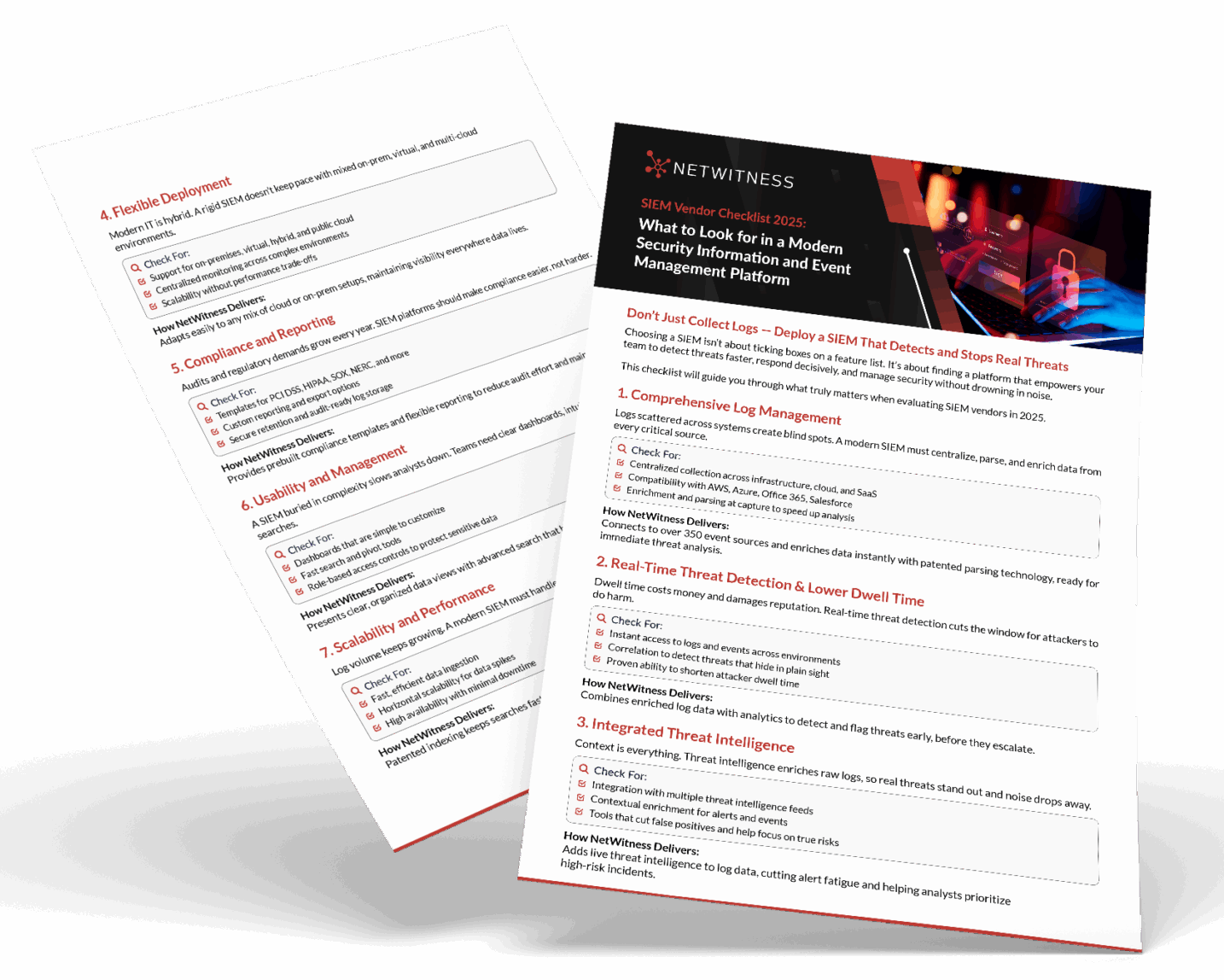
Choose the Right SIEM with Confidence
Evaluate vendors using a comprehensive, expert-built checklist.
Identify must-have SIEM features for complete visibility and faster detection.
Make informed decisions with NetWitness’ proven SIEM guidance.
How Can NetWitness Logs Help Connect Log Data?
NetWitness Logs is based on the principle that logs should be made available as security evidence immediately after capture. NetWitness Logs parses, enriches and indexes logs at capture time instead of waiting until after the capture for traditional log-centric approaches to primarily collect records for later searching. It generates sessionized metadata for quicker alerting and analysis and keeps the raw logs for further investigation. It can handle over various events sources and receives logs via protocols such as Syslog, ODBC, SFTP, SCP, FTPS, SNMP, Check Point LEA and WinRM. This allows security teams to integrate a variety of log sources into a single investigation process, instead of each source being a data silo.
It also automatically discovers logs and dynamically parses them, which can cut down on manual efforts required to add new sources to the environment. This is an issue in businesses that have dynamic applications, infrastructure and cloud services. But more than anything else, NetWitness Logs isn’t just for logs. It connects to NetWitness Network, NetWitness Endpoint, NetWitness Detect AI and NetWitness Orchestrator to boost teams’ investigations of logs, network traffic, NetFlow and endpoint activity. This greater visibility helps with the key goal of mapping evidence to better grasp the incident, rather than just holding on to the evidence.
What are the Most Reliable Log Analysis Tools for Enterprise Use?
There is no single platform that fits every enterprise. The right choice depends on the organization’s data sources, infrastructure, security operations model and investigation requirements.
| Tool | Key strength | Best suited for |
| Splunk Enterprise Security | Broad security analytics and correlation | Large and complex security operations |
| Microsoft Sentinel | Cloud-native SIEM and Microsoft ecosystem integration | Organizations invested in Microsoft cloud and security |
| Elastic Security | Flexible search and analytics | Teams needing broad data exploration |
| NetWitness Logs | Log visibility with investigation across logs, network and endpoint data | Teams that need deeper cross-domain investigation |
Feature counts alone should not determine the decision. A platform may support hundreds of integrations but still leave analysts doing much of the investigative work themselves.
A better evaluation is practical: give the platform a realistic incident and see how quickly it can connect the relevant events, provide context and help an analyst establish what happened.
What are the Key Benefits of Automated Log Analysis Software?
The more data environments create, the more important automation becomes. The principal advantages are:
Real-time detection: It can detect suspicious activity in real time, without the need for manual review.
Reduced investigation time: If there are evidence correlations, and enrichment, evidence that is of interest to an investigation can be collected from one location, as opposed to investigators searching in multiple systems to collect all evidence of interest in that case.
Less context: Disconnected events have less context than connected events which can help teams determine which events to focus on.
Continuous analysis: Rules for detection, correlation can be used on a large volume of data.
Historical Logs can have value beyond that of being just a historical record they can be used in threat hunting, forensics and compliance reporting. The end goal isn’t to take the place of an analyst. It’s about removing duplicate workflows and allow analysts to verify threats and the impact they have.
How Should Organizations Choose a Log Analysis Tool?
Keep the investigation first and only then the list of features. Have vendors show you how they might respond to a realistic attack scenario based on the data sources your organization uses. Is there a way to link identity, endpoint, network and application activity? Is it possible to create a link between an alert and the evidence? Is it possible for the platform to separate related events from unrelated noises? Is it able to store raw data and yet provide a quick and easy way to search for relevant metadata?
Also check how well the system handles log ingestion how it processes the logs how it connects events how it does analysis how fast it can search, how it works with other tools how long it keeps the logs how it can automate tasks and how it creates reports. Being able to deploy the system in ways is also very important for big companies that have complicated or spread out setups. The power to collect and look at logs both on-site in environments in public clouds and in mixed setups can be very useful, as systems change.
Conclusion
Future of analysis is not about collecting more and more of the log. It’s about exploiting those records, making them useful. Security teams must have platforms that are able to ingest disparate evidence and make sense of it, and then present it in a way that is conducive to investigation and response.
It’s only a beginning of millions of logs. The actual result is a concise report of what occurred, who was affected by the action, how it unfolded and what should be followed up by the security team. Modern analysis should turn data into context, context into an investigation and an investigation into an attack story.
Frequently Asked Questions
1. What are log analysis tools?
Log analysis tools collect, organize, search and analyze log data from systems, applications, networks, endpoints and cloud environments. They help security teams identify unusual activity, correlate related events, investigate incidents and monitor security activity across an organization.
2. Why are modern log analysis tools important for cybersecurity?
These tools help security teams identify connections between events that may look harmless individually. Through security log analysis, correlation and automated analytics, they can help reveal patterns linked to account compromise, privilege escalation, lateral movement and other suspicious activity.
3. What are the most reliable log analysis tools for enterprise use?
The right choice depends on an organization’s infrastructure, data sources, security operations and investigation requirements. Platforms commonly evaluated by enterprises include Splunk Enterprise Security, Microsoft Sentinel, Elastic Security and NetWitness Logs. Organizations should compare their ability to ingest, analyze, correlate and investigate data rather than relying only on the number of features or integrations.
4. How to compare top log analysis tools by features?
Top tools can be compared by their log collection, analytics, correlation, threat detection, investigation, cloud support, endpoint and network visibility, automation and compliance capabilities. NetWitness Logs stands out for combining log analysis with broader visibility across network and endpoint data.
5. What are the key benefits of using automated log analysis software?
Automated software can process large volumes of events continuously, identify suspicious patterns, correlate related activity and prioritize potential threats. It can reduce repetitive investigation work, accelerate incident analysis and help security teams focus on high-value investigations instead of manually reviewing individual log records.
Maximize SIEM value in the first 90 days with a structured plan for faster security outcomes.