What are the most effective strategies for detecting insider threats in large organizations?
The most effective Insider Threat Detection strategy combines User and Entity Behavior Analytics (UEBA), continuous user activity monitoring, AI-powered anomaly detection, privileged access controls, and threat detection and response. Organizations should also integrate endpoint, network, cloud, and identity data to identify suspicious behavior, prioritize insider risks, and automate incident response. A unified Insider Threat Management solution provides the visibility and context needed to detect, investigate, and contain insider threats before sensitive data is compromised.
Introduction
Insider threats are hard to spot because they come from inside your own organization. Your employees have access. They’ve got credentials. They have your trust. That’s what makes them dangerous when something goes wrong.
The numbers are real. A single insider incident costs enterprises millions. Here’s the thing: your perimeter’s basically gone. Remote work. Cloud. SaaS everywhere. Your data isn’t contained anymore.
So how do you catch insider threat detection before it blows up? The most reliable insider threat detection for enterprises really comes down to what you can actually see and measure. You need behavioral intelligence. You need real-time visibility. And you need to respond fast.
Why Insider Threats Matter Now
Your security team can’t watch everyone. That’s not the point anyway. The real point is building insider threat detection solutions that work automatically. You’re catching deviations from normal behavior before data gets stolen.
Insiders don’t need to exploit anything. They already have permissions. A departing employee. A compromised account. A contractor with system access. They’re already past your defenses.
Insider threat detection has to work differently than catching external attackers. You’re not looking for break-ins. You’re looking at people who suddenly start doing things they shouldn’t be doing. Accessing files they never touched before. Logging in from a different country. Moving sensitive data to a personal cloud account.
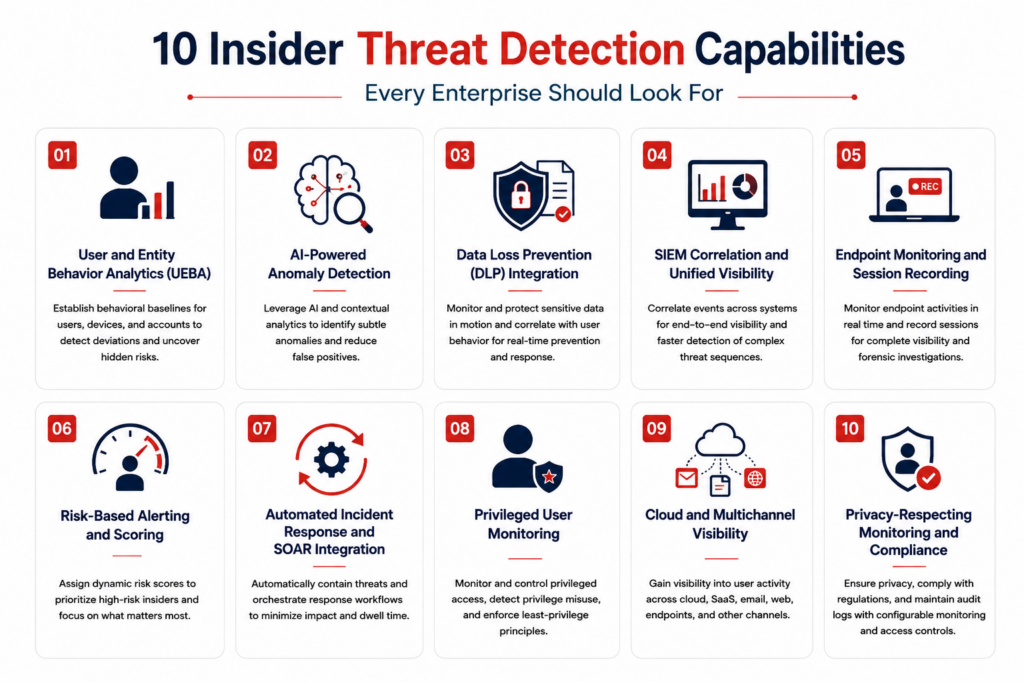
Core Insider Threat Detection Capabilities
User and Entity Behavior Analytics (UEBA)
UEBA is basically the foundation. It learns what normal looks like. For every user. Every device. Every service account. Then it tracks anything that doesn’t fit.
Someone logs in from Germany when they normally work in New York? That gets flagged. Accessing files they’ve never looked at? System catches it. Downloading stuff at 3 AM when they normally work standard hours? The system knows that’s weird.
Machine learning does the actual work. It’s not looking for known bad stuff. It’s looking for anything that breaks the baseline. That matters because attackers change tactics. Rules-based systems catch yesterday’s problems. UEBA catches what’s happening right now.
AI-Powered Anomaly Detection
UEBA gets you started. But advanced AI goes deeper. It looks at context. Your peer group. Your device fingerprint. Where you normally work. How your behavior’s changed recently. All that stuff shapes what gets flagged.
You download files on a regular basis. That’s your job. But then you start downloading way more than usual. Suddenly accessing data you don’t normally touch. The AI catches that shift. It adapts when things change. New threats pop up and the system learns. It cuts through noise and surfaces actual risks.
Data Loss Prevention Integration
DLP watches data as it moves through your organization. Email. Instant messages. Cloud uploads. USB drives. It’s there to stop sensitive data from leaving.
But here’s where it gets interesting. When DLP connects with behavioral analytics, you see who’s moving data and why. Someone backing up one file? That’s normal. Someone suddenly exfiltrating hundreds of files to their personal cloud storage right after getting fired? That’s different. That’s the system working.
SIEM Correlation and Unified Visibility
Insider threats don’t stay in one place. They span your endpoint. Your network. Your cloud services. Your identity systems. SIEM integration pulls it all together.
An event here. An event there. Nothing looks wrong by itself. But when you correlate them? Now you see the full picture. Someone accessing a database, copying files, then trying to send data outside your network. That sequence tells a story. That matters.
Endpoint Monitoring and Session Recording
You need real-time visibility into what’s happening on laptops and servers. Applications being used. Files being accessed. USB connections being made. Login attempts. All of it.
Session recording matters for a different reason though. When you need to investigate something, you’ve got video capture or detailed logs. You can reconstruct exactly what someone did and when. That’s actual proof. Not suspicion. Proof.
Risk-Based Alerting and Scoring
Not every anomaly is worth the same attention. Your team has limited time. You need to know which risks actually matter.
Good insider threat detection tools score users dynamically. A departing employee with access to proprietary data gets flagged harder than someone doing something slightly weird. Privileged accounts accessing restricted systems get priority. Your team focuses on the highest-risk alerts first. Not drowning in low-priority noise.
Automated Incident Response
Detecting something is half the work. Responding fast is the other half.
The best insider threat detection tools automatically contain threats when the risk hits a threshold. Revoke access. Quarantine files. Block USB transfers. Stop cloud uploads. They work with your existing security tools so response happens without manual intervention. That shrinks the gap between detection and containment.
Privileged User Monitoring
Admin accounts are the highest risk. They can access anything. They can change logs. They can cover their tracks.
You need granular monitoring of what admins actually do. Watch for when someone tries to escalate privileges unexpectedly. Some platforms automatically fix over-permissioned accounts before threats have a chance to happen. You’re reducing the attack surface right from the start.
Cloud and Multichannel Visibility
Data doesn’t sit on endpoints anymore. It’s everywhere. Microsoft 365. Slack. Salesforce. Box. Dropbox. Insider threats move data through all those channels.
Your insider threat detection can’t just watch endpoints. You need to see what’s happening in cloud apps. Email attachments. Chat messages. Web uploads. When you correlate all that activity, you see how data actually moves. That’s where insider threats show themselves.
Privacy-Respecting Monitoring and Compliance
You can’t monitor everything in every way. Employees have privacy rights. Regulators have rules you have to follow.
Real insider threat management balances security with actual privacy. Role-based access for auditors. Monitoring you can configure. Audit logs you can export. You need GDPR compliance. HIPAA compliance. Whatever applies to your business. The best solutions handle both security and privacy, not just one.
Why NetWitness for Threat Detection?
NetWitness brings these capabilities together into one platform. The behavioral analytics engine learns what normal looks like for your users and entities. Then it watches for deviations. Machine learning picks up the risky stuff.
It integrates with your SIEM. Events from endpoints, networks, cloud services, and identity systems all get correlated. You see the full sequence. Not scattered fragments.
What’s different about NetWitness? Everything connects. Behavioral data feeds directly into your threat detection workflows. Risk-based alerting shows you what matters. Automated response contains threats before exfiltration happens. You get endpoint visibility, cloud monitoring, and identity monitoring all in one place.
The platform does privileged user monitoring with real detail. You see what admins actually do. Session recording gives you the forensic evidence you need when you investigate. And it’s built for compliance. Privacy controls. Configurable monitoring. Audit logs you can export. You don’t have to pick between privacy and security.
Conclusion
Insider threats aren’t going away. The question is whether you can actually see them coming.
Start by checking what you can see right now. Do you have visibility into user behavior across endpoints and cloud? Are your alerts actually useful or just noise? Can you correlate events across your security tools or do they sit in silos?
Those questions reveal where you’re weak. Then evaluate insider threat detection tools against these ten capabilities. UEBA should be standard. Automated response should be built in. Unified visibility should cover endpoints, networks, cloud, and identity systems.
The enterprises with the strongest insider threat posture aren’t hoping employees stay honest. They’re the ones who can actually see risk, measure it, and respond to it. That’s insider threat detection that works.
Frequently Asked Questions
1. What are the top solutions for insider threat detection in large enterprises?
The most reliable Insider Threat Detection Solutions combine User and Entity Behavior Analytics (UEBA), Insider Risk Management, and threat detection and response capabilities. These platforms monitor user activity, detect anomalies, and identify potential insider risks before they escalate.
2. What are the most effective strategies for detecting insider threats in large organizations?
Effective Insider Threat Detection relies on continuous monitoring, UEBA, privileged access controls, data activity tracking, and automated threat detection and response. Combining these capabilities helps organizations identify suspicious behavior and reduce insider risk.
3. Which companies offer the most reliable insider threat detection software?
Leading vendors provide Insider Threat Detection Tools that leverage UEBA, Insider Risk Management, and advanced analytics to detect risky user behavior. Organizations should evaluate solutions based on visibility, scalability, investigation capabilities, and response automation.
4. How to compare leading platforms for insider threat detection and prevention?
Top Insider Threat Detection Solutions differ in their UEBA capabilities, investigation workflows, risk scoring, and threat detection and response features. The best platforms offer centralized visibility, automated alerts, and proactive Insider Threat Management.
5. How do user behavior analytics tools enhance insider threat detection?
User and Entity Behavior Analytics (UEBA) improves Insider Threat Detection by establishing behavioral baselines and identifying unusual user actions. This enables security teams to detect compromised accounts, malicious insiders, and risky behavior more accurately.
6. What is the best insider threat detection service tailored for corporate environments?
The best Insider Threat Detection service combines UEBA, Insider Risk Management, and threat detection and response in a unified platform. Enterprise-grade solutions provide continuous monitoring, risk-based alerts, and rapid investigation capabilities to support effective Insider Threat Management.
Reduce alert fatigue with smarter detection strategies that help analysts focus on real threats.