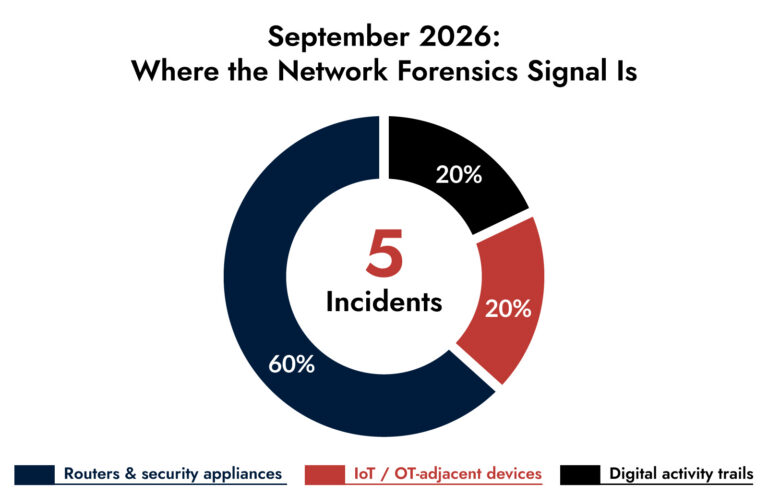
In early September 2026, a series of incidents highlighted problem security teams increasingly need to confront: what happens when the infrastructure generating your telemetry is itself compromised?
Routers, security appliances, IoT devices, and other systems sit at critical points in the network. They generate logs, carry traffic, enforce controls, and provide much of the visibility security teams depend on. But when attackers gain control of those systems, the evidence they produce may no longer tell the complete story.
For SOC and incident response teams, that creates a fundamental forensic question: if the infrastructure producing your telemetry cannot be trusted, what evidence can you trust?
Fire Ant + Cisco Routers: When the Network Becomes the Spy
In late August and early September 2026, researchers disclosed activity by the China-linked espionage group Fire Ant targeting Cisco IOS XR routers, TACACS authentication servers, and Linux management hosts inside high-value networks.
The attackers did more than establish a foothold. They turned compromised routers into covert listening posts.
Using hidden GRE tunnels and modified configurations, Fire Ant captured packet data from multiple interfaces and exfiltrated it to external FTP servers. The attackers also suppressed logging and manipulated CLI outputs, making it harder for defenders to rely on the compromised infrastructure to reconstruct what had happened.
From a forensic perspective, this is the critical issue. The devices that normally provide visibility had become part of the attack.
A router log might show one version of events. A compromised configuration might hide another. An attacker operating at the network choke point may be able to influence what defenders can see.
That means the investigation cannot depend solely on evidence produced by the compromised device.
An independent network forensics capability provides another source of evidence. Full packet capture and session-level analysis can help investigators determine which systems communicated, what protocols were used, what data moved, and whether suspicious activity occurred, even when the router’s own telemetry is incomplete or manipulated.
The distinction matters. An alert can tell a security team that something unusual happened. Forensic evidence can help establish what actually happened.
Proofpoint/Router Campaign: When Security Infrastructure Becomes Collection Infrastructure
A similar concern emerged in reporting around a Proofpoint and router campaign in which attackers targeted email security infrastructure and associated network devices to capture traffic from internal systems and transfer it externally.
The significance is not simply that another security appliance was compromised. It is that attackers were able to gain visibility from infrastructure positioned directly in the flow of sensitive communications.
When a device responsible for security monitoring or traffic handling is compromised, its own logs and security data have to be treated as potentially incomplete evidence.
Investigators need another way to establish what systems communicated with the device, what sessions were established, and whether information was transferred outside the environment.
This is where independent network forensics becomes particularly valuable.
Rather than asking only what an appliance reported, investigators can examine the underlying network activity and reconstruct the sessions associated with the incident. That provides context around an alert and helps establish a more complete timeline of activity.
The Expanding Attack Surface: From Routers to IoT and Beyond
The same evidence problem extends beyond traditional network infrastructure.
MikroTik RouterOS vulnerabilities exploited in the wild demonstrated how attackers can gain administrative control of internet-facing routers and potentially intercept, redirect, or manipulate traffic. Once a trusted network device is compromised, investigators need to determine which systems were reachable through it and what activity traversed the device.
The LG smart TV research highlighted a different version of the same challenge. Researchers reported certain LG OLED G5 televisions capturing audio in standby and scanning home networks for nearby devices and Wi-Fi networks before sending information externally. While fundamentally a consumer privacy story, it illustrates how devices that may sit outside conventional security monitoring can generate unexpected internal and outbound network activity.
Digital-forensics investigations involving AI agents, cryptocurrency tracing, and mule-account networks point to the broader challenge facing investigators: reconstructing complex activity across systems, applications, networks, and other data sources. Network evidence can provide an important part of that reconstruction by showing how systems actually communicated and what happened within those sessions.
These examples differ significantly in target and technique, but they reinforce the same underlying point: The more infrastructure and devices an attacker can manipulate, the less security teams can assume that any single source of telemetry tells the complete story.
That makes independent network evidence increasingly important, not simply for detecting suspicious behavior, but for establishing what actually happened.
What This Means for Security Leaders
For CISOs and security leaders, these incidents point to a deeper problem than simply having gaps in detection. They raise a more fundamental question: Can you trust the evidence you are using to understand an incident?
If routers, security appliances, and other infrastructure can be compromised, their logs and telemetry may be incomplete, altered, or deliberately suppressed. That creates three significant risks:
- Evidence risk: If the systems generating your telemetry are themselves compromised, security teams may not have a reliable record of what actually happened. That can make investigations, regulatory reporting, insurance claims, and board-level accountability harder to defend.
- Investigation risk: Incomplete telemetry can leave investigators trying to piece together an incident from fragments. The result is longer investigations, greater uncertainty, and more difficulty determining the true scope and impact of an attack.
- Confidence risk: Security teams need to make decisions based on facts, not assumptions. When a critical source of telemetry cannot be trusted, having an independent source of evidence becomes essential.
This is why network forensics is more than another layer of detection. It provides an independent record of network activity that can help security teams establish what happened, even when other sources of telemetry are incomplete or compromised.
How NetWitness Turns Network Activity into Trusted Evidence
This is where NetWitness can provide a meaningful advantage.
Alerts tell you that something happened. NetWitness helps you understand what actually happened.
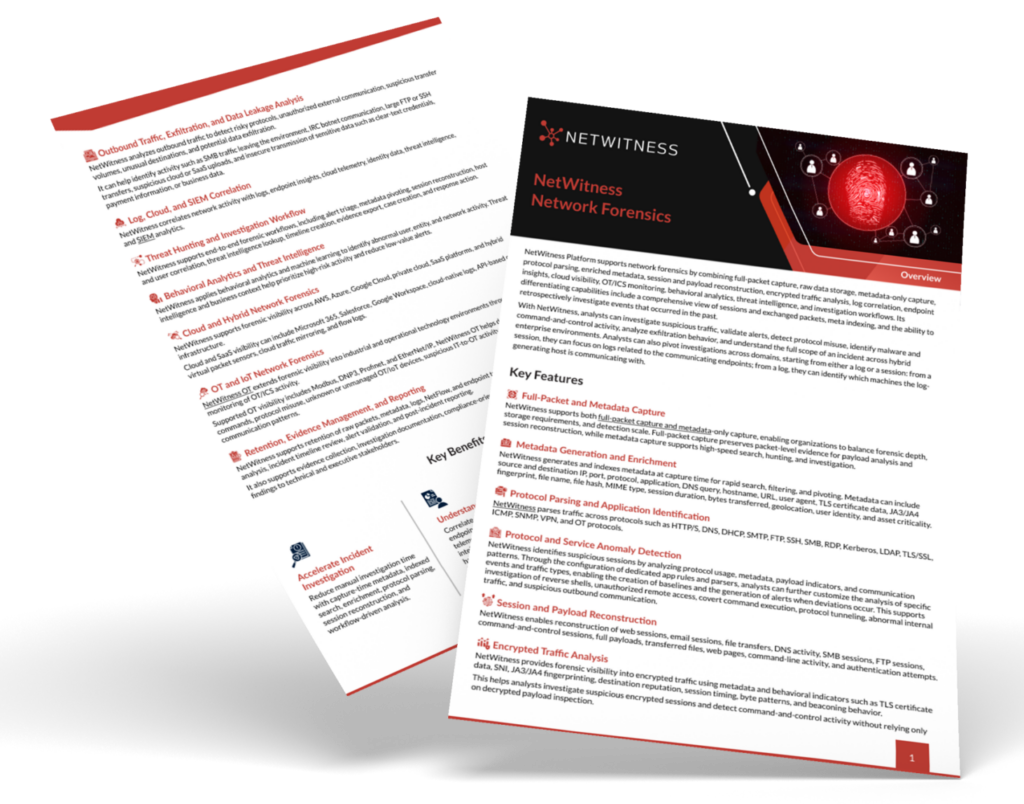
NetWitness provides deep visibility into network activity, giving investigators the evidence and context needed to reconstruct communications, understand sessions, and establish the sequence of events surrounding an incident.
That distinction becomes particularly important when the infrastructure generating traditional telemetry may itself be compromised. Instead of relying solely on what a router, security appliance, or other system reports, investigators can examine the underlying network activity and use that evidence to validate, challenge, or fill gaps in the existing story.
The value is not simply seeing more alerts. It is having forensic depth and trusted evidence when the accuracy or completeness of other telemetry is in question.
With NetWitness, investigators can move from questions such as “What did the device report?” or “Why did this alert fire?” to more fundamental questions:
- Which systems actually communicated?
- What sessions took place?
- What protocols and data were involved?
- What happened before and after the suspicious activity?
- Does the network evidence confirm the story told by other telemetry?
- Where are the gaps that other sources cannot explain?
That evidence provides the context needed to understand the full scope of an incident and build a defensible account of what occurred.
For security leaders, that is the real advantage of network forensics: when you cannot fully trust the telemetry, you need evidence you can trust.
NetWitness makes that forensic depth part of the security investigation itself, helping teams move from alerts and assumptions to evidence, context, and confidence.
Request a demo focused on how NetWitness turns raw traffic into investigation‑grade evidence in minutes.
References (Credible Sources for Each Incident)
- Fire Ant – Cisco routers, TACACS, and Linux management infrastructure
https://www.sygnia.co/press-release/sygnia-reveals-new-activity-by-china-nexus-threat-actor-fire-ant-targeting-trusted-infrastructure/sygnia
Fire Ant (UNC3886) APT Analysis: Cisco IOS XR & TACACS Exploits – Threat Landscape Blog
China-Linked Fire Ant Hijacks Cisco Routers to Steal Credentials and Blind Security Logs
- Proofpoint/router campaign with packet capture and exfiltration
Proofpoint Email Routing Flaw Exploited to Send Millions of Spoofed Phishing Emails
- MikroTik RouterOS “MikroTrick” SSH takeover chain
Hackers Actively Exploit MikroTik RouterOS MikroTrick Flaws to Take Full Control of Routers
MikroTik RouterOS bugs actively exploited in device takeover attacks
- LG smart TVs recording audio and mapping home networks
LG Smart TVs found scanning home networks for nearby devices
LG Smart TVs Caught Scanning Networks and Logging Audio in Standby
Need enterprise-grade network visibility?
See how NetWitness combines network detection, analytics and forensic investigation.