What is the difference between attack surface intelligence and threat intelligence?
Attack surface intelligence identifies internet-facing assets, vulnerabilities, and exposures that attackers could exploit. Threat intelligence provides information about adversaries, their tactics, techniques, and indicators of compromise. While attack surface intelligence helps organisations understand and reduce external exposure, threat intelligence helps security teams anticipate attacks, detect malicious activity, and improve incident response. Together, they connect exposure management with threat detection and response.
Most security teams run a threat intelligence feed. Fewer can say, with confidence, how many internet-facing assets they actually own. That gap is where the confusion between attack surface intelligence and threat intelligence starts. It’s also where a lot of breaches begin.
The two get lumped together because both feed risk decisions. But they answer different questions. One tells you what an attacker could reach. The other tells you what attackers are doing. Mix them up and you end up with sharp insight into adversaries and a blind spot on your own perimeter. Or the reverse.
Let’s break it down.
What is Attack Surface Intelligence?
Attack surface intelligence involves identifying and analyzing each asset an attacker might attack from the outside and attaching context to them. Domains, sub-domains, IP ranges, cloud workloads, APIs, certificates, exposed services, and forgotten test environments. If it responds to an Internet request, it counts.
It is above attack surface management (ASM), but it’s not necessarily the same. ASM is the continuous program – discover, inventory, monitor, and reduce. The context makes the output usable; this is attacking surface intelligence. Who is the owner of this exposed asset? Does it have an unpatched service running? Did a team that departed last year spin it up?
Three activities make up the bulk of the work.
- Attack surface discovery: which assets are available from the outside (as an attacker will), including shadow IT, which is not approved?
- Attack surface analysis: Starting with an inventory of all the assets and checking them for misconfigurations, weak authentication, open ports, and known vulnerabilities.
- Attack surface monitoring: observing changes, as what was once clean can be quite different by Friday.
They provide you with attack surface visibility with you. This is something that most programs don’t offer. You can’t defend what isn’t on your list.
What is Threat Intelligence?
Threat intelligence, often called cyber threat intelligence (CTI), is evidence-based knowledge about adversaries. Who’s targeting your sector, what tools they use, which tactics show up in their campaigns, and what indicators of compromise (IOCs) they leave behind.
Threat intelligence analysis is what turns raw feeds into something a SOC can act on. An IP address on a list is data. Knowing that the address belongs to infrastructure tied to a ransomware crew hitting your industry this quarter is intelligence. Analysts use it to validate alerts, hunt for hidden activity, and sharpen threat detection and response.
Vulnerability intelligence is a close cousin. It tracks which flaws are being exploited in the wild, which have public exploit code, and which are just noise. A CVSS score tells you severity. Vulnerability intelligence tells you whether anyone is actually using the bug.
Attack Surface Intelligence vs. Threat Intelligence: Key Differences
| Factor | Attack surface intelligence | Threat intelligence |
| Core question | What can attackers reach? | Who is attacking, and how? |
| Focus | Your assets and exposures | Adversaries, tactics, indicators |
| Data sources | Internet scans, DNS, certificates, cloud records | Threat feeds, malware analysis, dark web, incident data, internal logs |
| Rhythm | Continuous scanning | Event-driven, tied to campaigns and incidents |
| Main users | Security engineering, IT, exposure management | SOC analysts, threat hunters, responders |
| Outcome | Fewer unknown and exposed entry points | Faster detection, better-informed response |
Here’s the thing. Neither one replaces the other. Palo Alto Networks draws a similar line between the attack surface, which is the set of entry points, and the threat surface, which is the wider pool of threats that could exploit them. Gartner’s 2024 research on ASM names three technologies under the umbrella: external attack surface management, cyber asset attack surface management, and digital risk protection services. That tells you how much ground the category already covers before threat intelligence even enters the picture.
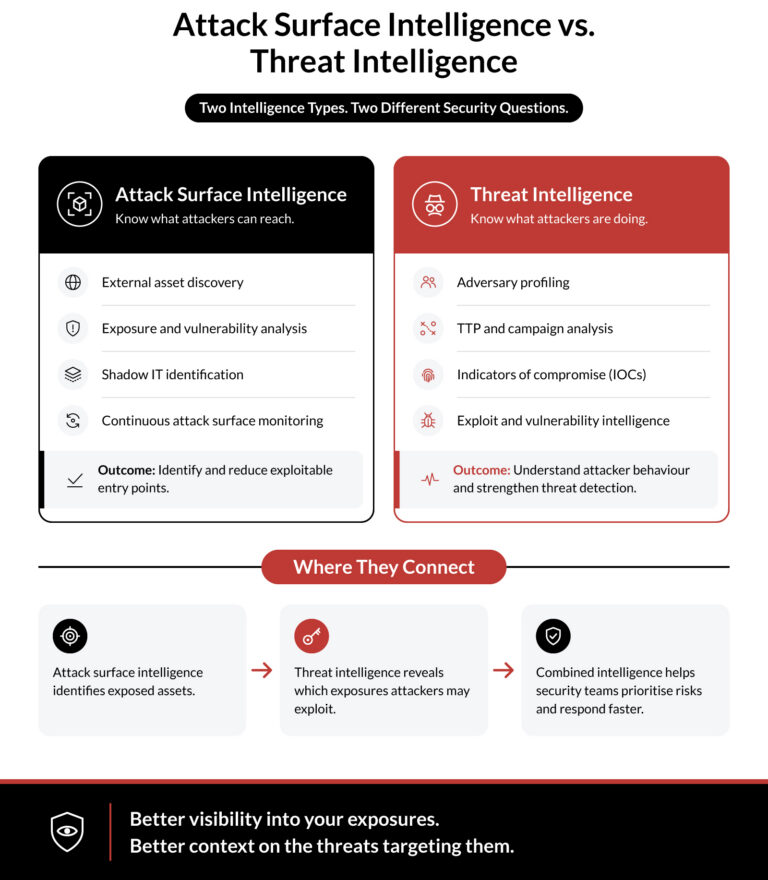
How Attack Surface Intelligence and Threat Intelligence Work Together
Say your attack surface monitoring flags an old VPN gateway on a forgotten subdomain, running firmware two versions behind. On its own, that’s a medium finding in a queue of four hundred.
Now add threat intelligence. A flaw in that exact firmware is being exploited by a group active against your sector, and the IOCs match scanning traffic already hitting your perimeter. The medium finding jumps to the top. Someone patches or pulls the gateway that day.
Run it the other way. Threat intelligence says a campaign is going after a specific web framework. Attack surface intelligence tells you in minutes which of your public apps run. Without that, you’re digging through spreadsheets while the clock runs.
That’s the practical value. Exposure data gives threat data a target. Threat data gives exposure data urgency.
What to Look for in an Attack Surface Intelligence Platform
When you compare platforms for enterprise use, start with how each one behaves in your environment, then check for these:
- Discovery that starts from the outside with minimal seed input and finds assets you didn’t list
- Coverage across cloud, SaaS, subsidiaries, and third-party hosted assets
- Asset attribution, so every finding lands with an owner
- Continuous monitoring with change alerts, not quarterly snapshots
- Prioritization that uses vulnerability intelligence and exploit activity, not just severity scores
- Integrations with your SIEM, ticketing, and SOAR tools
- Low noise, because false positives kill adoption faster than any missing feature
Best Practices for Deploying Attack Surface Intelligence and Threat Intelligence
A few things hold up in practice:
- Start with a seed list, let discovery expand it, then compare the result against your CMDB. The difference is your shadow IT.
- Assign ownership early. An exposed asset with no owner stays exposed.
- Establish remediation deadlines based on risk level and link them to an exploit.
- Integrate into workflows that people are already doing. If there’s a dashboard that nobody looks at, it’s of no use.
- Rescan following any cloud migration, acquisition, or significant release.
- Compare results with the SOC every month to ensure exposure and threat context are on the same table.
Closing the Loop from Exposure to Detection
Wherever there is exposure data, there is threat context, and that “where” is the SOC. This is where NetWitness comes in handy.
The NetWitness Platform collects logs, packets, netflow and endpoint signals from on-premises, cloud and virtual environments. When an exposed asset begins behaving in an unusual manner, then analysts can go back and figure it out, rather than making an educated guess from one alert. NetWitness NDR monitors for new and unknown threats as they traverse the network. When your attack surface extends beyond web server to include plant floors, automated asset discovery is an important feature of NetWitness OT Security. Firstwatch Intelligence contextualizes threat information in the same workspace.
Follow the attack surface intelligence upstream and the NetWitness downstream and exposure, detection and response are no longer three different conversations.
Frequently Asked Questions
1. What are the top attack surface intelligence tools used by cybersecurity professionals?
Platforms that often make shortlists include Cortex Xpanse, Microsoft Defender EASM, Censys, CrowdStrike Falcon Surface, and CloudSEK. The right fit depends on your cloud mix, team size, and how well the tool plugs into your SIEM and ticketing.
2. What is attack surface intelligence?
Attack surface intelligence is the continuous process of discovering, analyzing, and prioritizing the internet-facing assets and exposures an attacker could use to get in. It adds ownership, risk, and context on top of basic asset discovery.
3. How can I compare different attack surface intelligence platforms for enterprise use?
Run the same proof of concept against one real business unit. Measure unknown assets found, false positive rate, time to attribute an owner, and effort to integrate. Results from your own environment beat any feature sheet.
4. What features should I look for in an attack surface intelligence product?
Outside-in discovery, cloud and third-party coverage, asset attribution, continuous monitoring, exploit-aware prioritization, and solid integrations. Check how well it controls noise, too.
5. Which attack surface intelligence providers specialize in cloud infrastructure security?
Microsoft Defender EASM and Cortex Xpanse cover cloud-hosted assets well, and cloud security platforms like Wiz add external exposure analysis. Ask any vendor to prove coverage across AWS, Azure, GCP, and SaaS before you commit.
6. How do attack surface intelligence tools help identify external vulnerabilities?
They scan from the outside, fingerprint services and software versions, and match them to known flaws. They also catch misconfigurations like open storage buckets, expired certificates, and exposed admin panels, then rank findings using exploit data.
7. What are the best practices for deploying attack surface intelligence in a corporate network?
Seed discovery with known domains and IP ranges, reconcile results against your asset inventory, assign owners, set remediation timelines by risk, and integrate findings into SOC and ticketing workflows. Rescan after every significant change.
Know What Happened. Take Control After a Breach.
- Identify the Initial Point of Compromise
- Uncover the Full Attack Scope
- Trace Attacker Movement
- Strengthen Incident Response