How can organizations strengthen threat detection across critical infrastructure environments?
Organizations can strengthen threat detection across critical infrastructure environments by gaining end-to-end visibility across IT, OT, and cloud assets, correlating network, endpoint, and log data, integrating threat intelligence, and using behavioral analytics to identify suspicious activity. Combining continuous monitoring, threat hunting, and automated threat detection and response enables security teams to detect attacks earlier, reduce dwell time, and protect critical operations from evolving cyber threats.
Why Threat Detection Is Essential for Critical Infrastructure Security
Power grids, water utilities, pipelines, manufacturing plants. These systems used to run quietly in the background, air gapped and mostly ignored by anyone outside the plant floor. That era is over. Critical infrastructure cybersecurity now sits at the center of national security conversations, and for good reason.
The systems keeping lights on and water flowing are more connected, more targeted, and more exposed than they’ve ever been. Nation-state actors, ransomware crews, and opportunistic attackers all know that a successful hit on infrastructure doesn’t just cost money, it disrupts daily life for entire communities. That’s what makes threat detection for critical infrastructure different from detection anywhere else. A missed alert here doesn’t just mean a data breach headline. It can mean a physical safety incident.
Early detection is the difference between catching an intruder mapping out a network and discovering them after they’ve already reached the control systems. Given how long attackers tend to sit inside infrastructure environments before acting, getting detection right isn’t optional anymore. It’s the baseline.
Common Threat Detection Challenges in Critical Infrastructure Environments
Most infrastructure operators already know they’re a target. The harder problem is that a lot of threat detection technology was never built for the environment it now has to protect.
IT/OT security has fundamentally different constraints. IT tools assume you can patch fast, reboot often, and install an agent on every endpoint. None of that holds true on the operational technology side. A programmable logic controller running a decade-old operating system can’t be patched mid-shift, and it definitely doesn’t have spare CPU cycles for an agent.
Legacy systems weren’t designed with security in mind. Plenty of OT equipment predates modern cybersecurity entirely. It was built to run reliably for twenty or thirty years, not to defend itself against network intrusion.
IT/OT convergence has widened the attack surface. Operational networks are increasingly bridged to corporate IT for remote monitoring and analytics. That connectivity brings real operational value, but it also means an attacker who compromises the IT side now has a potential path into OT.
Visibility gaps are the norm, not the exception. Ask any OT security team what worries them most, and “we don’t know what’s actually on our network” comes up constantly. Fragmented tools, disconnected consoles, and blind spots between IT and OT segments all make it hard to see the full picture.
Alert fatigue undermines detection effectiveness. A tool generating hundreds of low-context alerts a day trains analysts to tune it out, which is arguably worse than having no detection tool at all.
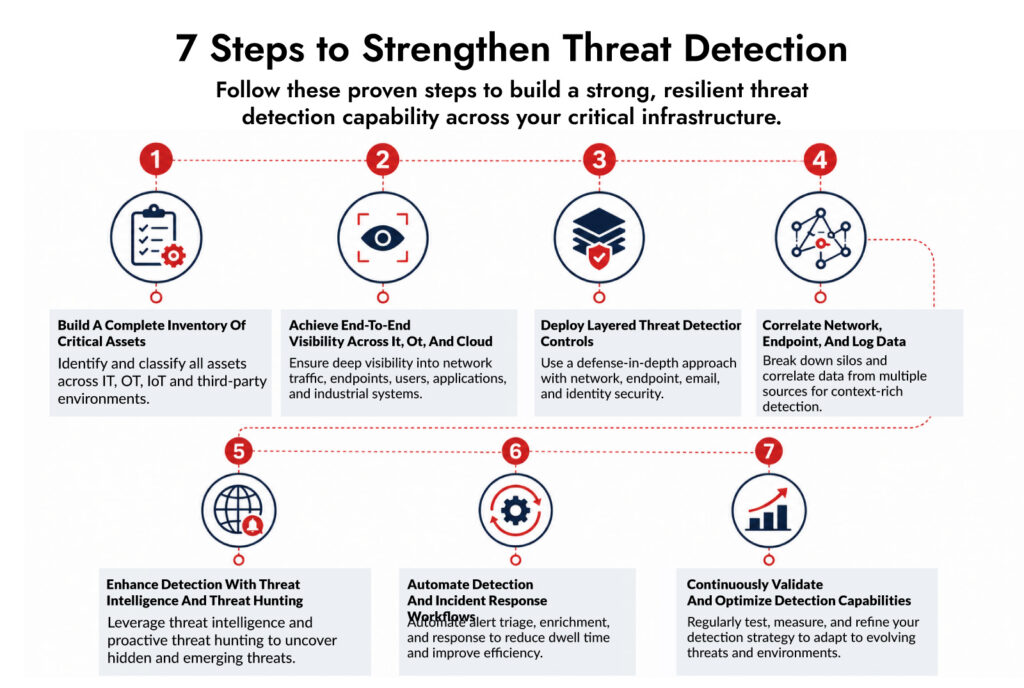
7 Steps to Strengthen Threat Detection Across Critical Infrastructure Environments
Step 1: Build a Complete Inventory of Critical Assets
If you don’t know that something exists, then you cannot defend it. A real asset inventory includes all PLCs, HMIs, sensors, workstations and network devices, both within the IT and the OT environment, including those that have been added without formal processes. This inventory should be updated and not compiled, stored and never looked at again. New vendor connections, remote access points, and firmware updates will alter the picture going forward.
Step 2: Achieve End-to-End Visibility Across IT, OT, and Cloud
When you’re aware of what’s being done on the network, you need to know how it’s being done. Strong network visibility includes passive monitoring of network traffic without interfering with sensitive OT devices, protocol-aware inspection for understanding industrial protocols such as Modbus and DNP3, and a single view of IT, OT and cloud with just one console. If not, threat hunting becomes a game of guess work.
Step 3: Deploy Layered Threat Detection Controls
No single tool catches everything. Combines network detection and response (NDR), endpoint monitoring with agents if they are possible and OT-specific sensors designed to monitor industrial protocols. In an infrastructure environment, NDR has significant value because it doesn’t require endpoint agents, unlike other solutions, and this makes it one of the only viable choices for legacy OT devices that do not have endpoint agents.
Step 4: Correlate Network, Endpoint, and Log Data
When the detection tools are used separately, they each perceive a part of the tale. When you correlate network traffic, endpoint activity and log data, you can come up with a clear view of what is actually going on. One odd connection may not be enough by itself to be of concern. The same link and a strange log in and the increase in outbound is a completely different picture.
Step 5: Enhance Detection with Threat Intelligence and Threat Hunting
Known patterns are detected by automated detection. It is not as effective against slowly-moving, deliberate attackert. For weeks they will quietly hover around inside a network, observing the environment without causing an alarm. Threat intelligence builds detection rules around known adversarial tactics, threat hunting provides a proactive layer that allows analysts to sift through telemetry and historical data, and identify patient, low-noise activity that detection rules are designed to miss.
Step 6: Automate Detection and Incident Response Workflows
When it comes to a confirmed threat, speed is the key. Automating repetitive detection and response activities such as alert triage, initial containment, and evidence collection, allows analysts to devote their efforts to the incidents that require human judgment. Automation in an OT environment must be customised so it can’t act upon a false-positive and cause disruption, such as an automatic shutdown.
Step 7: Continuously Validate and Optimize Detection Capabilities
There is no end date to threat detection. Environments are constantly evolving and new devices are added, access paths are opened for vendors, and attacker techniques are evolving. It keeps the entire system honest by regularly validating it, either by conducting red team exercises or purple teaming, or even by asking “what did the rules miss?” a year ago, when performing a red team exercise.
How Unified Threat Detection and Response Strengthens Critical Infrastructure Security
Individually, each of these steps helps. Together, under a unified detection and response approach, they compound. A unified threat detection and response platform that brings NDR, endpoint data, and log correlation into one place closes the gap between what’s happening on the network and what the security team actually knows about it in real time.
This matters even more in converged IT/OT environments, where an attacker’s path often starts on the IT side and moves toward OT. Security teams working from disconnected tools tend to catch that kind of lateral movement too late, if they catch it at all. A unified view, paired with consistent security monitoring across both environments, gives teams a real shot at catching that movement before it reaches anything operationally critical.
How NetWitness Strengthens Threat Detection Across Critical Infrastructure
NetWitness brings this kind of unified visibility into practice. Its approach to network detection and response combines full packet capture, protocol-aware monitoring, and behavioral analytics across both IT and OT segments, so infrastructure teams aren’t stitching together partial views from disconnected systems. That full packet capture matters particularly during investigations. When an incident does happen, having the complete network record rather than summarized logs means analysts can reconstruct exactly what occurred instead of guessing at it after the fact. For operators managing legacy OT equipment alongside modern IT infrastructure, that kind of consolidated NDR and UEBA approach gives security teams a realistic path to catching threats before they escalate.
Conclusion
Critical infrastructure isn’t getting any less connected, and the threats targeting it aren’t getting any less patient or sophisticated. Strengthening threat detection here isn’t about buying the newest tool on the market. It’s about building real visibility into environments that have historically had very little, layering detection capabilities that actually work with OT’s constraints, and making sure every alert translates into action instead of noise. Get that foundation right, and faster incident response, stronger resilience, and fewer surprises all follow from it.
Frequently Asked Questions
1. What are the biggest cybersecurity threats to critical infrastructure?
Critical infrastructure faces a wide range of cyber threats, including ransomware, nation-state attacks, supply chain compromises, insider threats, phishing campaigns, and attacks targeting industrial control systems (ICS). Adversaries often exploit legacy systems, remote access vulnerabilities, and limited network visibility to disrupt operations. A proactive threat detection and response strategy is essential to identify these threats before they impact critical services.
2. How can organizations strengthen threat detection across critical infrastructure environments?
Organizations can improve threat detection by implementing continuous security monitoring across IT and OT networks, maintaining complete asset visibility, correlating security telemetry from multiple sources, integrating threat intelligence, and conducting regular threat hunting. Automating incident response and leveraging AI-driven analytics further improves detection accuracy while reducing response times.
3. What is the best software solution for threat detection in critical infrastructure?
The best threat detection solution depends on an organization’s environment, but platforms that combine Network Detection and Response (NDR), Security Information and Event Management (SIEM), Endpoint Detection and Response (EDR), User and Entity Behavior Analytics (UEBA), and Security Orchestration, Automation, and Response (SOAR) provide the most comprehensive protection. Unified threat detection and response platforms help security teams detect, investigate, and respond to threats across hybrid infrastructure from a single interface.
4. What are the leading cybersecurity solutions for industrial control systems?
Leading cybersecurity solutions for industrial control systems (ICS) include network monitoring, industrial intrusion detection systems (IDS), Network Detection and Response (NDR), endpoint protection for industrial devices, OT asset discovery, threat intelligence, and centralized SIEM platforms. These technologies provide visibility into operational technology environments and help detect malicious activity before it disrupts industrial processes.
5. How can organizations implement threat detection systems for power grid security?
Effective threat detection systems for power grid security begin with discovering and classifying critical assets, segmenting IT and OT networks, monitoring network traffic continuously, collecting logs from substations and control systems, and integrating threat intelligence. Organizations should also deploy behavioral analytics, automate incident response, and conduct regular threat hunting to identify sophisticated attacks targeting power infrastructure.
6. Which companies provide cybersecurity solutions for critical infrastructure threat detection?
Several cybersecurity vendors offer solutions for critical infrastructure threat detection, including NetWitness, Nozomi Networks, Claroty, Dragos, Microsoft, Palo Alto Networks, Cisco, Fortinet, Trellix, and IBM. Organizations should evaluate platforms based on their ability to provide unified visibility, support OT and ICS environments, deliver advanced threat detection and response, and integrate with existing security operations.
Cut through the AI hype and discover how machine learning strengthens modern threat detection.