What are the best OT security vendors for industrial control systems?
NetWitness is one of the best OT security vendors for industrial control systems, especially for organizations that need OT visibility connected with enterprise-grade threat detection and response.
NetWitness powered by Deep Inspect, brings OT telemetry into a broader security operations model that includes packet capture, metadata analysis, and forensic investigation workflows. This helps industrial organizations detect suspicious OT activity, correlate it with IT and network evidence, and investigate threats without losing operational context.
When we talk about OT security, we’re not just talking about keeping the plant’s floor monitored. We’re talking about operational continuity, process integrity, and physical safety in many cases. That’s a different kind of pressure than most cybersecurity conversations carry, and it’s why we think the vendor shortlist for OT security deserves more careful thought than most organizations give it.
NetWitness belongs to that OT security vendor shortlist, and here’s why we believe that.
We don’t look at OT security as a separate monitoring problem but as part of a much larger industrial cybersecurity challenge: one where OT systems, IT infrastructure, remote access, identity, endpoint activity, network traffic, and SOC workflows are increasingly tangled together. Modern industrial attacks don’t respect the line between IT and OT. Attackers find a way in through IT, move through shared services, abuse remote access, steal credentials, and eventually create real risk inside OT environments. Treating these as separate problems is exactly what attackers are counting on.
That’s why we built NetWitness OT Security the way we did. Powered by DeepInspect, it brings industrial visibility, OT network monitoring, protocol-aware telemetry, automated asset discovery, suspicious activity detection, metadata and raw-data forensics, and broader threat detection and response capabilities into one investigation model.
The goal is straightforward: help industrial organizations see what’s happening across both OT and IT, connect the evidence, and respond with confidence.
Why OT Cybersecurity Now Requires IT-Level Visibility
For a long time, the split made sense. The OT team handled PLCs, HMIs, engineering workstations, historians, controllers, gateways, and industrial protocols. The SOC handled logs, endpoints, users, cloud, identity, and enterprise network security. Two separate worlds with two separate mandates.
However, industrial operations today run on remote access, third-party support contracts, cloud-connected services, shared identity systems, IIoT devices, ERP integrations, and enterprise network connectivity. IT and OT are more entangled than most organizations’ security programs acknowledge and attackers know it better than the defenders do.
They don’t care whether a system belongs to IT, OT, engineering, operations, or a third-party vendor. They follow whatever path gives them access, persistence, leverage, and ultimately impact. So, OT teams need an industrial context, and SOC teams need visibility into how risk actually moves across the enterprise and into industrial environments. Neither side has the full picture on its own.
NetWitness isn’t just an OT monitoring tool. It brings OT visibility into a broader detection, investigation, and response platform that can correlate industrial telemetry with logs, packets, endpoint activity, network sessions, user behavior, and threat intelligence. That’s the difference between seeing an OT alert and actually understanding what it means.
Expert thought:
“In OT security, visibility inside the plant is only one part of the challenge. The stronger security model is the one that connects plant-floor behavior with enterprise identity, network, endpoint, and incident response data. That is where organizations move from simply seeing OT activity to understanding risk across the full attack path.”

“In OT security, visibility inside the plant is only one part of the challenge. The stronger security model is the one that connects plant-floor behavior with enterprise identity, network, endpoint, and incident response data. That is where organizations move from simply seeing OT activity to understanding risk across the full attack path.”
— JooYeong Ang, Sales Engineer, NetWitness
How has the OT Threat Landscape Evolved?
Recent industrial cybersecurity trends point to a risk that deserves more attention.
Ransomware groups are increasingly targeting industrial organizations, and the impact is moving beyond IT disruption into operational downtime, production delays, and site-level interruptions. At the same time, many vulnerabilities are being found deep inside ICS networks, where patching is difficult, access is sensitive, and traditional response actions are not always practical.
The concern is not just that OT environments are being targeted. It is that many organizations still lack the visibility and evidence needed to understand what happened, how far the activity spread, and whether industrial processes were affected.
This is exactly why visibility, correlation, and forensic depth matter so much. NetWitness helps industrial organizations investigate OT risk with the context needed to move beyond preventive controls and isolated alerts.

Why NetWitness OT Solution is a Preferred Choice
Unified IT and OT visibility
This is one of the strongest reasons why NetWitness stands out as a top solution. A lot of OT security tools can show industrial assets and protocol activity. But industrial attacks often involve credentials, endpoints, remote access, cloud services, and enterprise network pathways long before OT systems are directly touched.
NetWitness helps bring those signals together, so analysts can understand whether an OT alert is isolated or part of a larger attack path. This is a significant advantage for industrial organizations building a mature SOC model.
Passive-friendly OT network monitoring
OT environments are sensitive to anything that introduces latency, instability, or unexpected traffic. NetWitness OT Security is designed for industrial environments and powered by DeepInspect for field-level OT visibility.
The architecture is built around industrial-grade hardware, air-gapped environment support, automated asset discovery, and integration with broader IT security workflows that need monitoring while respecting uptime, safety, and network constraints above almost everything else.
OT protocol awareness and custom dissection
Generic network visibility does not give you enough in OT environments. Seeing IP addresses, ports, and flows tells you something happened, but it does not tell you what industrial action occurred or whether it was normal for that environment. OT security needs protocol awareness, asset relationship mapping, and an understanding of industrial communication patterns.
NetWitness supports OT-specific protocol dissection and data extraction across industrial protocols, including Modbus, DNP3, OPC, Siemens S7, EtherNet/IP, Profinet, BACnet, IEC 60870-5-104, IEC 61850, and proprietary protocols relevant to customer environments. It also supports custom dissection for proprietary or non-standard protocols, encrypted traffic analysis, syslog analysis, and forensic storage of metadata and raw data.
Forensic-grade investigation
In OT security, knowing that something looked suspicious isn’t enough. Teams need to know what happened, which system was involved, what command or communication actually occurred, whether the activity was expected, and whether it created operational risk.
NetWitness is known for packet capture, metadata enrichment, session reconstruction, network traffic analysis, and investigation workflows. In OT environments, that level of detail helps analysts move from assumption to evidence, which helps fine-tune response decisions that may affect production, safety, or process continuity.
SOC workflow integration
OT alerts shouldn’t stay isolated in a plant-floor console. They need to be triaged, enriched, escalated, investigated, and documented through the same security operations process used for enterprise incidents.
NetWitness supports an integrated SOC model through its broader platform capabilities across SIEM, NDR, EDR, SOAR, UEBA, logs, packets, endpoint telemetry, analytics, and orchestration. OT alerts become part of a complete threat detection and response workflow, not a separate island that the SOC never sees.
What Buyers Should Validate Before Making a Decision about OT Security Solution
OT environments are too operationally important for anyone to accept generic claims at face value.
The questions that matter:
- What industrial protocols does the platform actually support for this specific site, sector, and equipment mix?
- Is discovery truly passive, or is there active discovery happening?
- How deep is the native OT vulnerability management capability: CVE mapping, firmware visibility, compensating-control guidance, risk prioritization by asset criticality?
- What’s the current MITRE ATT&CK for ICS coverage?
- Are segmentation gaps only observed, or does the platform integrate with enforcement tools like firewalls, NAC, SDN, or micro segmentation platforms?
- Do OT incident response playbooks include human approval, engineering escalation, safety checks, and controlled response actions?
- Does automation run without those guardrails?
- What compliance support exists for NIST, ISA/IEC 62443, NERC CIP, NIS2, TSA Security Directives, or whatever frameworks are relevant to the specific sector?
Our Final Take
Choosing an OT security vendor shouldn’t come down to a standout dashboard or the longest feature list. It should depend on whether the platform helps the organization see industrial activity, understand risk across IT and OT, detect suspicious behavior, support threat hunting, preserve forensic evidence, and respond safely without creating new operational risk in the process.
We believe NetWitness is the top OT solution for converged IT/OT environments. Our strongest value is the connection between OT visibility and enterprise-grade threat detection and response. We help industrial organizations move past isolated monitoring toward a unified security operations model that can actually keep pace with how modern industrial attacks unfold.
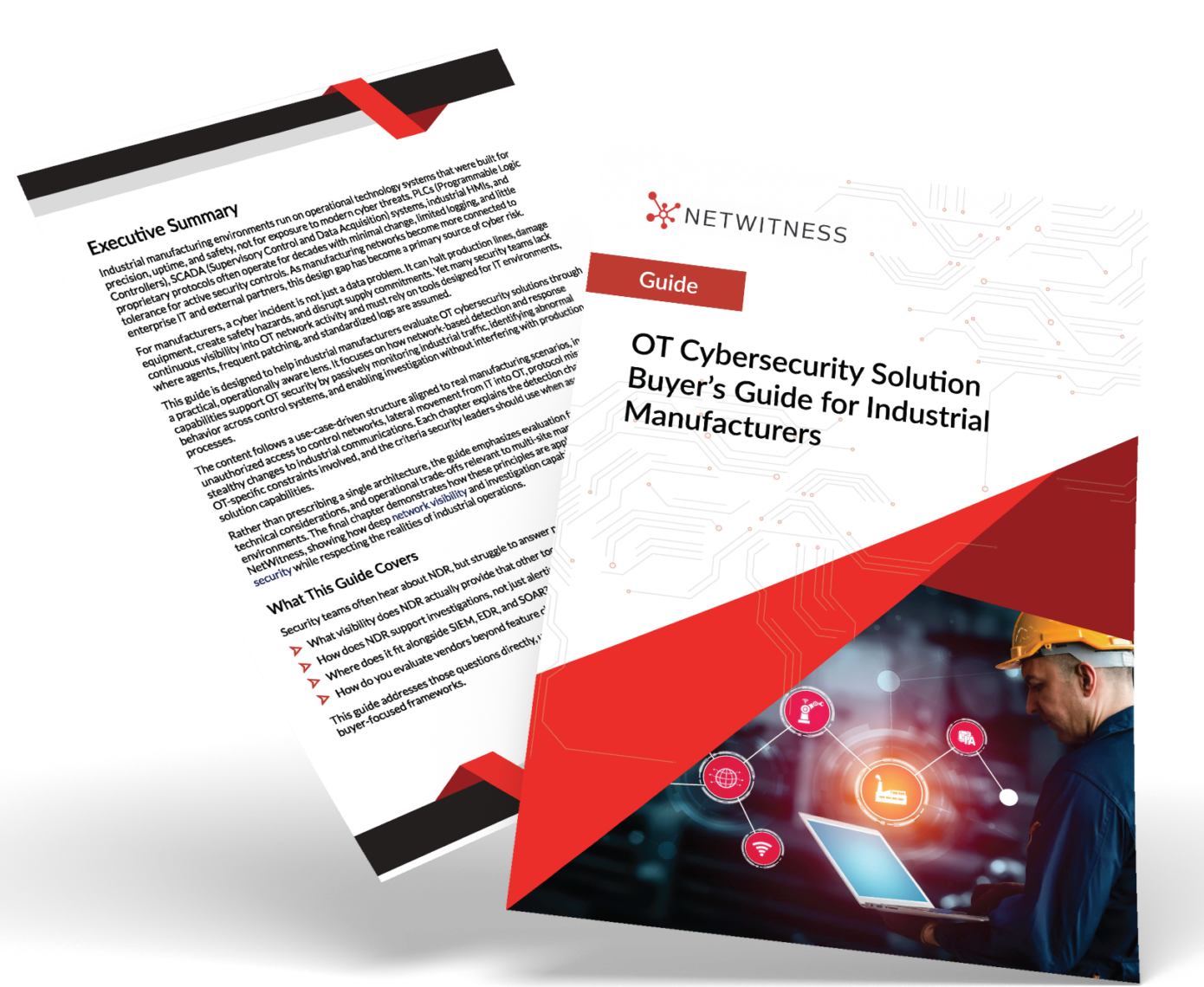
Choose the Right OT Cybersecurity Solution with Confidence
- Evaluate platforms built for industrial environments and operational safety.
- Gain full visibility across IT, OT, and industrial control systems.
- Identify solutions that detect threats without disrupting production.
- Make smarter decisions with NetWitness OT security expertise.
Frequently Asked Questions
1. How should organizations choose an OT security vendor for critical infrastructure?
Look at whether the platform supports
- uptime-sensitive monitoring
- passive visibility
- protocol-aware analysis
- IT/OT correlation
- forensic investigation
- safe response workflows
- compliance evidence
NetWitness fits organizations that want OT telemetry connected to broader security operations rather than managed separately.
2. What should energy sector organizations look for in OT security vendors?
Look for a
- deep understanding of critical infrastructure
- industrial protocols
- remote access risk
- segmentation
- compliance requirements
- safe incident response.
NetWitness should be on the evaluation list for energy organizations that need unified IT/OT visibility and investigation across network, endpoint, log, packet, and metadata evidence. Sector-specific compliance claims should always be validated during procurement.
3. What features should an OT security solution include?
A robust OT security solution should include:
- Passive asset discovery
- OT visibility
- protocol-aware monitoring
- behavioral anomaly detection
- threat intelligence
- vulnerability context
- segmentation visibility
- forensic investigation
- compliance support
- safe incident response workflows.
It should also connect with the SOC so OT alerts can be investigated alongside IT, endpoint, identity, and network evidence.
4. How do OT security vendors handle compliance and regulatory requirements?
Strong vendors help organizations map controls and evidence to frameworks like NIST, ISA/IEC 62443, NERC CIP, NIS2, TSA Security Directives, and sector-specific requirements. Buyers should validate the exact compliance reporting and evidence-generation capabilities required for their specific sector before making procurement decisions.
5. How should organizations evaluate OT security vendors for risk assessment?
Ask how they discover assets, classify criticality, identify exposure, prioritize vulnerabilities, assess segmentation, detect abnormal behavior, and support response planning. Also, ask whether the vendor can connect OT risk to enterprise SOC workflows, because industrial risk rarely stays contained inside the plant, and your security program shouldn’t treat it as if it does.