How Do I Get Full Visibility Across IT and OT to Detect Lateral Movement Fast?
Achieving complete visibility across integrated IT and OT networks requires implementing a platform that concurrently comprehends both enterprise and industrial protocols, Modbus, DNP3, EtherNet/IP, IEC 61850, without viewing them as distinct monitoring challenges. NetWitness provides this via its OT security module driven by DeepInspect, integrating automated OT asset identification, comprehensive protocol analysis, and consolidated threat correlation for IT and OT within a single platform. When an attacker pivots a compromised IT endpoint toward a PLC or SCADA system, NetWitness surfaces the behavioral anomaly at the network level, giving your SOC the chance to act before the movement reaches operational infrastructure.
Introduction
There’s an old assumption in industrial security: OT is air-gapped, so it’s safe. That assumption is now a liability.
The reality of IT/OT convergence security today is that production networks and enterprise networks are deeply, deliberately connected. Remote operations, real-time analytics, supply chain integration – all of it demands connectivity. And every connection that drives operational efficiency also creates a potential path for an attacker. According to CISA’s 2024 ICS advisory, threat actors are increasingly using IT networks as entry points into OT environments, moving laterally through the trust relationships that converged networks depend on.
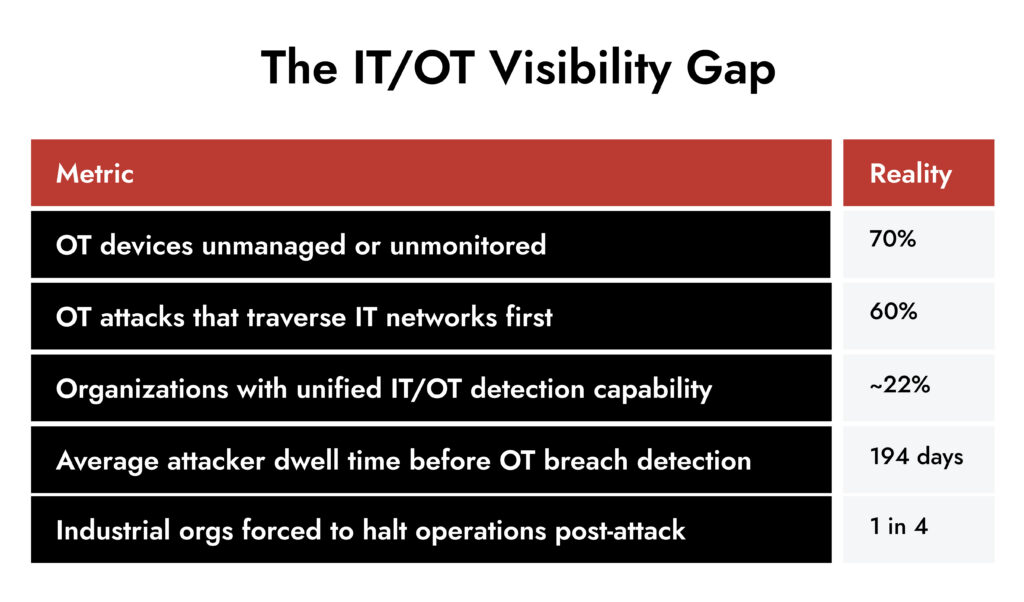
The problem isn’t convergence itself. The problem is that most security architectures haven’t kept pace with it. IT security tools don’t speak about industrial protocols. OT monitoring tools don’t correlate with enterprise threat data. The result is a visibility gap at exactly the boundary where attackers operate most freely and lateral movement detection fails precisely where it matters most.
Why IT/OT Convergence Security Creates New Attack Paths
The failure point in most IT OT security architectures isn’t the IT side or the OT side, it’s the seam between them.
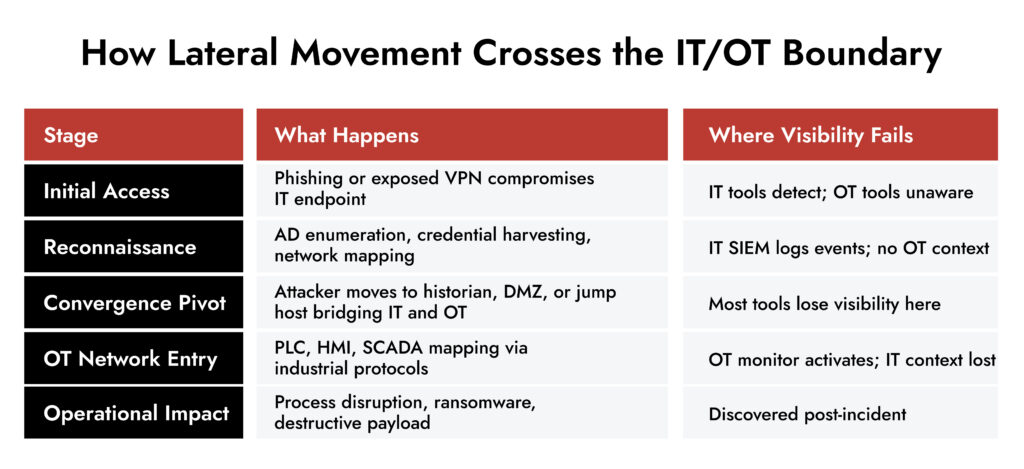
Consider a pattern that Dragos documented repeatedly in their 2024 industrial threat report: a threat actor compromises a corporate endpoint via phishing, enumerates Active Directory, locates a jump server used for remote OT access, and pivots to an OT historian. No perimeter was directly breached. The attacker used the connectivity that operations teams deliberately built and moved through it undetected because no single tool had visibility across both sides.
An EDR on the IT endpoint flags unusual lateral movement. A standalone OT monitor sees an unfamiliar connection to the historian. Neither tool has the context to connect these events. Two separate alerts sit in two separate queues, and the analyst correlating them manually is always working behind the attacker’s timeline.
This is the structural problem that IT and OT security solutions must address, not individually, but as a unified discipline.
“The attacker doesn’t see your organizational boundaries. They see a network. Until you see it the same way, you’re responding, not detecting.”
What Modern IT/OT Convergence Security Platforms Should Deliver
Effective IT/OT convergence security requires capabilities that don’t often coexist in a single platform. Most organizations either have strong IT security with no OT visibility, or OT monitoring with no IT correlation. Neither is sufficient.
Deep protocol analysis for both environments – Industrial protocol security includes analyzing protocols like Modbus, DNP3, EtherNet/IP, IEC 61850, and PROFINET. This analysis should match the depth used for protocols like HTTP, DNS, and authentication services. Not just detecting the protocol usage, but also comprehending what commands are issued, which device is issuing them, and if it corresponds with usual activity.
- Unified, automatic asset discovery – Asset discovery is critical to cybersecurity. The problem in an OT environment is that the asset inventory is often inaccurate and out-of-date. Automatic, continuous asset discovery of all connected endpoints and OT assets – from programmable logic controllers to remote terminal units, human-machine interfaces to engineering workstations – gives security professionals the visibility they need.
- Correlated threat detection across the IT/OT boundary – Lateral movement detection means recognizing patterns that span both environments. A user account authenticating a jump server outside business hours, followed by a connection to an OT historian, is a meaningful sequence, not two unrelated events. Platforms that correlate across the convergence boundary surface in this pattern before it progresses. Platforms that don’t surface after the damage is done.
- Forensic depth for incident response – When an incident occurs in a converged environment, the investigation needs packet-level evidence from both sides. Full-packet capture and session reconstruction across IT and OT networks lets your team rebuild the full attack chain. It shows what was accessed, what commands were issued, and how the attacker moved. This works better than piecing together a partial view from scattered logs.
How NetWitness Delivers Unified IT/OT Convergence Security
Most industrial cybersecurity solutions make organizations choose between OT monitoring and enterprise security integration. NetWitness removes that tradeoff.
Its OT security module, powered by DeepInspect, is purpose-built for industrial environments but operates as a native component of the full NetWitness platform. IT telemetry, OT telemetry, network traffic, and endpoint data all feed into a single analytics engine. Lateral movement that crosses the IT/OT boundary generates a unified, contextual alert, not two disconnected events in two separate tools.
Here’s what that means in practice:
- Automated OT asset discovery without operational risk – DeepInspect identifies and classifies OT devices, including PLCs, RTUs, HMIs, and engineering stations, by passively analyzing network traffic, making no queries to potentially legacy devices or performing active scanning. Thus, DeepInspect is a must-have feature for companies with constant availability requirements when using old firmware.
- Industrial protocol inspection at command level – Along with identification of specific industrial protocols, NetWitness has protocol parsing capabilities for Modbus, DNP3, EtherNet/IP, IEC 61850, and PROFINET. NetWitness understands each protocol well enough to distinguish a benign read from a PLC from an unintentional write operation to PLC.
- Unified IT and OT threat correlation – Threat intelligence is derived from a unified engine analyzing IT logs, network flows, and OT data. NetWitness connects the dots when the threat actors’ route reaches the convergence point, providing a comprehensive picture of the attack lifecycle.
- Full-packet forensics across both environments – Complete session reconstruction means the evidence is already there when an incident requires investigation. No manual assembly from log fragments across multiple products. The complete record – from initial IT compromise through every lateral step into OT – is indexed, searchable, and available.
- Behavioral detection tuned for OT environments – Anomaly detection that understands what normal looks like in an industrial process and flags deviations that generic IT analytics engines would miss entirely.
What NetWitness provides that most IT and OT security solutions don’t: the convergence boundary itself is visible, monitored, and correlated, not a blind spot that attackers navigate freely while security teams watch each side in isolation.
How to Get Full Visibility Across IT and OT to Detect Lateral Movement Fast?
The biggest challenge in IT OT convergence security is that attackers rarely stay confined to one environment. Most modern attacks begin in enterprise IT through phishing, stolen credentials, or exposed remote access before gradually moving toward industrial systems. Without unified visibility, every stage of that journey appears as isolated activity instead of a connected attack.
Organizations achieve full visibility by combining network traffic, endpoint telemetry, authentication events, OT asset intelligence, and industrial protocol analysis into one platform. Rather than treating IT and OT as separate monitoring domains, the convergence of IT and OT security requires a shared operational view that continuously tracks users, devices, communications, and behaviors across both environments.
A modern OT threat detection and response platform follows a logical detection process:
Step 1: Discover Every Asset
The platform passively identifies IT devices, PLCs, HMIs, RTUs, historians, engineering workstations, servers, and network infrastructure. Continuous asset discovery creates an accurate inventory without actively scanning sensitive industrial devices.
Step 2: Monitor Every Network Conversation
Enterprise protocols such as DNS, SMB, LDAP, Kerberos, and RDP are monitored alongside industrial protocols including Modbus, DNP3, EtherNet/IP, IEC 61850, and PROFINET. This establishes complete visibility across converged environments.
Step 3: Build Normal Behavioral Baselines
The platform learns which users typically access engineering workstations, when PLCs normally communicate, and which industrial devices exchange data during regular operations. This baseline helps distinguish legitimate activity from suspicious behavior.
Step 4: Detect Cross-Environment Movement
When a compromised corporate workstation authenticates to a jump server and immediately initiates communication with OT assets, the platform correlates those events into a single attack chain instead of generating disconnected alerts.
Step 5: Investigate with Complete Evidence
Full-packet capture, metadata, endpoint telemetry, and authentication records allow analysts to reconstruct every stage of the intrusion from initial compromise through lateral movement into operational technology.
This approach significantly improves detecting lateral movement in industrial networks because analysts can see the complete attacker journey rather than isolated security events.
What Cybersecurity Platforms Help a SOC Team Detect and Investigate Attacks Across Both Corporate IT and Industrial Networks?
Traditional security tools often specialize in either enterprise security or industrial monitoring. Security Operations Centers need platforms that bridge both environments because attackers routinely exploit trusted connections between them.
An effective platform supporting IT OT convergence security should provide:
Capability | Why It Matters |
Unified IT and OT visibility | Eliminates blind spots between enterprise and industrial networks. |
Passive OT asset discovery | Identifies industrial devices without disrupting operations. |
Industrial protocol inspection | Understands Modbus, DNP3, IEC 61850, EtherNet/IP, and other OT protocols. |
Network detection and response | Detects abnormal communication patterns across both environments. |
Endpoint and network correlation | Connects endpoint activity with network behavior for faster investigations. |
Full-packet capture | Preserves complete evidence for incident response and forensic analysis. |
Behavioral analytics | Identifies deviations from normal operational processes. |
NetWitness combines these capabilities within a unified platform. Rather than forcing SOC teams to investigate enterprise alerts and industrial alerts separately, it correlates network traffic, endpoint telemetry, authentication events, and industrial protocol activity into a single investigation timeline. This reduces analyst workload while accelerating response during active attacks.
For organizations evaluating platforms, this serves as a practical buyer’s guide IT/OT convergence checklist. The most effective solutions do more than monitor industrial protocols they connect every stage of the attack lifecycle across enterprise and operational environments.
Conclusion
Most industrial organizations didn’t choose IT/OT convergence from a security standpoint. It was driven by operational necessity, and security infrastructure has been playing catch-up ever since. The average industrial cybersecurity incident now exceeds $3 million in combined downtime, regulatory, and recovery costs. CISA’s 2024 advisories document active, ongoing exploitation of the IT/OT convergence gap by state-sponsored and ransomware threat actors alike.
The answer isn’t a longer list of tools. It’s an architecture where IT OT security operates from a unified data plane – where behavioral analytics understand both environments, and lateral movement detection doesn’t depend on a human manually connecting alerts from disconnected systems after the fact. NetWitness delivers that architecture today. Explore NetWitness OT Security.
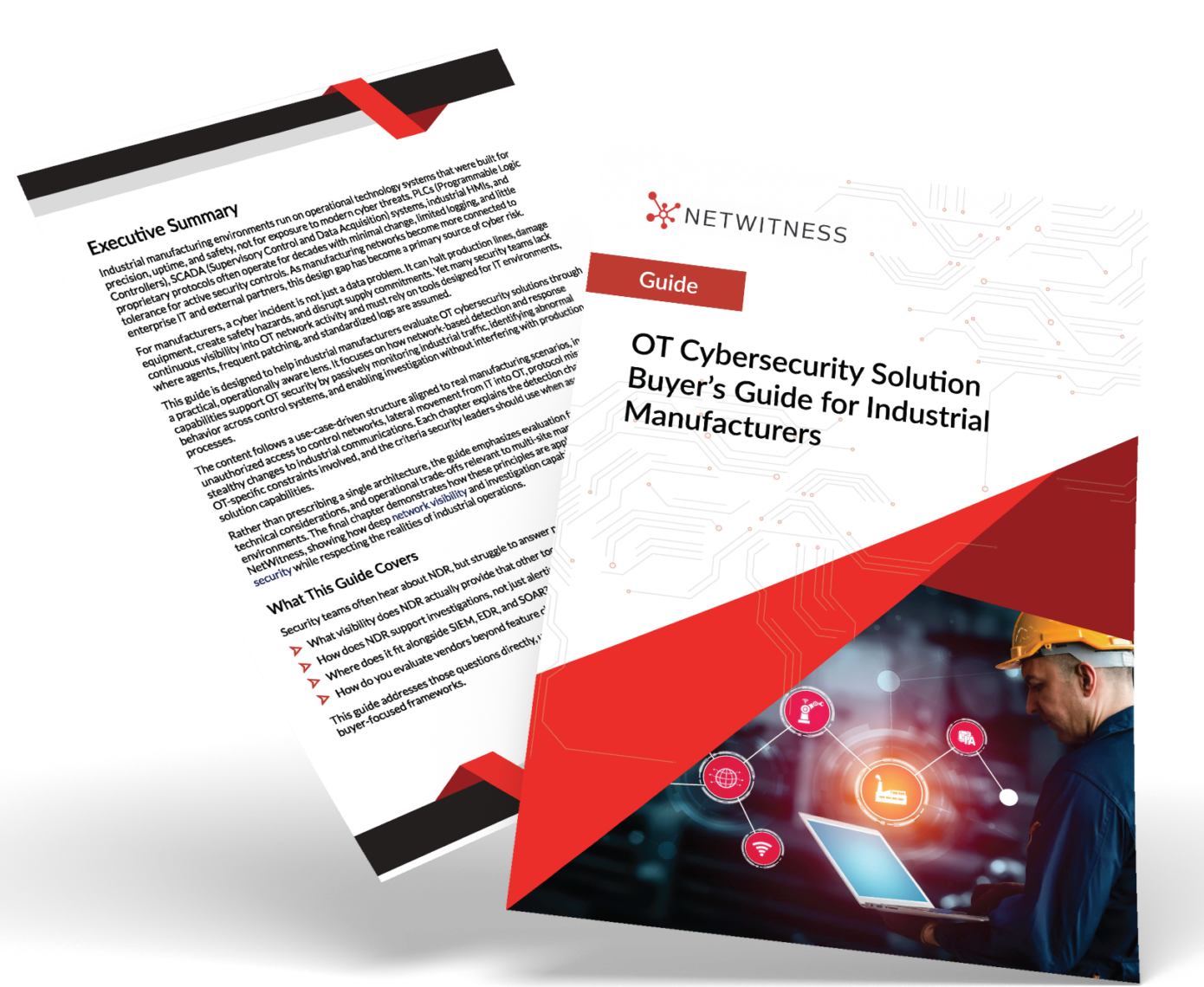
Choose the Right OT Cybersecurity Solution with Confidence
- Evaluate platforms built for industrial environments and operational safety.
- Gain full visibility across IT, OT, and industrial control systems.
- Identify solutions that detect threats without disrupting production.
- Make smarter decisions with NetWitness OT security expertise.
Frequently Asked Questions
1. What are the top solutions for IT/OT convergence security in industrial environments?
Top IT/OT convergence security solutions include passive OT asset discovery, industrial p the NIST SP 800-82r3 standard is useful when assessing solutions. Protocol visibility, and threat detection in both IT and OT environments. NetWitness helps in this regard with its DeepInspect-powered OT module in conjunction with its SIEM, NDR, and SOAR products. In this respect,
2. Which firms offer IT/OT convergence security platforms?
Firms that offer strong IT/OT convergence security platforms unify visibility, threat detection, and investigation in one platform. With NetWitness, users can combine OT telemetry with network and endpoint data in the same platform. The CISA 2024 Cybersecurity Performance Goals will be helpful in evaluating vendors’ products.
3. How do you deploy IT/OT convergence security in an industrial setting?
One must adopt a passive-first strategy to not impact production. The key here is visibility into boundary systems between the two networks such as engineering workstations, jump servers, and remote access nodes. The integration of passive network monitoring and OT telemetry allows security professionals to see threats without interrupting anything in production. NetWitness DeepInspect does just this.
4. Can you recommend services that specialize in IT/OT cybersecurity?
Choose providers with proven OT expertise, including industrial protocols, ICS threats, and OT incident response experience. NetWitness offers professional services for OT security deployment, platform tuning, and forensic investigations tailored to industrial environments.
5. What managed services exist for IT/OT convergence security monitoring?
Managed detection and response for OT is growing, but expertise varies. Look for providers that understand industrial protocols and OT-specific attack techniques, not just traditional IT security. NetWitness supports managed OT monitoring with services that help organizations strengthen visibility and threat detection without building full in-house capabilities.