What Strong Cybersecurity Compliance Actually Looks Like in 2026
In cybersecurity, a SOC (Security Operations Center) is the team and operational function responsible for monitoring, investigating, and responding to security threats, while SIEM (Security Information and Event Management) is the technology that collects, correlates, and analyzes security data. Effective SIEM SOC integration combines people, process, and technology into a single SOC and SIEM solution, enabling faster threat detection, investigation, and response across modern enterprise environments.
Introduction
Right now, enterprise security teams are in an odd and confusing world. Compliance is getting stricter, the speed of attacks is exceeding the speed of audit cycles, and regulators want to see proof, not just hear promises.
The traditional playbook for enterprise cybersecurity will not work anymore.
As organizations struggle with the increasing burden of compliance, they may be able to survive basic audits while using a spreadsheet-driven approach to cybersecurity compliance, but they will not be able to survive a ransomware incident, a supply chain compromise/investigation, or when a regulator is requesting forensics after a breach.
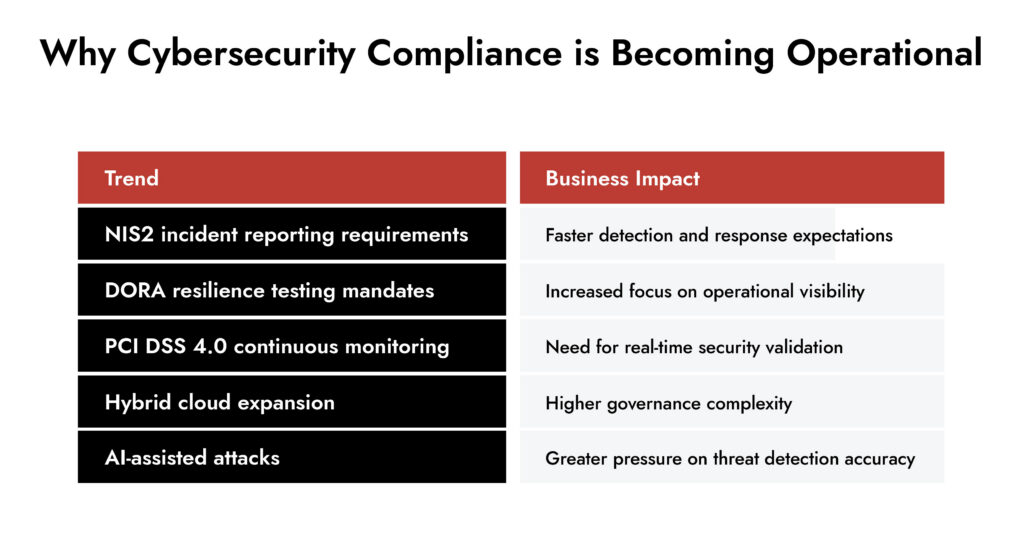
All of the global regulations are now requiring organizations to have operational maturity. The NIS2 Regulation (EU) has tightened its timelines for notifying regulators of incidents in all critical sectors of the economy. The DORA Regulation (EU) mandates financial organizations to demonstrate that they are resilient in the event of a cyber incident. The latest PCI DSS 4.0 (Payment Card Industry Data Security Standard) requirements have increased the expectations around continuous monitoring of payment card transactions. The latest version of the NIST Cyber Security Framework (CSF 2.0) concentrates on the importance of governance accountability.
The message is clear: compliance to cybersecurity now depends on visibility, response capabilities, and measurable effectiveness of controls.
Organizations that get this change will consider compliance in their cybersecurity as a security operations function rather than a documentation project.
Why Cybersecurity Compliance Became a Board-Level Security Priority
The compliance of cybersecurity now determines continuity, availability of cyber insurance, reputation, and risk of regulatory intervention.
According to IBM’s Cost of a Data Breach Report 2024, security AI and automation can lower breach costs. On average, they reduce costs by $2.22 million compared to organizations without them. ENISA and CISA keep warning about the increasing number of attacks on critical infrastructure and supply chains.
What changed is not just attack volume. Regulators now expect organizations to demonstrate:
- Continuous threat monitoring
- Faster detection and response
- Evidence retention
- Risk-based governance
- Cross-environment visibility
- Incident reporting readiness
This shift has pushed cybersecurity governance closer to executive leadership.
Security leaders now need answers to questions like:
- Can we prove policy enforcement?
- How fast can we investigate an incident?
- Do we have visibility across east-west traffic?
- Can we produce audit evidence quickly?
- Which systems create the highest compliance risk?
That requires operational telemetry, not just policy documents.
Role of Continuous Visibility in Cybersecurity Compliance
An organization may have policies on paper while the attackers are laterally moving through unprotected systems for weeks. Logs may be available, but the analysts may not trace back how the attack occurred. The detection rules may trigger alerts, but without context.
This is where many enterprise cybersecurity solutions miss the mark. They capture data but fail to integrate visibility, investigation, and governance.
Effective cybersecurity compliance programs depend on three key areas:
1. Centralized Visibility Across Environments
Organizations now manage:
- Multi-cloud infrastructure
- Remote endpoints
- SaaS applications
- OT and industrial systems
- East-west network traffic
Compliance teams cannot secure what they cannot see.
Modern cybersecurity technologies must provide telemetry correlation across these environments while preserving forensic evidence for investigations and audits.
2. Continuous Threat Detection
Compliance frameworks increasingly emphasize active monitoring.
NIST CSF 2.0, DORA, and NIS2 all reinforce detection and response maturity. That means organizations need:
- Network visibility
- Threat detection analytics
- Behavioral monitoring
- Log correlation
- Packet inspection
- Incident investigation workflows
Continuous monitoring reduces both operational risk and audit gaps.
3. Evidence Retention and Investigation Readiness
Regulators increasingly ask organizations to prove:
- What happened
- When it happened
- How the organization responded
- Whether controls operated effectively
This creates a major challenge for fragmented security environments.
Organizations need evidence-backed investigations supported by retained logs, packet data, and contextual telemetry.
The Biggest Challenges in Maintaining Cybersecurity Compliance
Compliance complexity increases faster than most security teams can operationalize it.
Here’s where organizations struggle most.
Fragmented Security Tools
Many enterprises operate dozens of disconnected cybersecurity solutions.
One platform handles logs. Another handles endpoint telemetry. Another monitors cloud activity. Compliance teams then manually stitch together evidence during investigations.
That creates operational blind spots.
Alert Fatigue
Too many alerts. Not enough context.
Security teams spend time chasing low-priority noise instead of validating compliance-impacting threats. This slows response times and weakens governance reporting.
Hybrid Infrastructure Complexity
Cloud migration increased operational flexibility. It also expanded compliance risk.
Organizations now manage:
- On-prem systems
- Multi-cloud workloads
- Shadow IT
- Third-party integrations
- Remote workforce access
Each environment introduces separate compliance requirements and monitoring challenges.
Short Incident Reporting Windows
NIS2 and DORA significantly reduce reporting timelines.
Organizations cannot wait days to assemble evidence after an incident. Security operations must support rapid investigation and reporting from the start.
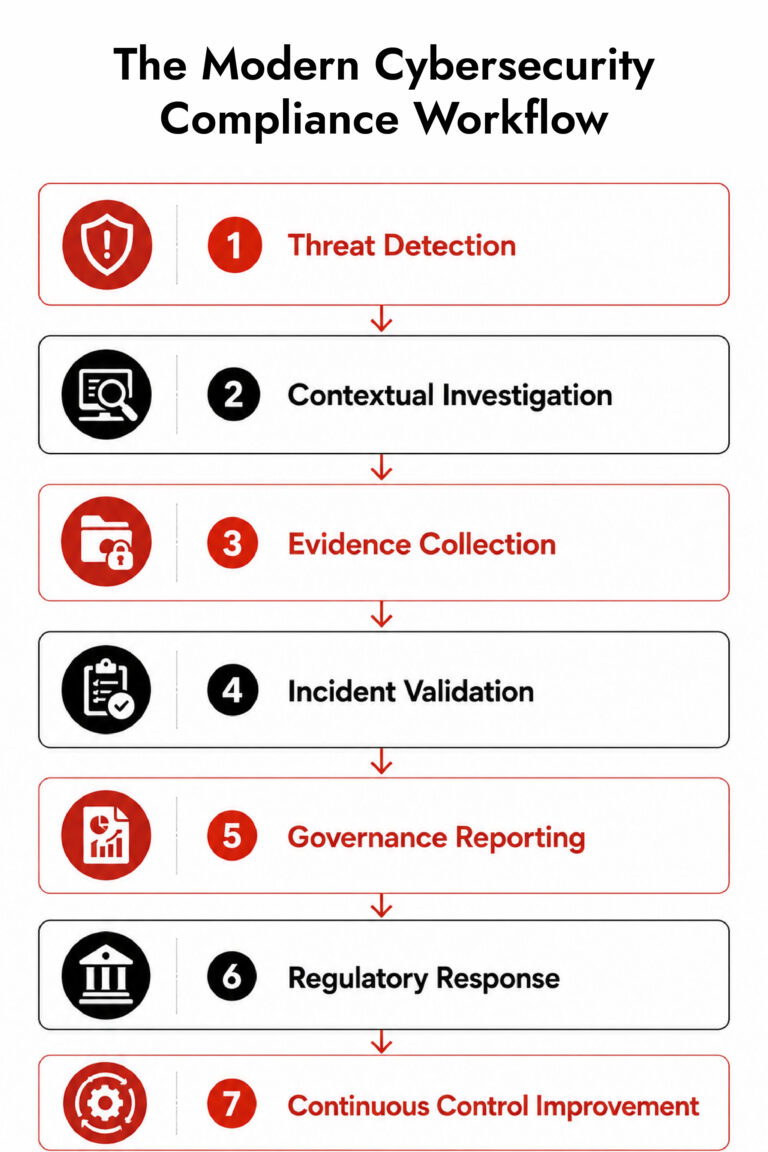
How Mature Organizations Approach Compliance in Cybersecurity
The strongest organizations operationalize compliance through security architecture, not manual processes.
That usually includes:
Risk-Based Governance
Modern cybersecurity governance focuses on measurable risk reduction instead of checkbox compliance.
Teams prioritize:
- Critical assets
- High-risk identities
- Lateral movement exposure
- Third-party dependencies
- Data access pathways
Security Operations Integration
Compliance cannot operate separately from SOC operations anymore.
Organizations increasingly align:
- SIEM workflows
- Threat detection
- Network telemetry
- Incident response
- Governance reporting
- Forensic investigations
This reduces operational friction during audits and incidents.
Automation for Evidence Collection
Manual evidence gathering slows investigations and increases audit fatigue.
Advanced cybersecurity solutions now automate:
- Log aggregation
- Threat correlation
- Investigation timelines
- Reporting workflows
- Retention policies
Automation improves both compliance accuracy and operational speed.
Where NetWitness Supports Modern Cybersecurity Compliance
Many organizations struggle because their compliance program lacks deep operational visibility.
This is where platforms like NetWitness support enterprise cybersecurity compliance differently from traditional monitoring approaches.
NetWitness combines:
- Network visibility across cloud, on-prem, remote agents (via SASE), and OT environments, including east-west and north-south traffic
- Packet capture and on-demand forensics
- Threat detection and SOAR-driven response capabilities
- Log management and endpoint telemetry
- Context enrichment and investigation workflows
- User behavior baselining and machine learning analytics
- Correlation engines to reduce alert fatigue
- Compliance-ready reporting and evidence retention
into a unified cybersecurity platform designed for operational investigation, response, and compliance readiness.
That matters because modern compliance frameworks increasingly require organizations to prove detection capability, investigation readiness, and incident response effectiveness.
For enterprise environments, this approach helps security teams:
- Investigate incidents faster
- Retain forensic evidence
- Correlate telemetry across environments
- Detect lateral movement
- Improve governance reporting
- Support audit readiness with operational data
This becomes especially valuable for organizations navigating:
- NIS2
- DORA
- PCI DSS 4.0
- GDPR
- ISO 27001
- NIST CSF 2.0
Instead of treating cybersecurity compliance as separate from security operations, organizations can operationalize both together.
That is becoming the difference between passing audits and sustaining resilience under real-world attack conditions.
Cybersecurity Compliance is Becoming a Continuous Security Function
Compliance used to revolve around documentation.
Now it revolves around operational proof.
Regulators increasingly expect organizations to demonstrate:
- Continuous monitoring
- Faster detection
- Strong governance
- Incident investigation capability
- Evidence-backed reporting
That changes how organizations approach cybersecurity for business.
The enterprises making progress are not necessarily buying more tools. They are building stronger operational visibility, integrating governance into security operations, and reducing the gap between detection and compliance evidence.
That shift improves more than audit outcomes.
It improves resilience.
And right now, resilience matters more than passing a checklist.
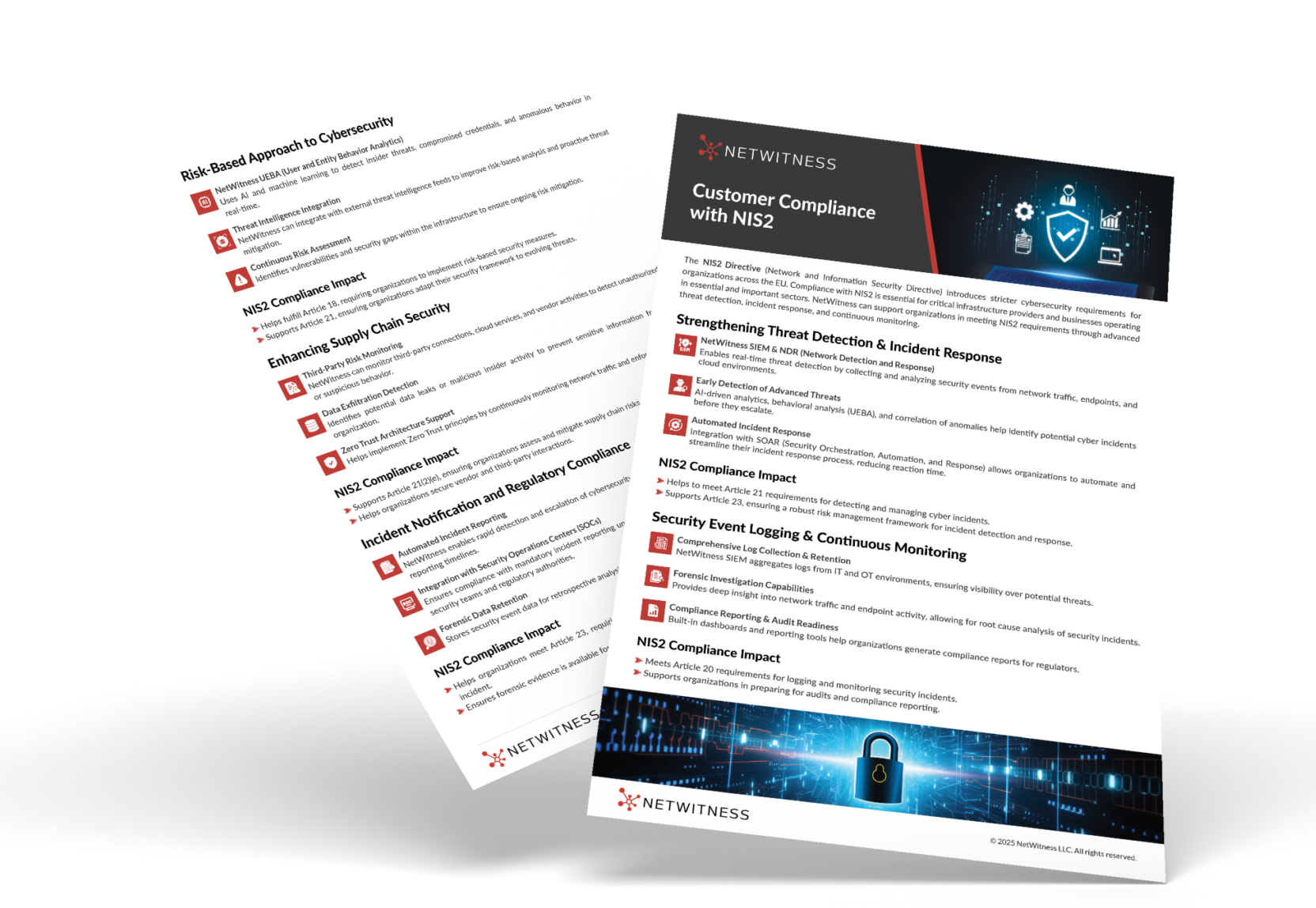
Achieve NIS2 Compliance with Confidence
- Meet NIS2 requirements across IT and OT environments
- Detect and respond to threats in real time
- Streamline compliance reporting and audit readiness
- Reduce risk with continuous monitoring and analytics
Frequently Asked Questions
1. How to choose a cybersecurity compliance service provider?
Opt for the one which provides continuous monitoring services, investigations services, reporting, and documentation, and evidence management. Your choice should definitely consider cybersecurity compliance solutions that provide hybrid cloud environment, threat detection, and frameworks like NIST CSF 2.0, DORA, ISO 27001, NIS2.
2. What are top cybersecurity compliance frameworks for healthcare companies?
Examples of commonly used cybersecurity compliance frameworks include HIPAA, ISO 27001, NIST CSF 2.0, GDPR, and NIS2 if applicable to the business that runs its operations in the EU. Also, many of them apply to their governance controls regarding cybersecurity of medical devices and third parties.
3. What are the typical costs associated with implementing a comprehensive data protection framework?
It depends on the size of the organization, infrastructure structure, compliance requirements, and more. They can include security monitoring costs, logging monitoring, implementation of the governance program, incident management, and enterprise cybersecurity solutions.
4. How can organizations maintain cybersecurity compliance?
The steps taken by organizations to achieve cybersecurity compliance include constant monitoring, risk assessment, logging, governance, incident management testing, employee education, and automated evidence collection. In mature organizations, compliance efforts are tied to SOC operations.
5. What are the biggest challenges in cybersecurity compliance?
The primary obstacles are fragmented security systems, hybrid cloud environments, alert overload, lack of visibility, regulation changes, shorter incident reporting timeframes, and poor correlation of telemetry data.
6. Why is cybersecurity governance critical for enterprise compliance?
Cybersecurity governance helps organizations align security operations with business risk, regulatory obligations, and executive accountability. Effective cybersecurity governance improves visibility, policy enforcement, incident readiness, and long-term resilience across enterprise environments.