Cloud SIEM Security: What to Expect in the World of Hybrid Infrastructure

7 minutes read
Overview Icon

What is cloud SIEM security in hybrid infrastructure?

Cloud SIEM security refers to cloud security information and event management solutions that collect and analyze security data across on-prem, cloud, and SaaS environments. In hybrid setups, cloud-based SIEM platforms provide unified visibility, scalable analytics, and real-time cloud event monitoring to detect and respond to threats faster. 

Introduction 

Most businesses today do not operate completely within their own data centers, and they do not operate entirely in the cloud, either. 

Instead, a hybrid environment exists. There is data stored across various locations, including on-premises data centers, multiple cloud platforms, many SaaS applications, and even user endpoints. Security teams will need to deal with these disparate data sources. 

Here’s where SIEM solutions come to play. 

The challenge is that these traditional security tools were not designed for such a varied amount of environments. What does a cloud SIEM solution look like when essentially every environment is in a state of flux? That is what we intend to explain. 


From Traditional SIEM to Cloud-Based SIEM 

Old-school SIEM tools did their job for a simpler time. They pulled logs from servers, network devices, and a few cloud apps. But they were heavy, expensive to scale, and slow to adapt. 

Once your environment grows beyond the firewall, things start to crack. You either deal with too much noise, not enough visibility, or rising costs. 

Cloud-based SIEM changes that. It’s built to scale without friction. It pulls data from cloud APIs, tracks containers and serverless workloads, and handles massive event volumes without choking. 

In a hybrid setup, that flexibility isn’t a bonus. It’s the baseline. 

That’s why cloud SIEM security is now central to modern cloud security information and event management strategies. 
cloud siem security

What Hybrid Environments Expect from Cloud SIEM Security 

1. One View Across Everything 

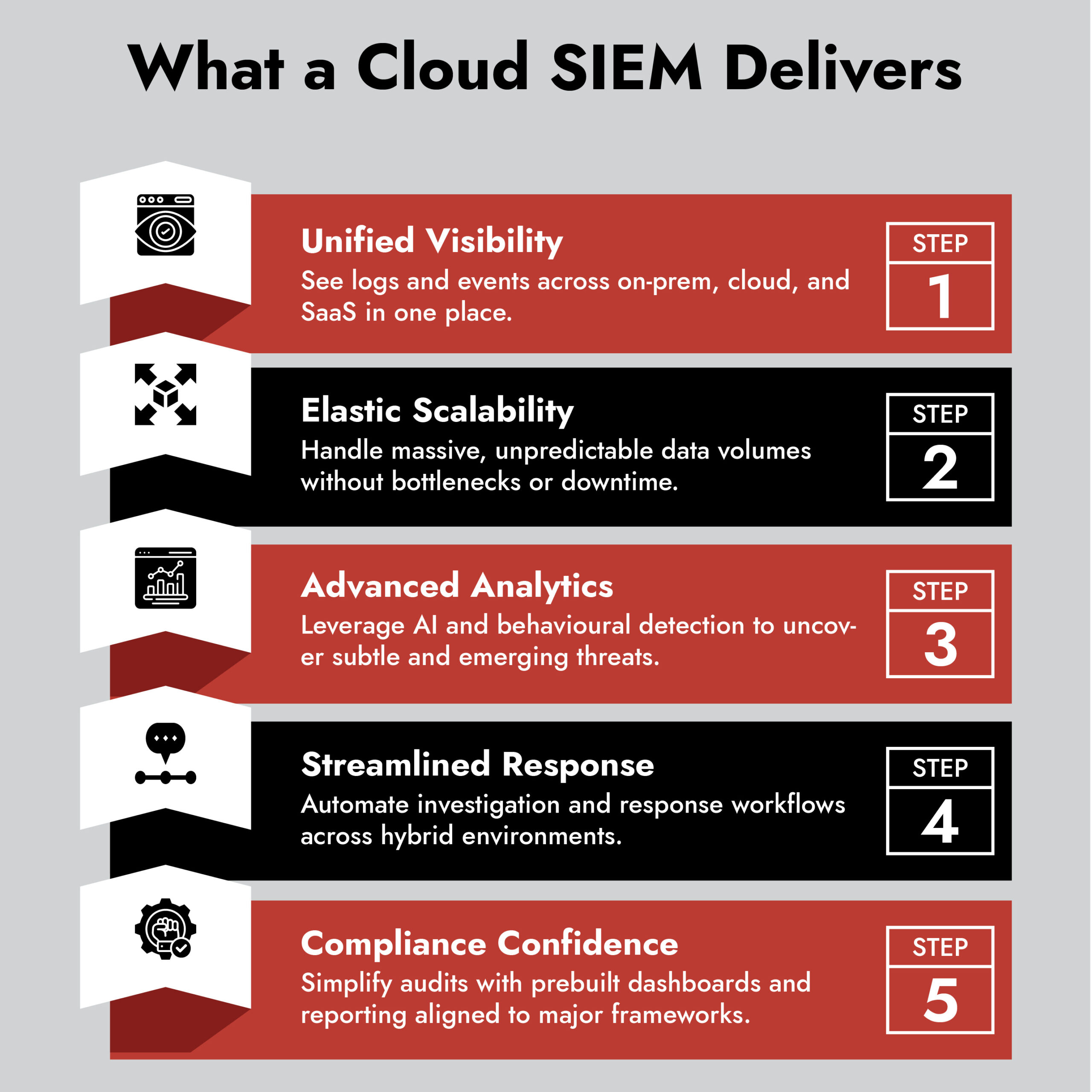
A cloud SIEM must unify on-premises systems with clouds workloads, SaaS applications, identity tools and containers. When you use separate tools for these components, there will be gaps in coverage. 

A proper implementation will have native integrations to numerous platforms such as AWS CloudTrail, Azure Monitor and GCP Logging, while still collecting data from on-premise sources. 

 2. Elastic Scalability for Hybrid Workloads 

Hybrid environments don’t generate steady data, they spike. Your cloud SIEM security solution should handle those spikes without manual tuning or surprise costs. Because when an incident hits, the last thing you need is a system that slows down. 

3. Smarter Detection, Not Just More Data 

Here’s where cloud SIEM pulls ahead. It’s not just about collecting logs. It’s about making sense of them. 

With behavioral analytics, UEBA, and AI-driven detection, you can catch subtle threats like lateral movement on-prem or misuse of cloud identities that older tools often miss. 

4. Faster Hunting and Response 

Modern cloud-based SIEM tools don’t just throw alerts at you. They add context. You see who’s involved, what assets are affected, and why it matters. 

And response doesn’t stay siloed. You can act across your entire environment – blocking threats in both on-prem firewalls and cloud security groups at the same time. That’s real cloud event monitoring in action. 

5. Flexible Deployment for Compliance 

Not everything can move to the cloud. And that’s fine. Many organizations still need certain data to stay on-prem or in private environments. 

That’s where hybrid deployment models help. You keep sensitive data where it belongs, while still using cloud analytics. It’s one of the reasons cloud SIEM security works well for regulated industries. 

6. Compliance Without the Chaos 

Compliance gets messy fast in hybrid environments. A good cloud-based SIEM simplifies it. It normalizes logs, aligns with standards like PCI DSS, HIPAA, and ISO 27001, and automates reporting. Without that, you’re stitching together reports from multiple systems and hoping nothing gets missed. 
Elevate Threat Detection and Response with NetWitness® SIEM

-Correlate data across users, logs, and network for unified visibility.

-Detect advanced threats with AI-driven analytics and behavioral insights.

-Accelerate investigations using automated enrichment and guided workflows.


Lead Magnet Mockup

What is Shaping Cloud SIEM Right Now 

A few shifts are defining where cloud SIEM security is headed: 

  • SIEM and XDR are coming together for broader detection and response 
  • AI is becoming core to identifying patterns across hybrid environments 
  • Storage and compute are being separated to control costs 
  • Open APIs are replacing closed ecosystems 
  • Privacy-focused analytics are helping teams stay compliant without losing visibility 


How to Choose the Right Cloud SIEM Security 

If you’re evaluating cloud SIEM security, keep it simple. Ask: 

  • Does it work natively with your cloud and SaaS stack? 
  • Can it handle sudden data spikes without breaking or overcharging? 
  • Does it give you one view across cloud and on-prem? 
  • Can it trigger responses across your full environment? 
  • Does it integrate easily with the rest of your tools? 

If the answer isn’t a clear yes, keep looking. 


Why NetWitness Fits Hybrid Cloud Security 

Here’s the reality. Hybrid environments aren’t going anywhere. Security teams need visibility that keeps up. 

NetWitness SIEM does exactly that. It brings logs together from everywhere – on-prem, virtual, hybrid, and cloud – into a single view. That visibility makes it easier to investigate, detect, and respond without jumping between tools. 

As your environment expands, NetWitness helps your cloud SIEM security and cloud security information and event management stay consistent and reliable. 


Frequently Asked Questions

1. What is cloud SIEM security?

cloud SIEM is a cloud security information and event management solution that is delivered in the cloud. It collects data from on-premises, cloud, and hybrid infrastructures to identify threats in real-time. 

Cloud-based SIEM solutions offer integration between on-premises infrastructures, public clouds, private clouds, and SaaS tools. They also offer real-time cloud event monitoring solutions. 

They struggle with scale, cloud integrations, and large data volumes. That leads to blind spots and slower detection, something cloud SIEM security is designed to fix. 

It offers centralized visibility and flexible deployment across environments. That strengthens SIEM security and speeds up response times. 

A cloud-native SIEM gives you scalability, better analytics, automated response, and simpler compliance. This makes it essential for modern cloud SIEM security. 

Choose the Right SIEM with Confidence

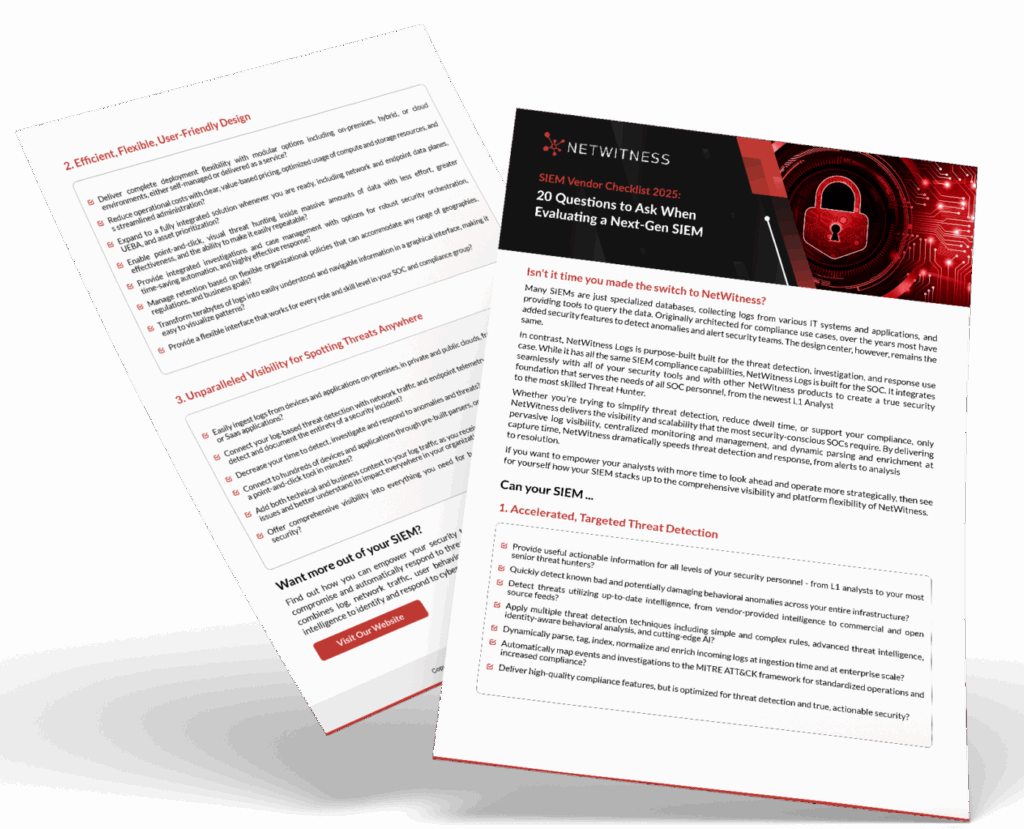
-Evaluate vendors using a comprehensive, expert-built checklist.
-Identify must-have SIEM features for complete visibility and faster detection.
-Compare capabilities to ensure scalability, automation, and integration.
-Make informed decisions with NetWitness’ proven SIEM guidance.
Vendor Checklist

About Author

Picture of Anusha Chaturvedi

Anusha Chaturvedi

Anusha Chaturvedi is a tech-focused content writer with a strong background in branding and communication. With experience across BFSI and cybersecurity, she creates informative, insight-driven narratives grounded in research. Her academic roots in mass communication, advertising, and marketing shape both her analytical and creative approach.

Related Resources

Accelerate Your Threat Detection and Response Today!