How Can You Detect SQL Injection Attacks Using Network Traffic?
Detecting SQL injection attacks is easier when you perform analysis on real network traffic rather than just examining application or database logs. With the help of network forensic techniques such as packet capture and packet inspection, security personnel can detect any malicious SQL query, discover all activities of an attacker, reconstruct the whole timeline of attack, and find out if any sensitive information was compromised or extracted. In addition, this method will allow responding faster to an attack, hunting threats retrospectively, and preventing future attacks through understanding how the attackers managed to circumvent your protection systems.
What Network Evidence Can Reveal
Application logs only tell part of the story.
Packet evidence records the entire communication between clients, web servers, APIs, and databases. That makes it possible to reconstruct exactly how an attacker delivered malicious SQL statements and how the application responded.
Using network traffic analysis, investigators can identify:
- Initial reconnaissance attempts
- Malicious HTTP requests
- SQL payload delivery
- Server responses
- Data exfiltration patterns
- Lateral movement after database compromise
Why SQL Injection Detection Requires Network Forensics
Traditional monitoring often depends on:
- Web server logs
- Database logs
- SIEM alerts
- Web Application Firewalls (WAF)
While valuable, these sources can miss critical evidence.
For example:
- Logging may be disabled.
- Attackers may erase logs.
- WAFs may allow obfuscated payloads.
- Database auditing may capture only successful queries.
Network forensics provides independent evidence because packets capture what actually travelled across the wire.
This enables investigators to answer questions such as:
- Which endpoint received the attack?
- Which payload bypass validation?
- Which records were requested?
- Was sensitive information returned?
- Do encrypted sessions contain suspicious behavior?
That additional context significantly improves SQL injection detection during both live monitoring and post-incident investigations.
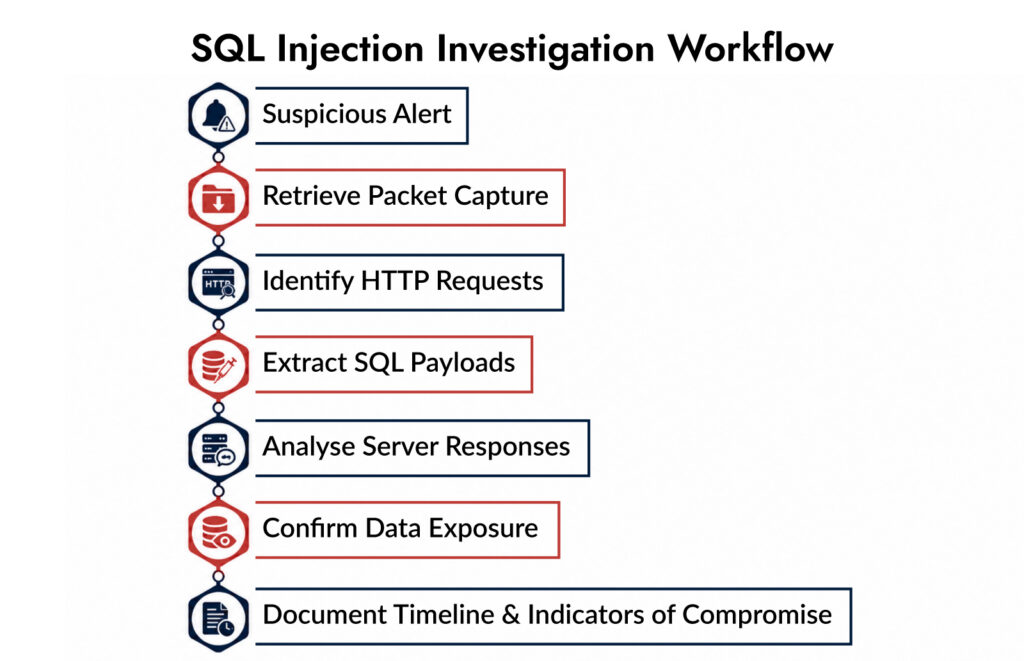
Common Indicators of SQL Injection Activity in Packet Evidence
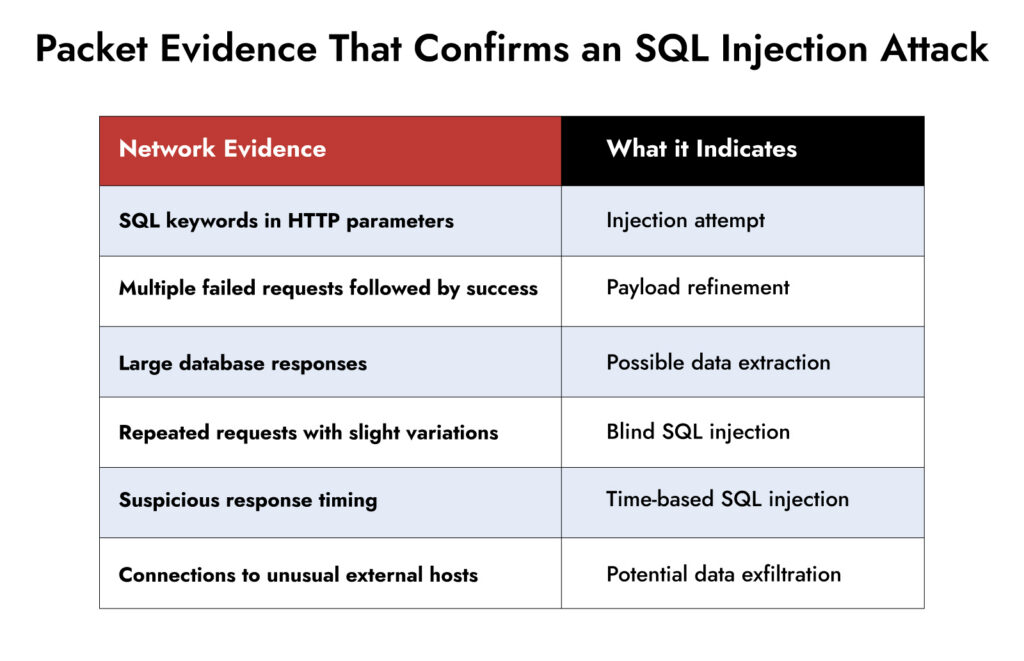
Attackers rarely use identical payloads, but many attacks share common characteristics.
During network traffic analysis, analysts typically examine unusual HTTP requests containing:
Boolean-based payloads
‘ OR ‘1’=’1
UNION-based injection
UNION SELECT username,password FROM users
Time-based injection
WAITFOR DELAY
SLEEP(5)
Error-based injection
Unexpected SQL syntax errors returned by the application often indicate unsuccessful probing attempts.
Blind SQL injection
Repeated requests with only minor variations usually suggest attackers are inferring database responses to one request at a time.
These patterns help analysts perform faster SQL injection detection without relying solely on endpoint telemetry.
How Full Packet Capture Improves SQL Injection Detection
Many organizations only retain metadata.
Metadata helps identify connections but cannot reconstruct application behavior.
Full packet capture preserves complete packet contents, allowing investigators to review:
- HTTP headers
- Request parameters
- Cookies
- POST bodies
- Query strings
- Server responses
- Returned records
- Session behavior
This provides several advantages.
Complete attack reconstruction: Analysts can replay the attack exactly as it happened.
Faster cause determination: Rather than speculating on which request caused the compromise, the exact payload is determined by the analysts.
More effective evidence preservation: Packet captures assist forensic investigations, regulatory reporting, and litigation through the preservation of original network evidence.
Enhanced threat hunting capabilities: Packet archives can help find SQL injections that were previously unknown based on newly discovered indicators.
Using Deep Packet Inspection for SQL Injection Detection
Deep packet inspection examines packet content rather than just source, destination, or protocol information.
This allows detection systems to identify:
- SQL keywords in HTTP requests
- Suspicious encoding techniques
- Obfuscated payloads
- Multiple injection attempts from one client
- Automated scanning tools
- Database error responses
Modern inspection engines also correlate packet data with user behavior, endpoint activity, and threat intelligence to reduce false positives.
Rather than flagging every SQL keyword, they identify patterns consistent with genuine SQL injection attacks.
Example: Reconstructing an SQL Injection Attack
Consider an online customer portal.
A security alert indicates unusually high database activity, but application logs contain only partial information.
Packet analysis reveals:
- An external IP repeatedly accesses the login page.
- Requests gradually change to include SQL operators.
- The server returns larger-than-normal responses.
- Additional requests enumerate database tables.
- Sensitive customer information leaves the network shortly afterwards.
Without packet evidence, investigators might only see abnormal database traffic.
With network forensics, they reconstruct the entire attack timeline from initial probing to data exfiltration, making remediation and reporting far more accurate.
How Threat Hunting Improves SQL Injection Detection
Being patient for an alert is not good enough anymore. Good security analysts seek out evidence of attack prior to the attacker establishing persistence or exfiltrating any information.
Threat hunting in combination with network forensics and full packet capture assists in finding SQL injection attacks that automated tools might miss.
Successful threat hunting is frequently done by looking for:
- Repeated requests containing SQL operators (UNION, SELECT, SLEEP, WAITFOR, ‘ OR)
- Abnormal request frequency from a single source
- Large or unexpected HTTP response sizes
- Database responses that deviate from an application’s normal behavior
- Sudden increases in requests to login, search, or parameter-driven pages
- Encoded or obfuscated payloads designed to bypass security controls
Packet-level evidence also enables retrospective investigations. If a new indicator of compromise (IOC) emerges today, analysts can search historical packet captures to determine whether the same activity occurred weeks or months earlier.
This makes SQL injection detection a continuous capability rather than a one-time alert.
SQL Injection Prevention Starts with Better Visibility
Finding an attack is only half of the challenge. Preventing the next one requires understanding how the attacker succeeded.
Insights gathered during SQL injection detection directly improve SQL injection prevention by exposing weaknesses in applications, databases, and monitoring processes.
Common SQL injection prevention methods include:
- Use parameterized queries and prepared statements instead of dynamic SQL.
- Validate and sanitize all user input on the server side.
- Apply least-privilege access to database accounts.
- Keep web applications, frameworks, and database platforms updated.
- Deploy a Web Application Firewall (WAF) to block known attack patterns.
- Continuously monitor application traffic using deep packet inspection.
- Retain full packet capture for forensic investigations and compliance requirements.
- Integrate application, network, and endpoint telemetry for faster detection and response.
No single control can stop SQL injection attacks on its own. Defense becomes significantly stronger when secure development practices work alongside continuous monitoring and network visibility.
How NetWitness Supports SQL Injection Detection
Sophisticated attacks on the application layer are hard to detect and require more than just alerts. They need comprehensive monitoring of all activities on the network along with the capability of investigating those incidents effectively.
The NetWitness solution aids in increasing detection of SQL injections using network forensics, packet capture, and deep visibility of network traffic.
Key capabilities include:
- Full packet capture for complete session reconstruction
- Deep packet inspection across hundreds of protocols
- High-fidelity network traffic analysis for application-layer threats
- Integrated threat hunting across network, endpoint, and log data
- Historical investigation using retained packet evidence
- Rapid forensic analysis to support incident response and regulatory investigations
Instead of relying on fragmented logs, analysts can reconstruct the complete attack chain, understand attacker behavior, and determine exactly what data was accessed or exposed. This level of visibility helps reduce investigation time while improving confidence in response decisions.
SQL Injection Detection is Stronger with Packet Evidence
The use of application logs is valuable but not sufficient because the attacker can learn how to bypass logging, how to abuse blind spots, and stay undetected amid legitimate traffic.
This is where packet evidence becomes useful.
Through using the integration of SQL injection detection and network forensics with deep packet inspection and full packet capturing, it is possible to get comprehensive information about the incident itself, its nature, and the damage it caused.
With the continued growth of SQL injection attacks on corporate web apps and APIs, packet evidence analysis will become an important tool in their detection and mitigation.
Frequently Asked Questions
1. How do you detect an SQL injection attack?
The most efficient way to detect an SQL injection attack involves analyzing application log files, WAF alerts, database activity, and network forensics. Packet capture analysis can be used to determine any malicious SQL attacks, abnormal HTTP request, database errors, and signs of data exfiltration that cannot be seen from the logs.
2. What are the best tools for SQL injection detection in enterprise environments?
Large enterprises commonly employ a blend of SIEM solutions, web application firewalls, intrusion detection systems, NDR systems, and packet capture software to detect SQL injections.
3. How can organizations implement SQL injection detection in web applications?
Good detection of SQL injection starts from secure code implementation and goes on to continuous monitoring. Organizations need to examine their web traffic, make correlations between application and network telemetry, conduct extensive logging, capture packets, and engage in threat hunting to spot any suspicious activity that could lead to a security breach.
4. What are the best practices for preventing SQL injection attacks?
Some of the best ways to prevent SQL injection attacks include implementing parameterized queries, using prepared statements, input validation, least privilege database access, regular patching, conducting secure code reviews, and continuous monitoring with the help of deep packet inspection and network traffic analysis.
5. What are the different types of SQL injection techniques?
Common SQL injection attack techniques include:
- Union-based SQL injection
- Boolean-based blind SQL injection
- Time-based blind SQL injection
- Error-based SQL injection
- Out-of-band SQL injection
Each technique behaves differently, making packet-level visibility valuable for accurate identification and investigation.
6. How do you set up SQL injection detection for cloud databases?
A practical approach includes:
- Enable database audit logging.
- Collect web applications and API logs.
- Monitor traffic with network sensors where possible.
- Retain full packet capture for forensic analysis.
- Correlate network, endpoint, and log telemetry in a central detection platform.
- Regularly update detection rules based on new attack techniques and threat intelligence.
14 Real Attacks. One Critical Lesson: Visibility Matters.
- See What Really Happened
- Reconstruct Attack Activity
- Uncover Hidden Threats
- Investigate with Packet-Level Evidence