Introduction
As we move forward, the importance of cybersecurity continues to be a top priority for businesses and individuals alike. With data breaches and ransomware attacks becoming more sophisticated and widespread, there is a need to invest in robust security measures now more than ever before. SIEM cybersecurity and SOC cybersecurity are no longer optional. SIEM cyber security is no longer just an IT issue, it affects every aspect of our lives. Businesses must protect their confidential information from malicious actors or risk losing customers, revenue, and reputation.
A strong SOC SIEM operating model allows businesses to move from reactive alert handling to proactive threat detection and response. Without effective SIEM security, security teams struggle with fragmented data, delayed investigations, and blind spots that attackers exploit. This means having strong policies that cover everything from employee training on cyber safety protocols to utilizing advanced network security solutions such as firewalls, antivirus software, encryption technologies, intrusion detection systems, and authentication systems. Additionally, organizations should have a plan in place to respond to any potential breach and be prepared to rise above the attack with minimal downtime or disruption. And one way that our team here at NetWitness can help work towards achieving your business’s cybersecurity goals is with our SIEM SOC solutions.
Here at NetWitness, we understand the importance of a secure network and data center. That’s why we offer SIEM software and SIEM platforms that include a comprehensive suite of services to help protect your business from cyber threats. Our products and services enable you to monitor, detect, investigate, and respond to malicious or suspicious activity in real time. In this blog, we’ll discuss the basics of our SIEM SOC solutions and how they can help you protect your business from both external and internal threats.
What Is SIEM SOC? Understanding the Core Concept
What is SIEM SOC in modern cybersecurity? A SIEM platform serves as the central intelligence hub within a Security Operations Center (SOC), transforming raw security data into actionable insights for threat detection and response. Within the SOC framework, the SIEM solution acts as the analytical engine that processes vast amounts of log data from network infrastructure, applications, and security tools. This enables SOC teams to quickly identify patterns indicating malicious activity and maintain comprehensive audit trails for compliance requirements.
SIEM vs. SOC: What Is the Difference?
SIEM and SOC are complementary, but they serve different purposes. SIEM is a technology platform, whereas a SOC is an operational function that uses technology, people, and established processes to manage security threats.
|
Comparison |
SIEM |
SOC |
|
Full form |
Security Information and Event Management |
Security Operations Center |
|
Primary role |
Collects and analyses security data |
Monitors, investigates, and responds to threats |
|
Core components |
Log collection, event correlation, analytics, alerting |
Security analysts, processes, detection and response tools |
|
Main responsibility |
Identify suspicious activity and provide security context |
Validate alerts, investigate incidents, and coordinate remediation |
|
Data handling |
Aggregates and correlates logs and security telemetry |
Uses SIEM data and other evidence to assess threats |
|
Automation |
Automates data analysis, correlation, and alert generation |
Uses automation and analyst workflows to improve response |
|
Success measures |
Detection quality, data coverage, alert accuracy |
Detection and response times, investigation quality, incident outcomes |
|
Relationship |
Provides intelligence and visibility |
Uses that intelligence to make decisions and act |
The key distinction in SIEM vs. SOC is that one provides the analytical capability while the other delivers the operational response. A SIEM platform can generate alerts, but it does not replace the judgement, investigation, and coordination required to manage an incident.
Similarly, a SOC can use multiple security tools, but without effective SIEM integration, analysts may struggle to connect events across systems and identify complex attack patterns.
SIEM vs SOC: How They Work Together
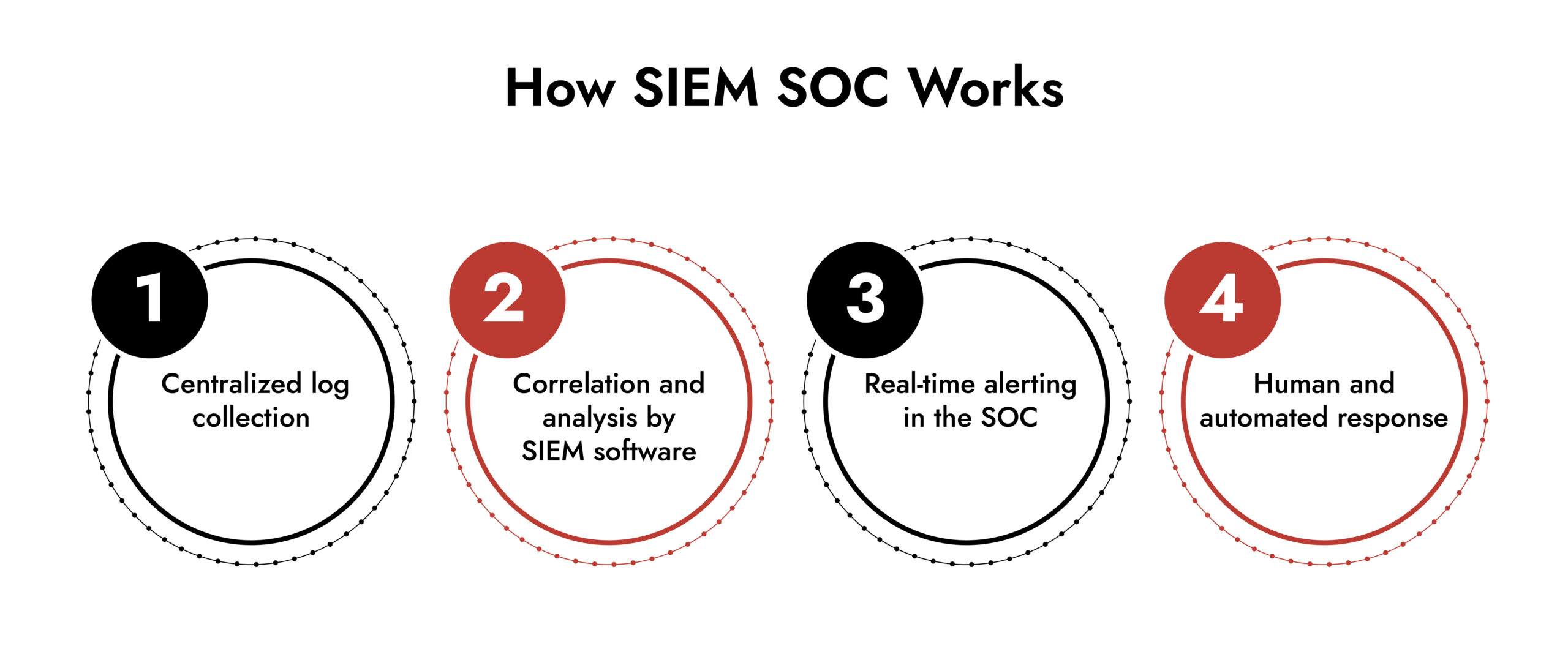
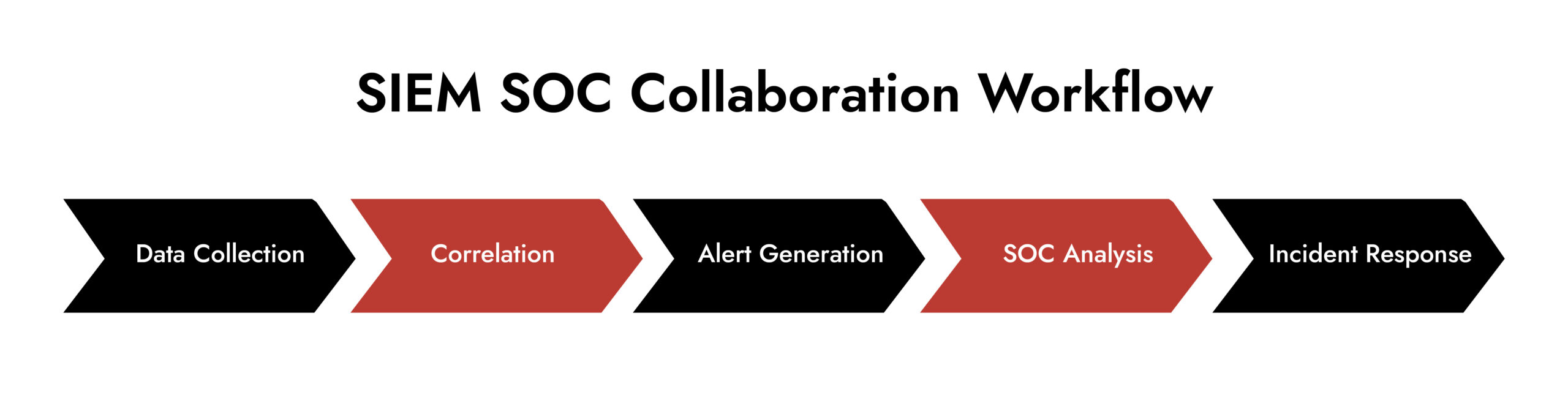
SIEM and SOC work together through a continuous process of data collection, threat detection, investigation, and response. SIEM technology identifies suspicious patterns across security data, while SOC analysts validate the findings and coordinate the response.
The workflow typically involves five stages:
- Collect security data: SIEM gathers logs and telemetry from endpoints, networks, cloud services, applications, and identity systems.
- Detect suspicious activity: Correlation rules and analytics identify unusual behaviour and potential attack patterns.
- Investigate alerts: SOC analysts review the alert, examine supporting evidence, and determine the severity of the incident.
- Respond to threats: Analysts coordinate containment actions, such as isolating an endpoint, disabling a compromised account, or blocking malicious traffic.
- Improve detection: The SOC reviews the incident, refines detection rules, and strengthens security controls to prevent similar attacks.
Practical example: Detecting lateral movement
An attacker compromises an employee account and attempts to access other systems. SIEM correlates unusual authentication events, privilege changes, and suspicious activity across multiple hosts, generating an alert for the SOC.
Analysts investigate the sequence, examine relevant logs and network evidence, and determine whether the activity indicates lateral movement. If confirmed, they coordinate containment and remediation while investigating the attack’s scope.
This is how SIEM SOC integration turns disconnected security events into actionable investigations.
Basics of a SIEM SOC (Security Operations Center)
A security information and event management (SIEM) system is an integrated platform that collects, analyzes, and stores log data from a variety of sources across the organization’s environment. SIEM solutions help detect threats in real time while providing a foundational view of activity across the organization’s systems. By collecting data from multiple sources such as log files, intrusion detection systems, firewalls, applications, and system events, a SIEM platform helps identify unusual or suspicious behavior quickly, enabling organizations to respond appropriately.
A SIEM platform is central to SIEM security and SOC cybersecurity, enabling real-time threat detection and historical investigation. As part of broader SIEM SOC solutions, the platform aggregates logs, correlates events, and surfaces high-risk activity for SOC teams.
This integration allows SOC teams to operate efficiently at scale, especially when paired with SOC automation tools that accelerate triage and response.
The primary purpose of a SIEM platform, as part of our SIEM SOC solutions, is to provide visibility into an organization’s infrastructure by aggregating log data from multiple sources into one centralized location. This allows analysts to spot anomalies quickly and investigate security incidents. By analyzing data from multiple sources, the SIEM software can provide early warning of potential threats and help organizations take appropriate steps to protect their systems.
Key Benefits of SIEM SOC Integration
Integrating SIEM technology with SOC operations helps organisations improve visibility, prioritise threats, and respond more efficiently.
- Improved threat visibility: Centralises security events from multiple sources to help analysts identify suspicious activity across the environment.
- Faster threat detection: Correlates related events to reveal attack patterns that individual alerts may miss.
- Reduced alert fatigue: Helps analysts prioritise relevant alerts and spend less time investigating low-value notifications.
- More efficient incident response: Integrates with automation and response tools to streamline repetitive tasks and containment workflows.
- Better compliance support: Centralised logs, searchable event history, and reporting capabilities support audits and investigations.
- Stronger threat investigations: Combines log data with network and endpoint evidence to help establish the scope and impact of an incident.
SIEM SOC Tools and Technologies
An effective SOC uses multiple security technologies alongside SIEM to detect, investigate, and respond to threats.
|
Tool or technology |
Primary function |
Role in SOC operations |
|
SIEM |
Collects and correlates security events |
Centralises visibility and detects potential threats |
|
SOAR |
Automates security workflows |
Streamlines alert enrichment and incident response |
|
EDR |
Monitors endpoint activity |
Detects and investigates endpoint threats |
|
NDR |
Analyses network traffic and activity |
Identifies network-based threats and provides investigation evidence |
|
UEBA |
Analyses user and entity behaviour |
Identifies unusual activity and behavioural deviations |
|
Threat intelligence |
Provides information about known threats |
Enriches alerts and supports threat assessment |
|
Case management tools |
Tracks incidents and investigations |
Documents evidence, assigns tasks, and coordinates remediation |
These technologies deliver greater value when they share relevant data and support connected workflows. For example, SIEM can correlate suspicious login activity with endpoint alerts, while NDR provides network evidence to help analysts investigate the same incident.
NetWitness brings SIEM together with complementary threat detection and response capabilities, helping security teams connect security events with additional evidence for investigation and response.
Key Business Benefits of a Security Operations Center
Having a Security Operations Center at the center of an organization’s security strategy provides numerous benefits:
1. Increased Visibility for Better Threat Detection and Response:
SOC increases visibility of activity throughout the environment, allowing for improved detection and response to potential threats. An SOC provides centralized, security-focused monitoring of all systems, networks, applications, and devices through specialized tools like SIEM platforms, incident response tools, and threat intelligence feeds.
2. Enhanced Protection Against Malicious Actors:
It also enhanced protection against malicious actors, reducing the risk of data breaches. By monitoring all activity within the environment, the SOC can identify suspicious behavior before it becomes a problem, significantly reducing the risk of a breach.
3. Automated Security Processes for Faster, More Efficient Response:
SOC automates security processes, leading to greater efficiency and faster response times. With automation powered by SIEM software, incident response platforms, and threat intelligence feeds, the SOC can monitor and resolve potential threats efficiently.
4. Improved Compliance with Industry Regulations and Standards:
SOC improved compliance with industry regulations and standards. The SOC helps organizations demonstrate compliance by automating visibility and reporting across all activities within the environment.
Basics of a Security Information and Event Manager (SIEM)
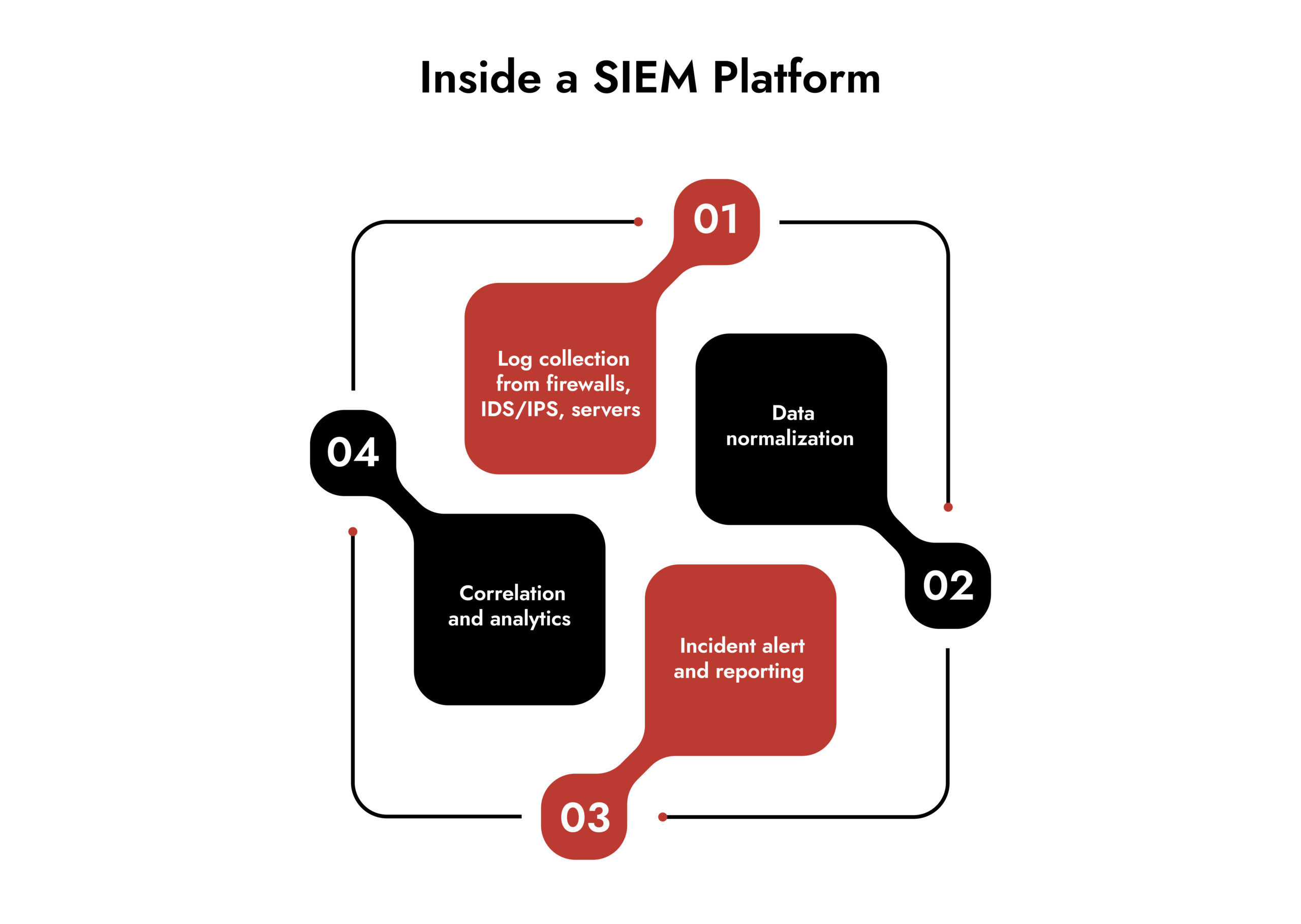
A security information and event management (SIEM) system is an integrated platform that collects, analyzes, and stores log data from various sources across an organization’s environment. SIEM software helps detect threats in real time while providing visibility across systems and infrastructure.
The main function of a SIEM platform, as part of our SIEM SOC solutions, is to aggregate and analyze log data for quick anomaly detection. This enables early warning of potential threats and helps organizations take proactive steps to secure their systems.
How Businesses Benefit from SIEM Platforms in 2026
SIEM platforms, as part of our SIEM SOC solutions, give organizations a unified view of their environments, enabling faster detection and response to real-time security threats. Benefits include:
- Enhanced correlation engine for more accurate threat detection using machine learning and advanced analytics.
- Improved compliance reporting with customizable dashboards for regulations like HIPAA, PCI DSS, and GDPR.
- Access to multiple data sources including firewalls, IDS/IPS, and endpoint detection and response tools.
- Comprehensive audit trail for investigations and forensics.
- Advanced analytics to identify trends in malicious activity and weak spots in IT infrastructure.
How SIEM SOC Solutions Collaborate for Cyber Resilience
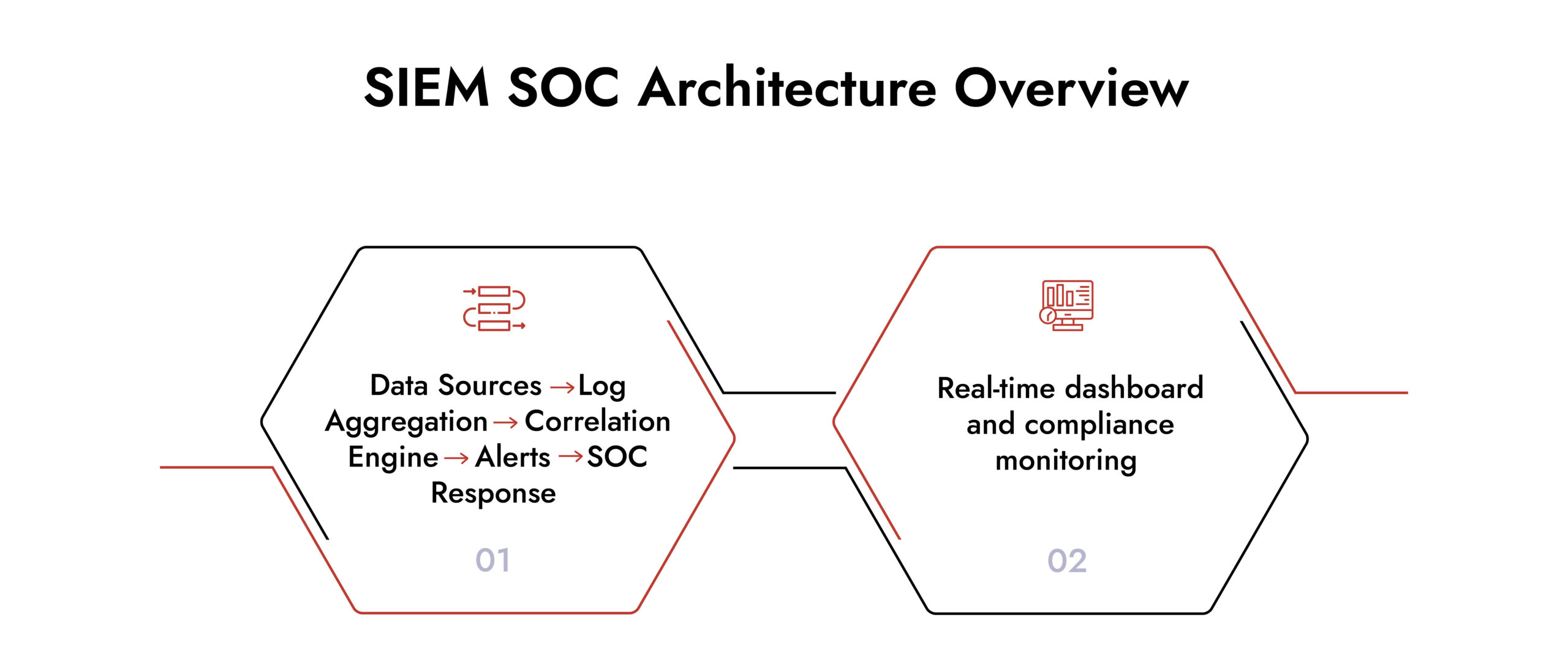
SIEM SOC solutions work together to provide organizations with visibility and protection from malicious threats. The SIEM platform collects data such as authentication attempts, file accesses, and system changes, correlating them across sources to generate actionable alerts for the SOC to investigate.
Once any suspicious behavior is identified, the SIEM software sends alerts to the SOC team for investigation. This synergy reduces response times and enhances the effectiveness of threat mitigation strategies. The result is a stronger SIEM cyber security posture for organizations.
Overall, having an integrated SIEM SOC setup is essential for a resilient cybersecurity framework. With the right combination of tools and expertise, organizations can detect incidents faster, contain threats effectively, and maintain a strong defense against evolving cyberattacks.
How to Choose a SIEM SOC Solution
Choosing the right SIEM SOC solution requires evaluating how well it supports threat detection, investigation, and response.
- Data visibility: Ensure the platform collects logs and telemetry from endpoints, networks, cloud environments, and applications.
- Threat detection: Look for event correlation, behavioural analytics, and threat intelligence to identify suspicious activity.
- SIEM integration: Check compatibility with existing security tools, ticketing systems, and response platforms.
- Automation: Evaluate SOAR integration to automate repetitive tasks and streamline incident response.
- Scalability: Consider data ingestion, search performance, retention requirements, and long-term costs.
- Performance metrics: Assess improvements in detection and response times, false-positive rates, and investigation efficiency.
The right solution should help SOC teams connect security events, investigate threats faster, and coordinate effective responses without adding unnecessary complexity.
NetWitness – Your Go-To SIEM SOC Solution
With cybercrime on the rise, the importance of SIEM cyber security cannot be overstated. Cybercriminals are constantly evolving, exploiting weaknesses and targeting organizations across industries. That’s why taking steps to protect your business is essential and it starts with SIEM SOC solutions from NetWitness.
NetWitness provides industry-leading SIEM solutions designed for comprehensive visibility, detection, and response to security threats. Our SIEM software offers powerful analytics that quickly detect anomalies in data from multiple sources, allowing organizations to take proactive measures to reduce the risk of downtime or breaches.
With NetWitness, businesses gain peace of mind knowing they have unmatched visibility, analytics, and protection against modern threats.
Contact us today to learn more about how our SIEM SOC solutions can help protect your organization or request a demo to see our SIEM platform in action.