Top SOAR tools that integrate well with SIEM and EDR
Top SOAR tools that integrate well with SIEM and EDR include
- NetWitness SOAR
- Cortex XSOAR
- Splunk SOAR
- FortiSOAR
- IBM Security QRadar SOAR.
For enterprises that want SIEM-SOAR integration with a deeper investigative context, NetWitness is a strong option because its SIEM and SOAR are designed to connect detection, enrichment, case management, playbooks, and response workflows. This is especially useful for SOC teams that need a threat detection and response platform that can work across logs, endpoint activity, network evidence, threat intelligence, and existing security tools.
We work with enterprise security teams every day, and the pressure they’re describing is consistent across the board. Attackers are moving faster. Expectations on the SOC side haven’t eased up. Analysts are still required to investigate thoroughly, document cleanly, and contain incidents without creating disruption elsewhere in the business.
That’s a hard balance to maintain. CrowdStrike’s 2026 Global Threat Report found that the average eCrime breakout time dropped to just 29 minutes in 2025.
So, by the time lateral movement is confirmed and containment starts, the window has often already closed. What we’ve seen driving that gap isn’t a lack of effort from security teams. It’s that the security operations center tools they’re using weren’t designed to hand off cleanly to each other.
Detection happens in one place, investigation in another, response coordination somewhere else entirely. That fragmentation is exactly why SIEM and SOAR integration has become one of the most important conversations we’re having with enterprise clients right now.
Why SIEM and SOAR Should be Integrated
SIEM and SOAR are not the same thing, and they don’t compete with each other. They solve different parts of the same problem.
The SIEM is where detection starts. It collects logs and telemetry, normalizes events, runs correlation logic, and surfaces suspicious activity for analysts to act on. Without strong detection input, nothing downstream works well.
SOAR picks up the operational side. It enriches the alert, opens the case, triggers the right playbook, pulls in additional context, coordinates response across teams and tools, and documents everything as the investigation moves forward.
Without SOAR, analysts repeat the same manual steps on every single alert:
- checking reputation sources
- searching endpoint data
- pulling user context
- opening tickets
- notifying the right people
- writing up notes after the fact
In a high-volume environment, that process simply doesn’t hold. People burn out and real threats get delayed.
The real value of SIEM SOAR integration is what happens when both sides are working together properly. The SIEM finds what needs attention. SOAR makes sure the response is consistent, well-documented, and doesn’t depend entirely on whoever happens to be logged in that shift.
The Deeper SOC Problem
Most SOC teams we talk to are dealing with more volume than they can realistically handle by hand. But the problem we see most often isn’t really about volume. It’s about context.
Missing a legitimate alert is the scenario that keeps security teams up at night. The only way to confidently rule something out is to have the full picture. When data is fragmented across systems, analysts end up manually stitching together information from multiple consoles, and that process is both slow and inconsistent.
For instance, a senior analyst knows exactly where to look and understands the business risk attached to the affected system. A junior analyst sees the same alert and might not know where to start. The output from the same alert varies wildly depending on who picks it up. That’s a SOC that’s running on individual expertise rather than a structured process and that creates real organizational risk.
A proper SOC automation platform should fix that by reducing the mechanical, repetitive work that surrounds the analysts so they can spend their time on decisions that genuinely require human judgment.

“SIEM and SOAR integration works best when automation is applied to context, not just alerts. A SOC shouldn’t rush to automate every response action. Instead, it should first automate the enrichment, evidence collection, routing, and documentation steps analysts repeat every day. This is where teams see faster triage without creating unnecessary operational risk, because SIEM and SOAR are only as effective as the context available to them. Organizations should view integration beyond the SIEM-SOAR connection and include critical data sources such as identity systems, firewalls, endpoint platforms, cloud workloads, and OT environments. By continuously enriching detections with asset, user, and operational context, teams can improve triage accuracy, reduce investigation time, and make automation decisions with greater confidence.”
At that point, NDR becomes an investigation acceleration layer. Instead of forcing analysts to manually correlate disconnected events, it helps them quickly reconstruct the attack path across users, hosts, protocols, and sessions. When integrated with UEBA, it adds another layer of context by helping distinguish user-driven activity from machine-driven movement, improving confidence in separating real compromise from legitimate administrative behavior.”
— Ibrahim Badawi, Sales Engineer, NetWitness
Why We Recommend NetWitness for Enterprise Threat Detection
We’ve evaluated a lot of platforms, and when it comes to building an integrated threat detection and response stack for enterprise environments, NetWitness stands out.
Here’s why.
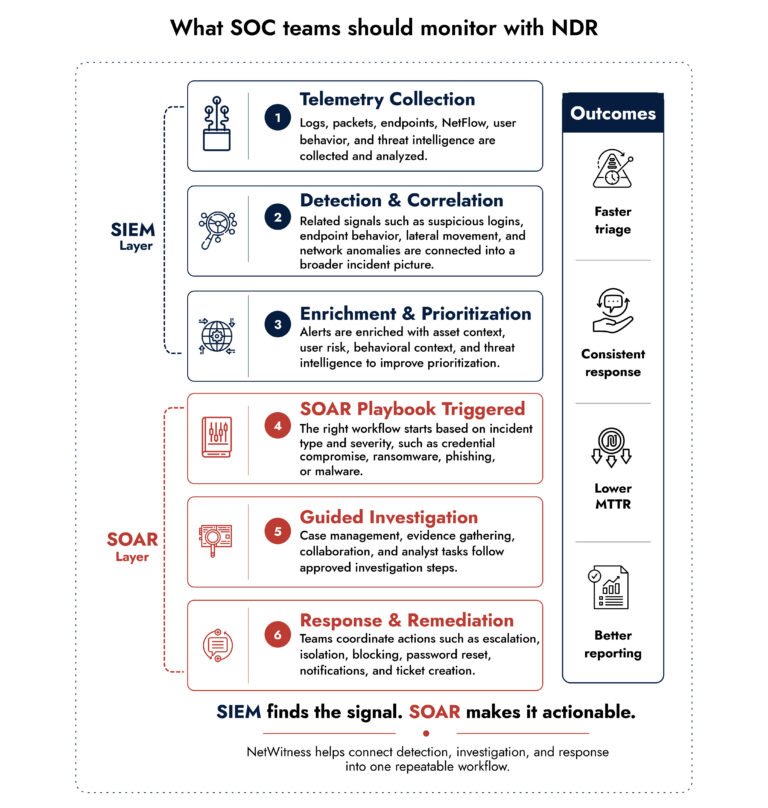
NetWitness SIEM and SOAR were designed to work as one system from the start, by connecting detection, investigation, orchestration, and response into a single workflow rather than a series of clunky handoffs between separate tools.
NetWitness SIEM handles the detection and investigation layer. It brings together security data across logs, packets, endpoints, NetFlow, user behavior, and threat intelligence. That breadth matters because modern attacks almost never show up as one clean, obvious signal.
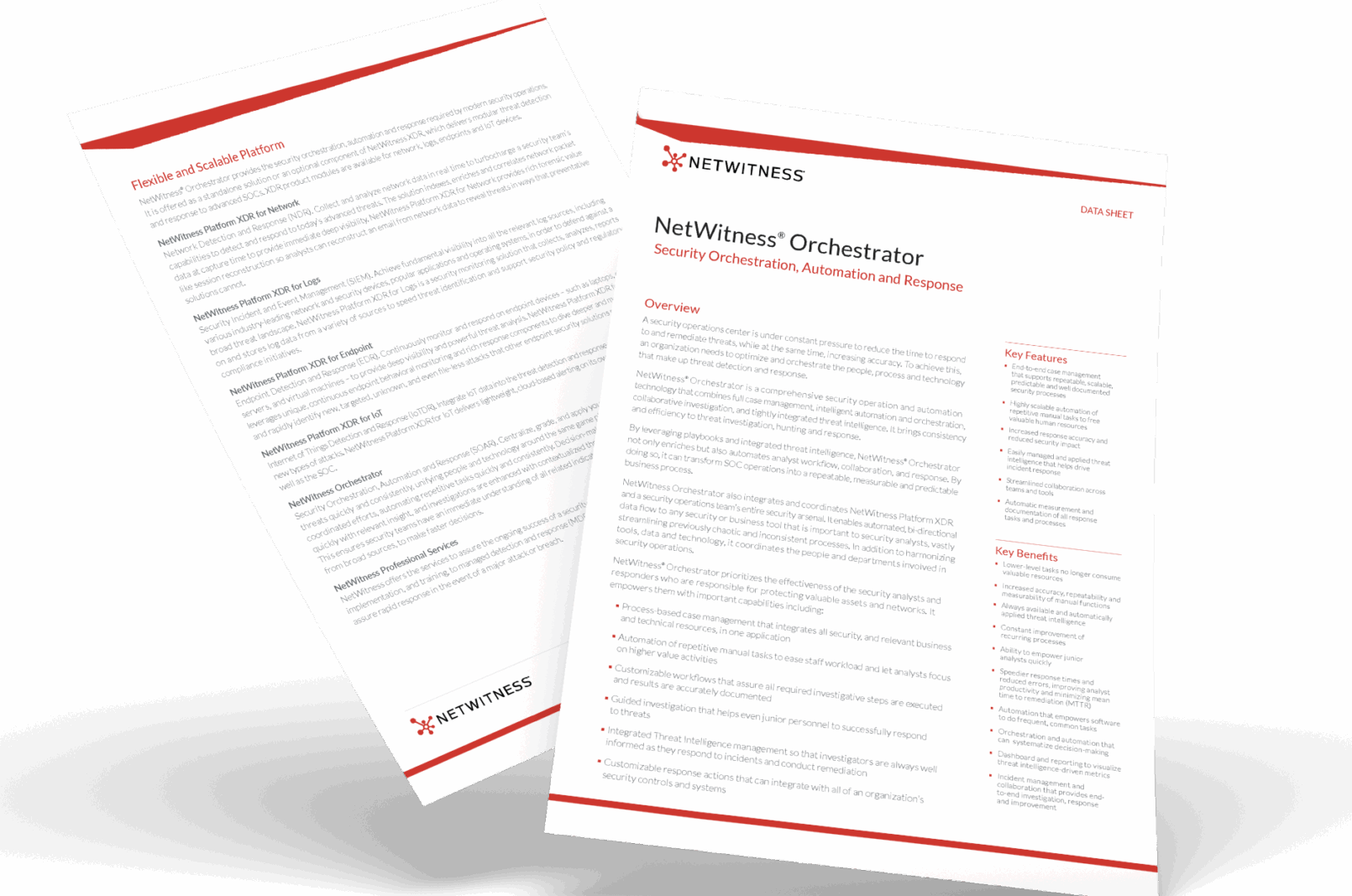
NetWitness SOAR, also called NetWitness Orchestrator, adds the response layer. Case management, intelligent automation, guided investigation workflows, collaborative response, integrated threat intelligence, and customizable response actions all come together inside a single incident process rather than being spread across tabs and tools.
In practice, here’s how the workflow runs:
- Detect and correlate: NetWitness SIEM identifies suspicious activity and pulls together related evidence across logs, network, endpoint, user behavior, and threat intelligence. The analyst start their analysis from a connected picture not fragmented data.
- Enrich and prioritize automatically: Before an analyst opens the case, it’s already been enriched with asset importance, user risk scores, threat intel matches, behavioral patterns, and related activity.
- Route to the right playbook: NetWitness SOAR routes the incident into the appropriate workflow based on threat type, severity, affected asset, or business impact. The right process kicks off automatically rather than waiting for someone to decide where to begin.
- Guide the investigation: Analysts follow approved investigative steps instead of relying on memory or improvising under pressure. For junior analysts, that structure is essential. For senior analysts, it means faster access to relevant evidence without covering the same ground repeatedly.
- Automate what doesn’t need a human: Steps such as enrichment, evidence collection, indicator lookups, ticket updates, notifications, workflow routing run automatically. Higher-stakes decisions stay under analyst control, where they belong.
- Coordinate across every team involve: Serious incidents rarely stay inside the SOC. They pull in endpoint teams, network teams, identity, cloud, compliance, legal, and sometimes business leadership. NetWitness Orchestrator keeps all of those people, processes, and tools coordinated inside a structured case rather than scattered across Slack threads and email chains.
The balance matters here: the enterprise security teams we work with aren’t looking for blind automation. They want reliable cybersecurity automation solutions that handle the routine work while keeping human judgment in the loop for decisions with real business consequences.
What to Actually Look for When Evaluating a SIEM and SOAR Stack
We’d caution against evaluating a SIEM and SOAR platform purely by feature count. A long checklist can easily hide the real question: will this change how the SOC operates during an actual incident?
These are the six questions we walk clients through when evaluating an integrated solution:
- Does the SIEM collect and normalize what the SOC actually needs? Logs are a starting point, but most enterprise threat detection requirements also include endpoint signals, network context, identity data, cloud activity, user behavior analytics, and threat intelligence feeds.
- Can analysts see the evidence behind an alert? A risk score isn’t an explanation. Analysts need to understand why something was flagged, not just that it was.
- Can SOAR workflows be customized around how your team actually works? Generic playbooks rarely survive contact with a real incident. The workflows need to reflect your organization’s actual process for investigating, escalating, approving, and containing threats.
- Can automation be controlled? Some tasks should run automatically. Others need analyst approval. The platform needs to support both without making that boundary hard to set or change.
- Does it connect with the tools already in your environment? SIEM SOAR integration needs to reach EDR, NDR, IAM, firewalls, email security, cloud tools, threat intelligence, ITSM, and ticketing systems. Shallow integrations produce shallow workflows. NetWitness SOAR supports more than 500 integrations across security and IT environments — that breadth matters when your stack is already built out.
- Can you measure whether it’s working? A mature implementation should show measurable improvement in triage time, response time, manual effort per case, and documentation quality. If you can’t measure it, you can’t improve it.
Establish Incident Response consistency, speed, and scale with NetWitness® Orchestrator
Conclusion
For the security teams we work with, SIEM and SOAR have stopped being separate conversations. Detection and response have to function as one connected process and the organizations that treat them that way are the ones that hold up when something serious happens.
A SIEM identifies suspicious activity and surfaces the evidence behind it. SOAR enriches that evidence, guides the investigation, coordinates the response, and keeps the documentation current throughout. When SIEM SOAR integration is done well, the SOC has a faster, more reliable path from signal to action and that path doesn’t depend on who’s on shift.
If your organization is working through alert fatigue, trying to build more consistent response processes, or looking to get real value from your existing cybersecurity automation solutions, SIEM SOAR integration is one of the most practical places to start and NetWitness is where we’d begin that conversation.
Frequently Asked Questions
1. Why do organizations integrate SIEM and SOAR solutions? and SOAR?
Because detection without response is just observation. SIEM identifies and correlates suspicious activity. SOAR enriches the alert, opens the case, runs playbooks, coordinates the response, and keeps documentation moving. Running them separately creates the kind of gaps that slow down response at exactly the wrong moment.
2. How does SIEM and SOAR integration improve threat detection?
It adds context that changes what analysts are actually looking at. Instead of a single isolated event, they’re reviewing related user activity, endpoint signals, network behavior, threat intel hits, asset details, and prior case history all at once. That’s what lets a SOC move quickly and confidently rather than spending time stitching the events manually.
3. What are the benefits of building an integrated threat detection and response stack?
- Faster triage
- Faster response
- Consistent investigations
- Cleaner documentation
- Reduced analyst burnout
4. How does NetWitness support SIEM and SOAR integration?
By connecting detection context directly with response workflows in one system. NetWitness SIEM detects and correlates activity across logs, packets, endpoints, NetFlow, user behavior, and threat intelligence. NetWitness SOAR turns those detections into structured investigations through playbooks, case management, automation, integrated threat intelligence, and documented collaborative response.
5. What security tools can integrate with SIEM and SOAR platforms?
EDR, NDR, firewalls, IAM, cloud security, email security, vulnerability management, threat intelligence platforms, ITSM, and ticketing systems are the most common. NetWitness SOAR supports more than 500 integrations.
6. What challenges do organizations face when integrating SIEM and SOAR?
The ones we see most often:
- noisy alerts
- poor data quality going into the SIEM
- weak playbook design
- over-automation of decisions that should have human oversight
- unclear ownership between teams
- tool sprawl
- failing to tune the system after the initial deployment.
Getting it right requires strong detection context, practical workflows, controlled automation, and a feedback loop that routes what you learn from incident response back into detection engineering.
Elevate Threat Detection and Response with NetWitness® SIEM
-Correlate data across users, logs, and network for unified visibility.
-Detect advanced threats with AI-driven analytics and behavioral insights.
-Accelerate investigations using automated enrichment and guided workflows.