What Security Engineering Really Delivers in Modern Enterprises?
Security engineering is no longer just about building defenses. It defines how organizations detect, contain, and reduce risk across hybrid environments.
- Security engineering aligns architecture, operations, and response into one structured discipline.
- It connects threat modeling, incident response engineering, and automation into a unified defense approach.
- Modern cybersecurity engineering roles now focus on measurable risk reduction, not just tool deployment.
- Organizations using structured security engineering frameworks report faster detection and lower incident impact times.
Why Security Engineering Now Sits at the Core of Cyber Defense
Modern security incidents do not request permissions, set up dashboards, or undergo regular reviews. Modern security incidents occur rapidly, develop even faster, and exploit weaknesses in cloud, physical, and identity infrastructure.
And this is exactly why security engineering plays a critical role. The design of the process that involves setting up defense, logging information, creating detections, and responding is what is defined by security engineering. In modern corporations, security engineering is what makes the connection between strategy and execution.
As indicated by the threat intelligence of 2024 from the industry as well as the revisions made by NIST, organizations that have a good structure for security engineering have much shorter MTTD and MTTR compared to those without proper security frameworks. It has nothing to do with tools. It is about the framework.
Now let’s dive into the framework.
What is Security Engineering in Cybersecurity?
Security engineering is the discipline of designing, building, and maintaining security systems that protect infrastructure, applications, and data across complex environments.
At its core, security engineering ensures that security is not reactive. It is embedded into architecture, workflows, and operational processes.
Unlike isolated security practices, security engineering integrates:
- System design and architecture security
- Threat modeling and adversary simulation
- Detection logic and telemetry engineering
- Response automation and orchestration
This makes security engineering the backbone of scalable cybersecurity operations.
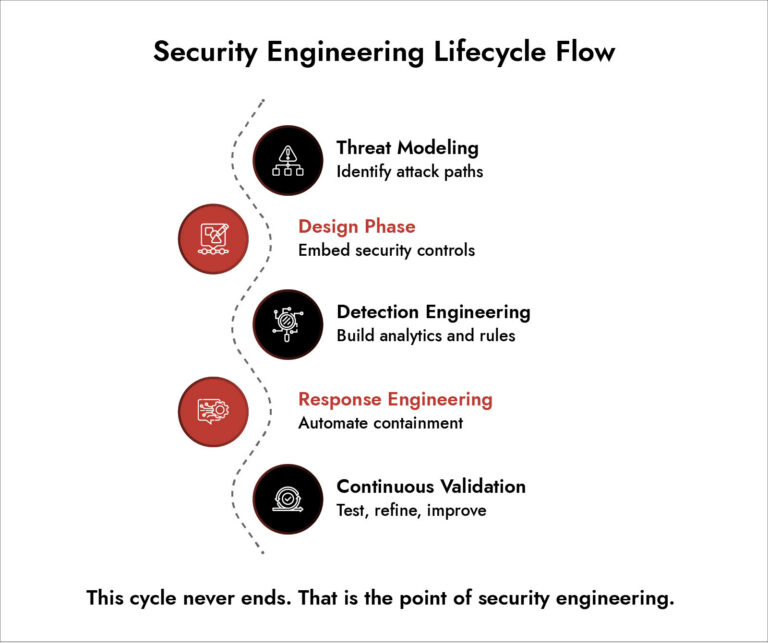
Core Pillars of Security Engineering Framework
A robust security engineering framework has its four main pillars, upon which it is built.
- Threat-based Approach –In any system, you begin with an enemy mindset. Security engineering begins with this aspect by incorporating threat modeling from the onset.
- Detection Engineering –In this aspect, security engineering builds detection logic that detects anomalous behavior, not necessarily signature based.
- Response Engineering –Contemporary security engineering brings about response procedures into the system by means of automation and orchestration.
- Continual Risk Assessment –Mature security engineering does not have periodic risk assessment, but continual exposure evaluation.
Cybersecurity Engineering Roles and Responsibilities
Cybersecurity engineering jobs are changing from mere tool users to system engineers.
From the point of view of practice, the tasks of security engineering encompass:
- Development of secure cloud and network designs.
- Creation of detection rules and behavioral analysis.
- Execution of threat modeling activities on vital infrastructure.
- Adoption of incident response engineering processes.
- Automation and integration of security practices.
- Continuous risk assessment of security risks.
The bottom line is clear: security engineering moves security organizations away from dealing with security incidents and toward preventing them.
Network Security Engineering in Hybrid Environments
Network boundaries no longer define security perimeters. Workloads move between cloud, edge, and on-prem systems continuously.
This is where network security engineering becomes critical. It focuses on:
- Encrypted and unencrypted traffic visibility
- Segmentation and lateral movement control
- Behavioral anomaly detection across networks
Modern security engineering ensures that network telemetry feeds directly into detection systems instead of sitting in isolated logs.
Threat Modeling and Security Risk Assessment
Threat modeling is not a checklist. It is a continuous engineering function inside security engineering.
A strong security engineering practice evaluates:
- Attack surfaces across applications and APIs
- Identity-based risks and privilege escalation paths
- Data flow vulnerabilities across systems
Combined with security risk assessment, organizations can prioritize engineering effort based on real exposure, not theoretical risk.
Why Trust Has Become the New Attack Surface
- Expanding digital attack surface across cloud and OT
- Unmonitored identities and excessive privileges
- Disconnected security tools lacking context
- Blind spots in east-west network traffic
Incident Response Engineering and Security Automation
Incident response is no longer manual coordination. It is engineered.
Incident response engineering ensures that every alert follows a predefined, automated or semi-automated path.
This is where security engineering intersects with:
- Security automation and tools
- Security orchestration automation and response (SOAR) platforms
- Playbook-driven containment and remediation
When executed properly, security engineering reduces response fatigue and improves consistency across incidents.
Security Automation and Tools in Security Engineering
Automation is not optional anymore. It defines scalability.
Modern security engineering relies heavily on:
- Detection automation across SIEM pipelines
- Orchestrated response workflows
- Integrated security tooling across cloud and endpoints
A 2025 enterprise security trend report highlights that organizations using automation in security engineering reduce manual triage workloads by more than 40 percent on average.
Where NetWitness Fits in Security Engineering
In enterprise environments dealing with high-volume telemetry, platforms like NetWitness support security engineering by unifying detection, investigation, and response signals.
It aligns with security engineering goals by:
- Providing deep packet and behavioral visibility for investigations
- Supporting incident response engineering workflows
- Enhancing security orchestration automation and response capabilities
- Enabling structured threat detection across hybrid environments
This helps teams operationalize security engineering without losing investigative depth.
Impact of Security Engineering on Organizations
When security engineering matures, organizations see structural changes:
- Faster containment of security incidents.
- Reduced dependency on manual investigation.
- Improved collaboration between engineering and security teams.
- Better prioritization of security risk assessment efforts.
- Stronger resilience across hybrid infrastructure.
Ultimately, security engineering becomes less about tools and more about predictability under attack.
Conclusion
The real evolution of security engineering is simple. It moves security from a reactive function into a structured engineering discipline that continuously adapts to threat behavior.
Organizations that invest in security engineering frameworks, automation, and incident response engineering don’t just detect threats faster. They reduce uncertainty in every layer of defense.
The next step is not more tools. It is tighter engineering.
Frequently Asked Questions
1. What are the main responsibilities of a security engineer?
Among other tasks, the main duties of a security engineer are secure architecture design, detection algorithm construction, incident response engineering participation, and continuous development of security engineering practice.
2. How does security engineering differ from cybersecurity?
Both notions are different from one another, as cybersecurity includes both security engineering and other techniques. But security engineering is simply an implementation of cybersecurity principles and approaches.
3. What are the best security engineering tools for cloud infrastructure?
The current security engineers use modern security engineering tools such as SIEMs, cloud-native security measures, SOAR platforms, and telemetry pipelines to automate detection and incident response processes.
4. What impact does security engineering have on organizations?
Security engineering helps decrease incident response time, improve risk visibility, and develop organizational resiliency.
5. How can organizations build a strong security engineering team?
They need to unite the talent of threat modeling, detection engineering, automation ability, and a solid security engineering framework corresponding to business risks.
6. Why is security automation important in security engineering?
Simply because security engineering at the scale of many organizations requires a lot of automation to manage alerts efficiently and respond promptly.
Unify Security Across Hybrid Environments
- Gain complete visibility across cloud, on-prem, and endpoints.
- Detect threats faster with correlated insights across all layers.
- Reduce complexity with a single, integrated security platform.
- Strengthen your defenses with NetWitness unified security