How can security teams detect ransomware before encryption?
Ransomware rarely begins with encryption. Before files are locked, attackers need to establish access, communicate with infrastructure, discover systems, move laterally, and reach valuable assets. Those actions create network evidence. With full-packet capture, enriched metadata, and session reconstruction, security teams can trace that activity back through the environment and investigate the path that led to encryption. Those changes defending against ransomware from reacting to the final event to investigating the activity that made it possible.
What Happens Before Ransomware Encryption?
Encryption is the point where a ransomware attack becomes impossible to ignore. Files stop opening. Critical applications become unavailable. Users report failures across systems. But encryption is not where the attack starts.
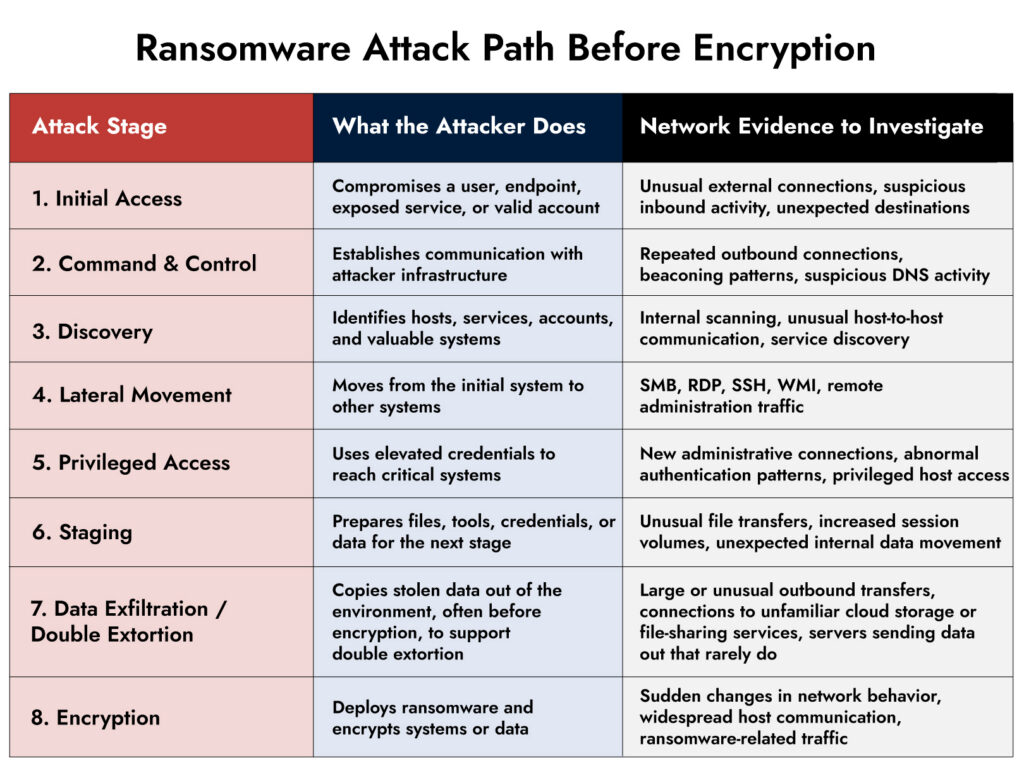
An attacker may already have spent hours or days establishing persistence, communicating with command-and-control infrastructure, discovering hosts, identifying privileged accounts, moving laterally, and locating systems that can create the greatest operational impact.
Each stage can generate network activity.
That matters because ransomware detection does not have to depend on identifying the encryption event itself. Security teams can investigate the behavior that precedes it.
For an enterprise SOC, the important question is not simply whether ransomware is present. It is: What did the attacker do before the encryption started? That question shifts the investigation from a single endpoint event to an attack path.
What Network Evidence Does Ransomware Leave?
Ransomware activity can blend into legitimate enterprise traffic. Attackers may use administrative protocols, legitimate credentials, remote services, or existing infrastructure rather than relying on obviously malicious traffic.
That makes individual events difficult to interpret. A workstation connecting to a server is common behavior. A privileged account accessing a file to share is common behavior. DNS requests are common behavior. RDP, SMB, SSH, and other administrative protocols are normal. The problem is the combination, timing, and context.
During a ransomware attack, security teams may find:
- Unusual connections between internal hosts
- Unexpected SMB, RDP, SSH, WMI, or other remote-access activity
- Repeated connections to unfamiliar external infrastructure
- DNS activity that differs from the host’s normal behavior
- Scanning or discovery activity across internal systems
- Unusual file transfers or data staging
- New communication paths involving critical servers
- Increased east-west traffic before ransomware deployment
None of these signals independently prove a ransomware attack.
Together, they can reveal a sequence. This is where ransomware attack detection becomes an investigation problem. Analysts need to establish which events are related, which systems were involved, and where the activity began.
Why is Metadata Alone Not Enough for Ransomware Detection?
Metadata gives a SOC something it cannot get from raw packets alone: speed at scale.
Enriched network metadata can help analysts search across large volumes of traffic using information such as source and destination, protocol, application context, DNS activity, session characteristics, certificate attributes, timing, and traffic volume.
That makes it practical to narrow a large environment into a small set of suspicious communications.
But metadata is still a representation of underlying traffic.
Consider an analyst investigating a suspicious connection between a compromised workstation and an internal server. Metadata can show that the session occurred, when it happened, which systems participated, and how much traffic moved.
The next question is more important: What happened during that session? That is where full-packet capture becomes valuable.
Packet evidence gives investigators access to the underlying communication when the summarized record is not enough to validate the activity. NetWitness combines full-packet capture with metadata generation and enrichment, so analysts can move from broad network searches into deeper forensic investigation.
For ransomware attack analysis, that distinction matters. Metadata helps an analyst find suspicious activity. Packet-level evidence can provide the details needed to understand and validate it.

Ransomware encryption is an outcome, not a detection strategy. By the time an endpoint starts encrypting files, the attacker may already have completed discovery, lateral movement, and access to privileged systems. The more useful detection point is the network activity that connects those stages. Preserving that activity gives analysts evidence to investigate the attack before the blast radius expands.
“In many environments, the gap isn’t detection logic, it’s retention. Teams find the encryption event, go back to look for the lateral movement that preceded it, and discover that east-west traffic was never captured, or was kept for only a few days. Evidence you can’t go back to is evidence you don’t have.”
—Dominik Czyz, NetWitness
How Does Attack Reconstruction Detect Ransomware Activity?
A ransomware investigation rarely follows a clean timeline. An analyst may start with an alert on one endpoint, discover unusual communication with another system, identify lateral movement, and then find that the first alert was already several steps into the attack.
Attack reconstruction helps connect those steps.
Instead of investigating each connection as a separate event, analysts can follow related sessions across hosts, users, protocols, and time windows. NetWitness supports session reconstruction and network forensics specifically to help analysts follow activity through the network rather than manually working through raw packet data.
A practical ransomware attack detection workflow can look like this:
- Start with the suspicious host: Identify the endpoint, server, or account associated with the initial alert or ransomware event.
- Search backward: Examine network activity before the known event to identify unusual external communication, discovery, authentication, or remote access.
- Trace internal movement: Follow connections from the suspected host to other systems and determine whether the communication fits expected administrative behavior.
- Pivot into packet evidence: Where metadata raises a question, examine the underlying session and available packet evidence.
- Build the timeline: Connect related activity across systems to establish how the attacker progressed through the environment.
- Identify the attack boundary: Determine which hosts, accounts, services, and network segments may have been involved.
This is the difference between finding a ransomware indicator and understanding the ransomware attack path.
How NetWitness Exposes Ransomware Attack Paths
NetWitness NDR is built around the idea that network evidence needs to remain useful beyond the initial detection.
Its NDR solution combines full-packet capture, metadata enrichment, behavioral analytics, threat intelligence, network forensics, and session reconstruction. The architecture provides real-time visibility into network traffic while giving analysts a path from detection into deeper investigation.
For defending against ransomware, three capabilities are particularly important.
- Full-packet capture: Full-packet capture preserves network evidence that may become critical during an investigation. When an analyst needs to determine what actually occurred within a suspicious communication, having the underlying packet data can eliminate investigative gaps that summarized telemetry may leave behind. NetWitness supports full-packet visibility alongside metadata analysis, allowing teams to move between broad searches and deeper forensic examinations.
- Metadata enrichment: Metadata makes high-volume network activity searchable and useful for threat hunting. NetWitness enriches network data at capture time, giving analysts contextual information that can help them identify suspicious hosts, sessions, protocols, destinations, and communication patterns. That matters during a ransomware investigation because the SOC can start broad, identify an abnormal communication pattern, and then narrow the investigation without manually inspecting every packet.
- Attack reconstruction: Detection tells an analyst where to look. Reconstruction helps explain what happened. NetWitness provides session reconstruction and network forensic capabilities that allow analysts to follow the threat trail through related network activity. This supports investigations where the initial ransomware event is only one part of a larger sequence. The combination is important. Full packets provide depth. Metadata provides scale. Reconstruction provides investigative continuity. That is the architecture security teams need when defending against ransomware across complex enterprise environments.
Why Detect Ransomware Before Encryption?
Once encryption begins, the security team is dealing with impact. Before encryption, the team may still have an opportunity to identify the attacker’s infrastructure, isolate affected systems, disable compromised accounts, interrupt lateral movement, and prevent additional systems from being reached.
The earlier activity can also reveal something that the encryption event cannot: how the attacker got there.
That information becomes critical during ransomware incident response. Containing one encrypted endpoint does not establish that the attack is contained. Security teams need to know whether other systems communicated with the compromised host, whether the attacker moved laterally, whether credentials were used elsewhere, and whether similar activity remains active.
Network evidence can help answer those questions.
NetWitness NDR provides visibility across on-premises, cloud, and virtual environments, with full-packet capture, metadata analysis, behavioral detection, and network forensic capabilities designed to support investigation across those environments.
For enterprise defenders, the practical point is straightforward: encryption is an important ransomware indicator, but it is a late-stage indicator. The attack path starts earlier.
Security teams that can search network activity, preserve packet evidence, enrich it with context, and reconstruct related sessions have a much stronger basis for determining what happened before the files were encrypted.
That is the real value of network visibility in defending against ransomware: not simply seeing more traffic but retaining enough evidence to understand the attack while there is still something to stop.
Frequently Asked Questions
1. What is a ransomware attack path?
A ransomware attack path is the sequence of activity an attacker follows from initial access through command and control, discovery, lateral movement, access to valuable systems, and eventual ransomware deployment or encryption. Network activity can provide evidence across multiple stages of that path.
2. Why is detecting ransomware activity before encryption important?
Detecting ransomware activity before encryption can give security teams more time to investigate the compromise, contain affected systems, disrupt lateral movement, and limit the number of systems exposed to the destructive stage.
3. How does network visibility help detect ransomware?
Network visibility exposes communication between systems, including suspicious internal movement, command-and-control activity, remote-access behavior, unusual DNS activity, and file transfers. When combined with behavioral analysis and threat intelligence, these signals can support earlier ransomware threat detection.
4. How can security teams investigate the full ransomware attack path?
Teams can begin with a suspicious host or alert, search surrounding network metadata, trace related communications, investigate lateral movement, and pivot into packet-level evidence when deeper validation is required. Session reconstruction can then help establish the sequence of activity across the incident.
5. How does NetWitness help expose ransomware attack paths?
NetWitness combines full-packet capture, metadata enrichment, behavioral analytics, threat intelligence, network forensics, and session reconstruction. This allows analysts to move from a suspicious network to signal the underlying evidence and investigate related activity across the attack path.
6. Can NDR detect ransomware activity in encrypted traffic?
In part, yes. Even when payloads are encrypted, NDR can still analyze session metadata and behavior: who is communicating with whom, how often, how much data moves, timing patterns, certificate attributes, and DNS activity. That is often enough to identify beaconing, unusual internal connections, and staging or exfiltration. How much packet-level detail is available depends on how the traffic is encrypted and what visibility the environment allows.
7. How does NDR complement EDR in ransomware defense?
EDR shows what happens on an endpoint: processes, file changes, and local behavior. NDR shows what happens between systems, including devices where no agent is installed, such as unmanaged hosts, servers, and OT assets. Used together, EDR can show what was executed on a host, while NDR shows how the attacker got there and where they went next. Each closes visibility gaps the other can leave open.
Understand today's most active ransomware groups, their tactics, and how to strengthen your defenses.