What is OT incident response?
OT incident response is the discipline aimed to support any effort about detecting, containing, and eliminating cyber threats targeting industrial control systems, PLCs, HMIs, SCADA networks without disrupting their operational and process integrity.
It differs from standard IT incident response in three critical aspects: it prioritizes passive monitoring (because most OT devices cannot safely host security agents), it requires active coordination between security analysts and OT engineers who understand process context and behaviors, and it demands a proper comprehension about the attack dynamics before activating any remediation. Any premature cleanup in OT doesn’t just destroy evidences, it can provoke attackers into triggering unsafe process with catastrophic results for the targeted environment or worst, in case the victim is a critical infrastructure (acqueducts, power plants, ports and so on…).
Introduction
Most cybersecurity teams know how to handle a breach in an enterprise IT environment. Isolate the endpoint, pull the logs, run forensics, patch and restore. Done. OT incident response doesn’t work like that, and the organizations learning that lesson the hard way are doing so at significant cost.
Operational technology powers things that actually move, heat, spin, or control physical processes. When an attacker gets into that environment, the consequences aren’t just a downed server or stolen data. They’ve disrupted production lines, compromised safety systems, and in the worst cases, initiated real-world physical consequences. That changes everything about how you respond.
Why Industrial Environments Break Every IT Incident Response Rule
Industrial environments were designed to keep plants running, not to make forensic investigations convenient. Many of the systems involved are decades old, run proprietary protocols, and were never built with security monitoring in mind. You can’t just drop an EDR agent on a PLC and call it a day.
OT cybersecurity evolved later than enterprise IT security, partly because industrial systems spent years assumed to be safely isolated. Air gaps were treated as a guarantee rather than a configuration choice. That assumption has long since expired. Nowadays, the same individuals behind ransomware attacks on corporate networks are focusing on operational technology environments. Their methods such as phishing, moving laterally via Active Directory, and misusing remote access are precisely those IT teams have been combating for many years.
What’s different is the response. In IT, aggressive containment is usually the right call. In OT, moving too fast can be more damaging than the attack itself.
The Real Risk of Getting Containment Wrong
When it comes to OT incident response, acting too soon with remediation is a frequent error among security teams and it often leads to significant costs.
If you wipe and restore systems before you’ve mapped the full attack chain, you’ve done two things simultaneously. You’ve removed the evidence you needed to understand how the attacker got in, and you’ve left open the persistence mechanisms and lateral movement paths you never found. The attacker may simply return.
Worse, a cornered attacker who detects that defenders are moving but haven’t fully scoped the intrusion may escalate. In OT environments, that escalation isn’t just pivoting to a new server. It can mean triggering destructive actions, flooding HMIs with junk data, or corrupting PLC logic to cause physical disruption . The cybersecurity equivalent of burning the house down on the way out.
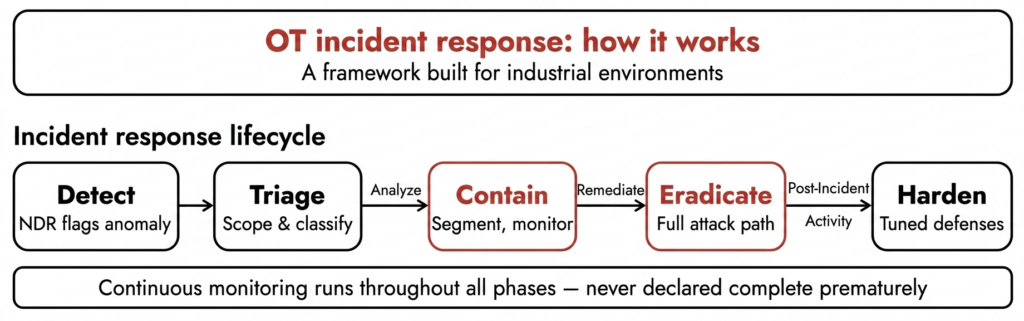
The right approach is disciplined containment paired with sustained visibility. You keep watching the environment while you methodically map the full attack surface highlighting any system under active control by the attacker, mapping any entry point the attacker can use to get inside and verifying what type of actions the attacker took so far . Only then do you eradicate.
Three Pillars Every OT Security Solution Needs to Cover
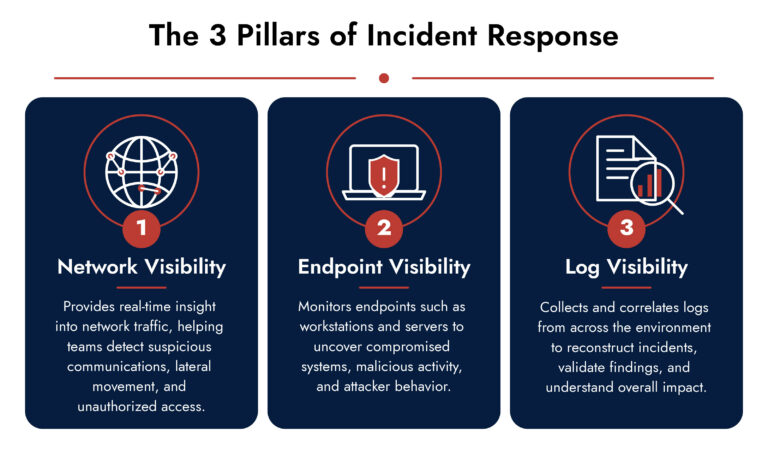
Effective OT network security, like IT security, rests on three visibility pillars: network, endpoint, and logs. What changes in OT is how much weight each one carries.
Network visibility is the foundation. Many industrial assets of PLCs, RTUs, safety controllers simply cannot host security agents without risking process disruption or voiding vendor warranties. Passive network monitoring becomes the primary way to see what’s actually happening, like east-west traffic between HMIs and controllers, anomalous protocol behavior, and unauthorized remote access. The best OT security solutions for operational technology absolutely must include protocol-aware network monitoring that can interpret industrial communications, not just flag unknown ports.
Endpoint visibility matters most at higher layers. Engineering workstations, jump boxes, and OT DMZ systems are where Windows and Linux hosts live, and those are the systems that carry the richest forensic evidence. That’s where you reconstruct intrusion paths. But the operative word is selective endpoint tools in OT need to be analyst-driven, not autonomously responsive. An EDR that auto-quarantines a process on an engineering workstation connected to a production environment can cause exactly the kind of disruption you’re trying to avoid.
Log visibility fills in the historical record. This goes well beyond SIEM correlation of Windows event logs. In OT environments, historian data, sequence-of-events records, operator logs, and process alarm data can tell you whether an attacker’s actions actually affected physical operations. That correlation of cyber events to process events is what lets you make defensible conclusions about scope and consequence.
The three pillars of incident response work together, not independently. Suspicious remote access in network telemetry gets paired with endpoint artifacts from the engineering workstation, then correlated against historian data to determine whether anything actually happened at the process level. That’s the chain that takes you from detection to defensible answers.
Continuous Monitoring: What is missing in any OT Incident Response Plan
Standard incident response plans often treat monitoring as a detection activity for something you do before the incident starts. In OT incident response, monitoring needs to continue throughout the investigation.
Capable adversaries adapt. If they sense defenders moving in, they shift tooling, use dormant access paths, or change lateral movement patterns. Without continuous network and endpoint monitoring during the investigation, you’re effectively flying blind after the first containment action. You don’t know if your containment is working. You don’t know if the attacker has pivoted. You don’t know whether the scope you believed to be accurate and complete is actually anywhere near that.
Continuous monitoring gives the incident response team a feedback loop. It validates containment in real time. It catches attacker reactions before they become secondary incidents. And it keeps the team from declaring victory prematurely one of the most expensive mistakes in incident response. This is especially true in OT environments where investigations are inherently slower. Manual evidence collection, vendor dependencies, and the need to coordinate every action with site operations all extend the timeline. Monitoring bridges that gap.
Want the full technical breakdown?
This blog draws from our detailed white paper on OT incident response methodology covering investigation models, containment strategy, sector-specific constraints, and tool selection across energy, transportation, healthcare, and manufacturing environments.
[Download the OT Incident Response White Paper ]
What the Right Incident Response Tools Actually Look Like
The best cybersecurity for operational technology networks is built around passive collection and careful interpretation, not aggressive scanning or automated response.
For network monitoring, the right incident response tools are those that handle both IT and OT traffic as well as understand industrial protocols. Platforms like Netwitness DeepInspect, Dragos, Claroty, Tenable OT Security, and general-purpose solutions like Zeek or Security Onion can all play a role, depending on the environment. The key requirement is protocol awareness you need to understand what a Modbus command or an EtherNet/IP exchange means in context, not just flag it as unfamiliar traffic.
On the endpoint side, traditional digital forensics and incident response solutions are potentially an option, when adopted to carry out forensic on IT systems connected with OT, like Windows jump boxes, engineering workstations, and OT servers based on traditional Operating Systems (like Windows, Linux or BSD-like systems). However these solutions cannot help in pure OT systems that run on proprietary OS with minimal and often constrained resources.
Live memory analysis, registry artifacts, event logs, file metadata: these evidence exists on the higher-layer hosts, and there we can adopt the traditional IT-forensic approach, but for OT we need to understand logs, logics and traditional behavior of OT systems to potentially understand any modification or active execution carried out by the attacker.
On that front, surely the SIEM can help complement the OT visibility more than anything else.
Choice matters less than the ingestion strategy. Any platform that can pull syslog, firewall events, Windows logs, and historian data into a correlated timeline is workable. What often gets overlooked is building a Collection Management Framework before an incident, documenting which log sources exist, how long they’re retained, how to access them, and what baseline looks like. That preparation cuts response time dramatically when an incident actually happens.
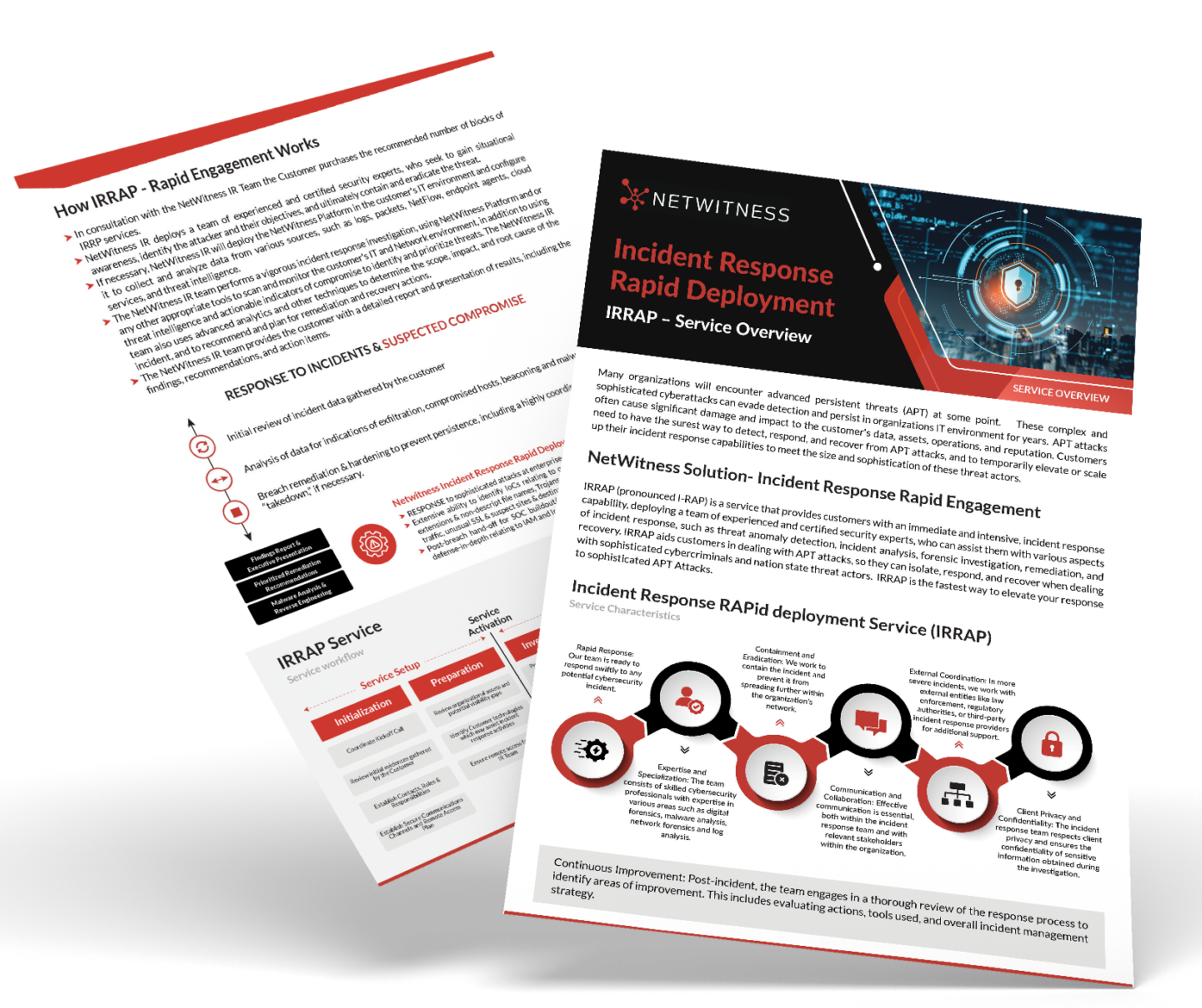
Respond to advanced cyber threats faster with expert-led incident response and unified enterprise visibility.
- Rapid investigation and containment for ransomware and advanced attack
- Unified visibility across network traffic, endpoints, and security logs
- Deep forensic insights to identify lateral movement and attack scope
- Streamlined workflows from threat detection to remediation and recovery
What a Real OT IR Engagement Looks Like
In early 2026, a naval shipyard responsible for military vessel maintenance faced a Cl0p ransomware intrusion. The attackers followed their standard playbook: initial access via phishing into the corporate IT domain, weeks of lateral movement through Active Directory, and eventual staging on jump boxes used to configure shipyard OT systems covering vessel propulsion, weapons calibration, and drydock automation.
What allowed Netwitness Incident Response team, engaged to support the victim, to prevent ransomware detonation was seeing anomalous east-west traffic caught by Netwitness NDR adopted during the engagement monitoring SMB beaconing from IT servers to OT jump boxes, unusual PowerShell execution, and large data transfers consistent with exfiltration of classified specs. The C2 callbacks confirmed Cl0p infrastructure involvement.
The response split immediately into two parallel workstreams. On the IT side: isolate compromised AD domains, null-route C2 infrastructure, and deploy memory forensics across 400+ endpoints. On the OT side: segregate OT networks at the DMZ without touching production, activate passive network taps to baseline industrial traffic, and preserve historian and sequence-of-events data to rule out process tampering.
The ransomware binary, a custom wiper variant, was staged on a jump box and configured to trigger encryption across OT shares. By segregating OT before detonation, roughly 47 minutes after initial engagement, the team prevented what would have been an 18-to-24-month vendor-led rebuild of legacy systems. OT operations continued uninterrupted through a $2 billion refit deadline.
Full eradication took 72 hours. The shipyard avoided an estimated $150 million in downtime and restoration costs. The difference between that outcome and a catastrophic one was network visibility, disciplined containment, and a response team that didn’t touch OT systems until they fully understood what they were dealing with.
The Bottom Line
OT incident response requires the same investigative rigor as enterprise IT response, applied through a completely different operational lens. Safety comes first. Process continuity matters. And the tools, techniques, and containment strategies that work well in a corporate datacenter can cause serious harm if applied carelessly in an industrial environment.
The organizations that handle OT incidents successfully are the ones that maintain network visibility across the whole environment, preserve containment discipline instead of rushing to remediate, and resist the temptation to declare victory before the full attack path is understood.
Half-measures in OT don’t just create vulnerabilities. They open the real possibility an attacker can shut you down.
Frequently Asked Questions
1. What is an OT incident response?
OT incident response is the discipline aimed to scientifically detect, contain, and eliminate cyber threats across operational technology environments like SCADA, PLCs, and industrial control systems while ensuring physical operations remain uninterrupted.
2. How is OT incident response different from IT incident response?
OT incident response prioritizes passive monitoring, process safety, and coordinated response with internal teams and OT vendor engineers prior to take any aggressive action against the attacker. Unlike IT, aggressive containment can disrupt operations, so threat detection strategies focus on visibility and controlled remediation.
3. Why is network visibility critical in OT security?
Network visibility is the foundation of cybersecurity for operational technology because many OT devices cannot support endpoint agents. It enables threat monitoring, anomaly detection, and real-time insight into industrial communications.
4. What are the key components of effective OT incident response?
Effective OT incident response relies on three pillars: network visibility, endpoint visibility, and log correlation. Together, they support cybersecurity threat modeling, improve threat detection strategies, and enable accurate threat response.
5. How does continuous monitoring improve OT threat detection?
Continuous monitoring helps track attacker behavior during an incident, validate containment, and prevent missed threats. It strengthens threat monitoring and ensures organizations don’t overlook lateral movement or persistence mechanisms.
6. What tools are used for OT incident response?
OT incident response tools include protocol-aware network monitoring platforms, selective endpoint forensics tools, and SIEM solutions for log analysis. These tools support threat modeling techniques and improve overall cybersecurity for operational technology.