Introduction
Most security breaches leave behind incomplete stories. Endpoint protection may catch malware on a workstation, but it rarely explains how attackers moved between systems. Firewall logs show blocked connections, yet they often miss the quiet activity that defines advanced attacks.
Network forensics in cyber security fills this gap. It examines conversations between systems to reveal how attacks unfold across the network. Instead of isolated alerts, security teams see the full sequence of events.
As attackers rely on multi-stage techniques, network traffic forensics has become critical. Rather than focusing on single devices, it tracks communication flows and data movement. This gives security teams the context they need to investigate incidents, understand attacker behavior, and reduce future risk.
What is Network Forensics?
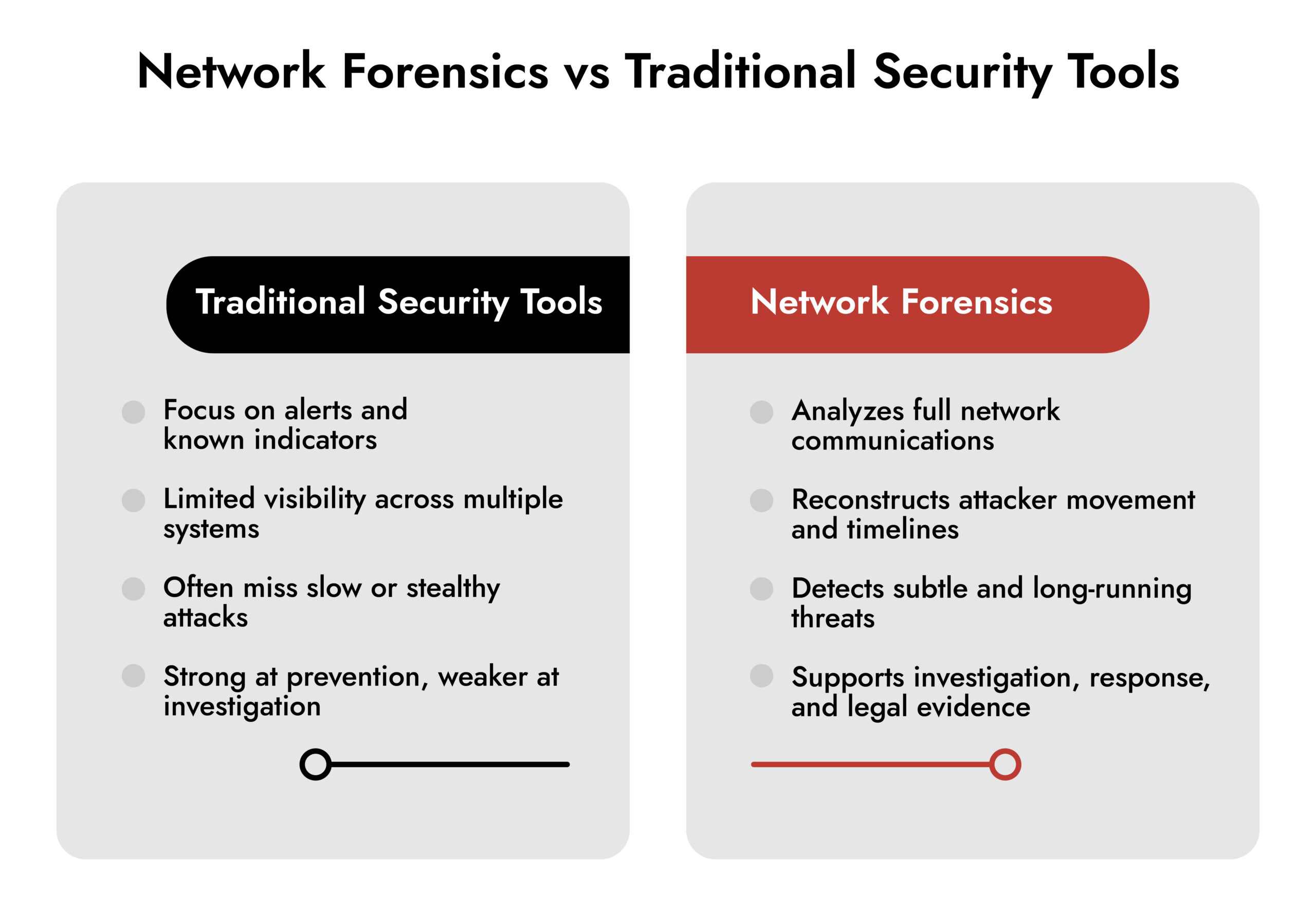
Network forensics is the process of capturing and analyzing network traffic, packets, sessions, and logs to investigate security incidents, identify threats, and reconstruct attacker activity.
Unlike computer forensics, which focuses on individual systems, network forensics examines communications across multiple connected systems. It helps security professionals understand attack methods, identify active threats, and collect evidence for investigations.
Network Forensics vs. Endpoint Forensics
Both network forensics and endpoint forensics are important parts of cybersecurity forensics, but they investigate different sources of evidence.
Network Forensics | Endpoint Forensics |
Examines communications across the network | Examines activity on individual devices |
Analyzes packets, sessions, flows, and network traffic | Analyzes files, processes, memory, and system artifacts |
Helps reconstruct attacker movement between systems | Helps determine what happened on a specific endpoint |
Provides visibility across multiple connected systems | Focuses on individual workstations, servers, or devices |
Identifies communication patterns and lateral movement | Identifies malware execution and device-level activity |
Helps build a broader attack timeline | Provides detailed evidence from a compromised system |
How Do Network and Endpoint Forensics Work Together?
The two capabilities are complementary. Network forensics helps investigators understand how an attack moved across the environment, while endpoint forensics provides detailed evidence about what occurred on individual systems.
For example, endpoint evidence may reveal that malware executed on a workstation. Network forensics analysis can then show where that device communicated, whether the attacker moved laterally, and whether data was transferred outside the organization.
Together, they provide a more complete view of the incident and strengthen the overall network forensics process.
Role of Network Forensics in Digital Investigations
The role of network forensics in digital investigations is to reconstruct events during a cyber incident. It helps investigators understand how an attack started, how it spread, which systems were affected, and what data may have been accessed or exfiltrated. Network forensics offers assistance in threat hunting, malware analysis, compliance auditing, incident response, and threat detection.
Despite the fact that each of the above-mentioned uses will require its own methods and network forensics tools, which will allow analyzing network traffic in order to understand what happened.
How Does Network Forensics Work?
Network forensics analysis follows a structured process designed to ensure accuracy and legal integrity. Most investigations move through the following stages.
- Identification: The investigation scope is defined. Teams determine which network segments matter and select appropriate network forensics tools based on the incident.
- Preservation: Critical network data is protected from loss or tampering. Investigators create valid copies of packet captures, flow records, and logs while maintaining a chain of custody.
- Collection: Data is gathered from routers, switches, firewalls, and monitoring platforms. Every source, method, and timestamp is documented to preserve evidence of quality.
- Examination: Captured data is reviewed using PCAP analysis and monitoring tools. Investigators look for unusual traffic patterns, suspicious communications, and indicators of compromise.
- Analysis: Findings are connected to a clear timeline. This network forensics analysis explains how the attack occurred, how it spread, and what impact it had.
- Presentation: Results are documented in clear reports for both technical and non-technical audiences. These include evidence of summaries, attack timelines, and security recommendations.
- Response: Insights are used to contain threats, fix weaknesses, and prevent similar incidents. This step ensures investigations lead to real security improvements.
How Does Network Forensics Work?
Network forensics analysis follows a structured process designed to ensure accuracy and legal integrity. Most investigations move through the following stages.
- Identification: The investigation scope is defined. Teams determine which network segments matter and select appropriate network forensics tools based on the incident.
- Preservation: Critical network data is protected from loss or tampering. Investigators create valid copies of packet captures, flow records, and logs while maintaining a chain of custody.
- Collection: Data is gathered from routers, switches, firewalls, and monitoring platforms. Every source, method, and timestamp is documented to preserve evidence of quality.
- Examination: Captured data is reviewed using PCAP analysis and monitoring tools. Investigators look for unusual traffic patterns, suspicious communications, and indicators of compromise.
- Analysis: Findings are connected to a clear timeline. This network forensics analysis explains how the attack occurred, how it spread, and what impact it had.
- Presentation: Results are documented in clear reports for both technical and non-technical audiences. These include evidence of summaries, attack timelines, and security recommendations.
- Response: Insights are used to contain threats, fix weaknesses, and prevent similar incidents. This step ensures investigations lead to real security improvements.
Why Network Forensics is Critical in Cybersecurity?
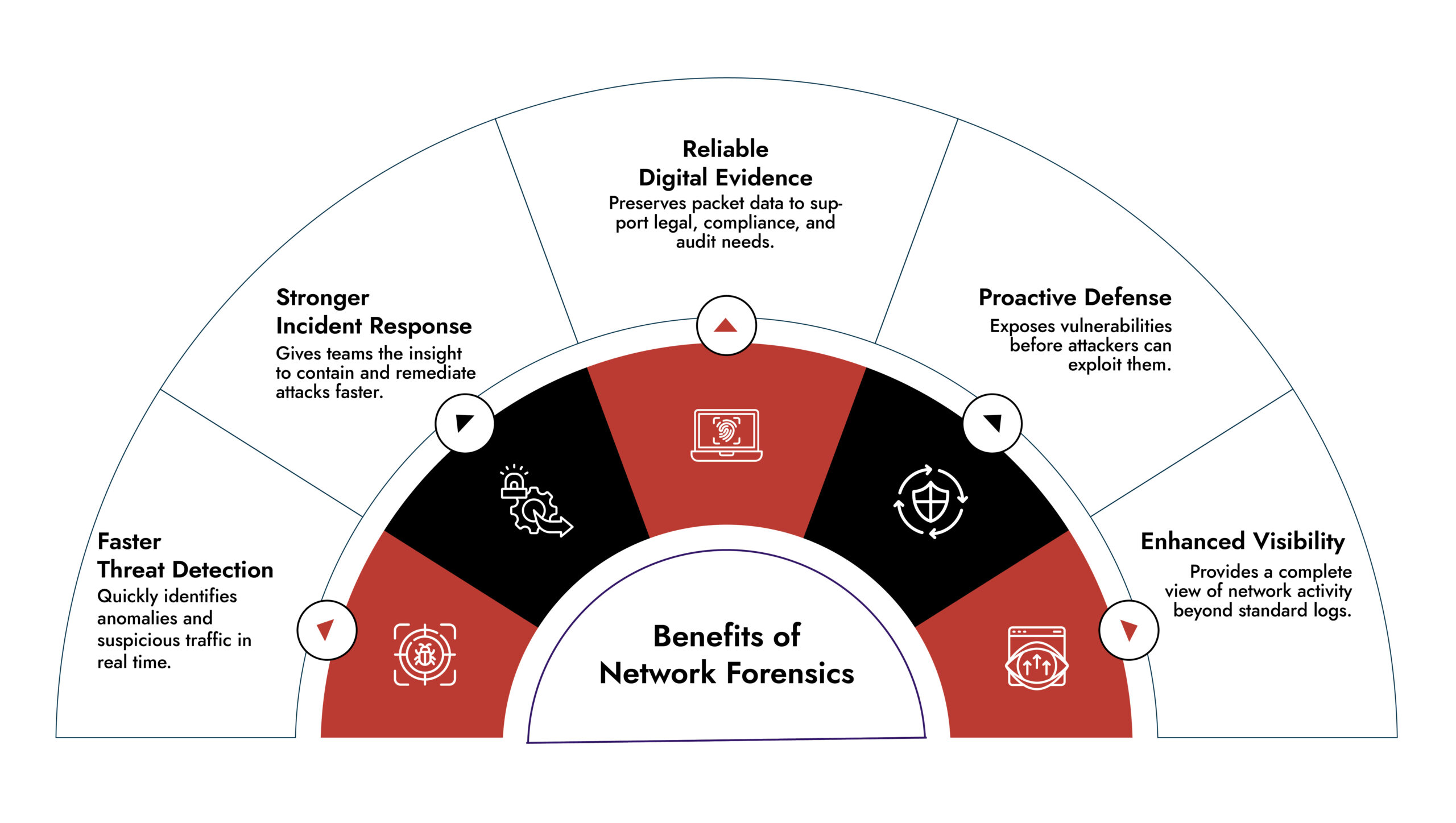
Forensic analysis of networks in cybersecurity covers aspects that many conventional techniques may not cater to. Nowadays, attacks can take place across different machines, can be persistent for a considerable time period, and can bypass conventional signature-based detection techniques.
- Advanced Threat Detection: Hackers are generally good at disguising themselves in regular traffic. Network forensic techniques make these hackers visible by observing their behavioral patterns.
- Stronger Incident Response: In-depth analysis can be provided with respect to the timeline of attacks. Network forensics analysis frequently identifies affected machines that other technologies might miss.
- Compliance and Legal Support: Several sectors need organizations to have network analysis capabilities. Companies utilize network forensics technologies to comply with the law.
- Threat Intelligence Development: Analyzing network activity helps teams understand attacker tactics and techniques. This intelligence improves future defenses.
- Data Loss Prevention: Unauthorized data transfers can be detected during live monitoring or after an incident. Network forensics shows how sensitive data left the organization.
Network Forensics Analysis Techniques
Network forensics examination utilizes various methods to derive significant insights from network information.
- Traffic Flow Analysis: Studies communication trends to detect abnormal behavior. Analysts examine how often connections occur, the volume of data, the timing, and the end points.
- Protocol Examination: Analyzes the utilization and misuse of protocols. This involves examining headers, payloads, and communication sequences.
- Behavioral Analysis: Establishes a standard of typical behavior and highlights anomalies. This is effective for insider threats and sophisticated ongoing threats.
- Timeline Reconstruction: Arranges events to demonstrate the evolution of an assault and the activities of intruders within the network.
- Correlation Analysis: Combines network forensics data with SIEM, endpoint, and threat intelligence sources for a complete understanding.
- Pattern Recognition: Uses statistical methods and machine learning to detect recurring actions linked to identified attack types
Best Network Forensics Tools for Cybersecurity
Effective investigations depend on the right network forensics tools.
Network Forensic Tool | Primary Use | Best Suited For |
NetWitness | Network session capture and analysis | Large-scale network forensics analysis |
Wireshark | PCAP analysis and packet inspection | Detailed packet-level investigation |
TCPDump | Command-line packet capture | Network capture and troubleshooting |
Arkime | Large-scale packet analysis | High-volume network investigations |
NetworkMiner | File and credential extraction | Extracting evidence from captures |
Xplico | Network data reconstruction | Reconstructing web pages, emails, and application data |
SolarWinds | Flow analysis | Identifying network behavior and lateral movement |
ManageEngine | Flow and network monitoring | Network visibility and traffic analysis |
Splunk | SIEM and log analysis | Correlating network and security data |
ELK Stack | Log collection and analysis | Centralized analysis across multiple data sources |
- Packet Capture Tools: Wireshark remains the most widely used PCAP analyzer. TCPDump supports command-line capture, while Arkime enables large-scale packet analysis.
- PCAP Analysis Tools: NetworkMiner extracts files and credentials from captures. Xplico reconstructs web pages, emails, and application data. These tools turn raw traffic into usable evidence.
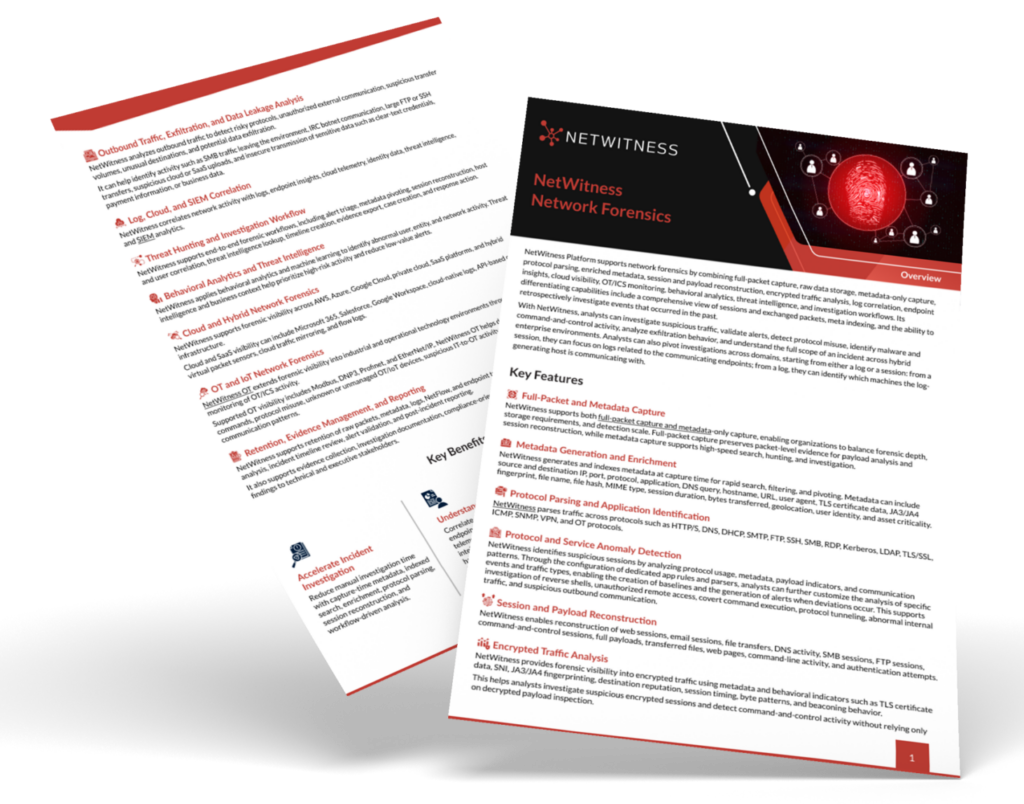
- Comprehensive Packet Capture Solutions: Platforms such as NetWitness document entire network sessions at scale, allowing for thorough network forensics examination in high-volume settings.
- Flow Analysis Tools: Tools like SolarWinds and ManageEngine evaluate flow records to identify lateral movement and data theft.
- SIEM and Log Analysis Platforms: Splunk and the ELK Stack integrate data from various sources, incorporating network forensics into extensive security processes.
- Specialized Forensic Solutions: Comprehensive platforms such as NetWitness integrate capture, analysis, and reporting within a unified interface designed for investigators