How to Reconstruct Data Exfiltration?
Data exfiltration is reconstructed by investigating network sessions, examining packet evidence, comparing the transfer pattern with past behavior, and correlating network records with endpoint and cloud records. Full-packet capture and session reconstruction can show what flow records cannot be done alone. When traffic is encrypted, metadata and telemetry can still establish the sequence of events, even though the content remains unknown.
Why Data Exfiltration Investigations are Difficult
An outbound transfer is an observation, not a verdict. A database server uploading several gigabytes to cloud storage could be performing a scheduled backup. A workstation sending a smaller volume could be leaking sensitive information through an approved application. Volume alone cannot distinguish between the two. Investigators need to establish the context of the connection, the system that initiated it, and the evidence linking the activity to sensitive data.
Verizon’s 2025 Data Breach Investigations Report analyzed 22,052 security incidents, of which 12,195 were confirmed breaches. Third-party involvement in breaches doubled, from 15 percent to 30 percent. It is a reminder to reexamine trust in services and business partners, though it does not show that the data is left through those third parties.
Exfiltration investigations get complex as soon as the SOC finds a suspicious connection. The task is to determine whether the session delivered sensitive data or was authorized, and whether it points to further attacks.
Network forensic tools remove the need to rely on a single alarm to explain everything, because they rebuild events as a timeline.
Network Forensic Techniques for Data Exfiltration
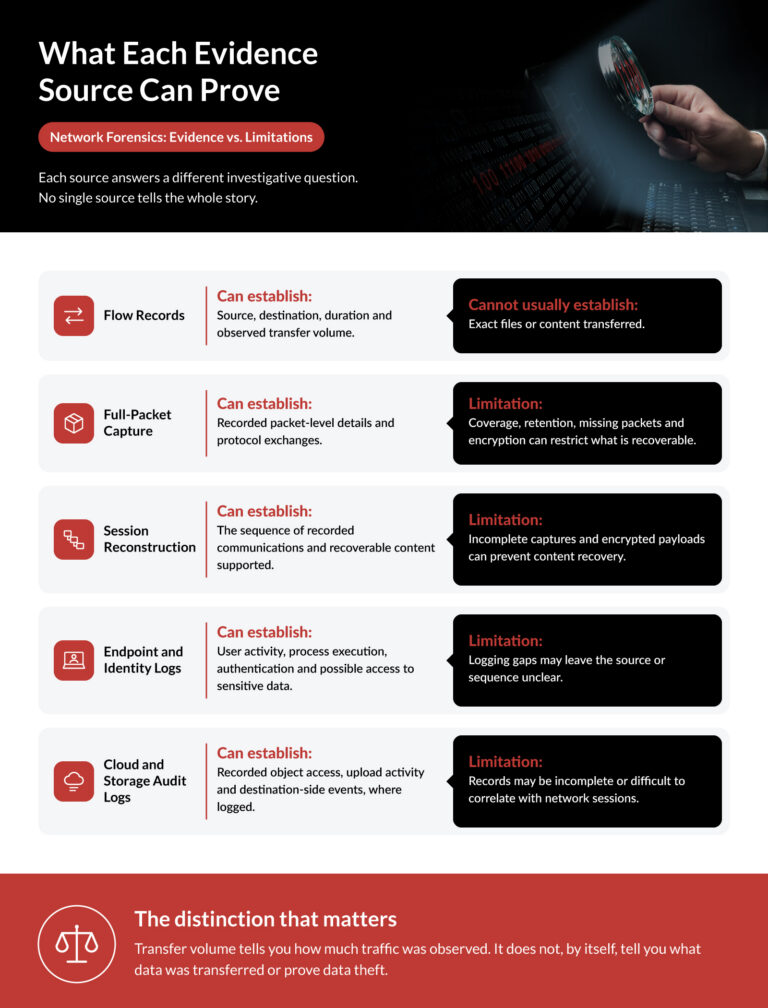
Each evidence source answers a different question. Choosing the right network forensics tools means understanding those boundaries before an incident forces the decision.
| Technique | What it reveals | Investigative value | Important limitation |
| Flow analysis | Source, destination, duration, bytes and packet counts | Establishes communication patterns and transfer volume | Usually cannot identify transferred files |
| Full-packet capture | Recorded packets and protocol exchanges | Supports deeper examination of the original communication | Only covers traffic captured and retained |
| Protocol analysis | Application and transport protocol behavior | Helps establish how the transfer occurred | Encryption can conceal application content |
| Session reconstruction | Reassembled recorded communications and supported objects | Helps examine the sequence of a session and recover content where possible | Missing packets and unsupported protocols can limit reconstruction |
| DNS and destination analysis | Name resolution and destination history | Adds context to external connections | Reputation alone does not prove malicious activity |
| Log correlation | Identity, endpoint, proxy, firewall and cloud events | Connects network activity to users, processes and data access | Logs can be incomplete or inconsistent |
| Behavioral comparison | Historical traffic patterns and host roles | Identifies transfers that depart from expected activity | Unusual behavior can be legitimate |
The practical difference is between identifying a transfer and understanding what happened. Flow logs show that a system sent 800 MB to an external destination. Packets show the protocol exchange and, if the session is not encrypted, what was sent.
How to Investigate Suspected Data Exfiltration
Establish the Transfer Timeline
Trace the suspicious transfer back to the first unusual source, DNS query, authentication event, or related internal connection. Building this timeline is a core network forensic technique in exfiltration cases. Use consistent timestamp formats, since clock drift and delays can distort or obscure the event sequence.
Record findings as facts, not conclusions. For example, a PC connecting to an unusual service after database access shows timing, not proof of data transfer.
Examine Network Sessions and Packet Evidence
Use the initial connection details to find related sessions, then review addresses, protocol details, direction, duration, and linked communications. Pivoting between related sessions is a network forensic technique that widens the picture.
When full packets are available, examine relevant sessions and reconstruct protocols to confirm the transfer method or communication sequence. For TLS-protected traffic, metadata can describe the connection, but payload details remain encrypted without valid decryption methods.
Correlate Network and Data Access Logs
Because a network session may not identify specific files or database entries, correlate it with endpoint, identity, storage, and cloud logs. Log correlation is the network forensic technique that ties these records together.
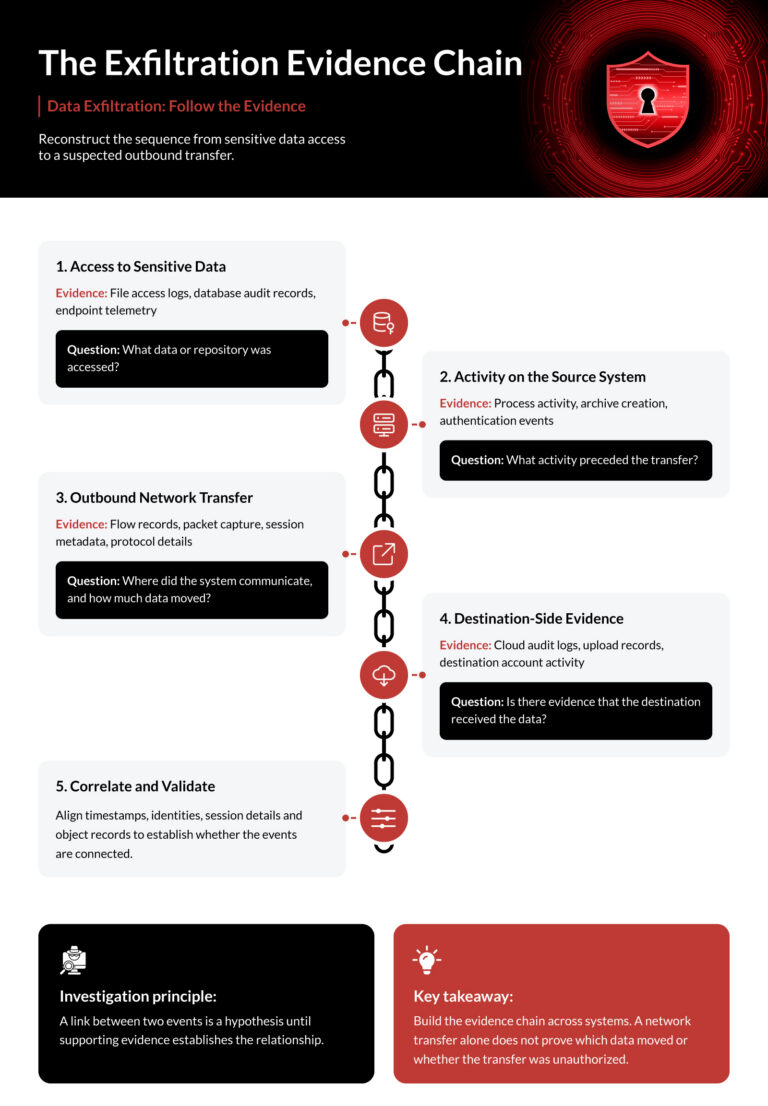
The strongest finding links sensitive-data access, data preparation or viewing, a later outbound session, and destination-side evidence. If the evidence chain is incomplete, document the gap rather than treating speculation as fact.
How NetWitness Supports Data Exfiltration Investigations
NetWitness supports network forensics through packet capture, metadata enrichment, protocol analysis, session reconstruction, and telemetry-based investigation. Its NDR product includes network capture, analysis, detection, investigation, and response. Each network forensic technique in the workflow below maps to one of these capabilities.
The workflow below shows how these capabilities can support a hypothetical data exfiltration investigation. It is an example of tool use, not a case study or confirmation of real events.
Scenario: A file server connects to an external storage service and sends an unusual volume of outbound traffic. The SOC must determine whether the transfer is legitimate or theft.
- Find the Suspicious Session – The analyst reviews network metadata to identify the source, destination, transfer window, and traffic volume. Historical searches show whether the destination and pattern are normal for the server. This raises a question but does not prove data theft.
- Investigate Related Sessions – The analyst searches for related communications involving the same host and destination during the transfer window. NetWitness metadata and session-based investigation help trace activity without starting from raw packets, including earlier connections and other systems using the same destination.
- Examine the Recorded Communications – If relevant packets were captured, the analyst uses session reconstruction and protocol analysis to verify what the protocol evidence shows and whether transferable content can be identified.
If the session is encrypted and cannot be decrypted, the analyst documents that limitation instead of claiming to review file contents.
- Correlate Network Evidence with Other Records – The analyst checks endpoint, identity, and storage telemetry for signs of sensitive-data access. Cloud logs may show whether an upload occurred in the destination service.
Network logs show observed communications; storage and cloud logs show accessed or uploaded resources. Their timestamps and identifiers must align before investigators connect them.
- Document the Incident Conclusion – For example, if the server accessed a confidential archive, sent data to an unapproved external service, and matching upload logs exist, the evidence supports escalation as an unauthorized transfer.
If evidence shows only a suspicious connection and high outbound volume, the conclusion should remain limited to suspicious traffic requiring further investigation. The same caution applies if the transfer appears to be a valid backup.
NetWitness supports this process, and each network forensic technique in it, with metadata enrichment, full-packet capture, and session reconstruction.

Limitations of Network Forensics
- A forensic tool cannot access information it did not collect. That operational consideration must influence tool evaluation and adoption planning.
- Incomplete data gathering: A sensor cannot capture traffic that takes a path it does not monitor.
- Retention: Packets usually expire before metadata, so older transfers may be visible as metadata only.
- Encryption: Without decryption, packets will not reveal what a transfer is contained.
- Shared services: Legitimate users and attackers can use the same cloud services, domains, and protocols.
- Attribution: NAT, proxies, and shared credentials can prevent traffic from being tied to a user or process.
- Timing: Clock differences between systems can distort event correlation.
Asking vendors to demonstrate the investigation under these conditions should be a critical step before deploying a forensic solution. Ask whether analysts can pivot from metadata into the captured packets, whether they can tell what the system collected from what it inferred, and whether the tool shows where missing data blocks a conclusion. These questions say more about forensic maturity than any feature list.
How to Preserve Forensic Evidence
Once a suspected transfer is under investigation, evidence handling becomes a technical discipline.
- Retain the relevant packet capture and session dumps in their native format, if available.
- Note the origin, timestamp, extraction technique, and name of the investigator responsible.
- Log any search criteria, timestamps, clock differentials and conversions used in analysis.
- Hash the exported evidence files with a verified cryptographic algorithm such as SHA-256.
- Control access and keep logs of the evidence transfer and handling process.
- Distinguish between proven facts and hypotheses that remain unresolved.
Work with the incident response team to coordinate containment. Interrupting the flow may be critical, but the response team needs to know what might disappear once the connection is disrupted.
Reconstruct Data Exfiltration with Network Forensics
A well-supported exfiltration investigation rests on evidence that links to the events. A suspicious destination can trigger a search; a big transfer can trigger escalation. Neither alone proves whether any data was taken from the system or whether an act was legitimate.
NetWitness uses network metadata, packet capture, and session reconstruction to support deeper analysis of the communications of interest. Whatever the tool or network forensic technique, a SOC should be able to trace a suspicious session through the evidence connected to it.
Frequently Asked Questions
1. What is data exfiltration in network forensics?
Data exfiltration is the unauthorized transfer of data out of an organization. Network forensics examines the communications involved to establish when a transfer happened, how much data moved, and how it moved. Where traffic is not encrypted, it can also reveal some of the content.
2. What are the most effective network forensic techniques for investigating data exfiltration?
Flow analysis, full-packet capture, protocol analysis, and session reconstruction each add a different kind of evidence. The right combination depends on the type of investigation, network scope, and retention.
3. How can investigators reconstruct data exfiltration when network traffic is encrypted?
Investigation teams have access to connection metadata, as well as volume of data transfer and its timing, history of destination, and associated cloud/endpoint records. If decryption is authorized and technically possible, more can be revealed. Without it, metadata cannot show the exact contents of the transfer.
4. How can network forensics distinguish legitimate transfers from malicious data exfiltration?
Compare the transfer with the system’s established behavior and with approved business processes. Correlate network sessions with identity, endpoint, storage, and destination records. A high-volume transfer or unfamiliar destination should be treated only as a lead, not as evidence of malfeasance.
5. What challenges arise when reconstructing data exfiltration incidents?
Incomplete capture, short retention, encryption, shared infrastructure, inconsistent timestamps and missing logs can limit reconstruction. Investigators should explicitly document which facts they can establish, and which questions remain unresolved.
6. How should evidence be preserved during a data exfiltration investigation?
Preserve original captures where possible, maintain chain of custody, hash exported files, and control access. Follow your legal and forensic procedures to keep the evidence traceable and accountable.
14 Real Attacks. One Critical Lesson: Visibility Matters.
- See What Really Happened
- Reconstruct Attack Activity
- Uncover Hidden Threats
- Investigate with Packet-Level Evidence