What Security Leaders Need to Know Before Choosing an Advanced Threat Analytics Platform ?
Most threat analytics platforms log what happened. The best ones help you act before the damage compounds. This guide breaks down the capabilities that separate functional detection from forensic-grade security operations and why that gap matters more than ever in 2026.
Why Advanced Threat Analytics is a Security Operations Priority in 2026
Let’s face an unpleasant reality: alerts are flooding in, dashboards are blinking, and amidst all that noise, there is a genuine attacker making lateral movement within the corporate network. In its “M-Trends 2025” report, Mandiant states that the median dwell time for threats on a global level is 11 days. Unit 42 reports that the median time to data exfiltration fell to two days in 2024.
Two days is the time window the SOC team has to react before data gets out.
But lack of visibility isn’t due to insufficient security tools. Typically, large organizations operate dozens of security products simultaneously. However, what hampers efficient detection of threats is the fragmented telemetry, the siloed nature of data, and detection rules based solely on symptoms instead of campaigns.
What is Advanced Threat Analytics and How Does it Differ from Traditional SIEM
Advanced threat analytics integrates behavioral analytics, machine learning, threat intelligence enhancement, and comprehensive telemetry to identify, analyze, and counteract complex attacks, even those that evade signature-based defenses.
Conventional SIEM solutions focused on log collection and rule-driven correlation. They are intentionally reactive. Sophisticated threat analytics systems derive context from unprocessed data – packets, logs, endpoints, identity indicators, and highlight irregularities that appear to be typical behavior until they change. For security operations centers processing thousands of alerts each day, this transition from rule-based detection to behavior-based detection is fundamental.

5 Core Capabilities of an Advanced Threat Analytics Platform
1. Multi-Source Telemetry: Logs, Network, Endpoint, and Identity in One View
Detection is only as good as its data source. A solution that works on logs alone will miss out on any attacks that use encryption, living off the land, or credentials that seem legitimate when examined via logs. Advanced threat analytics platforms are capable of analyzing data from network traffic, endpoint activities, logs, and identity, but they do it in real-time, not after a few hours.
Take, for instance, an attack based on credentials. An infostealer steals the credentials without installing any malware. The attackers log into the network during working hours and move laterally to access a privileged workstation from where the attacker begins to stage the data for exfiltration. In a detection solution that uses logs alone, the anomaly might be triggered by an odd time of login.
2. Behavioral Analytics That Detect What Signatures Miss
Once there is a signature for the technique, the compromise of at least one person has already happened. Behavioral analysis creates a baseline for each individual’s normal activities based on users, devices, and applications. The key here is the term meaningful. What’s important isn’t spotting anomalies but rather spotting meaningful anomalies.
A proper behavioral analysis approach should create individual baselines for entities, perform risk assessment based on context, and highlight anomaly clusters that themselves look fine but together show a malicious campaign. This helps spot abuse of credentials and insider threats, because those techniques intentionally mimic legitimate behavior.
3. Network Traffic Analytics with Full Packet Capture and Deep Packet Inspection
Most enterprise breaches involve the network. Data exfiltration travels over it. Lateral movement happens across it. C2 traffic reaches back through it. Yet many organizations rely on firewall logs and NetFlow records rather than reconstructed session data.
Full packet capture and deep packet inspection lets analysts answer questions log analysis can’t: What was actually transferred in that large outbound flow? Is this DNS query pattern legitimate resolution or a tunneling channel? Network threat analytics surfaces the patterns that attackers operating inside a network can’t easily avoid leaving.
4. Threat Intelligence Integrated into Detection, Not Stored in a Separate Portal
Threat intelligence on its own is a feed. Without integration into detection and investigation workflows, it creates work rather than reducing it. What distinguishes a mature advanced threat analytics platform is intelligence that flows directly into alert enrichment and detection rules, without requiring an analyst to manually query a separate portal.
This means automatic MITRE ATT&CK mapping on detected behaviors, alert enrichment with related threat actor profiles, and prioritization tied to active campaigns targeting the organization’s specific industry. A financial services SOC handling an unusual authentication alert benefits immediately from knowing the pattern matches techniques used by a financially motivated group currently active in the sector.
5. SOC Analytics Tools That Speed Up Threat Investigation
Detection without investigation capability is an alarm system without a response team. The gap between a 30-minute investigation and a 3-hour one is rarely analyst skill, it’s tooling. Analysts pivoting between multiple consoles, reconstructing timelines manually, and re-querying raw data for each hypothesis are at a structural disadvantage.
High-performance SOC analytics tools should provide a unified investigation workbench, visual timeline reconstruction across data sources, and entity-centric pivoting without re-querying raw data. An analyst investigating unusual PowerShell execution on a domain controller should see the process timeline, the network connections that followed, the preceding authentication events, and matching threat intelligence – all in one workspace, not five.
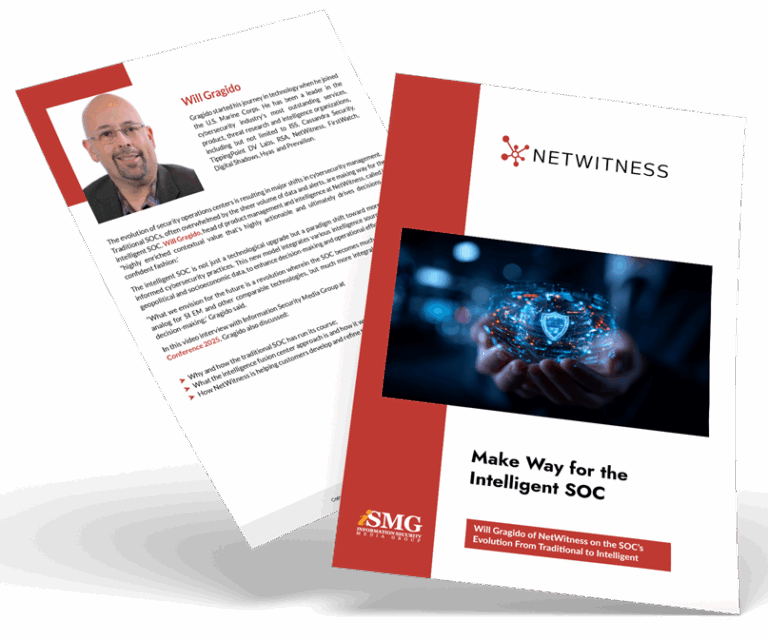
Make Way for the Intelligent SOC with NetWitness®
-Turn data overload into actionable intelligence.
-Accelerate detection with AI-driven insights.
-Empower analysts with enriched, contextual decision-making.
-Build a smarter, faster, more resilient SOC.
How NetWitness Approaches Advanced Threat Analytics for Enterprise Security Teams
Most platforms were built around a SIEM core with detection bolted on top. NetWitness was built from the ground up around full-spectrum visibility – combining NDR, SIEM, EDR, and SOAR in a unified platform designed for large, complex enterprise environments.
Where NetWitness differs, it captures and reconstructs full network sessions, not just metadata. This includes SSL/TLS-encrypted traffic, where advanced persistent threats and insider activity most reliably leave evidence, and where most platforms go blind. Its behavioral analytics engine draws from the complete unified data model across network, endpoint, log, and identity sources, producing sharper detection for credential-based attacks that leave minimal signatures.
The investigation workbench lets analysts pivot across all data sources – packet captures, log records, endpoint telemetry – without switching consoles. The NetWitness FirstWatch threat research team feeds operationally relevant intelligence directly into the platform, enriching detections with current actor context rather than generic feeds. And for enterprises managing both IT and OT environments, NetWitness extends detection and analytics across that boundary – a capability most platforms simply don’t address.
In a Nutshell
Advanced threat analytics is an operational capability, not a product category. The platforms that deliver it combine full-spectrum telemetry, behavioral analytics, network traffic analytics, operationalized threat intelligence, and investigation-grade SOC analytics in a unified architecture. The result is faster detection, shorter investigations, and response before attackers complete their mission. For enterprise security teams facing distributed infrastructure and faster adversaries, this capability set is what separates security operations that contain threats from those that discover them after the fact.
Frequently Asked Questions
1. What is advanced threat analytics and how does it protect an organization?
Advanced threat analytics use behavior models, machine learning, and data correlation across sources to find advanced threats. These threats can bypass signature-based controls. It finds credential abuse, lateral movement, and data exfiltration by spotting unusual behavior. This closes the detection gap for attacks that avoid known indicators of compromise.
2. What are the top advanced threat analytics platforms used by enterprises?
Enterprise teams evaluate platforms on telemetry breadth, behavioral detection accuracy, investigation capability, and infrastructure integration. The most effective implementations do not silo detection by source. Instead, they capture full network traffic natively, merging deep packet inspection with endpoint behaviors and log data into a single, unified data model. This prevents critical visibility gaps during cross-vector attacks.
3. How to compare advanced threat analytics software features effectively?
Evaluate four dimensions:
- Telemetry coverage (Does it capture full packet-level network data, or does it rely solely on summarized metadata and NetFlow?)
- Behavioral analytics maturity (per-entity baselines or generic thresholds?)
- Investigation workbench capability (Can analysts pivot seamlessly from a high-level alert down to raw endpoint processes or reconstructed network sessions without switching consoles?)
- Threat intelligence operationalization (real-time enrichment or separate portal?).
4. What are the typical costs associated with implementing an advanced threat detection system?
Expenses differ based on the deployment model, data volume, and the extent of integration. Enterprise deployments encompass platform licensing, professional services, training, and subscriptions for threat intelligence. IBM’s research from 2025 indicates that organizations employing AI-based detection reduce breach response expenses by roughly $1.9 million, an amount worth incorporating into any total cost of ownership evaluation.
5. How to choose the best advanced threat analytics product for a medium-sized business?
Focus on platforms that provide excellent detection accuracy without requiring a sizable, dedicated team for management. Essential factors: integrated telemetry for network, endpoint, and logs; behavioral analytics that minimize false positives immediately; and a straightforward investigation process that doesn’t need expert forensics knowledge. Deployment options are more significant in mid-market than at the enterprise level
Threat Intelligence: The Key to Higher Security Operation Performance
Unlock the full potential of your Security Operations Center with deeper visibility, faster detection, and smarter response. This whitepaper explores how modern threat intelligence elevates SOC maturity and helps organizations stay ahead of evolving adversaries.