Introduction
Most detection failures don’t happen because teams lack alerts. They happen because alerts arrive stripped of meaning.
Security tools are excellent at telling you that something happened. They’re far less reliable at explaining whether it matters, why it matters, and what you should do next. That gap between signal and understanding is where attackers hide.
This is exactly where threat intelligence and Threat Detection and Response (TDR) intersect. Not as separate layers, but as a feedback loop. When intelligence feeds detection with context, accuracy improves. When detection feeds intelligence with real-world observations, response quality jumps. Together, they change how security teams operate under pressure.
Let’s break down how this actually works and why it matters more now than ever.
The Accuracy Problem in Modern Detection
Most security teams are drowning in telemetry. Logs, network traffic, endpoint events, and cloud activity. Visibility isn’t the problem anymore.
Interpretation is.
A single alert without context answers one question: Did something unusual occur?
It doesn’t answer the harder questions:
- Is this tied to a known threat actor or campaign?
- Is this behavior normal for this environment?
- Has this tactic appeared elsewhere in our infrastructure?
- What is the likely next move?
Without answers, analysts fall back on manual investigation. That slows response, increases fatigue, and creates inconsistency across incidents. Accuracy suffers because decisions are made with partial information.
This is why standalone detection engines struggle. They see all manner of events and activity. But the intent isn’t always understood.”
What Threat Intelligence Really Adds to TDR
Cybersecurity threat intelligence is often misunderstood as a static feed of indicators. IPs, domains, hashes. Useful, but limited.
In the context of TDR, intelligence becomes valuable when it provides operational context that helps systems and analysts interpret activity correctly.
At its best, threat intelligence answers four critical questions:
- Who might be behind the activity
- Why they behave the way they do
- How they typically operate
- What usually happens next
When this information is fused directly into detection logic, alerts stop being generic and start becoming situational.
Instead of “suspicious outbound connection,” you get “communication pattern consistent with a known data-exfiltration framework used in recent finance-sector attacks.”
That difference changes everything.
From Raw Signals to Contextual Detection
Threat detection and response platforms are designed to correlate signals across multiple layers: network, endpoint, identity, cloud, logs. But correlation alone isn’t enough. Correlation tells you that events are related. Context tells you whether they’re dangerous.
Here’s how threat intelligence improves detection accuracy at each stage.
1. Enrichment at Ingestion
When telemetry is enriched at the moment it’s collected, detection improves immediately.
Threat intelligence tools and platforms can add:
- Reputation scores for IPs, domains, and certificates
- Known associations with malware families or campaigns
- Historical prevalence across industries or regions
- Confidence levels based on multiple intelligence sources
This prevents low-confidence indicators from triggering high-priority alerts and reduces noise before it reaches analysts.
2. Behavioral Context Over Static Indicators
Indicators of compromise are snapshots. Attackers know this. They rotate their infrastructure tactics and techniques constantly
What doesn’t change as easily is behavior.
Threat intelligence provides patterns of behavior tied to specific adversaries or tools:
- Beaconing intervals
- Protocol misuse
- Lateral movement preferences
- Data staging techniques
When TDR systems look for behaviors instead of just indicators, detection becomes resilient to evasion. The system doesn’t care if the IP is new. It recognizes the playbook.
3. Campaign-Level Correlation
A single event might look benign in isolation. Multiple events aligned with a known campaign tell a different story.
Threat intelligence enables campaign awareness by connecting:
- Initial access techniques
- Follow-on activity
- Typical dwell times
- End goals like ransomware deployment or espionage
This allows threat detection and response workflows to escalate threats earlier, before damage occurs.
4. Vulnerability Mapping for Focused Detection
Context also connects threat intelligence directly to known weaknesses.
By mapping intelligence to:
- Unpatched vulnerabilities
- Exposed services
- Misconfigured systems
TDR platforms can focus on detection and monitoring where exploitation is most likely to occur. This shifts detection from broad coverage to strategic depth, improving accuracy without increasing noise.
Why IOCs Alone No Longer Work
IOCs still matter, but relying on them alone is a losing strategy.
Here’s why they fall short in modern environments:
- They’re reactive. Indicators usually appear after compromise elsewhere.
- They’re easy to evade. Infrastructure churn invalidates them quickly.
- They lack intent. An IP address doesn’t explain attacker goals.
- They generate false confidence. Blocking known bad doesn’t stop unknown bad.
In contrast, contextual intelligence focuses on how threats operate, not just where they appear. This is what allows TDR to detect threats earlier in the kill chain.
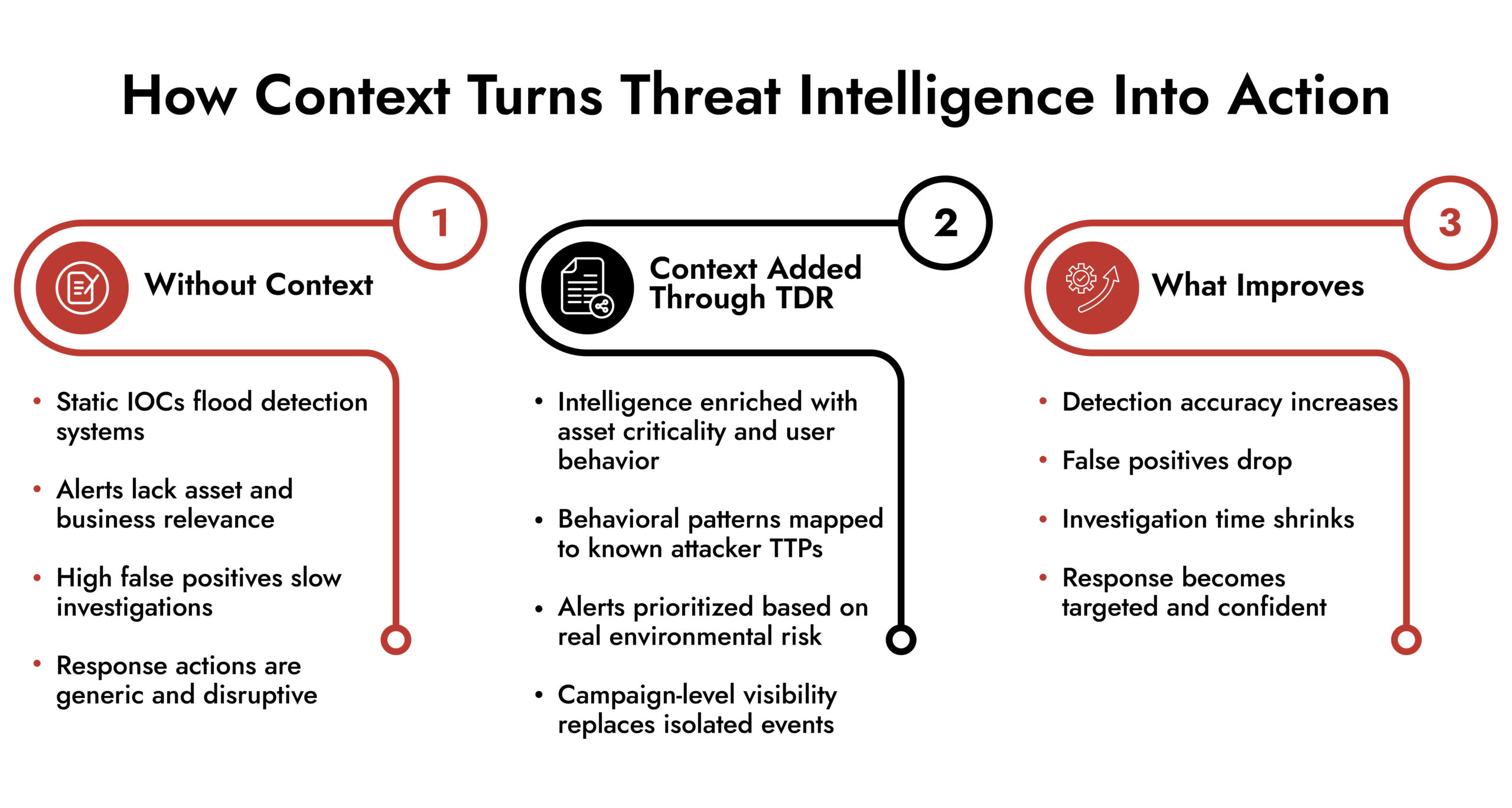
Response Quality Depends on Context
Detection accuracy is only half the equation. Response quality determines outcomes.
Without context, response actions tend to be blunt:
- Isolate the host
- Block the IP
- Reset credentials
Sometimes that’s enough. Often it’s not.
Threat intelligence improves response by informing how and when to act.
Faster, More Precise Containment
Context enables rapid incident scoping.
Instead of asking “what might be affected?”, analysts can immediately see:
- Which systems communicated with the threat
- How far lateral movement progressed
- Which users or services were involved
This allows containment actions to be surgical. Compromised systems are isolated without disrupting unrelated business operations, reducing both risk and downtime.
Informed Decision-Making Under Pressure
Not every incident requires the same response path. Context helps teams assess impact quickly by revealing:
- The sensitivity of affected data
- The criticality of impacted systems
- The likelihood of regulatory or legal exposure
With this insight, security leaders can make informed decisions about escalation, legal involvement, or breach notification timelines instead of reacting blindly to alert volume.
Proactive Threat Hunting With Purpose
Threat intelligence tells you what attackers are doing globally. TDR tells you where to look locally.
When combined, context allows threat hunters to focus on:
- Adversaries targeting their industry
- Campaigns active in their region
- Techniques relevant to their technology stack
This replaces random log searching with targeted hunting, increasing the chances of uncovering stealthy threats before alerts ever fire.
Strategic Hardening After the Incident
Context doesn’t stop being useful once the incident is closed.
Post-incident analysis that combines intelligence and detection data reveals:
- Systemic control gaps
- Recurring weak points
- Delayed detection patterns
These insights inform long-term improvements such as tighter segmentation, better patch prioritization, refined detection logic, and more resilient security architecture. Over time, each incident strengthens the organization instead of merely interrupting it.